
All posts by Wintery Knight

https://winteryknight.com/

How can the four gospels be independent sources?

Investigation in progress

Previously, I blogged about the historical criteria that historians use to evaluate documents. One of the criteria is “multiple independent sources”. If a story is reported in multiple independent sources, then historians are more likely to evaluate it as historically accurate. But how about the four gospels? Are they independent sources? The answer might not be what you expect.

Here’s how the question was put to Dr. Craig:

The latest video, “Did Jesus Rise From the Dead,” is especially compelling, but I had a question about it. In the part one video, you cite as evidence, the Gospels plus Acts and First Corinthians and you refer to them as “independent” and “unconnected” sources. But this isn’t exactly true, is it? After all, two of these books were written by the same author, Luke, and so Luke and Acts are connected by authorship. Furthermore, isn’t it true that much information relayed in Matthew and Luke were taken from Mark? This two facts would make it untrue to call the Gospels “independent” and “unconnected” would they not?

Here’s the video he’s talking about:

Dr. Craig answers the question in a recent question of the week. I think this answer is important for those who aren’t aware of how the gospels are organized.

He writes:

The objection is based on a simple misunderstanding. It assumes that the sources I’m referring to are the books of the New Testament.  But that’s not what I’m talking about.

New Testament critics have identified a number of sources behind the New Testament, sources on which the New Testament authors drew. For example, Matthew and Luke drew not only upon Mark as a source but also upon a source which scholars designate “Q,” which appears to have been a source containing Jesus’ sayings or teachings. Thus, if you could show that a saying in Matthew or Luke appears in both Mark and Q, that would count as multiple, independent attestation.

What does this mean? It means that although there is overlap between Matthew and Luke, called “Q”, there are actually three independent sources there: Matthew’s source, called M. Luke’s source, called L. And the material common to Matthew and Luke, which therefore PRE-DATES Matthew and Luke, called Q.

Dr. Craig lists out several independent sources in his full reply:

  1. the pre-Markan Passion story used by Mark
  2. the rest of the gospel of Mark has a source
  3. Matthew’s source (M)
  4. Luke’s source (L)
  5. John’s gospel which is very different from Mark, Luke and Matthew
  6. the sermons in Acts have a source
  7. the early creed found in Paul’s 1 Corinthians 15

So if you are trying to lay out something from the New Testament, and you can find it in two of these sources, and at least one of them is very early, you’re in pretty good shape.

Although the questioner and the other critics might question the “minimal facts” that pass the historical tests, many of these facts are not questioned by even atheistic scholars.

Here’s a useful tip for non-professionals who want to disagree with Dr. Craig. Dr. Craig publishes his arguments in academic presses like Oxford University Press, not to mention scholarly peer-reviewed journals. He’s also debated his ideas against famous atheist historians like Gerd Ludemann, Marcus Borg, James Crossley, Bart Ehrman, etc. So it’s probably a good idea for people who want to disagree with him to first read some academic literature, or at least ask a professional. Before you post your YouTube video. You could even just ask a professional atheist historian. They will tell you what’s wrong with an argument like your “the sources are not independent” argument. Just check yourself before you post something in public. A lot of people who are still puzzling out these questions will look at a mistake like this, and immediately dismiss atheism as a sloppy, anti-intellectual worldview.

You can watch more of Dr. Craig’s videos in his playlist, here. These are especially useful for people who want to get the overall scope of the battlefield before deciding where to focus in study. Everybody should know about all of these arguments regardless of where you choose to specialize.

Which political party stands up to evil at home and abroad?

Let him who desires peace prepare for war

Lately, I’m being asked to make a positive case for why anyone should vote Republican. Many Christians think that they can take the easy way out and just prove that Republicans do better than Democrats on social issues like marriage and abortion. But that’s lazy. A better strategy is to take a kitchen sink approach by arguing that Republicans are also better on fiscal policy and foreign policy.

Today, let’s look at three stories that clearly show that Republicans correctly identify evil and take effective steps to deter it – at home and abroad.

Let’s start with an international story, where Trump is confronting the autocratic Iranian regime, which is seeking nuclear weapons to menace peaceful countries in the region.

The Washington Free Beacon reports:

The Trump administration on Monday announced an unprecedented set of new sanctions on Iran’s nuclear and ballistic missile sectors.

Secretary of State Mike Pompeo was joined at the State Department by top Trump administration officials as they announced the new measures, which target Iran’s proliferation of nuclear materials used to feed its atomic weapons program. The sanctions also seek to restrain Iran’s contested ballistic missile program, which has progressed in tandem with its nuclear program as the country seeks to construct a weapon capable of carrying a nuclear warhead.

The most far-reaching sanctions will target Iran’s Ministry of Defense and Armed Forces Logistics agency, as well as its leaders, for exporting arms to Venezuelan dictator Nicolas Maduro, who also was targeted by the new sanctions. The measures are aimed at stopping Iran from exporting arms across the globe, including to regional hotspots such as Yemen, Syria, Lebanon, and Iraq.

The new sanctions are being issued under a fresh executive order announced Monday by the White House enabling the United States to sanction Iranian government actors and those globally who have been identified as aiding Iran’s nuclear and missile programs. The move comes a month after the United States invoked a procedural mechanism at the United Nations that ordered the “snapback” of all global sanctions on Iran. Snapback took effect on Saturday. The unprecedented move was met with anger by European powers and Tehran’s allies, raising questions about whether the world will uphold the sanctions. Pompeo and senior Trump administration officials warned that they will not hesitate to sanction any country caught working with Iran.

“Now that virtually all U.N. sanctions have been reimposed on Iran, stakeholders worldwide are warned that the United States will aggressively use U.S. sanctions authorities to impose consequences for failures to comply with the snapped-back U.N. measures on Iran and ensure that Iran does not reap the benefits of U.N.-prohibited activity,” the State Department said in announcing the new action.

Let’s move down to the federal level, with a story from The Federalist:

The Department of Justice labeled New York City, Portland, and Seattle as cities “permitting violence and destruction of property,” in a statement Monday.

Attorney General William Barr said state and local leaders in these cities are endangering citizens, including peaceful protestors.

“We cannot allow federal tax dollars to be wasted when the safety of the citizenry hangs in the balance. It is my hope that the cities identified by the Department of Justice today will reverse course and become serious about performing the basic function of government and start protecting their own citizens,” he said.

Citing various failures by each city such as rising gun violence, police budget cuts, lack of prosecution for those arrested and charged with “protest-related charges,” lack of protection against property destruction and vandalism,  rejection of federal law enforcement, and allowing anarchists to take over certain geographical areas such as CHOP, the DOJ noted that these cities all failed to handle the rapidly increasing violence that occurred in their areas in response to the death of George Floyd in May.

The article notes that this action follows on an order from Trump to not waste federal tax dollars on cities that neglect to protect their citizens from criminals.

Meanwhile, at the state level, there was this story from Florida, repported by Daily Wire:

Florida Governor Ron DeSantis announced new legislation Monday that would create additional felonies to punish protesters who turn violent and would create severe penalties for cities that elect to defund or disband their police departments.

Local Miami news reports that “violent protesters and looters would face new felonies” under the legislation, particularly if they damage property as part of their demonstrations, engage in “disorderly” conduct,” or assault a law enforcement officer.

If caught and convicted, violent protesters could lose their access to state-based welfare programs, DeSantis said.

DeSantis says, though, that the new legislation is designed to prevent the type of violence, anarchy, and destruction Americans have witnessed in places like Portland, Oregon, where unrest has raged unabated for more than 100 days. The legislation also covers activities like harassing people dining at restaurants and tearing down monuments.

[…]To reinforce the idea that the new laws were designed to provide law enforcement with more tools to control destructive demonstrations, the package includes proposed penalities for municipalities who elect to “defund the police” or disband their local police departments.

“The proposed package would also strip municipalities of state money if they defund law enforcement,” local Miami news reported.

I think it’s important for people to understand that good and evil do exist. We can’t fix everything in the world, but we can certainly deter future aggressive acts by standing up to terrorists and criminals at home and abroad. If you agree, then you vote Republican.

Federal government sues pro-LGBT Kroger for persecuting Christian employees

Kroger promotes LGBT tyranny over religious liberty

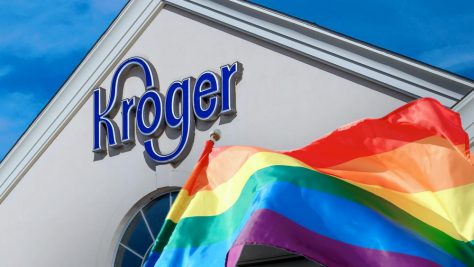
I thought this story about how the federal government is suing Kroger, a far-left grocery store chain, was interesting. You would never see a story like this happening in a Democrat administration. But in a Republican administration, religious liberty is still more important than the feelings of “being offended” of people on the left. Let’s see the story, then I’ll tell a personal story about this topic.

Here’s Christian Post reporting:

A major supermarket chain is facing a lawsuit after firing two employees over their refusal to wear a rainbow emblem that violates their religious beliefs as part of their work uniform.

The Equal Employment Opportunity Commission filed a lawsuit against the Kroger Company Monday in response to action taken by Kroger Store No. 625 in Conway, Arkansas, against two employees. The employees were terminated after they refused to abide by the new dress code, which required them to wear an apron depicting a rainbow-colored heart emblem.

The women contended that wearing the apron would amount to an endorsement of the LGBTQ movement, which contradicts their religious beliefs. According to the EEOC, “one woman offered to wear the apron with the emblem covered and the other offered to wear a different apron without the emblem, but the company made no attempt to accommodate their requests.”

The EEOC alleged that when the women continued to refuse to wear the apron with the emblem visible, “Kroger retaliated against them by disciplining and ultimately discharging them.”

Kroger’s actions violated Title VII of the 1964 Civil Rights Act, argued the EEOC, which is working to secure “monetary relief in the form of back pay and compensatory damages” for the two women “as well as an injunction against future discrimination.”

More details about the two brave Christian women:

According to the Arkansas Democrat-Gazette, one of the women, Brenda Lawson, worked in the deli department at the store from 2011 until her termination on June 1, 2019. The other woman, Trudy Rickerd, worked as a cashier and file maintenance clerk from 2006 until her termination on May 29, 2019.

The complaint cited a letter written by Rickerd explaining her objection to wearing the apron. “I have a sincerely held religious belief that I cannot wear a symbol that promotes or endorses something that is in violation of my religious faith … I am happy to buy another apron to ensure there is no financial hardship on Kroger,” she said.

In case you didn’t know, Kroger has a reputation for putting LGBT rights above free speech and religious liberty:

Kroger has launched a 2020 Pride campaign company-wide, which includes its 3514 grocery stores across 42 states. The chain is the second-largest retailer after Walmart.

“At The Kroger Co., we embrace diversity and inclusion as core values, and we ingrain these in everything we do,” according to the company website. The site also notes that Kroger recently received a perfect score on the Human Rights Campaign’s 2020 Corporate Equality Index in recognition of its commitment to LGBTQ-plus inclusion and equality.

Kroger also says:

“We’re one of the few retailers willing to openly advocate for and make real change toward LGBTQ-plus diversity and inclusion, and we’re proud to offer:
—Same-sex partner benefits and transgender-inclusive healthcare.

—An Associate Resource Group that provides an uplifting community for LGBTQ-plus associates and allies.

—Strong alliances with LGBTQ-plus suppliers through our partnership with the National Gay and Lesbian Chamber of Commerce.

The suit was filed in the U.S. District Court for the Eastern District of Arkansas, Central Division, and seeks monetary relief in the form of back pay and compensatory damages, as well as an injunction against future discrimination.

The article continues by describing some of the programs that Kroger champions that would make any Bible-believing Christian uncomfortable. But Christians don’t matter to Kroger.

Anyway, I wanted to tell a story about this. I spent about 10 years of my IT career in a large IT company. I was regularly pressured by non-Christians to accept and celebrate LGBT values. Pro-LGBT propaganda was hung all over the building. Diversity and inclusion concerns were made part of the performance evaluation process. And so on.

After the Florida gay nightclub bombing, I remember my manager bringing me a rainbow colored ribbon and telling me to put it on. I told her that I would take it and wear it later. But these ribbons were being dispensed company-wide as a formal effort to promote LGBT values. I have no doubt that my refusal to wear the ribbon was noted and may have affected my performance review and promotion decision.