Tag Archives: John C. Waldron

Lt. Cmdr. John C. Waldron and the heroic charge of VT-8 at the Battle of Midway

I have been reading lots of books about the World War II battles in the Pacific theater lately, and I wanted to write a post about one of the heroes I found who was the most compelling to me. You may have seen him in the old 1976 Midway movie or the new 2019 Midway movie. But neither movie tells the full story. The man I am talking about is Lt. Commander John C. Waldron.

So, everyone knows the conclusion of the Battle of Midway. On June 4, 1942, Japan attacked the American-occupied island with carrier-based strike aircraft from 4 aircraft carriers, as a prologue to a planned amphibious landing. The Americans had broken the Japanese transmission code and were on site with 3 carriers (plus an airstrip on Midway) the morning of the attack. At the end of the first day, the Japanese had lost all 4 carriers, and the Americans had lost none, although Yorktown was heavily damaged. This (along with the defense of Guadalcanal) was a major turning point in the Pacific war. The Japanese would never again be on offense.

I like to blog about the story of John C. Waldron every year, and normally I use this old article from the Federalist that tells the story of John Waldron. But this year, I decided to use a different article from Warfare History Network, to maybe get a different angle on it.

So, their article starts with the key answer to the question – how were the Americans able to sink 4 carriers? And the answer is that when the squadrons of Dauntless dive bombers found the Japanese carriers, they were amazed to find that the the Japanese fighter cover was nowhere to be found. Why? Because 3 squadrons of these old and slow Devastator torpedo bombers had already attacked the Japanese carriers, without fighter escort. And they had pulled the superior Japanese Zero fighters out of position to low altitude, and exhausted their highly-effective 20 mm cannon ammunition.

The article says:

The pilots of Bombing Squadron 6 could not believe what they were seeing on the morning of June 4, 1942. The squadron was about 150 miles northwest of Midway atoll when good visibility allowed the dive-bombers from the aircraft carrier USS Enterprise to make out three Japanese carriers almost 20,000 feet below. The light tan flight decks clearly stood out against the backdrop of the deep blue sea. A fourth carrier stood off in the distance. Most remarkable was the absence of any Japanese Mitsubishi Zero fighter planes. At a time when the squadron expected to be swarmed by Zeros, none were present.

[…]The dive-bombers were not the first American carrier-based planes to attack the enemy flattops. Three squadrons of torpedo planes had already made low-level attacks. The first torpedo squadron to find the carriers had been Torpedo Squadron 8.

The article is a magnificent explanation of the battle, but the key point for us to focus on is the sacrifice of the three torpedo squadrons, and especially VT-8 (Hornet’s torpedo bomber squadron) which attacked first and had every single aircraft shot down with only one torpedo dropped that missed.

John Waldron was the leader of VT-8, which is the torpedo bomber squadron on the USS Hornet aircraft carrier. This squadron was composed of outdated and slow Devastator torpedo bombers, armed with the Mark 13 Mod 1 torpedoes, which malfunctioned at a very high rate.

I had Grok write up something for you about the plane and the weapon and here is the summary:

The Douglas TBD-1 Devastator featured a top speed of about 206 mph (much less when laden). It carried a single Mark 13 aerial torpedo. By 1942, it was obsolete: slow, poorly armored, with weak defensive armament (usually one forward .30- or .50-cal and a rear .30-cal). Its low speed and limited maneuverability made it highly vulnerable.

The Mark 13 torpedo was even more problematic. Early versions suffered severe reliability issues. A 1943 analysis of 105 drops at over 150 knots revealed: 36% ran cold (failed to propel), 20% sank, 20% had poor deflection (veered off), 18% had unsatisfactory depth performance, and only about 31% gave a satisfactory run—many with multiple defects. Drops required very low speed (~100 knots or less) and low altitude (~80 feet) from ~1,000 yards out for any chance of success, making the launching aircraft easy targets.

What I like about Waldron is that he is a native American. So, he is coming into the Navy as a kind of outsider. On the morning of June 4th, fighters, dive bombers and torpedo bombers all launched from the deck of the Hornet against the Japanese carriers, which had already been detected by US patrol aircraft:

In the Hornet’s ready room, the men of Torpedo 8 were up early to prepare for battle. Settling down into their comfortable chairs for briefings, the pilots found a memo from Lt. Cmdr. Waldron. His message concluded: “My greatest hope is that we encounter a favorable tactical situation, but if we don’t, and the worst comes to the worst, I want each of us to do his utmost to destroy our enemies. If there is only one plane left to make a final run-in, I want that man to go in and get a hit. May God be with us all. Good luck, happy landings and give ’em hell.”

The commander of Hornet’s entire air group was a tall, handsome white pilot named Stanhope Ring. He is more known for attention-seeking than for skill as a pilot, due to his long career of administrative jobs. He decided to launch the entire airgroup to the WEST even though the Japanese carriers had been spotted SOUTHWEST of the Hornet. Waldron voiced his disagreement, but Ring would not listen to him. Eventually, Waldron just ordered his torpedo squadron to break from the main strike package, and all his pilots listened to him, and disregarded Ring:

As the air group left the carrier, the torpedo planes stayed low while the faster bombers and fighters gained altitude. Early in the flight Waldron broke radio silence to continue his argument with Ring about the course to the Japanese carriers. A short time later Waldron turned his torpedo planes away from the rest of the air group. Before long the torpedo squadron was alone, separated from the rest of the air group in which it was to make a coordinated attack.

Just to be clear, disobeying Ring was a court martial offense, but Waldron was so intent on striking the enemy, that he had to do it. He could not be part of a strike mission that was not going to find the enemy planes, because of the leader’s incompetence.

Ring’s dive bombers and fighters went on a long flight without ever finding any targets. It is now called “Stanhope Ring’s Flight to Nowhere”. He landed back on the Hornet with all his munitions. But Waldron found the enemy carriers:

With good visibility, the pilots were able to identify three enemy carriers surrounded by a strong escort of cruisers and destroyers. Waldron had taken his squadron directly to the Japanese carriers.

Waldron sent a contact report to Ring, but Ring’s fighters and dive bombers did not acknowledge or change course to join up with Waldron’s torpedo bombers. It’s almost as if Ring couldn’t admit that he had made a mistake, and would rather see the torpedo bombers fail than admit he was wrong. So, would Waldron attack alone, without escort? It would be certain death to do it. But this might be their only chance to make a difference. Even if it meant a court martial later – assuming he survived, which was highly doubtful.

Here’s what he decided:

Waldron now had to make a critical decision—strike immediately unescorted, or wait for other squadrons to arrive to make a coordinated attack. He decided to attack and wiggled his wings to signal his decision to the rest of the group. The squadron immediately joined up in attack formation and dropped to 60 feet. Moving the planes close together allowed for concentrated fire from the rear guns.

[…]Approaching the carriers from the east, Waldron headed for the southernmost flattop. Noticing strong antiaircraft fire some distance ahead, he switched to the centrally located carrier. The target was about 16,000 yards away when Japanese fighters suddenly appeared. As many as 30 Zeros swarmed at the torpedo planes from above and behind. One Devastator on the left side of the formation immediately went down in flames.

[…]Waldron’s plane was hit shortly afterward and began to head toward the ocean with the left fuel tank ruptured and on fire.

The Devastators were shot down one by one until there were none left, and only one pilot survived and was later rescued. In the 1976 movie “Midway”, Vice Admiral Nagumo, the commander of the carrier strike force, says: “They sacrifice themselves like Samurai, these Americans.” That’s not how the military is presented in schools and culture today, but that’s how I see them, because I read the actual history!

Here’s the clip:

The movie emphasizes an additional effect of the sacrificial strike: the Japanese carriers cannot steer into the wind to launch their own strike against the American carriers. They are too busy dodging the torpedo bombers.

But it wasn’t just Waldron who sacrificed himself:

In the aftermath of Torpedo 8’s heroic attack, two additional torpedo squadrons located the Japanese carriers. Shortly after 9:30 am, Torpedo Squadron 6 from the Enterprise, under the command of Lt. Cmdr. Eugene Lindsey, attacked without fighter cover. At about 10 am. Torpedo Squadron 3 from the Yorktown attacked under the lead of Lt. Cmdr. Lance Massey. His escort group of six Wildcat fighter planes had been overwhelmed by Japanese Zeros.

Like Torpedo 8, these squadrons staged heroic attacks, suffered terrible losses, and scored no hits. Of the 41 torpedo planes that participated in the attacks, only six survived. Like Waldron, squadron commanders Lindsey and Massey were killed in action.

And, as we foreshadowed, the attacks were not in vain:

At about 10:20 am, Bombing Squadron 6 and Scouting Squadron 6 arrived from the Enterprise and dove toward the carriers Kaga and Soryu. Almost simultaneously, dive-bombers from the Yorktown attacked the carrier Akagi. Within five minutes all three Japanese carriers were burning as a result of direct bomb hits. The great battle once envisioned by the Japanese had now turned into a decisive American victory.

The importance of the torpedo attacks on the outcome of the battle cannot be underestimated. The brave assaults caused the Japanese fighter cover to be pulled out of position and antiaircraft gunners to focus on the low-level attackers. The evasive maneuvering needed to defend against the torpedo planes may have prevented the Japanese carriers from launching additional fighter planes. All levels of the Japanese air defense network were either out of position or unprepared to meet the subsequent dive bomber attacks.

This is my favorite part – they got their reward in the end:

In the aftermath of the battle, all 15 of the pilots who participated in the June 4 attack of Torpedo 8 were awarded the Navy Cross. The rear gunners received the Distinguished Flying Cross. On April 5, 1943, President Franklin D. Roosevelt awarded Torpedo Squadron 8 the Presidential Unit Citation. Praising the heroic attack, the citation concluded, “The loss of twenty-nine lives, typifying valor, loyalty, and determination, was the price paid for Torpedo Squadron 8’s vital contribution to the eventual success of our forces in this epic battle of the air.”

The names I remember from the Battle of Midway are the 3 leaders of the torpedo bomber squadrons: Waldron, Lindsey and Massey. I also remember McClusky for his decision to follow the racing Japanese destroyer despite being at “bingo” fuel levels. And I remember Brockman, the captain of the submarine Nautilus, whose attack caused that Japanese destroyer to have to stop to depth charge his submarine, and then race back to the carrier strike force at high speed, leading McClusky’s strike package to the main body.

You can learn more about the Battle of Midway in this helpful video:

This plaque at the United States Naval Academy Club honors the three commanders of the torpedo bomber squadrons:
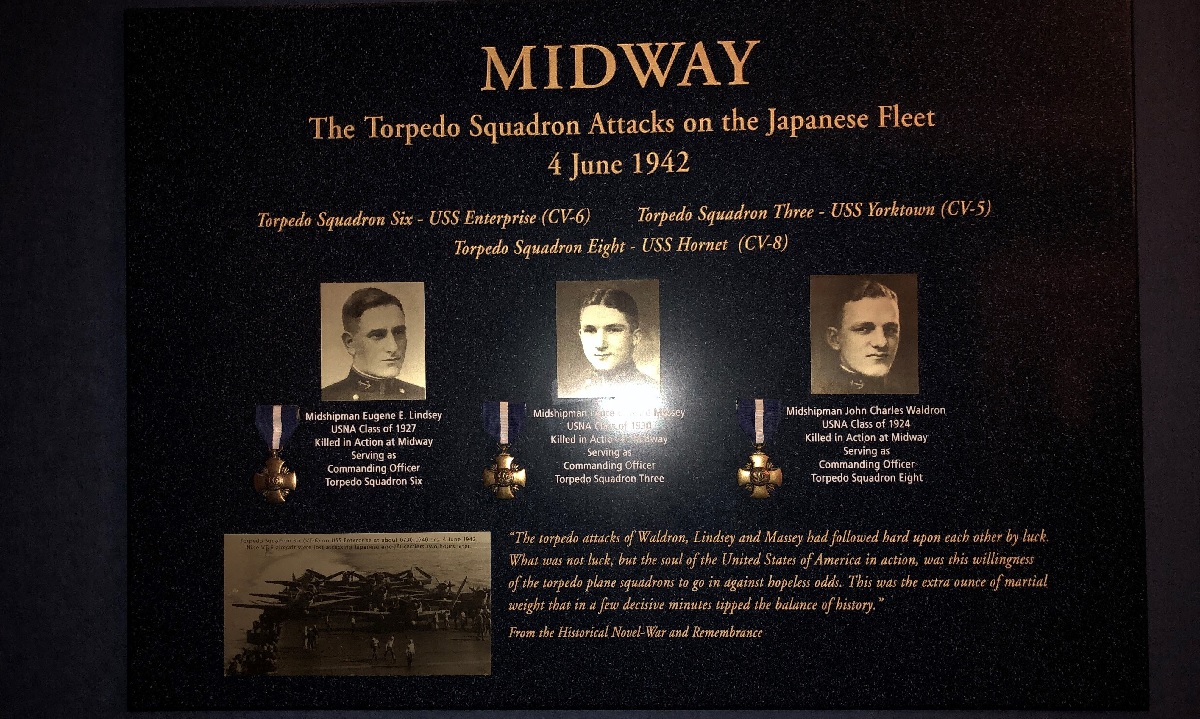
Plaque honoring the Torpedo Squadron commanders at Midway
Plaque honoring the Midway torpedo bomber squadron commanders

According to the Family Research Council, the plaque reads:

The torpedo attacks of Waldron, Lindsey, and Massey had followed hard upon each other by luck. What was not luck, but the soul of the United States in action, was the willingness of the torpedo plane squadrons to go in against hopeless odds. This was the extra ounce of martial weight that in a few decisive minutes tipped the balance of history.

So, here is what I wanted to say about this.

John Waldron was not properly equipped by his organization to make a difference at Midway. His planes were too old and slow, his torpedoes almost never worked. His leader was incompetent and prevented him from leading others to find and attack the actual targets. The only way he could do something to his enemy was to disobey orders and go off on his own. If he had lived, he probably would have been court-martialed for insubordination. Everyone watching must have thought “what a waste of effort”. It was only later that it became evident to all that what he did was necessary for the second wave to succeed.

When I read this story, it immediately occurred to me that this is the problem that serious Christians are facing today. Instead of finding and fighting the real targets: atheism, radical feminism, communism, etc., all our forces have been sent on wild goose chases, so that now many Christian leaders are actually trying to promote the priorities of the secular left, e.g. – global warming, wealth redistribution, feminism, sexual immorality, open borders, critical race theory, etc.

My recommendation for Christians today is to focus their attention on studying the evidence in areas like science, economics and history, so that they can fulfill the mandate of 1 Peter 3:15 with authoritative teaching and appealing to “signs” (e.g. the origin of the universe, fine-tuning, the origin of life, etc.) in the same way that Jesus did. The main strike force is going in the wrong direction, and it falls to us to break off and strike the enemy alone.

What can Christians learn from the bravest naval aviator at the Battle of Midway?

I have been reading lots of books about the World War II battles in the Pacific theater lately, and I wanted to write a post about one of the heroes I found who was the most compelling to me. You may have seen him in the old 1976 Midway movie or the new 2019 Midway movie. But neither movie tells the full story. The man I am talking about is Lt. Commander John C. Waldron.

John Waldron was the leader of the torpedo bomber squadron on the Hornet. This squadron was composed of outdated and slow Devastator torpedo bombers, armed with the Mark 13 Mod 1 torpedoes, which malfunctioned about 90% of the time.

I found an article on the Federalist that tells the story of John Waldron:

Now there are countless men and woman who deserve to be singled out for their valor, but with the 75th anniversary of the Battle of Midway just around the corner, I thought it would be appropriate to call your attention to one of the bravest men who ever lived. A man who, knowing he was facing certain death, led the first attack against the Japanese aircraft carriers and played a direct role in what would be a decisive victory for the United States, and a defeat from which Japan would never recover. That man was Lt. Commander John C. Waldron.

Now for those who don’t know, the Battle of Midway was the turning point in the Pacific theater. The Japanese had an elaborate plan that involved attacking the U.S. base on Midway Island in order to lure the Americans into a battle which the Japanese High command felt their experience and tactics would overwhelm and annihilate the American fleet. With no significant U.S. naval presence, Hawaii and the entire West Coast would be at risk of invasion. But the Americans broke the Japanese code and set a trap of their own – hoping to destroy their enemy’s carriers and thereby establish U.S. dominance in the Pacific. And that was exactly what happened : The U.S. fleet surprised the Japanese, sank their four carriers, and took the first real step to winning the Second World War.

John Waldron was 42 years old when the USS Hornet steamed towards Midway on June 1st, 1942. Born and raised on a reservation in South Dakota, he had never seen the ocean until he attended the Naval Academy. It wasn’t long after he graduated that he moved into naval aviation. He had been assigned to be the squadron leader of the Hornet’s torpedo bombers in late 1941 and had been drilling his men tirelessly ever since. Waldron had the reputation of a tough as nails, no-nonsense commander. Not surprising, since Waldron was a direct descendant of the warriors from the Oglala Lakota tribe – part of the Great Sioux Nation. The tough skin he developed came from decades of derision from his peers over his meager beginnings, and from the racism directed at his Native American heritage. Waldron didn’t care what anyone thought of him – all he wanted to do was fight for his country. He was a natural leader and his men would follow him into the gates of Hell, which, as fate would have it, is exactly what they would do in the upcoming battle.

On the morning of June 4th, the Americans were ready to spring their trap, but in the preflight briefing aboard the Hornet there was a problem. Stanhope Ring, who was in command of the carrier’s air group, directed his pilots to head northwest of the last reported position of the Japanese fleet. Waldron disagreed with this decision, feeling that they should head in the exact direction of that last sighting. He wasn’t shy about expressing this opinion, much the displeasure of Ring. Waldron continued to lobby his superior officer several times after the briefing ended, but to no avail.

The Federalist article doesn’t talk much about Stanhope Ring, but the book I just finished called “The Battle of Midway” by Craig L. Symonds did. Ring was a very tall, good-looking, and white officer who had breezed up the chain of command thanks to his good looks and confident manner. He loved to show off for cameras, and pull rank on subordinates. He was too proud to admit that Waldron was right in front of the other pilots.

More:

The air strike force took off from the deck of the Hornet – fighters, dive bombers, and the 15 planes in Waldron’s torpedo squadron. This force would be joined in the air by similar strike forces from the other U.S. carriers – the Yorktown and the Enterprise. Shortly after the Hornet’s air group was airborne, Waldron couldn’t contain his anger anymore. He broke radio silence to tell Ring that they were headed in the wrong direction. He repeated that comment and Ring issued a terse reply that he was in charge of this group and to stay the hell off the radio. Waldron waited a couple of minutes before replying “The hell with you” and peeled his squadron off and headed due west, where he felt the Japanese fleet was.

Less than an hour later, Waldron was proved right. He had led his squadron on a direct line to the enemy. Waldron broke radio silence again to signal to Ring that he had found the fleet, but Ring and the rest of the Hornet’s planes were too far away to hear. So now, Waldron was faced with a brutal decision. If he went in to attack, he would do so without any fighter protection, and they’d be totally at the mercy of the Japanese fighters. To make matters worse, the U.S. planes (Douglas Devastators) were hopelessly outdated aircraft – their top speed was about a third of what the Japanese fighters could do. They had hoped to get the newer Grumman Avengers, but the Hornet had left Pearl Harbor before they had arrived from the mainland. All of this meant that Waldron and Torpedo 8 were looking at a suicidal attack run. […]Waldron got on the radio again and told his men “We will go in. We won’t turn back. Former strategy cannot be used. We will attack. Good luck!”

And with that, the planes of Torpedo 8 closed up their formation and bore down on the Japanese fleet, some seven miles distant.

The Japanese fighters quickly pounced on the Americans, who were going in low and slow – the only way torpedo bombers can attack. One by one the planes from Torpedo 8 were shot down. […]Every single plane in Torpedo 8 was destroyed and not one torpedo hit a Japanese ship.

Not only were the torpedo bombers of John Waldron’s VT-8 (Hornet) shot down, but two more waves led by Eugene Lindsey VT-6 (Enterprise) and Edward Massey VT-3 (Yorktown) were also repulsed without a hit.

More:

History might have viewed Waldron’s attack as more insane than brave, and utterly pointless….except for what happened next. Shortly after his failed attack, the torpedo squadron from the Enterprise attacked the fleet – and right after that the torpedo squadron from the Yorktown. Both of those squadrons had devastating casualties as well (10 of 14 planes lost and 10 of 12 respectively) without inflicting any damage on any Japanese ship. But these three attacks in succession drew the Japanese fighter cover down so low, that it left their carriers exposed to dive bomber attacks. It also burned up a lot of fuel for the fighters, who now needed to land before they could continue their defense of the fleet. The attacks also forced the Japanese carriers into defensive maneuvers, so they were unable to land any planes or launch any for a strike on the American carriers.

In addition to using up their fuel and coming down to low altitude, the Japanese CAP (combat air patrol) fighters also used up most of their dangerous 20 mm ammunition. They mostly had much weaker 7.7 mm ammunition remaining when the dive bombers from the Enterprise and Yorktown arrived.

More:

As the Japanese were trying to compose themselves after the three fierce but harmless attacks, the American dive bombers from the Enterprise and Yorktown arrived and quickly struck. Within minutes, three of the Japanese carriers were in flames – the heart of the Imperial Navy had been gutted.

[…]The other planes from the Hornet never found the Japanese ships. Ring kept his planes flying in that northwesterly direction until they were too low on fuel to keep going. They returned to the Hornet with their full payload of bombs.

[…]Now, there were a lot of heroes that day – some who lived and some who died, but the valor that John Waldron displayed in defying orders he knew were wrong and then attacking the enemy when he knew it meant certain death, place him on a special level. His actions directly helped the Americans win this crucial battle, which turned the tide of the war in the favor of the United States. He got the Navy Cross for his actions that day, but it seems astonishing to me that he wasn’t awarded the Medal of Honor – he is definitely worthy of it.

You can learn more about the Battle of Midway in this helpful video:

So, here is what I wanted to say about this.

John Waldron was not properly equipped by his organization to make a difference at Midway. His planes were too old and slow, his torpedoes almost never worked. His leader was an arrogant, incompetent coward who prevented him from leading others to find and attack the actual targets. The only way he could do something to his enemy was to disobey orders and go off on his own. If he had lived, he probably would have been court-martialed for insubordination. After Waldron was shot down, every single one of the men in his squadron continued their attack until they too were all shot down. Everyone watching must have thought “what a waste of effort”. It was only later that it became evident to all that what he did was necessary for the second wave to succeed.

This plaque at the United States Naval Academy Club honors the three commanders of the torpedo bomber squadrons:

Plaque honoring the Torpedo Squadron commanders at Midway
Plaque honoring the Midway torpedo bomber squadron commanders

According to the Family Research Council, the plaque reads:

The torpedo attacks of Waldron, Lindsey, and Massey had followed hard upon each other by luck. What was not luck, but the soul of the United States in action, was the willingness of the torpedo plane squadrons to go in against hopeless odds. This was the extra ounce of martial weight that in a few decisive minutes tipped the balance of history.

When I read this story, it immediately occurred to me that this is the problem that serious Christians are facing today. Parents and pastors are not equipping young people to actually make a difference. Instead of finding and fighting the real targets: atheism, radical feminism, communism, etc., all our forces have been sent on wild goose chases, so that now “Christians” are actually trying to promote the priorities of the secular left, e.g. – global warming, wealth redistribution, affirming sexual immorality, open borders, critical race theory, etc.

The few of us who actually know how to do our jobs are poorly equipped. We are prevented from leading by organizations that are focused on feelings rather than results. We can only hope that our decision to attack against hopeless odds somehow paves the way for a second wave to succeed. It has happened before, and that’s why we should be brave and continue to engage our opponents using tools that work (philosophy of religion, evidential apologetics, scientific research, historical evidence, chastity, sobriety, self-control, good stewardship of our educations, careers and finances, effective charitable giving, self-sacrificial love, etc.).

What can Christians learn from the bravest naval aviator at the Battle of Midway?

I have been reading lots of books about the World War II battles in the Pacific theater lately, and I wanted to write a post about one of the heroes I found who was the most compelling to me. You may have seen him in the old 1976 Midway movie or the new 2019 Midway movie. But neither movie tells the full story. The man I am talking about is Lt. Commander John C. Waldron.

John Waldron was the leader of the torpedo bomber squadron on the Hornet. This squadron was composed of outdated and slow Devastator torpedo bombers, armed with the Mark 13 Mod 1 torpedoes, which malfunctioned about 90% of the time.

I found an article on the Federalist that tells the story of John Waldron:

Now there are countless men and woman who deserve to be singled out for their valor, but with the 75th anniversary of the Battle of Midway just around the corner, I thought it would be appropriate to call your attention to one of the bravest men who ever lived. A man who, knowing he was facing certain death, led the first attack against the Japanese aircraft carriers and played a direct role in what would be a decisive victory for the United States, and a defeat from which Japan would never recover. That man was Lt. Commander John C. Waldron.

Now for those who don’t know, the Battle of Midway was the turning point in the Pacific theater. The Japanese had an elaborate plan that involved attacking the U.S. base on Midway Island in order to lure the Americans into a battle which the Japanese High command felt their experience and tactics would overwhelm and annihilate the American fleet. With no significant U.S. naval presence, Hawaii and the entire West Coast would be at risk of invasion. But the Americans broke the Japanese code and set a trap of their own – hoping to destroy their enemy’s carriers and thereby establish U.S. dominance in the Pacific. And that was exactly what happened : The U.S. fleet surprised the Japanese, sank their four carriers, and took the first real step to winning the Second World War.

John Waldron was 42 years old when the USS Hornet steamed towards Midway on June 1st, 1942. Born and raised on a reservation in South Dakota, he had never seen the ocean until he attended the Naval Academy. It wasn’t long after he graduated that he moved into naval aviation. He had been assigned to be the squadron leader of the Hornet’s torpedo bombers in late 1941 and had been drilling his men tirelessly ever since. Waldron had the reputation of a tough as nails, no-nonsense commander. Not surprising, since Waldron was a direct descendant of the warriors from the Oglala Lakota tribe – part of the Great Sioux Nation. The tough skin he developed came from decades of derision from his peers over his meager beginnings, and from the racism directed at his Native American heritage. Waldron didn’t care what anyone thought of him – all he wanted to do was fight for his country. He was a natural leader and his men would follow him into the gates of Hell, which, as fate would have it, is exactly what they would do in the upcoming battle.

On the morning of June 4th, the Americans were ready to spring their trap, but in the preflight briefing aboard the Hornet there was a problem. Stanhope Ring, who was in command of the carrier’s air group, directed his pilots to head northwest of the last reported position of the Japanese fleet. Waldron disagreed with this decision, feeling that they should head in the exact direction of that last sighting. He wasn’t shy about expressing this opinion, much the displeasure of Ring. Waldron continued to lobby his superior officer several times after the briefing ended, but to no avail.

The Federalist article doesn’t talk much about Stanhope Ring, but the book I just finished called “The Battle of Midway” by Craig L. Symonds did. Ring was a very tall, good-looking, and white officer who had breezed up the chain of command thanks to his good looks and confident manner. He loved to show off for cameras, and pull rank on subordinates. He was too proud to admit that Waldron was right in front of the other pilots.

More:

The air strike force took off from the deck of the Hornet – fighters, dive bombers, and the 15 planes in Waldron’s torpedo squadron. This force would be joined in the air by similar strike forces from the other U.S. carriers – the Yorktown and the Enterprise. Shortly after the Hornet’s air group was airborne, Waldron couldn’t contain his anger anymore. He broke radio silence to tell Ring that they were headed in the wrong direction. He repeated that comment and Ring issued a terse reply that he was in charge of this group and to stay the hell off the radio. Waldron waited a couple of minutes before replying “The hell with you” and peeled his squadron off and headed due west, where he felt the Japanese fleet was.

Less than an hour later, Waldron was proved right. He had led his squadron on a direct line to the enemy. Waldron broke radio silence again to signal to Ring that he had found the fleet, but Ring and the rest of the Hornet’s planes were too far away to hear. So now, Waldron was faced with a brutal decision. If he went in to attack, he would do so without any fighter protection, and they’d be totally at the mercy of the Japanese fighters. To make matters worse, the U.S. planes (Douglas Devastators) were hopelessly outdated aircraft – their top speed was about a third of what the Japanese fighters could do. They had hoped to get the newer Grumman Avengers, but the Hornet had left Pearl Harbor before they had arrived from the mainland. All of this meant that Waldron and Torpedo 8 were looking at a suicidal attack run. […]Waldron got on the radio again and told his men “We will go in. We won’t turn back. Former strategy cannot be used. We will attack. Good luck!”

And with that, the planes of Torpedo 8 closed up their formation and bore down on the Japanese fleet, some seven miles distant.

The Japanese fighters quickly pounced on the Americans, who were going in low and slow – the only way torpedo bombers can attack. One by one the planes from Torpedo 8 were shot down. […]Every single plane in Torpedo 8 was destroyed and not one torpedo hit a Japanese ship.

Not only were the torpedo bombers of John Waldron’s VT-8 (Hornet) shot down, but two more waves led by Eugene Lindsey VT-6 (Enterprise) and Edward Massey VT-3 (Yorktown) were also repulsed without a hit.

More:

History might have viewed Waldron’s attack as more insane than brave, and utterly pointless….except for what happened next. Shortly after his failed attack, the torpedo squadron from the Enterprise attacked the fleet – and right after that the torpedo squadron from the Yorktown. Both of those squadrons had devastating casualties as well (10 of 14 planes lost and 10 of 12 respectively) without inflicting any damage on any Japanese ship. But these three attacks in succession drew the Japanese fighter cover down so low, that it left their carriers exposed to dive bomber attacks. It also burned up a lot of fuel for the fighters, who now needed to land before they could continue their defense of the fleet. The attacks also forced the Japanese carriers into defensive maneuvers, so they were unable to land any planes or launch any for a strike on the American carriers.

In addition to using up their fuel and coming down to low altitude, the Japanese CAP (combat air patrol) fighters also used up most of their dangerous 20 mm ammunition. They mostly had much weaker 7.7 mm ammunition remaining when the dive bombers from the Enterprise and Yorktown arrived.

More:

As the Japanese were trying to compose themselves after the three fierce but harmless attacks, the American dive bombers from the Enterprise and Yorktown arrived and quickly struck. Within minutes, three of the Japanese carriers were in flames – the heart of the Imperial Navy had been gutted.

[…]The other planes from the Hornet never found the Japanese ships. Ring kept his planes flying in that northwesterly direction until they were too low on fuel to keep going. They returned to the Hornet with their full payload of bombs.

[…]Now, there were a lot of heroes that day – some who lived and some who died, but the valor that John Waldron displayed in defying orders he knew were wrong and then attacking the enemy when he knew it meant certain death, place him on a special level. His actions directly helped the Americans win this crucial battle, which turned the tide of the war in the favor of the United States. He got the Navy Cross for his actions that day, but it seems astonishing to me that he wasn’t awarded the Medal of Honor – he is definitely worthy of it.

You can learn more about the Battle of Midway in this helpful video:

So, here is what I wanted to say about this.

John Waldron was not properly equipped by his organization to make a difference at Midway. His planes were too old and slow, his torpedoes almost never worked. His leader was an arrogant, incompetent coward who prevented him from leading others to find and attack the actual targets. The only way he could do something to his enemy was to disobey orders and go off on his own. If he had lived, he probably would have been court-martialed for insubordination. After Waldron was shot down, every single one of the men in his squadron continued their attack until they too were all shot down. Everyone watching must have thought “what a waste of effort”. It was only later that it became evident to all that what he did was necessary for the second wave to succeed.

This plaque at the United States Naval Academy Club honors the three commanders of the torpedo bomber squadrons:

Plaque honoring the Torpedo Squadron commanders at Midway
Plaque honoring the Midway torpedo bomber squadron commanders

According to the Family Research Council, the plaque reads:

The torpedo attacks of Waldron, Lindsey, and Massey had followed hard upon each other by luck. What was not luck, but the soul of the United States in action, was the willingness of the torpedo plane squadrons to go in against hopeless odds. This was the extra ounce of martial weight that in a few decisive minutes tipped the balance of history.

When I read this story, it immediately occurred to me that this is the problem that serious Christians are facing today. Parents and pastors are not equipping young people to actually make a difference. Instead of finding and fighting the real targets: atheism, radical feminism, communism, etc., all our forces have been sent on wild goose chases, so that now “Christians” are actually trying to promote the priorities of the secular left, e.g. – global warming, wealth redistribution, affirming sexual immorality, open borders, critical race theory, etc.

The few of us who actually know how to do our jobs are poorly equipped. We are prevented from leading by organizations that are focused on feelings rather than results. We can only hope that our decision to attack against hopeless odds somehow paves the way for a second wave to succeed. It has happened before, and that’s why we should be brave and continue to engage our opponents using tools that work (philosophy of religion, evidential apologetics, scientific research, historical evidence, chastity, sobriety, self-control, good stewardship of our educations, careers and finances, effective charitable giving, self-sacrificial love, etc.).