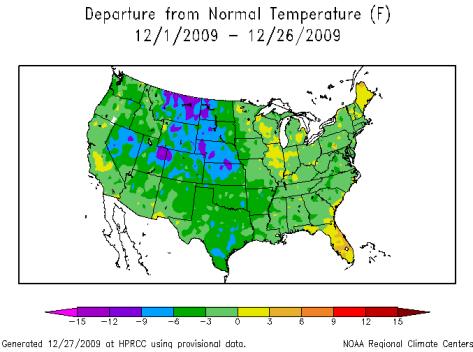
According to NOAA, October was the third coldest on record in the US, with almost every state showing temperatures from one to ten degrees below normal. Some Parts of Colorado received record snowfall during October, starting the first week of the month.
With a few days left, it appears that December is headed for a repeat, with temperatures ranging from one to fifteen degrees below normal.
Map:
I know what the response from the secular left will be: global temperatures are not evidence against global warming, and even if global warming is a lie, we need to move towards communism to stop pollution and overpopulation.
Consider Janet Napolitano, Barack Obama’s pick for the head of the Department of Homeland Security.
According to a report produced in April 2009 by the DHS, conservative Americans who are pro-life and pro-marriage, and who believe in the Constitution, federalism and the rule of law are potential terrorists.
Here’s a refresher of what the report was about from US News & World Report.
… Napolitano’s department prepared a report for state and local police officials titled “Rightwing Extremism: Current Economic and Political Climate Fueling Resurgence in Radicalization and Recruitment.” Little more than a nine-page screed against phantoms, the report purports to address potential threats from religious and racial hate groups as well as “those that are mainly antigovernment, rejecting federal authority in favor of state or local authority, or rejecting government authority entirely.” The report also singles out for special consideration anti-abortion activists, gun owners, immigration opponents and… returning veterans.
Here she is on CNN talking about how returning Iraq war veterans are potential terrorists.
And consider this story where she refuses to say the word terrorism in her remarks to Congress.
Excerpt:
Napolitano is the first homeland security secretary to drop the term “terror” and “vulnerability” from remarks prepared for delivery to the House Homeland Security Committee, according to a copy obtained by The Associated Press.
Tom Ridge, who headed the agency when it was launched in 2003, mentioned terrorism 11 times in his prepared statement at his debut before the oversight committee in 2003. And in 2005 Michael Chertoff, the second secretary, mentioned terrorism seven times, according to an AP analysis of the prepared testimonies.
Does she strike you as grounded in reality? Or ideology?
And now she says that “the system worked”
I’ve posted all this background to introduce Napolitano’s latest comments of the recent terrorist attack, that Al-Quaeda is taking reponsibility for, and that the DHS failed to prevent.
Homeland Security Secretary Janet Napolitano has created controversy over her remarks that “The system worked” on CNN’s “State of the Union”. She was referring to the terrorist attack on Northwest Airlines flight 253 from Amsterdam to Detroit.
“The system worked”, she says. This, in spite of the following facts:
The terrorist’s name, Abdul Farouk Abdulmutallab, was on the tied list of potential terrorists.
Abdulmutallab’s father reported his son had been recruited and trained by al Qaida to the United States Embassy in Lagos, Nigeria.
Abdulmutallab is not permitted into the UK because of terrorist concerns.
Abdulmutallab may have been allowed on board without a passport. Witnesses in the gate area allege he was introduced by a well-dressed man as a Sudanese refugee seeking sanction in the United States.
Homeland Security cleared the passenger list before NW253 departed.
But “the system worked”!
Maybe the system is only designed to prevent terrorist attacks from”right-wing extremists”? I really don’t know. What I do know is that the DHS will not be effective if they believe in an alternate “Michael Moore” parallel universe, where Rush Limbaugh is actually responsible for the 9/11 attacks instead of Osama Bin Laden.
Two of the four leaders allegedly behind the al Qaeda plot to blow up a Northwest Airlines passenger jet over Detroit were released by the U.S. from the Guantanamo prison in November, 2007, according to American officials and Department of Defense documents.
[…]American officials agreed to send the two terrorists from Guantanamo to Saudi Arabia where they entered into an “art therapy rehabilitation program” and were set free, according to U.S. and Saudi officials.
Elections matter, so let’s remember Janet Napolitano the next time we have to vote in 2010. The only way to deal with Napolitano is by voting Democrats out and putting some grown-ups in to handle things like the economy, health care, and national security.
Now, thanks to the latest research, we have the answer: calcium. Evolutionists are now saying that a rise in ocean calcium levels triggered the assembly of unicellular organisms into multicellular organisms and the rest, as evolutionists say, is history. What is astonishing is that there is anyone left out there who questions evolution. Can’t they see that these guys are doing the heavy lifting? This is just rock solid investigative research, the kind we’ve come to expect from evolutionists.
From the abstract of the paper:
We propose that stronger cell adhesion allowed the integrity of genetically uniform animals composed only of “self” cells, facilitating genetic constitutions to remain within the metazoan individual and be passed down inheritance lines. The Cambrian explosion might have been triggered by the coincidence in time of primitive animals endowed with self-/non-self-recognition and of a surge in seawater calcium that increased the binding forces between their calcium-dependent cell adhesion molecules.
It seems to me that the thing to be explained in the Cambrian explosion is “where did the NEW information come from for the NEW body plans”. Positing better glue to stick single cells together doesn’t address where the NEW code came from totally NEW body plans and NEW organ types.
Please post challenges on Dr. Hunter’s blog, as biophysics is his area of expertise.