
All posts by Wintery Knight

https://winteryknight.com/

Can a person be a feminist and still believe in marriage?

Here’s a research paper written in 2003 from the Heritage Foundation.

Excerpt:

Marriage is good for men, women, children–and society. Because of this simple fact, President George W. Bush has proposed a new pilot program to promote healthy marriage. Despite demonstrated evidence in every major social policy area of the need to rebuild a strong and healthy culture of marriage, President Bush’s new marriage initiative is still opposed by the extreme wing of feminism that sees no good in marriage or in unity between men and women, and between mothers and fathers.

Moderate, mainstream feminists have long rejected this animus against marriage; the vast majority of such feminists either are married or intend to marry. Mainstream feminists are focused on a worthy concern: removing obstacles to the advancement of women in all walks of life.

Radical feminists, however, while embracing this mainstream goal–even hiding behind it–go much further: They seek to undermine the nuclear family of married father, mother, and children, which they label the “patriarchal family.” As feminist leader Betty Friedan has warned, this anti-marriage agenda places radical feminists profoundly at odds with the family aspirations of mainstream feminists and most other American women.

The next part of the paper quotes from leading third-wave feminists who oppose marriage.

Here are some of the recent ones:

In her 1996 book In the Name of the Family: Rethinking Family Values in the Postmodern Age, Judith Stacey, Professor of Gender Studies and Sociology at the University of Southern California, consigned traditional marriage to the dustbin of history.36 Stacey contended that “Inequity and coercion…always lay at the vortex of that supposedly voluntary `compassionate marriage’ of the traditional nuclear family.”37 She welcomed the fact that traditional married-couple families (which she terms “The Family”) are being replaced by single-mother families (which she terms the postmodern “family of woman”):

Perhaps the postmodern “family of woman” will take the lead in burying The Family at long last. The [married nuclear] Family is a concept derived from faulty theoretical premises and an imperialistic logic, which even at its height never served the best interests of women, their children, or even many men…. The [nuclear married] family is dead. Long live our families!38

Stacey urged policymakers to abandon their concern with restoring marital commitment between mothers and fathers and instead “move forward toward the postmodern family regime,” characterized by single parenthood and transitory relationships.39

In 1996, Claudia Card, professor of Philosophy at the University of Wisconsin-Madison, continued the attack:

The legal rights of access that married partners have to each other’s persons, property, and lives makes it all but impossible for a spouse to defend herself (or himself), or to be protected against torture, rape, battery, stalking, mayhem, or murder by the other spouse…. Legal marriage thus enlists state support for conditions conducive to murder and mayhem.40

Other radical feminists suggested that a culture of self-sufficiency and high turnover in intimate relationships is the key to independence and protection from hostile home life. Activist Fran Peavey, in a 1997 Harvard article ironically titled “A Celebration of Love and Commitment,” suggested that “Instead of getting married for life, men and women (in whatever combination suits their sexual orientation) should sign up for a seven-year hitch. If they want to reenlist for another seven, they may, but after that, the marriage is over.”41 Also in 1997, radical feminist author Ashton Applewhite, in her book Cutting Loose–Why Women Who End Their Marriages Do So Well proclaimed: “Women who end their marriages are far better off afterward.”42

Another feminist widely read during the 1990s was Barbara Ehrenreich, a former columnist with Time magazine who now writes for The Nation.43 Throughout her work, Ehrenreich extols single parenthood and disparages marriage. Divorce, she argues, produces “no lasting psychological damage” for children. What America needs is not fewer divorces but more “good divorces.”44 Rather than seeking to strengthen marriage, policymakers “should concentrate on improving the quality of divorce.”45 In general, Ehrenreich concludes that single parenthood presents no problems that cannot be solved by much larger government subsidies to single parents.46

Ehrenreich writes enthusiastically about efforts to move beyond the narrow limits of the nuclear married family toward more rational forms of human relationship:

There is a long and honorable tradition of “anti-family” thought. The French philosopher Charles Fourier taught that the family was a barrier to human progress; early feminists saw a degrading parallel between marriage and prostitution. More recently, the renowned British anthropologist Edmund Leach stated, “far from being the basis of the good society, the family with its narrow privacy and tawdry secrets, is the source of all discontents.”47

While Ehrenreich recognizes that men and women are inevitably drawn to one another, she believes male-female relationships should be ad hoc, provisional, and transitory. She particularly disparages the idea of long-term marital commitment between fathers and mothers. In the future, children will be raised increasingly by communal groups of adults.48 These children apparently will fare far better than those raised within the tight constraints of the nuclear married family “with its deep impacted tensions.”49

The paper goes on to explain how these messages have entered into college textbooks. College textbooks used in classes where young women are expected to agree with the textbooks in order to get their good grades. This is what your children will learn. It’s not what you think feminism is that matters – it’s what they think feminism is. And what they think is what the textbooks tell them to think – or else they get drummed out of the university. This is where the 42% out-of-wedlock birth rate came from. And why our children are growing up without fathers, and growing further and further away from God. Marriage is bad (apparently) because husbands and their traditional roles are bad. So what men for? Sperm-donors and wallets. Men understand this and so we don’t marry.

Do you ever wonder why we have things like no-fault divorce, abortion, co-habitation, hooking-up, in vitro fertilization, socialism, welfare, and so on? It’s because of feminism. Feminism is anti-marriage. Should women now complain about men not being willing to marry and commit? Of course not. So long as women support feminism, by voting for feminists like Barack Obama and Hillary Clinton, then marriage will decline. If women don’t like men and don’t care about what men want and think men are evil then they should not expect men to accept their traditional roles as protectors and providers and moral/spiritual leaders. Don’t complain that there are no men around who will marry you. Of course there aren’t – because ideas have consequences. Feminism has consequences.
New study finds that feminism does not empower women in relationships

From the Daily Caller. (H/T Kelli)

Excerpt:

“Girl power” might have brought women and girls victories in academics and sports but, as a recent book out of the University of Texas reports, an unintended consequence of women’s success has given men a leg up in the game of love.

Based on research published in their new book,“Premarital Sex in America: How Young Americans Meet, Mate and Think About Marrying,” Mark Regnerus and Jeremy Uecker, sociologists from the University of Texas at Austin, have found that with women becoming more educated and professionally successful than ever, it has become extremely difficult for them to find a committed man.

Financially secure and with less incentive to marry, more and more young women are playing the field longer and lowering the value of women in general — leaving their sisters, (usually older and hearing the tick-tock of their biological clocks) out in the cold.

If he can get to the “business” with just one or two dinners with Martha, why would he commit to 20 dates and “maybe” Mary?

Regnerus told The Daily Caller that in the sexual economy women act almost like a cartel. At one time the price of sex was extremely high, but with the demise of the shotgun wedding, the invention of “the pill” and a population of willing women, the “price” of sex has plummeted.

“People’s individual choices matter in part because they contribute to collective norms, collective possibilities,” Regnerus said. “So this is why I say there is no such thing as truly discrete sex because it becomes a data point in what you expect from women or from men in subsequent relationships.”

According to Regnerus, it is largely women who decide the going rate for sex.

“So if you think of a collective of men and a collective of women, the men come to learn what is expected of them in order to access sex, because they want it a little bit more than women …Women have to decide, more than men, how much it is worth so to speak … but she is not deciding alone,” he said.

In this model, phenomena such as the “one-night stand” act to lower the price for all and as women get older the value becomes more consequential.

“When you are say 27, 32, I assume most women wouldn’t want to give it up just for dinner,” Regnerus said. “They are at a different life phase where they want to cut the crap and say, ‘If this is going nowhere, then goodbye.’ But the problem is they are being under-bid and men are reaching further down the age range.”

The article goes on to cite Jennifer Roback Morse and Carrie Lukas, who are two of my favorite women in the whole world when it comes to this issue. I have read Dr. Morse’s “Love and Economics” and “Smart Sex” and Mrs. Lukas’ book “The Politically Incorrect Guide to Women, Sex and Feminism”, and I highly, highly recommend them all to men and women. Carolyn Graglia’s “Domestic Tranquility” and George Gilder’s “Men and Marriage” also pretty good, with lots of insights on how feminism changes the dynamics of marriage.

Related posts

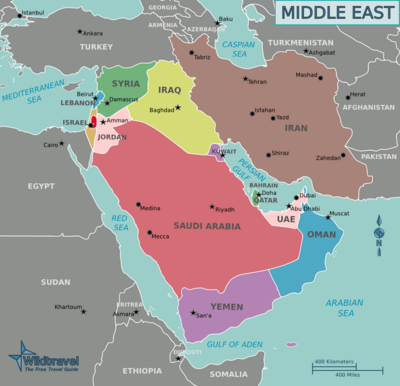
    Obama’s weak foreign policy may lead to WAR in the Middle East

    Map of Middle East
    Map of Middle East

    First article from the left-wing Huffington Post. (H/T Gateway Pundit)

    Excerpt:

    In its first year, the Obama administration cut funding for democracy and governance programming in Egypt by more than half, from $50 million in 2008 to $20 million in 2009 (Congress later appropriated another $5 million). The level of funding for civil society programs and non-governmental organizations (NGOs) was cut disproportionately, from $32 million to only $7 million. Though funding levels for 2010 are not yet available, they are expected to show an increase to $14 million, says Stephen McInerny, the director of advocacy at the Project on Middle East Democracy. He notes that the Bush administration slashed economic aid to Egypt in the 2009 budget but kept the funding for democracy and governance programs constant, while Obama cut funding to those programs in an effort to make the cuts more proportional and under pressure from the American embassy in Cairo.

    Second article, from the LA Times. (H/T Gateway Pundit)

    Excerpt:

    The Obama administration said for the first time that it supports a role for groups such as the Muslim Brotherhood, a banned Islamist organization, in a reformed Egyptian government.

    […]The statement was an acknowledgment that any popularly accepted new government will probably include groups that are not considered friendly to U.S. interests, and was a signal that the White House is prepared for that probability after 30 years of reliable relations with Egyptian President Hosni Mubarak.

    Third article, from National Review. (H/T Hyscience)

    Excerpt:

    Hamas’s overt intervention in Egypt is an alarming development, although a predictable one. It is worth pointing out that Hamas is not merely colluding with the Muslim Brotherhood. Hamas is the Muslim Brotherhood. That, of course, will not be what you hear from our foreign-policy experts, such as Obama adviser Bruce Riedel, who are busily sculpting their narrative about how the Brotherhood — the font on modern jihadist terror — has renounced violence and is really nothing for us to be very concerned about. But the stubborn fact is that Hamas is the most prominent of the Brotherhood’s Palestinian branches, whose operations long predated Hamas and brought Hamas (a/k/a, the Islamic Resistance Movement) into being.

    So that’s what’s happening in Egypt… Hamas is moving in to take control, just like Hezbollah controls Lebanon (now). But why now? Why didn’t this happen when George W. Bush was President?

    Well, Barack Obama is no George W. Bush.

    Let’s review:

    • Obama insulted our British allies
    • Obama insulted our Afghan allies
    • Obama backed Iran’s suppression of pro-democracy protestors
    • Obama did nothing when Russian tanks rolled through Georgia
    • Obama did nothing when Hezbollah took over Lebanon
    • Obama backed the socialist Zeyala in Honduras
    • Obama met with Chavez, Ortega and Morales and kept silent while they insulted the United States
    • Obama did nothing while Turkey became increasingly Islamicized
    • Obama cut funding to democracy and governance programs in Egypt

    And what is the end game of all of this weakness and moral equivalence?

    Excerpt:

    The circle is now complete. This week Barack Obama truly became what many people believe he was all along, the long lost second term of Jimmy Carter’s presidency.

    […]First he criticized the weakened leader of Egypt, Hosni Mubarak. Next Obama threatened to emasculate Mubarak’s standing with the Egyptian military by reducing US financial aid if Mubarak didn’t allow the protests and revolution in the streets to continue.

    Obama followed up by tacitly signaling that he supports the violent Islamic protests which are backed by the Shariah-compliant extremists of the Moslem Brotherhood, which is the only real opposition party in Egypt to the thirty-year dictator Mubarak. After that, like Carter, Obama showed constant indecision and weakness, which is having the result of undermining our allies and empowering the forces of insanity and evil on the ground in Egypt and other destabilized countries in the region like Tunisia, Lebanon and Jordan.

    Just like Carter, Obama got us to this point by undermining our only ally in the area, Israel, and empowering all of her regional enemies for the first two years of his presidency. That undermining has led us directly to these out of control events.

    At this moment, of the four nations that border Israel, two of them, Syria and Lebanon, are client states of Iran waging constant war and the other two which both have brokered peace are facing internal turmoil, Jordan is facing Islamic protests in her streets and the relatively stable tourist destination Egypt, is exploding in revolution.

    The way Obama is handling the Egyptian crisis there can only be one outcome. The Moslem brotherhood will seize total control of the nation and turn the Arab world’s most populace country into a totalitarian Islamic theocracy just like Iran. Egypt’s fall will be a strategic disaster for the US because Egypt borders Israel and controls the vital Suez Canal which connects the Indian Ocean to the Mediterranean Sea. The Suez is one of the most vital water-ways in the entire world because it is the shipping lane that allows Middle East oil to get to the consumer countries in Europe.

    If Egypt falls to this kind of governance total war will quickly come to the Middle East with catastrophic strategic and economic consequences for the whole world.

    Strength doesn’t cause wars – weakness causes wars. When you are strong, aggressors know that aggression will cause them plenty. Obama, and his constant apologizing and appeasing and siding with terrorists and dictators, is what REALLY causes wars.