

All posts by Wintery Knight

https://winteryknight.com/

New study: couples who cohabitate before marriage have higher risk of marital dissolution

When I was in college studying computer science, there was a new idea going around called “design patterns”. Basically, this was a cookbook of component arrangements that were “best practices” for solving certain problems. Depending on your problem, you might try different patterns, like Observer, Visitor, Strategy, etc. And it turns out that there are design patterns for social issues, too.
Cohabition Instability

Here’s a new report from the Institute for Family Studies:

Fifty to 65% of Americans believe that living together before marriage will improve their odds of relationship success. Younger Americans are especially likely to believe in the beneficial effects of cohabitation, and to view living together as providing a valuable test of a relationship ahead of marriage. Yet living together before marriage has long been associated with a higher risk for divorce, contradicting the common belief that cohabitation will improve the odds of a marriage lasting.

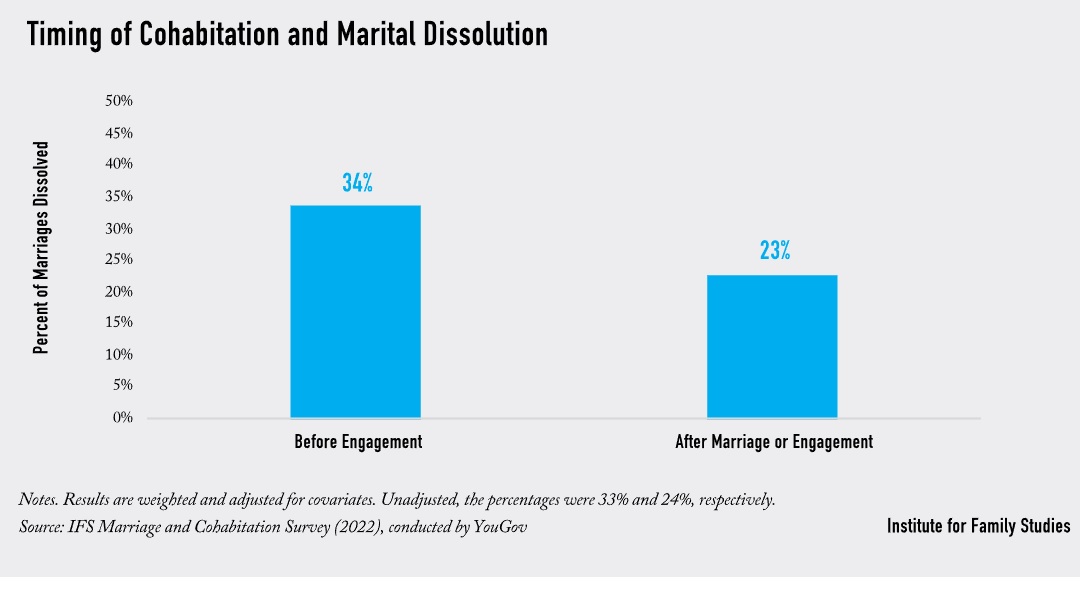
[…]Using a new national sample of Americans who married for the first time in the years 2010 to 2019, we examined the stability of these marriages as of 2022 based on whether or not, and when, people had lived together prior to marriage. Consistent with prior research, couples who cohabited before marriage were more likely to see their marriages end than those who did not cohabit before marriage.

Key findings:

  •  34% of marriages ended among those who cohabited before being engaged, compared to 23% of marriages for those who lived together only after being either married or engaged to be married.

And this from the key takeaways was interesting:

  • Reasons for moving in together also matter: People who reported that their top reason for moving in together was either to test the relationship or because it made sense financially were more likely to see their marriages end than those who did so because they wanted to spend more time with their partner.
  • Having a greater number of prior cohabiting partners is associated with a higher likelihood of marriages ending.

I think the key point in these studies is that couples who decide to commit are moving in very different reasons than couples who just slide into cohabitation because it’s convenient.

It’s interesting because it shows that being cautious about commitment is more likely to cause instability. The attitude seems to be “I’ll keep doing this as long as it makes me happy”.

With commitment, the attitude is going to be more like “let’s decide to unite, and then it will be on us to make it work”. The old marriage vows were all about that commitment. I really have to wonder whether people mean it when they say those words today, they are so counter to our hedonistic culture.

I think what people should be looking for is a mate who thinks that the relationship works better if both people work at it. If you have one person who thinks that it is the other person’s job to make them happy, run from that relationship. Like, if you are always doing little things to help the other person do well in their tasks and purposes, and they never do anything to help you, then that’s a bad sign. You don’t want to commit to someone who thinks that relationships should be effortless, that they don’t have to do anything to put gas in your fuel tank in order to make you perform.

Ideally, you want someone who thinks that it’s fun to put fuel in your tank, and thinks that it’s their job to do that for you. Just because they like to see your engine run.

Ryan T. Anderson lectures on marriage and why it matters

Here’s the lecture:

About the speaker:

Ryan T. Anderson researches and writes about marriage and religious liberty as the William E. Simon Fellow at The Heritage Foundation. He also focuses on justice and moral principles in economic thought, health care and education, and has expertise in bioethics and natural law theory.

Anderson, who joined the leading Washington think tank’s DeVos Center for Religion and Civil Society in 2012, also is the editor of Public Discourse, the online journal of the Witherspoon Institute of Princeton, N.J.

Anderson’s recent work at Heritage focuses on the constitutional questions surrounding same-sex “marriage.” He is the co-author with Princeton’s Robert P. George and Sherif Girgis of the acclaimed book “What Is Marriage? Man and Woman: A Defense” (Encounter Books, December 2012).

The lecture starts at 7:20 in. The lecture ends at 49:35. There are 32 minutes of Q&A.

Introduction:

  • When talking about marriage in public, we should talk about philosophy, sociology and public policy
  • Gay marriage proponents need to be pressed to define what marriage is, on their view
  • Every definition of marriage is going to include some relationships, and exclude others
  • It’s meaningless to portray one side as nice and the other mean
  • Typically, marriage redefiners view marriage as a more intense emotional relationship
  • Marriage redefiners should be challenged in three ways:
  • 1) Does the redefined version of marriage have a public policy reason to prefer only two people?
  • 2) Does the redefined version of marriage have a reason to prefer permanence?
  • 3) Does the redefined version of marriage have a reason to prefer sexual exclusivity?
  • Also, if marriage is just about romance, then why is the state getting involved in recognizing it?
  • The talk: 1) What marriage is, 2) Why marriage matters, 3) What are the consequences of redefining marriage?

What marriage is:

  • Marriage unites spouses – hearts, minds and bodies
  • Marriage unites spouses to perform a good: creating a human being and raising that human being
  • Marriage is a commitment: permanent and exclusive
  • Male and female natures are distinct and complementary

The public purpose of marriage:

  • to attach men and women to each other
  • to attach mothers and fathers to their children
  • there is no such thing as parenting, there is only mothering and fathering
  • the evidence shows that children benefit from mothering and fathering
  • boys who grow up without fathers are more likely to commit crimes
  • girls who grow up without fathers are more likely to have sex earlier
  • Children benefit from having a mother and a father
  • can’t say that fathers are essential for children if we support gay marriage, which makes fathers optional
  • without marriage: child poverty increases, crime increases, social mobility decreases, welfare spending increases
  • when government encourages marriage, then government has less do to – stays smaller, spends less
  • if we promote marriage as an idea, we are not excluding gay relationships or even partner benefits
  • finally, gay marriage has shown itself to be hostile to religious liberty

Consequences redefining marriage:

  • it undermines the norm in public like that kids deserve a mom and a dad – moms and dads are interchangeable
  • it changes the institution of marriage away from the needs of children, and towards the needs of adults
  • it undermines the norm of permanence
  • we learned what happens when marriage is redefined before: with no-fault divorce
  • no-fault divorce: after this became law, divorce rates doubled – the law changed society
  • gay marriage would teach society that mothers and fathers are optional when raising children
  • if marriage is what people with intense feelings do, then how can you rationally limit marriage to only two people?
  • if marriage is what people with intense feelings do, then if other people cause intense feelings, there’s no fidelity
  • if marriage is what people with intense feelings do, then if the feelings go away, there is no permanence
  • the public policy consequences to undermining the norms of exclusivity and permanence = fatherless children and fragmented families
  • a final consequences is the decline and elimination of religious liberty – e.g. – adoption agencies closing, businesses being sued

We’re doing very well on abortion, but we need to get better at knowing how to discuss marriage. If you’re looking for something short to read, click here. If you want to read a long paper that his book is based on.

Republicans act to prevent Biden for importing millions of Palestinian refugees

Sometimes, people who don’t know very much about politics lazily say “both parties are the same, so it doesn’t matter whether you vote or not… the system is rigged”. But is this really true? Let’s take a look at the issue of immigration, and see if the two parties really are the same when we look at the details.

Here’s an article from Breitbart News:

Reps. Tom Tiffany (R-WI) and Andy Ogles (R-TN) are introducing legislation that would ban President Joe Biden’s administration from importing Palestinians to the United States to be resettled in American communities.

The bill, exclusively shared with Breitbart News ahead of its introduction, is titled the “Guaranteeing Aggressors Zero Admission Act” or the GAZA Act. The legislation would prevent Biden’s administration from issuing visas to those with Palestinian Authority passports.

[…]Likewise, the bill would prevent Biden’s Department of Homeland Security (DHS) from funneling Palestinians into the U.S. through the agency’s parole pipeline.

But what about the Democrat view of immigration?

Following the U.S. withdrawal from Afghanistan, Biden used his administration’s parole pipeline to resettle nearly 100,000 Afghans across American communities — many of whom were not interviewed in person beforehand and who were found to be linked to terrorism.

As Breitbart News reported, in Fiscal Year 2022 alone, Biden’s DHS gave green cards to about 63,000 legal immigrants to permanently resettle in the U.S. who arrived from countries previously included in a national travel ban list due to their involvement with terrorism.

What I am hearing is that the weapons that America abandoned fell into the hands of the Palestinians, which is why you can see photographs of them holding American military weapons. That seems to be Biden’s foreign policy – arm our enemies, reward them with cash and prizes for attacking us and our allies.

Meanwhile, here’s a message from Ron DeSantis, reported in Fox News:

Florida Gov. and GOP presidential hopeful Ron DeSantis Sunday stuck to his stance that the U.S. should not accept refugees from Gaza amid the ongoing conflict with Israel.

“Palestinian Arabs should go to Arab countries, the U.S. should not be absorbing any of those,” DeSantis said during an appearance on CBS’s “Face the Nation” Sunday.

The Florida governor’s remarks come after he sparked controversy with comments made on the campaign trail in Iowa Saturday, arguing to those in the audience that the refugees would be “antisemitic.”

“I don’t know what Biden’s going to do, but we cannot accept people from Gaza into this country as refugees,” DeSantis said during the event. “If you look at how they behave, not all of them are Hamas, but they are all antisemitic. None of them believe in Israel’s right to exist.”

That’s bold, but he’s not wrong.

So there is a clear difference between the parties on issues. I think the people who say that there is no difference just don’t know what the differences are, because it takes work to know.