
All posts by Wintery Knight

https://winteryknight.com/

Wayne Grudem explains what the Bible says about spending, saving and charity

Bible study that hits the spot

A practical lecture on money – spending, saving, charitable giving – from famous pastor Wayne Grudem.

I like the way that Wayne Grudem navigates the Bible finding the passages that tell you who God is, so that you can make better decisions by analyzing alternatives and choosing the one that gives your Boss a maximum return on investment. He’s very practical.

The MP3 file is here.

The PDF outline is here.

Spending:

  • Christianity does not teach asceticism (= don’t enjoy anything in this world), Paul condemns it in 1 Timothy 4:1-5
  • When you buy nice things, even if it is a little more expensive, it’s an opportunity to be thankful for nice things that God has provided
  • Even being rich is OK, but don’t let it make you haughty and arrogant, and don’t set your hopes on your money (see 1 Tim 6:17)
  • It is important for you to earn money, and you are supposed to use it to support yourself and be independent
  • It is possible to overspend and live recklessly (Luke 15:13) and it’s also possible to overspend and live too luxuriously
  • Increasing your income through career progression is wise, because it allows you to give away more and save more
  • God gives us freedom to decide how much we spend, how much we give away, and how much we save
  • every choice a Christian makes with money will give him or her more or less reward in his or her afterlife
  • Do not spend more than you have – you should make every effort to get out of debt as quickly as possible

Saving:

  • Saving money is wise so you can help yourself and others, and have money in your old age when you will not be working
  • If you do not save your own money, you end up being dependent on others (e.g. – family or taxpayers)
  • Not saving money for the future is a way of “putting God to the test” (Matt 4:7)
  • You are to “be dependent on no one”, to the extent that you can (1 Thes 4:12)
  • We don’t know the future, that’s why we should prepare for an emergency, and buy insurance to guard (James 4:13-17)
  • It’s right for us to learn how to save to be able to buy bigger assets, like a car or a college education
  • Saving and investing in stocks and bonds lets people in business start and grow companies, creating jobs and new products
  • Don’t over-save, trusting too much in money more than you trust in God (Ps 62.10; Matt 6:19,24; Luke 12:15-21)

Giving:

  • it is required for the people of God to give something out of what they earn, but no percentage is specified (Deut 26:12-13)
  • you do not give money to become right with God, you can’t earn your salvation
  • a Christian gives to show God that you trust him to take care of you, and to experience trusting him through your giving
  • the quality of your resurrection life with God is affected by giving you do for the Kingdom (Phil 4, Matt 6:19-21; 1 Tim 6:18-19)
  • when you get involved in the lives of others and give to them, you have the joy of experiencing caring for others (Acts 20:35)
  • it’s possible to give too little, but it’s also possible to give too much – be careful about pride creeping in as well

The first part of this lecture made me think of my treat for the week, which is to get a double chicken burrito bowl after my weight lifting. It is very easy to say grace when you are hovering over a double chicken burrito bowl. It is good to have nice things especially when it makes you thankful for what you have.

I was so happy listening to this talk because he was condemning bad stewardship, which I see in a lot of young people these days. I was happy until he got to the part about trusting in your savings for your security, and then I thought – that’s what I do wrong! I save a lot but it’s not just for emergencies and to share with others, like he was saying – I want a sense of security. This was more of a temptation in my 20s than it is now in my 30s, though.

Charity should hurt

I can remember being in my first full-time job as a newly hired junior programmer when the 2001 recession struck. I would cry while signing checks to support William Lane Craig’s Reasonable Faith ministry, because I was so scared. I had no family or friends where I lived to help me if anything went wrong, and that’s been the story of my working life. If anything goes wrong, there is no backup. But it’s that experience of crying when I gave that allows me to say today “that’s when I became the man I am, that’s what a man does when he is a follower of Jesus”. If you are not doing the actions of charity, then you will not having the experience of trusting God and letting him lead you. There is more to the Christian life than just saying the right things – you have to do the right things.

Don’t follow your heart

If you’re scared about giving when you are young, then do what I did in my 20s: work 70-hour weeks, get promoted often, and save everything you earn. I volunteered every Saturday for 9 months in order to get my first white-collar part-time job when I was still in high-school. The faster you increase your savings, the easier it’s going to be to take a genuine interest in caring for the people around you. Read Phil 1 (fellowship), Phil 2 (concern for others), and Phil 4 (charity). Turn off your emotions and desires when it comes to choosing what to study and what work to do, and put Philippians into practice. Your freedom to give is very much tied to the quality of your decisions of what to study, where to work, how much you spend on entertainment, and so on. That’s why you need to turn off your feelings and desires and do what works, even it it’s not fun, and even if it involves responsibilities, expectations and obligations.
Should Christians expect to know God’s will by means of feelings and intuitions?

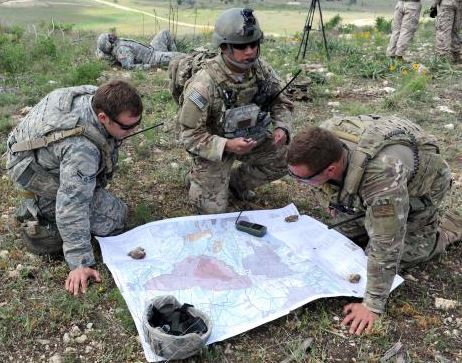
Air Force TACPs confirm target locations with their map

There are two views on the topic of decision making and the will of God. The view you learn in the church is called “the traditional view”. I call this view the feelings/intuition view. This view that elevates feelings / intuitions to the level of divine communications from God. The more practical view is called “the wisdom view”. I call this view the battlefield commander view. I am a proponent of the wisdom / commander view.

Let’s learn about the two different views:

[The traditional view is] that God has a plan for our lives and that we receive guidance through methods such as “open and closed doors”, “feeling led” and “the still, small, voice”.

[The wisdom view] holds that God does not have an “individual will” for our lives, but rather that all of God’s will can be summed up within two categories, God’s sovereign will and God’s moral will. Basically God’s sovereign will is all the things that god decrees will happen. It is hidden (mostly) from us, and does not play an active part in our decision, although some of it is revealed in the bible. God’s moral will is the part that we must concern ourselves with in making decisions. It is fully revealed in the bible and our decisions must be made within it. We may use wisdom in applying god’s moral will to our lives, or we may be in an area not covered by god’s moral will. We must finally submit in advance to God’s sovereign will, being prepared for him to sovereignty intervene and redirect us through whatever means he wills (see James).

Here’s a bit more from someone else:

Regarding the view that God has a personal will for us individually that we have to discern and find, J.I. Packer says, “The first thing to say is that the idea of guidance is actually a novelty among orthodox evangelicals. It does not go back farther than the last century. Second, it has led people to so much foolish action on the one hand, and so much foolish inaction on the other, as well as puzzlement and heartbreak when the ‘hotline’ to God seems to go silent, that it has to be discredited. Third, it must be said that Scripture gives us no more warrant constantly to expect personal ‘hotline,’ ‘voice-from-the-control-tower’ guidance than to expect new authoritative revelations to come our way for the guidance of the whole church.” (Hot Tub Religion, page 118).

As to the point of the question, how do I make decisions, I attempt to make decisions in light of three factors: God’s moral will, wisdom, and my personal desires. If something is opposed to God’s moral will, then I should obviously flee from it. If it’s not opposed, then I consider the wisdom of the choices. For example, would it be wise for me to marry a woman who loves Jesus, though we have nothing else in common? Probably not. If the options pass the criteria of wisdom, then I’m free to choose how I wish. If I’m offered two jobs, and both are honoring to God, and both would be wise to take, then I’m free to choose the job I would like more. I don’t need to put out a fleece or await some other confirmation from God. If it’s moral and wise, then the only question as to whether or not it will honor Him is my attitude.

Some examples of this model used in the Bible (in theological circles referred to as the Wisdom Model) are in Paul’s planning of a mission to Rome in Romans 1:9-15, 15:22-24, the Jerusalem Council (Acts 15:1-29), and Paul’s instructions for legal disputes (1 Cor 6:3-6).

The best book on this topic is Garry Friesen’s “Decision Making and the Will of God”. In it, you’ll find a full assessment about what the Bible teaches on this topic.

When I am trying to decide what will be effective, I look at Christian scholars, at their papers, books, and public debates. That’s effectiveness because it is addressed to a non-Christian audience in public with the force of reason and evidence. It is persuasion and it is addressed to rational minds. I want to change the minds of people who have a large influence on society on the whole. I don’t think that offering Christianity as life-enhancement or self-help is really “having an influence”. I think that offering Christianity as truth, with support, is “having an influence”.

So let me be clear about what I believe:

  • I don’t think that God normally talks to people directly
  • I don’t believe that life is an Easter egg hunt, filled with clues accessible only to emotion and intuition
  • I don’t believe that God expects people to discover a specific will for their lives using non-rational means
  • I think that people make up their own life plan that is consistent with the Bible
  • The goal of the life plan is to be effective, and there are no other considerations
  • I think that there are many good things a person can do, but that some are more effective than others
  • I think that with respect to the goal of serving God effectively, my happiness is expendable
  • I don’t think that the purpose of doing something for the Lord is to feel good about ourselves
  • I don’t think that people should choose ineffective things to do just because they like them
  • I don’t think that people should choose ineffective things to do just because they are good at them
  • I think people should do hard things that they don’t like – as long as it’s more effective
  • I don’t think that any course of action is as effective as any other – some plans accomplish more
  • I don’t think that life is totally unpredictable and irrational and subjective
  • I think that we can know what is or is not effective by studying and learning about the world
  • I think life is like a battlefield that must be surveyed, understood and acted upon deliberately

I think that every person is the commanding officer of his or her own life, and each person must study everything they can, make a plan that is consistent with the Bible’s moral prescriptions, execute the plan and achieve whatever they can achieve for the Lord. And the goal is not comfort or happy feelings, but real achievements. Not for the purpose of being saved, of course, because salvation is a free gift of God because of what Jesus did on the cross. Life is more like a battle than a vacation resort or a buffet or a shopping center. God’s will for us is not have happy feelings, but that we freely choose to sacrifice ourselves out of obedience and service to him. In my case, that means studying hard things, making money, saving money, and giving money away to good scholars, sponsoring good events and being persuasive to non-Christians. None of this necessarily makes me happy, but it does work to bring glory to God. I cried when I had to learn calculus, because it was so hard. But who cares? The main thing is that I have money now to sponsor Christian speakers or to give books to Christians to read, and God is happy with that.

I think that it is very important to realize that God is not impressed by our not being smart and not being effective. If we have the ability to be smart, then we should be smart, whether it makes us happy or not. If we have the ability to make money, then we should make money, whether it makes us happy or not. If we have the ability have a great influence, then we should have a great influence, whether it makes us happy or not. There will be plenty of time for happiness after we’re dead. But this life is a time of serving, and we should try to serve effectively, whether it makes us happy or not. With respect to God’s purposes in the world, my happiness is expendable.

Whenever someone questions my goals and plans by saying that I am asserting my will over God’s will, the first question I want to ask that person is this: “how do you know what God’s will is?” and “what is your basis for thinking that my plan to serve will not be effective?”. I want to know if I have misunderstood something about the way the world is, or miscalculated in some way. I want someone to look at my calculations and show where they are going to produce a less optimal result for the Lord. That’s the only concern I have – effectiveness for the Lord. Usually what I have found is that the other person wants to make the purpose of life their own happiness, and it makes them happier to choose what to do moment by moment, without having to study anything or make plans. It’s not that they have better goals (for God) or better plans (for God). It’s that they want their goals to be above God, and they don’t want to make plans other than to do whatever makes them happy.

I also found this summary of the Friesen book useful:

Remember Jeremiah 17:9:

9 “The heart is more deceitful than all else
And is desperately sick;
Who can understand it?.

Wisdom is best.

Obama’s weak Syria foreign policy produced the catastrophe of Aleppo

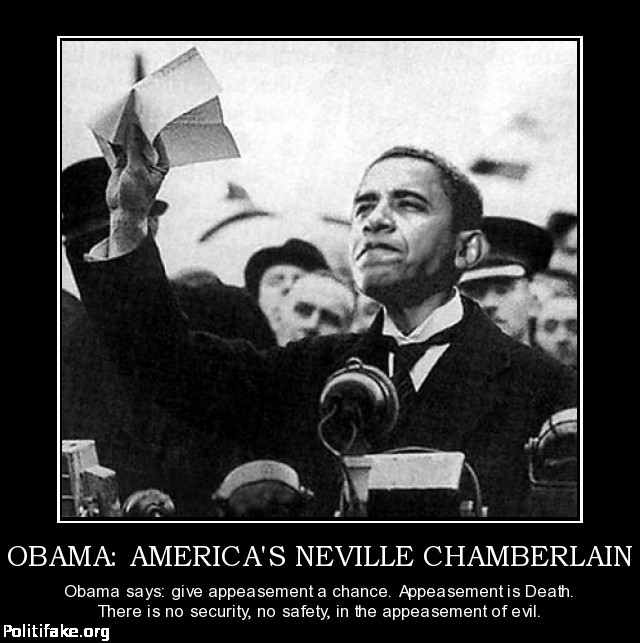
Neville Chamberlain Obama: peace in our time

We elected a stupid man who doesn’t know how the world works. Although you would never know it from the mainstream media, Obama’s 8-year reign of error has been one foreign policy blunder after another. The retreat from Iraq, which created ISIS. The non-response to Russian aggression in Georgia and Ukraine. The disastrous interventions in Libya and Egypt. The deal to give Iran piles of cash to develop nuclear weapons. And his failure to react quickly to the Syrian crisis. Across the world it has been one failure after another, for 8 years in a row.

Here is the latest news from the far-left Washington Post:

THE BATTLE for Aleppo is ending in catastrophe, both for the tens of thousands of people who have been besieged there and for the future of Syria. On Wednesday, Syrian government and Iranian-led Shiite militia forces renewed attacks on the last rebel-held streets of the city, shredding a promiseto allow a peaceful evacuation. According to the United Nations, the pro-government forces have been executing civilians in the street or in their homes — including, on Monday, at least 11 women and 13 children. Thousands of men have been rounded up and gang-pressed into the Syrian army, or dispatched to an unknown but likely terrible fate. The United Nations’ term for this nightmare was apt: “A complete meltdown of humanity.”

The meltdown has several dimensions. One is the utter disrespect for the laws of war by the regime of Bashar al-Assad and its Russian and Iranian allies. These forces systematically destroyed hospitals, including pediatric facilities; decimated civilian housing with bunker-buster bombs and chlorine gas; and refused to allow food or humanitarian aid of any kind into the besieged districts of the city. Aleppo represents “the death of respect for international law and the rules of war,” David Miliband, the former British foreign secretary who now heads the International Rescue Committee, was quoted as saying . It sets a horrific precedent for conflicts in the 21st century.

The fall of Aleppo also means the elimination of any prospect in the foreseeable future for the end of Syria’s war or the waves of refugees and international terrorism it is generating.

Who is to blame for this?

The far-left Washington Post says it’s Obama’s fault:

Above all, Aleppo represents a meltdown of the West’s moral and political will — and in particular, a collapse of U.S. leadership. By refusing to intervene against the Assad regime’s atrocities, or even to enforce the “red line” he declared on the use of chemical weapons, President Obama created a vacuum that was filled by Vladimir Putin and Iran’s Revolutionary Guard. As recently as October, Mr. Obama set aside options drawn up by his advisers to save Aleppo. Instead, he supported the delusional diplomacy of Secretary of State John F. Kerry, whose endless appeals to Moscow for cease-fires yielded — as Mr. Putin no doubt intended — nothing more than a humiliating display of American weakness.

And it’s not just the Washington Post.

Is Barack Obama focused on protecting the American people?

The far-left extremist UK Guardian, one of the most radically secular and progressive newspapers on the planet, featured an article by a far-left writer entitled “Barack Obama’s presidency will be defined by his failure to face down Assad“.

Excerpt:

In an interview with Jeffrey Goldberg of the Atlantic magazine earlier this year, President Obama said he was “very proud” of the moment in 2013 when, against the “overwhelming weight of conventional wisdom”, he decided not to honour his own “red line”, allowing Assad to escape accountability for a chemical attack that had killed more than 1,400 civilians.

Obama may be alone in this judgment. A year earlier, seemingly on a whim, he had set a red line on the use of chemical weapons at a time when none were being used. The red line was, in effect, a green light to conventional killing. But the regime called Obama’s bluff – and, predictably, he backed down. No longer fearing punishment, the regime escalated its tactics.

Nearly four times as many people were killed in the two years after the chemical attack as had died in the two years before. Obama’s abandonment discredited Syria’s nationalist opposition and empowered the Islamists. It helped Isis emerge from the shadows to establish itself as a major force. Together, these developments triggered a mass exodus that would displace over half the country’s population.

Everyone knows that the Obama administration bent over and bowed to the Russians and the Iranians from day one, with the “Russian reset” and the Iran nuclear weapons deal. Obama treated enemies like friends, and now we are seeing the consequences of his moral relativism and anti-American pacificism.

This part of the Guardian article is my favorite, because it really shows the fundamental problem – namely, that there is a complete disconnect between Obama’s high opinion of his own ability and the actual consequences of his policies in objective reality:

But in his valedictory press conference, last Friday, Obama defended his policy on Syria – albeit with logic whose fractures even his eloquence could not conceal. Inverting cause and consequence, he cited Russian and Iranian presence in Syria as his reason for not confronting Assad (neither was there in August 2013); he cited the disunion among rebels as the reason for not supporting them (they fragmented because they were denied meaningful support); and he cited the fear of deeper American involvement as his justification for restraint (even though a year later it would lead to a far bigger deployment across two states).

He really is in his own little world, where everything he does works fabulously well, because of his superhuman intellect. The man belongs in an insane asylum – never has someone so unqualified and incompetent had a higher opinion of himself, despite manifest failure that even the far left UK Guardian can see plainly. The American people elected an unstable clown who makes decisions based on delusions instead of evidence. And instead of correcting himself when his failures are known,  he persists in his delusions, casting the blame on everyone but himself. As if a narcissistic clown with no education and no resume ought to expect to be successful, and if he is not, then other people must be to blame.