All posts by Wintery Knight

https://winteryknight.com/

The psychological motivation of those who embrace postmodernism

Can a person be postmodern and a Christian? Not for long

Famous analytical philosopher John Searle has written a book “Mind, Language And Society: Philosophy In The Real World”, explaining what’s factually wrong with postmodernism. In the introduction, he explains what postmodernism is, and what motivates people to accept postmodernism.

He writes:

[…][W]hen we act or think or talk in the following sorts of ways we take a lot for granted: when we hammer a nail, or order a takeout meal from a restaurant, or conduct a lab experiment, or wonder where to go on vacation, we take the following for granted: there exists a real world that is totally independent of human beings and of what they think or say about it, and statements about objects and states of affairs in that world are true or false depending on whether things in the world really are the way we say they are. So, for example, if in pondering my vacation plans I wonder whether Greece is hotter in the summer than Italy, I simply take it for granted that there exists a real world containing places like Greece and Italy and that they have various temperatures. Furthermore, if I read in a travel book that the average summer temperature in Greece is hotter than in Italy, I know that what the book says will be true if and only if it really is hotter on average in the summer in Greece than in Italy. This is because I take it for granted that such statements are true only if there is something independent of the statement in virtue of which, or because of which, it is true.

[…]These two Background presuppositions have long histories and various famous names. The first, that there is a real world existing independently of us, I like to call “external realism.” “Realism,” because it asserts the existence of the real world, and “external” to distinguish it from other sorts of realism-for example, realism about mathematical objects (mathematical realism) or realism about ethical facts (ethical realism). The second view, that a statement is true if things in the world are the way the statement says they are, and false otherwise, is called “the correspondence theory of truth.” This theory comes in a lot of different versions, but the basic idea is that statements are true if they correspond to, or describe, or fit, how things really are in the world, and false if they do not.

The “correspondence theory of truth” is the view of truth assumed in books of the Bible whose genre is such that that they were intended by the authors to be taken literally, (with allowances for symbolism, figures of speech, metaphors, hyperbole, etc.).

But what about the postmodernists, who seek to deny the objectivity of external reality?

More Searle:

Thinkers who wish to deny the correspondence theory of truth or the referential theory of thought and language typically find it embarrassing to have to concede external realism. Often they would rather not talk about it at all, or they have some more or less subtle reason for rejecting it. In fact, very few thinkers come right out and say that there is no such thing as a real world existing absolutely, objectively, and totally independently of us. Some do. Some come right out and say that the so-called real world is a “social construct.”

What is behind the denial of objective reality, and statements about external reality that are warranted by evidence?

It is not easy to get a fix on what drives contemporary antirealism, but if we had to pick out a thread that runs through the wide variety of arguments, it would be what is sometimes called “perspectivism.” Perspectivism is the idea that our knowledge of reality is never “unmediated,” that it is always mediated by a point of view, by a particular set of predilections, or, worse yet by sinister political motives, such as an allegiance to a political group or ideology. And because we can never have unmediated knowledge of the world, then perhaps there is no real world, or perhaps it is useless to even talk about it, or perhaps it is not even interesting.

Searle is going to refute anti-realism in the rest of the book, but here is his guess at what is motivating the anti-realists:

I have to confess, however, that I think there is a much deeper reason for the persistent appeal of all forms of antirealism, and this has become obvious in the twentieth century: it satisfies a basic urge to power. It just seems too disgusting, somehow, that we should have to be at the mercy of the “real world.” It seems too awful that our representations should have to be answerable to anything but us. This is why people who hold contemporary versions of antirealism and reject the correspondence theory of truth typically sneer at the opposing view. 

[…]I don’t think it is the argument that is actually driving the impulse to deny realism. I think that as a matter of contemporary cultural and intellectual history, the attacks on realism are not driven by arguments, because the arguments are more or less obviously feeble, for reasons I will explain in detail in a moment. Rather, as I suggested earlier, the motivation for denying realism is a kind of will to power, and it manifests itself in a number of ways. In universities, most notably in various humanities disciplines, it is assumed that, if there is no real world, then science is on the same footing as the humanities. They both deal with social constructs, not with independent realities. From this assumption, forms of postmodernism, deconstruction, and so on, are easily developed, having been completely turned loose from the tiresome moorings and constraints of having to confront the real world. If the real world is just an invention-a social construct designed to oppress the marginalized elements of society-then let’s get rid of the real world and construct the world we want. That, I think, is the real driving psychological force behind antirealism at the end of the twentieth century.

Now, I’ll go one step further than Searle.

People, from the Fall, have had the desire to step into the place of God. It’s true that we creatures exist in a universe created and designed by God. But, there is a way to work around the fact that God made the universe and the laws that the universe runs on, including logic, mathematics and natural laws. And that way is to deny logic, mathematics and natural laws. Postmodernists simply deny that there is any way to construct rational arguments and support the premises with evidence from the real world. That way, they imagine, they are free to escape a God-designed world, including a God-designed specification for how they ought to live. The postmoderns deny the reliable methods of knowing about the God-created reality because logic and evidence can be used to point to God’s existence, God’s character, and God’s actions in history.

And that’s why there is this effort to make reality “optional” and perspectival. Everyone can be their own God, and escape any accountability to the real God – the God who is easily discovered through the use of logic and evidence. I believe that this is also behind the rise of atheists, who feign allegiance to logic and science, but then express “skepticism” about the origin of the universe, the fine-tuning of the universe, objective morality, the minimal facts concerning the historical Jesus, and other undeniables.
Can a person be postmodern and a Christian at the same time?

Can a person be postmodern and a Christian? Not for long
Can a person be postmodern and a Christian? Let’s look at their leader

Wow. Postmodern “Christian” Brian McLaren has completely abandoned traditional Christianity. McLaren, you may already know, spear-headed the “emergent church” movement – an attempt to fuse postmodern relativism with liberal Christianity.

Greg Koukl and Kevin DeYoung analyze his latest book “A New Kind of Christianity”.

The MP3 file is here.

Details:

Kevin DeYoung – Brian McLaren’s New Kind of Christianity
Host: Greg Koukl

Guest: Kevin DeYoung – Brian McLaren’s “New Kind of Christianity” (00:00:00)
Commentary: Reality vs. Religion? The Modern Upper Story Leap (00:56:39)
Guest: Dennis Prager – Reality vs. Religion (01:52:25)

We’re interested in the first hour of the three-hour show.

Topics of hour one:

  • What is Brian’s view of Creation?
  • What is Brian’s view of the Fall?
  • What is Brian’s view of Scripture?
  • What is Brian’s view of Truth?
  • What is Brian’s view of sin and Hell?
  • What is Brian’s view of the Fall?
  • What is Brian’s view of atonement?
  • How did Brian’s leftist political views infect his theology?
  • How did postmodernism affect Brian’s epistemology?
  • How faithful is Brian in interpreting the text?

There’s also a nice blog post about Brian McLaren by Melinda from Stand to Reason, too.

Excerpt:

McLaren doesn’t think the Bible is to be taken literally. For instance, the Garden of Eden story isn’t about sin and the Fall, rather it’s a “compassionate coming of age story.”  Consequently, the whole idea of sin and Hell is a horrible overreaction and has caused the church to offer a violent message and image all these years.  It follows from this interpretation then, that there is no need for the cross and Jesus’ death and resurrection.  Those are violent ideas resulting from a bad reading of the Bible.

And a couple of longer reviews are linked.

Tim Challies and Kevin DeYoung have written excellent and more in-depth reviews of McLaren’s new book and I highly recommend them.

I highly recommend you listen to this podcast and if you know anyone who is being influenced by the (non) religious left, take a look at the articles, especially the DeYoung article, which is quite good.

A generous “orthodoxy”?

And finally, here is a review of another much earlier Brian McLaren book by Biola University professor of philosophy Doug Geivett – one of my absolute favorite people. This is back when McLaren was just starting to leave orthodox Christianity behind.

Excerpt:

Brian McLaren’s book A Generous Orthodoxy (Zondervan, 2004) has been called a manifesto of the “emerging church” — a movement that is rethinking Christianity against the backdrop of postmodernism. McLaren is the founding pastor of Cedar Ridge Community Church in Spencerville, Md.

[…]In using the term “orthodoxy” for his position, McLaren is making a political move to subvert traditional evangelical theology. “Orthodoxy,” as he uses it, is whatever happens to be in vogue and culturally dominant. Also, an important theme among postmodernists has to do with the nature of belief — they doubt that people have, or need, good reasons to believe as they do, so they emphasize behavior over belief. (This probably explains why McLaren’s book relies less on evidence and argumentation and more on rhetoric.) However, in de-emphasizing the importance of belief, McLaren and other postmodernists overlook three things.

First, belief is the engine that drives behavior. The best way to cure wrong action is to identify false beliefs. Second, all people — even postmodernists — have definite beliefs about the things that matter most. They can’t help it. While McLaren resists the invitation to state clearly what he believes — for example, about the eternal destiny of nonbelievers — surely he has some view of the matter and that view influences his approach to the proclamation of the gospel. (As a pastor, he should have good ideas about this and a host of other issues of theological significance.) Third — though postmodernists sneer at the idea of evidence — evidence matters because it’s how we determine what’s true and is crucial to ordering our lives according to truth. In this respect, the postmodernist is out of step with the culture because human beings are by nature evidence-gatherers.

Very important to understand where these postmodern “Christians” are coming from, and where they end up when they’ve worked their mystical anti-realism through to its conclusions.

Is apologetics a waste of time in a postmodern culture?


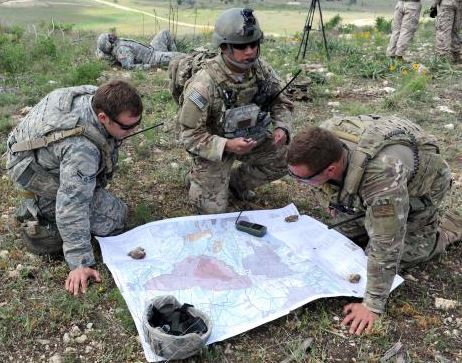
Air Force TACPs confirm target locations with their map

One thing that I noticed while growing up in youth groups and campus clubs is that most of the young unmarried ladies don’t have much interest in making a case for Christian truth claims that are reasonable and supported by evidence. Is it that they are just too lazy to do the studying? Well, no – they do very well in school and get decent jobs after they graduate. So they are able to learn and work on things they like, just not defending their faith. Is it that aren’t able to communicate? Well, no – they are able to talk and talk about things they are interested in, like clothes, television, movies, food, fitness, etc. So what’s the real problem here? I think the problem is that women (more than men) have accepted a postmodern worldview. Postmodernism reduces questions of religion and ethics to personal preferences, divorced from reason and evidence. In postmodernism, everyone is equally right about whichever religion or morality they prefer. And you choose what you like – what resonates with you. For postmodern “Christians”, it causes them to lose all motivation to study and engage in debate in areas like religion and ethics.

Look at this clip of William Lane Craig:

He’s also written a response here.

Personally, I don’t even see how you can BE a Christian and accept postmodernism.

When I was an undergraduate, there was a girl I attended IVCF with named Kerry. Although she was doing a STEM degree and graduated #2 in her class, she just preferred not to study anything related to the real questions that atheists ask. Why not? Because some male youth pastor she had a crush on had convinced her that postmodernism was true, and that it was a waste of time to argue about cosmic fine-tuning. She was more than happy to discover that (thanks to postmodernism) religion was all about feelings and intuitions. No need to waste time reading anything to learn how to give an answer for the hope within you. I would repeat to her verbatim questions I had got from atheists students in high school and university, and she just refused to do anything to come up with an answer. For her, Christianity was about feeling good and being liked, and God would never ask her to do anything (study, debate) that would cause her to be unhappy.

Another woman I worked for told me that she had enough trouble in her day-to-day life to take on any trouble in her religion. She was a leader in a program called the “Calvinettes” – girls interested in Calvinism, I guess. I asked her if she was teaching these Calvinettes anything that would help them when they were confronted by relativism and naturalism in the university. She said no, and that studying science and history was not desired by her Calvinettes, because people who study are nerdy and unpopular. Although she claimed to be in a two-way relationship with God, she never saw any responsibility to defend his honor when it was called into question.

I guess I have trouble understanding postmoderns who It would be like me marrying, and standing there silent when people spoke lies about my wife. Sharing my opinion is not what is needed here, you have to defend your wife and prove her goodness by making a factual case that overrides the other person’s opinions.

One thing is for sure: postmodern Christians don’t treat God very well. It’s almost as if embracing postmdodernism is done precisely because it relieves a person of having to do any studying and having to do any battling. When it comes to defending God’s reputation and honor when it’s called into question, we have to do what works. Not what makes us feel good. Not what makes people like us.