

All posts by Wintery Knight

https://winteryknight.com/

How the presence and quality of fathers affects belief in God

Does government provide incentives for people to get married?
A father in the home helps children to reconcile love and moral boundaries

Here’s an article by Paul Copan which points out how father presence/absence and father quality affects belief and disbelief in God.

Excerpt:

Seventh, the attempt to psychologize believers applies more readily to the hardened atheist.It is interesting that while atheists and skeptics often psychoanalyze the religious believer, they regularly fail to psychoanalyze their ownrejection of God. Why are believers subject to such scrutiny and not atheists? Remember another feature of Freud’s psychoanalysis — namely, an underlying resentment that desires to kill the father figure.

Why presume atheism is the rational, psychologically sound, and default position while theism is somehow psychologically deficient? New York University psychology professor Paul Vitz turns the tables on such thinking. He essentially says, “Let’s look into the lives of leading atheists and skeptics in the past. What do they have in common?” The result is interesting: virtually all of these leading figures lacked a positive fatherly role model — or had no father at all.11

Let’s look at some of them.

  • Voltaire(1694–1778): This biting critic of religion, though not an atheist, strongly rejected his father and rejected his birth name of François-Marie Arouet.
  • David Hume(1711–76): The father of this Scottish skeptic died when Hume was only 2 years old. Hume’s biographers mention no relatives or family friends who could have served as father figures.
  • Baron d’Holbach(1723–89): This French atheist became an orphan at age 13 and lived with his uncle.
  • Ludwig Feuerbach (1804–72): At age 13, his father left his family and took up living with another woman in a different town.
  • Karl Marx(1818–83): Marx’s father, a Jew, converted to being a Lutheran under pressure — not out of any religious conviction. Marx, therefore, did not respect his father.
  • Friedrich Nietzsche(1844–1900): He was 4 when he lost his father.
  • Sigmund Freud(1856–1939): His father, Jacob, was a great disappointment to him; his father was passive and weak. Freud also mentioned that his father was a sexual pervert and that his children suffered for it.
  • Bertrand Russell(1872–1970): His father died when he was 4.
  • Albert Camus(1913–60): His father died when he was 1 year old, and in his autobiographical novel The First Man, his father is the central figure preoccupation of his work.
  • Jean-Paul Sartre(1905–80): The famous existentialist’s father died before he was born.12
  • Madeleine Murray-O’Hair (1919–95): She hated her father and even tried to kill him with a butcher knife.
  • We could throw in a few more prominent contemporary atheists not mentioned by Vitz with similar childhood challenges:
  • Daniel Dennett (1942–): His father died when he was 5 years of age and had little influence on Dennett.13
  • Christopher Hitchens (1949–): His father (“the Commander”) was a good man, according to Hitchens, but he and Hitchens “didn’t hold much converse.” Once having “a respectful distance,” their relationship took on a “definite coolness” with an “occasional thaw.” Hitchens adds: “I am rather barren of paternal recollections.”14
  • Richard Dawkins (1941–): Though encouraged by his parents to study science, he mentions being molested as a child — no insignificant event, though Dawkins dismisses it as merely embarrassing.15

Moreover, Vitz’s study notes how many prominent theists in the past — such as Blaise Pascal, G.K. Chesterton, Karl Barth, and Dietrich Bonhoeffer — have had in common a loving, caring father in their lives.16

Not only is there that anecdotal evidence, but there is also statistical evidence.

Excerpt:

In 1994 the Swiss carried out an extra survey that the researchers for our masters in Europe (I write from England) were happy to record. The question was asked to determine whether a person’s religion carried through to the next generation, and if so, why, or if not, why not. The result is dynamite. There is one critical factor. It is overwhelming, and it is this: It is the religious practice of the father of the family that, above all, determines the future attendance at or absence from church of the children.

If both father and mother attend regularly, 33 percent of their children will end up as regular churchgoers, and 41 percent will end up attending irregularly. Only a quarter of their children will end up not practicing at all. If the father is irregular and mother regular, only 3 percent of the children will subsequently become regulars themselves, while a further 59 percent will become irregulars. Thirty-eight percent will be lost.

If the father is non-practicing and mother regular, only 2 percent of children will become regular worshippers, and 37 percent will attend irregularly. Over 60 percent of their children will be lost completely to the church.

Let us look at the figures the other way round. What happens if the father is regular but the mother irregular or non-practicing? Extraordinarily, the percentage of children becoming regular goesupfrom 33 percent to 38 percent with the irregular mother and to 44 percent with the non-practicing, as if loyalty to father’s commitment grows in proportion to mother’s laxity, indifference, or hostility.

[…]In short, if a father does not go to church, no matter how faithful his wife’s devotions, only one child in 50 will become a regular worshipper. If a father does go regularly, regardless of the practice of the mother, between two-thirds and three-quarters of their children will become churchgoers (regular and irregular). If a father goes but irregularly to church, regardless of his wife’s devotion, between a half and two-thirds of their offspring will find themselves coming to church regularly or occasionally.

A non-practicing mother with a regular father will see a minimum of two-thirds of her children ending up at church. In contrast, a non-practicing father with a regular mother will see two-thirds of his children never darken the church door. If his wife is similarly negligent that figure rises to 80 percent!

The results are shocking, but they should not be surprising. They are about as politically incorrect as it is possible to be; but they simply confirm what psychologists, criminologists, educationalists, and traditional Christians know. You cannot buck the biology of the created order. Father’s influence, from the determination of a child’s sex by the implantation of his seed to the funerary rites surrounding his passing, is out of all proportion to his allotted, and severely diminished role, in Western liberal society.

Basically, anyone who doesn’t have a benevolent, involved father is going to have an more difficult time believing that moral boundaries set by an authority are for the benefit of the person who is being bounded. The best way to make moral boundaries stick is to see that they apply to the person making the boundaries as well – and that these moral boundaries are rational, evidentially-grounded and not arbitrary. It is therefore very important to children to be shepherded by a man who studied moral issues (including evidence from outside the Bible) in order to know how to be persuasive to others. If you want your child to be religious and moral, you have to pick a man who is religious and moral. And it can’t just be a faith commitment that he makes, he can just lie about that. Women ought to check whether men are bound to what they believe by checking what they’ve read. A man usually acts consistently with what he believes, and beliefs only get formed when a man informs himself through things like reading.

My advice to Christian women is this. When you are picking a man, be sure and choose one who is already invested in Christian things and producing results. It’s very unlikely that he’s going to start from nothing after you marry him. If you value your kids, make a man’s interest in developing and acting on a Christian worldview the main thing you are looking for.

How good is Alexander Vilenkin’s no-God explanation for the origin of the universe?

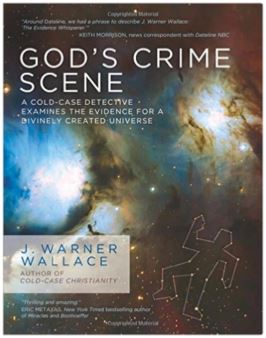
God's Crime Scene: A Cold-Case Detective Examines the Evidence for a Divinely Created Universe
God’s Crime Scene: A Cold-Case Detective Examines the Evidence for a Divinely Created Universe

I’ve been spending some time going over J. Warner Wallace’s splendid book “God’s Crime Scene” with a friend of mine over Skype. Last week we did chapter 1 on the origin of the universe. We were both struck at Wallace’s statement about Alexander Vilenkin, a non-theist who thinks that the universe had a beginning out of nothing.

Wallace writes:

If you’re a bit confused by all the alternatives offered by those who deny the universe had a beginning, perhaps it’s time to call an expert witness. In this case, there’s no one better than Alexander Vilenkin, theoretical physicist, cosmologist, professor of physics, and director of the Institute of Cosmology at Tufts University. Partnering with mathematician Arvind Borde, cosmologist Alan Guth, and graduate researcher Audrey Mithani, Vilenkin has written several papers demonstrating demonstrating any model of the universe in which expansion is occurring, regardless of the early conditions of the cosmos, must have a beginning.[8] Vilenkin’s work addresses all the models we’ve already described, plus any future proposals in which the expansion of the universe is acknowledged. [9]Vilenkin is a critical expert witness because he simplifies and makes sense of the diverse, sometimes-confusing scientific data.’

This week, my friend asked me why Vilenkin was still not ready to become a theist. Well, Dr. William Lane Craig got asked that same question in his question of the week, and his answer was interesting.

Vilenkin’s view affirms the nothing that precedes the universe:

Modern physics can describe the emergence of the universe as a physical process that does not require a cause. Nothing can be created from nothing, says Lucretius, if only because the conservation of energy makes it impossible to create nothing [sic; something?] from nothing. . . .

There is a loophole in this reasoning. The energy of the gravitational field is negative; it is conceivable that this negative energy could compensate for the positive energy of matter, making the total energy of the cosmos equal to zero. In fact, this is precisely what happens in a closed universe, in which the space closes on itself, like the surface of a sphere. It follows from the laws of general relativity that the total energy of such a universe is necessarily equal to zero. . . .

If all the conserved numbers of a closed universe are equal to zero, then there is nothing to prevent such a universe from being spontaneously created out of nothing. And according to quantum mechanics, any process which is not strictly forbidden by the conservation laws will happen with some probability. . . .

What causes the universe to pop out of nothing? No cause is needed.[1]

Dr. Craig replies at length, here is the part I liked best:

Finally, Vilenkin’s inference that because the positive and negative energy in the universe sum to zero, therefore no cause of the universe’s coming into being is needed is hard to take seriously. This is like saying that if your debts balance your assets, then your net worth is zero, and so there is no cause of your financial situation! (Vilenkin would, I hope, not agree with Peter Atkins that because the positive and negative energy of the universe sum to zero, therefore nothing exists now, and so “Nothing did indeed come from nothing.”[2] For as Descartes taught us, I, at least, undeniably exist, and so something exists.) Christopher Isham, Britain’s premier quantum cosmologist, rightly points out that there still needs to be “ontic seeding” to create the positive and negative energy in the first place, even if on balance its sum is naught.[3]

Vilenkin’s interaction with the kalam cosmological argument is, as I say, fascinating because we see here so clearly how philosophical faux pas, not scientific mistakes, invalidate the objections of an eminent scientist to the argument. This should be an object lesson to all those who, like Stephen Hawking or Lawrence Krauss, naïvely think that philosophy is a sterile and irrelevant discipline compared to science. Philosophy can help all of us, including scientists, to avoid the logical mistakes and conceptual confusions that are all too prevalent in discussions taking place on the borderland of physics, metaphysics, and theology.

That’s a very simple refutation of a famous scientist’s speculative cosmology that anyone can understand. Christians are on very good ground when it comes to the science of origins.

You would think that more Christians would be aware of this evidence and the difficulties that naturalists have in accounting for the origin of the universe in their worldview. But, for some reason, it’s not a real hot topic in most churches. Nor is the fine-tuning or the origin of life or the Cambrian explosion. It’s really strange! If you haven’t yet picked up Wallace’s book, I highly recommend it. It’s the best book for blue collar workers who like evidence. The book touches on virtually every piece of evidence relevant to the God question, including some I had never seen before.

Positive arguments for Christian theism

Are evangelism and human responsibility for sin rational in Calvinism?

Bible study that hits the spot

Here is a quote from Dr. Craig that seems to get Calvinists so angry:

“The counterfactuals of creaturely freedom which confront Him are outside His control. He has to play with the hand He has been dealt.”

(Source)

Calvinists have told me that this quotation from Dr. Craig is “heretical” or “borderline heretical”. They are claiming that Dr. Craig thinks that God is lacking in power somehow. But why is God’s power limited, according to this quote?

Well, it’s because God respects FREE WILL. That quote is simply Dr. Craig’s way of saying that God does not override the free will of his creatures.

So let’s make sense of Craig’s statement. Either there is determinism and God causes people to act, or humans have free will and they cause themselves to do things. If you do not cause yourself to act, then you are not responsible for what you do. Just think for a minute. If I push you into someone and you fall into them and then they fall off a cliff, then are you a murderer? No – I would be, because I am the cause. The Bible teaches that God has chosen to limit his power so that that people have genuine responsibility for their actions, and that means they have genuine free will. Humans can only be responsible for their sins if they have the ability to do other than they do, and this is the traditional Christian view.

It’s true that human beings are totally depraved as a result of the fall, and do not want God in their lives, but they are responsible because God wants them to be saved, and it is their free choice that prevents it. Rather than force humans to love him against their will, God lets them resist him, and so they are responsible for their sin.

Dr. Craig cites the famous Calvinist D. A. Carson (who I like) explaining some of the themes of the Bible that affirm robust free will and human responsibility:

The classical Reformed [scholars]… acknowledge that the reconciliation of Scriptural texts affirming human freedom and contingency with Scriptural texts affirming divine sovereignty is inscrutable. D. A. Carson identifies nine streams of texts affirming human freedom: (1) People face a multitude of divine exhortations and commands, (2) people are said to obey, believe, and choose God, (3) people sin and rebel against God, (4) people’s sins are judged by God, (5) people are tested by God, (6) people receive divine rewards, (7) the elect are responsible to respond to God’s initiative, (8) prayers are not mere showpieces scripted by God, and (9) God literally pleads with sinners to repent and be saved (Divine Sovereignty and Human Responsibility: Biblical Perspectives in Tension, pp. 18-22). These passages rule out a deterministic understanding of divine providence, which would preclude human freedom.

On Calvinism, however, all of these 9 features of reality, supported by dozens and dozens of Bible passages, are all false. On Calvinism, God is the sole causal agent. There is no free will. People go to Heaven or Hell as a choice of God. People can only perform good actions if God acts unilaterally to “regenerate” them, making obedience to God possible. Calvinism teaches that God and his agents are constantly exhorting and commanding things that they literally cannot do because they are unregenerate, and the only way to get regenerate is for God to regenerate them, against their will. And they can’t resist that.

So let’s make sense of D.A. Carson’s list of 9 items:

  1. On Calvinism, when God or his agents exhort or command people to perform good actions, it’s meaningless because God has to unilaterally regenerate them first, so that they can perform the good actions.
  2. On Calvinism, when God or his agents tell people to obey, believe and choose God, it’s meaningless because God has to unilaterally regenerate them first, so they can obey, believe and choose God.
  3. On Calvinism, when people sin and rebel against God, it’s like people are soda cans that God shakes up some of them, and then pops the tabs on all of them and the ones he shook up fizz.
  4. On Calvinism, when God judges people for sinning, it’s like God sends the cans who don’t fizz to Hell for eternity, even though he unilaterally chose not to shake them, which is the only way they could fizz.
  5. On Calvinism, when God tests people, it’s meaningless, because there is no way they can pass the tests unless God unilaterally regenerates them first, so they can pass the test.
  6. On Calvinism, when people receive divine rewards, it’s meaningless, because all the credit goes to God for regenerating them. They are just fizzing because God shook their can of soda.
  7. On Calvinism, when people respond to God’s initiative, it’s meaningless, because God’s regeneration is irresistible and irrevocable. They can do nothing other than fizz when he shakes the can.
  8. On Calvinism, when people pray, it’s meaningless, because God unilaterally decides whether to regenerate people or not, and all their fizzing comes solely from his decision to shake or not shake the can.
  9. On Calvinism, when God pleads with sinners to repent and be saved, it’s meaningless, because God has to unilaterally regenerate them before they can repent, and then that repentance cannot be resisted at any time after.

Here’s William Lane Craig to explain it further in an answer to a question of the week from Dr. Craig’s Reasonable Faith web site.

5 problems:

  1. Universal, divine, causal determinism cannot offer a coherent interpretation of Scripture.
  2. Universal causal determinism cannot be rationally affirmed.
  3. Universal, divine, determinism makes God the author of sin and precludes human responsibility.
  4. Universal, divine, determinism nullifies human agency.
  5. Universal, divine determinism makes reality into a farce.

If God’s choice, to regenerate or not, causally determines whether we can respond to him, or not, then that is determinism. And it makes our lives meaningless because we are not responsible for anything we do. Life is a puppet show, and there is only one person pulling the strings. Evangelism makes no sense, because God decides unilaterally and irrevocably who is saved. When I explain this to Calvinists, their response is that God commands us to evangelize, so we must even if it makes no sense on their view.

A Calvinist might respond to this defense of free will and human responsibility with passages from Romans 8 and 9, but those are best understood as speaking about corporate election, rather than unilaterally-determined selection. Membership in the elect group is based on people responding to God’s drawing of them to him. That interpretation fits with the rest of the Bible, which is uniformly affirmative of human free will and human responsibility. Concerns about diminished divine sovereignty are resolved by middle knowledge, in which God chooses to actualize exactly the world that achieves his sovereign will out of all the possible worlds, and he saves exactly the people he chooses to save – but without violating their free will. Yes, it’s cosmic entrapment, but at least the cosmic entrapment does not violate the free will of the creatures, which would render then irresponsible for their own sins.

Disclaimer: I don’t think that this is an issue that should divide Christians, and I do think that Calvinists are most definitely Christians. And that they are very devout and intelligent Christians, too. I think they just have a presupposition of theological determinism that colors the way they read the Bible, resulting in an unBiblical anthropology. This often leads them to a Mormon epistemology (“the Bible is true because I feel that it’s true”) and magic words evangelism (“the correct way to evangelize is not to use evidence but to invite unbelievers to presuppose the truth of the Bible because it causes them to have all the feels”).

If you are looking for a good book on this issue, I recommend Kenneth Keathley’s “Salvation and Sovereignty“, which is a thorough discussion of the problem of divine sovereignty and human freedom.