All posts by Wintery Knight

https://winteryknight.com/

New study: marijuana triples risk of high blood pressure

Investigation in progress

I actually have two studies for this post, both reported by far-left news sources, oddly enough.

First one is from the radical leftist Reuters.

Excerpt:

People who smoke marijuana have a three times greater risk of dying from hypertension, or high blood pressure, than those who have never used the drug, scientists said on Wednesday.

The risk grows with every year of use, they said.

The findings, from a study of some 1,200 people, could have implications in the United States among other countries. Several states have legalized marijuana and others are moving toward it. It is decriminalized in a number of other countries.

[…]The study, published in the European Journal of Preventive Cardiology, was a retrospective follow-up study of 1,213 people aged 20 or above who had been involved in a large and ongoing National Health and Nutrition Examination Survey. In 2005–2006, they were asked if they had ever used marijuana.

For Yankey’s study, information on marijuana use was merged with mortality data in 2011 from the U.S. National Center for Health Statistics, and adjusted for confounding factors such as tobacco smoking and variables including sex, age and ethnicity.

The average duration of use among users of marijuana, or cannabis, was 11.5 years.

The results showed marijuana users had a 3.42-times higher risk of death from hypertension than non-users, and a 1.04 greater risk for each year of use.

There is a problem with that study, though:

Yankey said were limitations in the way marijuana use was assessed — including that researchers could not be sure whether people had used the drug continuously since they first tried it.

Here is a second study reported by the radically-leftist CNN.

Excerpt:

The number of children who were admitted to emergency rooms for unintentional marijuana intoxication increased by 133% in France over an 11-year period, according to a new study.

Marijuana intoxication can occur when a child accidentally ingests a marijuana product or inhales marijuana smoke. Symptoms can vary based on the child’s age and size but often include sleepiness, difficulty breathing, seizures or even coma. Effects usually last six to 24 hours.

Cannabis is illegal in France, but it has the highest rate of marijuana use in Europe, said Dr. Isabelle Claudet, lead author of the study, published Monday in the journal Pediatrics.

“And that means we are facing an increase in emergency admissions of marijuana intoxication and an increase in severe symptoms seen in children,” said Claudet, a pediatric emergency physician in Toulouse.

She and other researchers analyzed the number of French children under 6 admitted to pediatric emergency departments because of unintentional cannabis intoxication and the number of cannabis-related calls involving children to French poison control centers.

From 2004 to 2014, 235 children were admitted to ERs with cannabis intoxication, and there was a 133% increase in the admissions rate for it. The number of calls to poison control centers related to cannabis exposure in children increased by 312% in the same period.

[…]Over the 11-year span, the severity of symptoms in children admitted to emergency departments because of marijuana intoxication also increased.

Twenty times more severe cases were reported in 2014 compared with 2004, and and four times more severe cases were reported in 2014 compared with 2013. Of the 32 children reported to have gone into comas, 53% were admitted in 2014, and there were more cannabis-related admissions than any other type of pediatric emergency room admission.

One of the problems with making drugs legal is that it is known to increase the use of the drugs. And the more available a drug becomes, the more likely it is to fall into the hands of children. Especially at a time like this, where both parents (if there are two parents) usually work. That means no one is at home to supervise.

This week, someone at work had asked me why I was so unwilling to spend money on entertainment. It made me think back to my early years growing up in a poor immigrant household. We simply didn’t have money for things like cigarettes or alcohol or entertainment. Our first TV was a black and white TV, for goodness sake. We were always the last to get the new inventions, like microwaves and computers. I wasn’t interested in alcohol or drugs because I couldn’t afford them. I was too busy trying to make money because my parents had none to give me. Sometimes, I think that American children have TOO MUCH money. If you had to choose between food and drugs, you’d choose food.

Related posts

Utilitarianism and the Moral Life by J. P. Moreland

I have a key that will unlock a puzzling mystery

I found this essay on After All, but it looks like their site is not working well, so I’m just going to steal it and post it here, in case it disappears completely. This is one of my favorite short essays on utilitarianism, and it’s a wonder that the thing can’t stay up somewhere. Well, it will have a home here now. I’d be surprised to see anyone else be this awesome in a measly 1000 words as Dr. Moreland is below.

—-

Utilitarianism and the Moral Life

What Is Utilitarianism?

Utilitarianism (also called consequentialism) is a moral theory developed and refined in the modern world by Jeremy Bentham (1748-1832) and John Stuart Mill (1806-1873). It can be defined as follows:

An action or moral rule is right if and only if it maximizes the amount of nonmoral good produced in the consequences that result from doing that act or following that rule compared with other acts or rules open to the agent.

By focusing on three features of utilitarianism, we can clarify this definition.

(1) Utilitarian theories of value.

What is a nonmoral good? Utilitarians deny that there are any moral actions or rules that are intrinsically right or wrong. But they do believe in objective values that are nonmoral.

Hedonistic utilitarians say that the only intrinsic good is pleasure and the avoidance of pain. Quantitative hedonists (Bentham) say that the amount of pleasure and pain is the only thing that matters in deciding between two courses of action, I should do the one that produces the greatest amount of pleasure and the least amount of pain (measured by factors like the duration and intensity of the pleasure). Qualitative hedonists (Mill) say that pleasure is the only intrinsic good, but the type of pleasure is what is important, not the amount. They would rank pleasures that come from reading, art, and friendship as more valuable than those that come from, say, a full stomach.

Pluralistic utilitarians
say there are a number of things that have intrinsic, nonmoral value: pleasure, friendship, health, knowledge, freedom, peace, security, and so forth. For pluralists, it is not just the pleasure that comes from friendship that has value but also friendship itself.

Currently, the most popular utilitarian view of value is subjective preference utilitarianism. This position says it is presumptuous and impossible to specify things that have intrinsic nonmoral worth. So, they claim, intrinsic value ought to be defined as that which each individual subjectively desires or wants, provided these do not harm others. Unfortunately, this view collapses into moral relativism.

(2) Utilitarians and maximizing utility.

Utilitarians use the term utility to stand for whatever good they are seeking to produce as consequences of a moral action (e.g., “pleasure” for the hedonist, “satisfaction of subjective preference” for others). They see morality in a means-to-ends way. The sole value of a moral action or rule is the utility of its consequences. Moral action should maximize utility. This can be interpreted in different ways, but many utilitarians embrace the following: the correct moral action or rule is the one that produces the greatest amount of utility for the greatest number of people.

(3) Two forms of utilitarianism: act utilitarianism and rule utilitarianism.

According to act utilitarianism, an act is right if and only if no other act available maximizes utility more than the act in question. Here, each new moral situation is evaluated on its own, and moral rules like “don’t steal” or “don’t break promises” are secondary The moral agent must weigh available alternatives and choose the one that produces the best consequences. Rule utilitarianism says that correct moral actions are done in keeping with correct moral rules, However, no moral rule is intrinsically right or wrong. Rather, a correct moral rule is one that would maximize utility if most people followed it as opposed to following an alternative rule. Here, alternative rules (e.g., “don’t lie” vs. “don’t lie unless doing so would enhance friendship”) are compared for their consequences, not specific actions.

What Is Wrong with Utilitarianism?

Several objections show the inadequacy of utilitarianism as a normative moral theory.

First, utilitarianism can be used to justify actions that are clearly immoral. Consider the case of a severely deformed fetus. The child is certain to live a brief, albeit painless life. He or she will make no contribution to society. Society, however, will bear great expense. Doctors and other caregivers will invest time, emotion, and effort in adding mere hours to the baby’s life. The parents will know and love the child only long enough to be heartbroken at the inevitable loss. An abortion negates all those “utility” losses. There is no positive utility lost. Many of the same costs are involved in the care of the terminally ill elderly. They too may suffer no pain, but they may offer no benefit to society. In balancing positives and negatives, and excluding from the equation the objective sacredness of all human life, we arrive at morally repugnant decisions. Here deontological and virtue ethics steer us clear of what is easier to what is right.

Second, in a similar way, utilitarianism denies the existence of supererogatory acts. These are acts of moral heroism that are not morally obligatory but are still praiseworthy. Examples would be giving 75 percent of your income to the poor or throwing yourself on a bomb to save a stranger. Consider the bomb example. You have two choices — throwing yourself on the bomb or not doing so. Each choice would have consequences and, according to utilitarianism, you are morally obligated to do one or the other depending on which option maximized utility. Thus, there is no room for acts that go beyond the call of morality.

Third, utilitarianism has an inadequate view of human rights and human dignity. If enslaving a minority of people, say by a lottery, would produce the greatest good for the greatest number, or if conceiving children only to harvest their parts would do the same, then these could he justified in a utilitarian scheme. But enslavement and abortion violate individual rights and treat people as a means to an end, not as creatures with intrinsic dignity as human beings. If acts of abortion, active euthanasia, physician-assisted suicide, and so forth maximize utility, then they are morally obligatory for the utilitarian. But any moral system that makes abortion and suicide morally obligatory is surely flawed.

Finally, utilitarianism has an inadequate view of motives and character. We should praise good motives and seek good character because such motives and character are intrinsically valuable. But utilitarianism implies that the only reason we should praise good motives instead of bad ones, or seek good character instead of bad character, is because such acts would maximize utility. But this has the cart before the horse. We should praise good motives and blame bad ones because they are good or bad, not because such acts of praising and blaming produce good consequences.

In sum, it should be clear that utilitarianism is an inadequate moral theory. Unfortunately, ours is a pragmatic culture and utilitarianism is on the rise. But for those of us who follow Christ, a combination of virtue and deontological ethics is a more adequate view of common sense morality found in natural law and of the moral vision contained in the Bible.

Harvard University could lose federal funding because of anti-Asian preferences

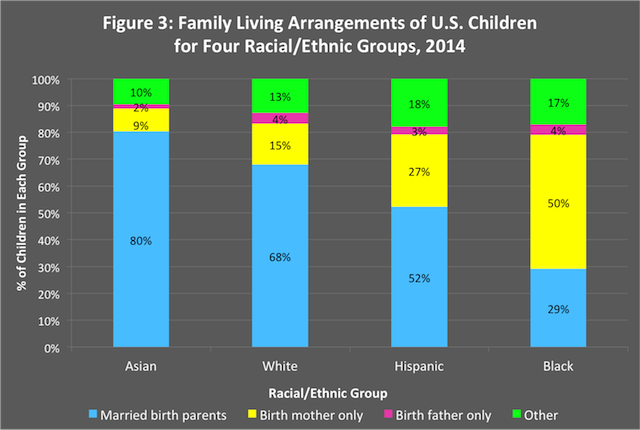
Asians marry before they have children, so the kids have two parents
Asians marry before they have children, so most Asian kids have two parents

I would love to see Harvard University and other left-wing institutions lose taxpayer money over this.

The College Fix reports:

When Harvard University faced a regulatory complaint in 2015 about alleged quotas that held down Asian-American admissions, the Obama administration gave it a pass, citing ongoing litigation on the subject.

Now that the Trump administration is in charge, Harvard is facing a battle over its affirmative action policies on both regulatory and judicial fronts.

Asian-American groups that have long accused Harvard of discrimination are celebrating the regulatory about-face.

“We are happy hearing that and hope for concrete steps taken by the” Justice Department, Chunyan Li, a board member of the Asian American Coalition for Education, told The College Fix in a phone call.

[…]An internal job posting leaked Tuesday said DOJ’s civil rights division is seeking “attorney detailees” who already work in the division to conduct “investigations and possible litigation related to intentional race-based discrimination in college and university admissions.”

The division consists of Trump political appointees, as opposed to the career civil servants who lead DOJ’s Educational Opportunity Section, Circa reported.

This is actually a real problem in left-wing colleges and universities, and there was even a recent study about it that was published in Science, one of the top peer-reviewed journals.

Excerpt:

When it comes to academic achievement, Asian-Americans outclass every other ethnic group, with more than half over age 25 holding a bachelor’s degree—well above the national average of 28%. To find what gives Asian-Americans a leg up, a team of sociologists scoured two long-term surveys covering more than 5000 U.S. Asian and white students. After crunching test scores, GPAs, teacher evaluations, and social factors such as immigration status, the team reports a simple explanation online today in the Proceedings of the National Academy of Sciences: Asian-American students work harder.

The team found that students from all Asian ethnic groups put greater importance on effort than on natural ability. This outlook, the team argues, causes students to respond to challenges by trying harder and has a greater impact on Asian-Americans’ academic achievement than does cognitive ability or socioeconomic status. However, the team says Asian-American students reported lower self-esteem, more conflict with their parents, and less time spent with friends compared with their white peers. The team suspects the high academic expectations or their “outsider” status in American society could be to blame.

Although it’s trendy on the left to say that they are color-blind, the truth is that the left is obsessed with race and racism. In this case, racial discrimination against hard-working Asians. I have no problem with letting in as many Asians as deserve to get admitted, because race shouldn’t be a factor in admissions. The best students should be admitted – the ones who can actually do the work.

If Harvard does lose it’s federal funding for racism, then it would be nice to see all the other colleges that discriminate on race lose their as well. It’s amazing to me that we give so much money to educational institutions anyway, which just drives up the cost of a college education.