
All posts by Wintery Knight

https://winteryknight.com/

What are the historical arguments for the empty tomb narrative?

Investigation in progress

I wanted to go over this article by William Lane Craig which includes a discussion of the empty tomb, along with the other minimal facts that support the resurrection.

The word resurrection means bodily resurrection

The concept of resurrection in use among the first converts to Christianity was a Jewish concept of resurrection. And that concept of resurrection is unequivocally in favor of a bodily resurrection. The body (soma) that went into the grave is the body (soma) that came out.

Craig explains what this means with respect to the fast start of Christian belief:

For a first century Jew the idea that a man might be raised from the dead while his body remained in the tomb was simply a contradiction in terms. In the words of E. E. Ellis, “It is very unlikely that the earliest Palestinian Christians could conceive of any distinction between resurrection and physical, ‘grave emptying’ resurrection. To them an anastasis without an empty grave would have been about as meaningful as a square circle.”

And:

Even if the disciples had believed in the resurrection of Jesus, it is doubtful they would have generated any following. So long as the body was interred in the tomb, a Christian movement founded on belief in the resurrection of the dead man would have been an impossible folly.

It’s significant that the belief in the resurrection started off in the city where the tomb was located. Anyone, such as the Romans or Jewish high priests, who wanted to nip the movement in the bud could easily have produced the body to end it all. They did not do so, because they could not do so, although they had every reason to do so.

There are multiple early, eyewitness sources for the empty tomb

Paul’s early creed from 1 Corinthians 15:3-7, dated to within 5 years of the crucifixion, implies the empty tomb.

Craig writes:

In the formula cited by Paul the expression “he was raised” following the phrase “he was buried” implies the empty tomb. A first century Jew could not think otherwise. As E. L. Bode observes, the notion of the occurrence of a spiritual resurrection while the body remained in the tomb is a peculiarity of modern theology. For the Jews it was the remains of the man in the tomb which were raised; hence, they carefully preserved the bones of the dead in ossuaries until the eschatological resurrection. There can be no doubt that both Paul and the early Christian formula he cites pre-suppose the existence of the empty tomb.

The dating of the resurrection as having occurred “on the third day” implies the empty tomb. The date specified for the resurrection would have been the date that the tomb was discovered to be empty.

The phrase “on the third day” probably points to the discovery of the empty tomb. Very briefly summarized, the point is that since no one actually witnessed the resurrection of Jesus, how did Christians come to date it “on the third day?” The most probable answer is that they did so because this was the day of the discovery of the empty tomb by Jesus’ women followers. Hence, the resurrection itself came to be dated on that day. Thus, in the old Christian formula quoted by Paul we have extremely early evidence for the existence of Jesus’ empty tomb.

A few quotes from atheist historians not from Dr. Craig’s article: (thanks to Eric of Ratio Christi OSU)

Michael Goulder (Atheist NT Prof. at Birmingham) “…it goes back at least to what Paul was taught when he was converted, a couple of years after the crucifixion.” [“The Baseless Fabric of a Vision,” in Gavin D’Costa, editor, Resurrection Reconsidered (Oxford, 1996), 48.]

Gerd Lüdemann (Atheist Prof of NT at Göttingen): “…the elements in the tradition are to be dated to the first two years after the crucifixion of Jesus…not later than three years… the formation of the appearance traditions mentioned in I Cor.15.3-8 falls into the time between 30 and 33 CE.” [The Resurrection of Jesus, trans. by Bowden (Fortress, 1994), 171-72.]

Robert Funk (Non-Christian scholar, founder of the Jesus Seminar): “…The conviction that Jesus had risen from the dead had already taken root by the time Paul was converted about 33 C.E. On the assumption that Jesus died about 30 C.E., the time for development was thus two or three years at most.” [Roy W. Hoover, and the Jesus Seminar, The Acts of Jesus, 466.]

The early pre-Markan burial narrative mentions the empty tomb. This source pre-dates Mark, the earliest gospel. The source has been dated by some scholars to the 40s. For example, the atheist scholar James Crossley dates Mark some time in the 40s. (See the debate below)

The empty tomb story is part of the pre-Markan passion story and is therefore very old. The empty tomb story was probably the end of Mark’s passion source. As Mark is the earliest of our gospels, this source is therefore itself quite old. In fact the commentator R. Pesch contends that it is an incredibly early source. He produces two lines of evidence for this conclusion:

(a) Paul’s account of the Last Supper in 1 Cor. 11:23-5 presupposes the Markan account. Since Paul’s own traditions are themselves very old, the Markan source must be yet older.

(b) The pre-Markan passion story never refers to the high priest by name. It is as when I say “The President is hosting a dinner at the White House” and everyone knows whom I am speaking of because it is the man currently in office. Similarly the pre-Markan passion story refers to the “high priest” as if he were still in power. Since Caiaphas held office from AD 18-37, this means at the latest the pre-Markan source must come from within seven years after Jesus’ death. This source thus goes back to within the first few years of the Jerusalem fellowship and is therefore an ancient and reliable source of historical information.

So we are dealing with very early sources for the empty tomb.

Lack of legendary embellishments

The empty tomb narrative in the gospels lacks legendary embellishments, unlike later 2nd century forgeries that originated outside of Jerusalem.

The eyewitness testimony of the women

This is the evidence that has been the most convincing to skeptics, and to me as well.

The tomb was probably discovered empty by women. To understand this point one has to recall two facts about the role of women in Jewish society.

(a) Woman occupied a low rung on the Jewish social ladder. This is evident in such rabbinic expressions as “Sooner let the words of the law be burnt than delivered to women” and “Happy is he whose children are male, but woe to him whose children are female.”

(b) The testimony of women was regarded as so worthless that they were not even permitted to serve as legal witnesses in a court of law. In light of these facts, how remarkable must it seem that it is women who are the discoverers of Jesus’ empty tomb. Any later legend would certainly have made the male disciples to discover the empty tomb. The fact that women, whose testimony was worthless, rather than men, are the chief witnesses to the empty tomb is most plausibly accounted for by the fact that, like it or not, they were the discoverers of the empty tomb and the gospels accurately record this.

The earliest response from the Jewish high priests assumes the empty tomb

This report from Matthew 28 fulfills the criteria of enemy attestation, although Matthew is not the earliest source we have. Oh, well.

In Matthew 28, we find the Christian attempt to refute the earliest Jewish polemic against the resurrection. That polemic asserted that the disciples stole away the body. The Christians responded to this by reciting the story of the guard at the tomb, and the polemic in turn charged that the guard fell asleep. Now the noteworthy feature of this whole dispute is not the historicity of the guards but rather the presupposition of both parties that the body was missing. The earliest Jewish response to the proclamation of the resurrection was an attempt to explain away the empty tomb. Thus, the evidence of the adversaries of the disciples provides evidence in support of the empty tomb.

Note how careful Craig is not to imply that the guard tradition is historical, because we can’t prove the guard as a “minimal fact”, since it doesn’t pass the standard historical criteria.

See it used in a debate

You can see the arguments made and defended from criticism in this debate with the atheist scholar James Crossley.

This my favorite resurrection debate.
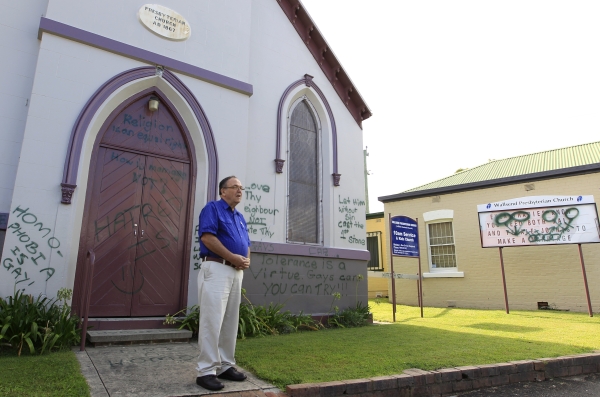
Should people in sinful lifestyles bully churches into celebrating them?

Anti-marriage gay activists vandalize church

This story was the topic of the most recent episode of the Reasonable Faith podcast. Basically, a conservative, apologetics-friendly church had a homosexual person who wanted to be openly gay and still be accepted as a member. After he was told by the church that he could attend the church, but not be a member, he decided to write the mainstream media to shame the church.

Here is the link to Reasonable Faith‘s podcast – and they have a transcript.

I want to first focus on the letter written by the gay man:

Dear Watermark Community Church,

Today I celebrate a very interesting anniversary with you. It was exactly one year ago when you told me that I was no longer worthy to serve, be in a community group, and be a member of your church.

I spent years in your church battling against my homosexuality. I believed with all my heart that God would change me; I prayed for change almost daily. But when I wasn’t able to change, you turned your back on me.

You say our “sin” is not unique, but you treat us in a unique manner; this is unacceptable behavior. We are actual people that have actual feelings.

Here we are a year later and you are still doing to others what you did to me. You are tarnishing the name of God to Christians and non-Christians alike; you should be ashamed of yourselves! Do not forget, Jesus was a angry with people just like you who said certain groups of people were not worthy to be followers of Him.

Thank you for removing yourself from my life! I am who God made me to be. I cannot change my sexual orientation and nor would I want to. I now have internal peace and happiness unlike ever before.

Jason Thomas

As Reasonable Faith notes, this is what he said and this is what the far-left Dallas Morning News reported. It sounds like the church was very mean to him, but is that what really happened?

Here is what the church actually wrote to him:

Dear Jason,

This is a difficult letter to write, as I am sure that it will be a difficult one to hear and receive. We genuinely care for you, love you, and want nothing more for you than to live an abundant life that is found in Jesus Christ alone.

However, in our attempt to shepherd you, we have recognised a destructive pattern that prohibits us in caring for you and playing the role you desire for us to have in your life (1 Peter 5:1-4; Acts 20:28). Specifically, your desire to actively participate in a same-sex relationship with another man, and your unwillingness to heed biblical counsel from your church to turn from that relationship, has made it exceedingly difficult to shepherd you during this time.

As we noted during our time together last Tuesday (9/29/15), and through the years, we have gently & repeatedly brought these patterns to your attention and, at times, you have heeded this counsel and repented. But now, this is no longer the case. So, in obedience to Matthew 18:15-18 and 1 Corinthians 5:11, we are left with no other option but to remove you from our body and treat you as we would anyone who is living out of fellowship with God…and we lovingly, but firmly, call you back to repentance. This means that you are no longer a member of our body at Watermark. We are praying that repentance comes quickly and that you do not continue choosing a path of destruction and one that leads you away from the authority and care of the church.

We recognise that these patterns are only symptoms of a heart that is either unwilling or unable to fully trust God in every area of your life, including your sexuality. We plead with you to run to the Lord and allow the Spirit of God to begin to transform your heart in a mighty way (Titus 3:3-7).

In order to help you through this time, we would like to make some tangible recommendations that we hope will serve as a catalyst for true repentance and heart-change in your life. They are:

1. Faithful attendance of Re:Generation targeting the above issue, while following counsel to not be in a dating relationship during that time.

2. Meet with a Watermark staff member who shares in the same struggle (same sex attraction) who has found freedom, healing, and victory through our Savior Jesus Christ (just let Brandon know when you’re ready to meet with him).

We affirm your many gifts, your heart of kindness, and we value the way God has uniquely formed you (Psalm 139:13-14). We all pray for your repentance and full restoration so that your gifts and passions can be fully unleashed for the Kingdom of God. We love you, Jason, and stand at the gate for you and eagerly await God’s restoration in your life (Luke 15:20).

In Christ,

The Elders of Watermark Community Church

Here is what one of my friends at Watermark who was aware of the situation told me:

I think it’s clear that Watermark was very kind and loving in their discipline and can’t be called hypocritical or homophobic, and they were not trying to change the man’s sexual orientation but rather simply asking him to abstain from sexual relationships. They give lots of chances before administering discipline and the process is the same each time they go through this with members. Some repent and some turn away.

As we have seen, publicizing those who disagree with homosexuality and gay marriage is a favorite tactic of the fascist left. Sometimes, it just involves smearing (e.g. – the Southern Povery Law Center).  Sometimes, it involves lawfare, (e.g. – the attorney general of Washington state). Sometimes, it involves leaking the names of pro-marriage donors (e.g. – the Human Rights Campaign). Sometimes, it involves vandalism, violence and even domestic terrorism (e.g. – Floyd Lee Corkins’ attack on the Family Research Council). When it comes to homosexuality and gay marriage, fascism is the normal response to dissent.

I’m in a situation right now where I am trying to become a member of a wonderful PCA church, which I have been attending regularly for months – but never taken communion. The PCA church is a Reformed church and they believe in infant baptism.

I am a 3.9 point Calvinist, and opposed to infant baptism. Both of these challenges came up in the new members meeting (not from me, because I don’t want to do anything in their church to annoy the leaders at all). The lead pastor said that all we have to do for salvation is to trust God, he does everything. Well, as long as that trust is a genuine free will choice, then I agree with him. He also said that you don’t have to sign off on every point of Reformed theology, especially predestination. He assured us that many of the elders were former baptists, and they had good reasons for their Presbyterian view. This was a FIVE HOUR free for all discussion with the pastors and elders! Yet, I did not feel it was my place to raise public criticisms even in a home setting. Instead, I went out of my way to try to ask questions about the parts of the church that impressed me: apologetics and public debates with atheists. Going forward, I don’t intend to express my thoughts to anyone in the church, and I certainly DO NOT want to be a leader in the church. That’s what this blog is for. I didn’t start that church, I’m just there to attend and learn.

I just find it astonishing that gay activists and other radicals on the left think that they can try to bring in the mainstream media and the law to punish the church for holding to orthodox Christian moral values. But this is why we call sin “sin”. We don’t call chastity a sin, because chaste people aren’t fascists when they hear disagreement. We don’t call caring for the elderly a sin, because caring people aren’t fascists when they hear disagreement. There is something really wrong with these behaviors that the Bible forbids, and you can see what it is when you look at the totalitarian responses to mere disagreement with the sin.

Look at 1 Corinthians 6:1-10:

1 If any of you has a dispute with another, do you dare to take it before the ungodly for judgment instead of before the Lord’s people?

2 Or do you not know that the Lord’s people will judge the world? And if you are to judge the world, are you not competent to judge trivial cases?

3 Do you not know that we will judge angels? How much more the things of this life!

4 Therefore, if you have disputes about such matters, do you ask for a ruling from those whose way of life is scorned in the church? 

5 I say this to shame you. Is it possible that there is nobody among you wise enough to judge a dispute between believers? 

6 But instead, one brother takes another to court—and this in front of unbelievers!

7 The very fact that you have lawsuits among you means you have been completely defeated already. Why not rather be wronged? Why not rather be cheated? 

8 Instead, you yourselves cheat and do wrong, and you do this to your brothers and sisters.

9 Or do you not know that wrongdoers will not inherit the kingdom of God? Do not be deceived:Neither the sexually immoral nor idolaters nor adulterers nor men who have sex with men

10 nor thieves nor the greedy nor drunkards nor slanderers nor swindlers will inherit the kingdom of God.

Consider 1 Corinthians 5:9-13:

9 I wrote to you in my letter not to associate with sexually immoral people—

10 not at all meaning the people of this world who are immoral, or the greedy and swindlers, or idolaters. In that case you would have to leave this world.

11 But now I am writing to you that you must not associate with anyone who claims to be a brother or sister but is sexually immoral or greedy, an idolater or slanderer, a drunkard or swindler. Do not even eat with such people.

12 What business is it of mine to judge those outside the church? Are you not to judge those inside?

13 God will judge those outside. “Expel the wicked person from among you.”

Everyone sins. Fine. Keep it to yourself. Don’t use the law to force Bible-believing Christians to celebrate your sins. The church’s job is to help you to be more like Christ. You’re in a community where everyone is supposed to be serious about growing as a Christian and part of that involves improving your character morally. Another part means getting along with other Christians instead of being disruptive.

Regarding complaints about not being able to act on your sexual orientation, I have no sympathy. I am attracted to women, and I am a virgin, because I am not married. I am not going to church to rebel against this requirement. My job is to structure my life in such a way that it is easier to obey it, whether that involves studying the issue in the research or drawing the line long before I have to make a decision in the heat of the moment. God must be #1 in a person’s life, setting goals and policies, and our job is to make and execute effective plans that deliver results for the Boss.

By the way, do not miss this other recent article on homosexuality from Reasonable Faith.

Two reasons to avoid premarital sex: trust issues and contact with exes

I have a key that will unlock a puzzling mystery

This is from Family Studies blog.  (H/T Brad Wilcox)

Excerpt:.

My own research with working-class young adults leads me to believe that they have basically made peace with sexual permissiveness—at least outside of marriage—even as they retain some ambivalence about it. They tend to move in quickly with new romantic partners, even as they worry that people rush too quickly into relationships. From survey data, we know that people without a college education have more lifetime sexual partners than those with a college education, and that most of them see no problem with premarital sex.

But there is one problem: easy access to sex with multiple partners can make for complicated relationships. As sexual partners accumulate, so does the potential for distrust. As one man whose ex-girlfriend had cheated on him explained, “It’s gonna take a lot more time for me to ever trust somebody again like that. I let her in quick, and now it’s never gonna happen again.” One divorced man said simply, “Everyone has to watch their ass all the time.” There is the feeling that no one is safe—even in marriage. As another young man claimed, “Nowadays, even though you got a ring on your finger, people tend to look past that.”

So people describe keeping vigilant watch over their partners’ cell phones, policing for messages from exes. They live an all but married lifestyle, yet they say that they are hesitant to make the commitment of marriage. Why? Part of the reason is that they don’t trust their partner, or themselves, to remain in the marriage. In one survey, 42.5 percent of low-income, unmarried respondents cited “worry that the marriage would end in divorce” as a reason they might not be pursuing marriage, and 23.5 percent cited “questions about whether your partner is trustworthy.” As one young man that I interviewed said after learning that his fiancée was cheating on him, “I don’t trust nobody.”

That distrust is at least partly the legacy of the libertarian sexual ethic, which assumes that sexual activity outside of marriage is typically okay so long as people are mutually consenting to the acts. And that distrust is why I have a hard time believing—as Noah Smith does—that sexual permissiveness will somehow evolve into more stable marriages for the working class. (Indeed, having more sexual partners prior to marriage is linked to greater odds of divorce, as Nicholas Wolfinger and W. Bradford Wilcox recently documented.) There is no invisible hand that will transform James and Jessica’s distrust and cynicism, which stems in part from their multiple past sexual relationships, into trust and an enduring marriage. What the working class needs—what we all need—to achieve our shared aspirations for lifelong love and a stable family is social permission to date without immediately having sex.

That’s important because today young people often assume that withholding sex is a sign of distrust. As James said, if you begin a relationship and don’t have sex, “they automatically assume that you’re cheating.”  But sliding into sex often translates into sliding into a relationship—and children—without first building trust and discerning for character and compatibility. And that slide often contributes to the erosion of trust in the opposite sex and in lifelong love. We must confront that reality if we’re serious about empowering working young adults to achieve trusting relationships.

“Withholding sex” makes it sound bad. You don’t have sex or even do sexual things before marriage because you are trying to prove to your partner that you have self-control enough that when you are married, he/she need not be concerned that you are OK with sex outside of a lifelong commitment. You restrain yourself in order to prove to the other person that you have what it takes in order to be trusted, and the other person does the same to you. It’s not that you are trying to reduce the amount of “fun” you are having, it’s that you are auditioning for a role, and this is what the other person needs to see from you during the courtship – chastity. Chastity demonstrates to them that the commitment you are offering is not based on things that fade, like beauty or youth.