Fact-checking the fact-checkers: is Politifact reliable or biased?

Politifact is a web site run by some left-wing journalists at the Tampa Bay Times. As you might expect from academic studies of media bias, their content might as well be written by the Democrat Party. But it’s not enough to just declare Politifact a Democrat propaganda operation – I need to actually give you details and examples. And so I will, in the rest of this post.

Let’s start with two recent examples, then I’ll show you the worst example of media bias I have ever seen from Politifact.

Missouri Senate Race

Here’s one analysis from the Daily Wire:

On Tuesday, Politifact, which purports to be a neutral fact-checking website but in fact leans heavily to the left, got caught protecting a member of the Democratic Party: Democratic Missouri Sen. Claire McCaskill.

Politifact took issue with the ad from The Senate Leadership Fund, a pro-Republican super PAC, that claimed that McCaskill said “normal people” could afford private planes.

[…]After they were corrected, Politifact acknowledged the mistake, writing,

Initially, we published this fact-check with a rating of False, because based on the video available, it did not appear that McCaskill was talking about private planes. After publication, we received more complete video of the question-and-answer session between McCaskill and a constituent that showed she was in fact responding to a question about private planes, as well as a report describing the meeting. We re-assessed the evidence, archived the original version here, and published the version you see here with a new rating of Half True. We apologize for the error.

Daily wire also linked to some more failed Politifact “fact checks”:  herehere, and here.

Arizona Senate Race

Politifact also screwed up their fact-check for the Arizona Senate race.

The Daily Caller explains:

PolitiFact incorrectly labeled it “mostly false” that Democratic Senate candidate Kyrsten Sinema “protested troops in a pink tutu” during its live fact-check of the Arizona Senate debate Monday night.

It’s an established fact that Sinema, a former Green Party activist who co-founded an anti-war group, wore a pink tutu at one of the multiple anti-war protests she attended in 2003.

“While we were in harm’s way, she was protesting our troops in a pink tutu,” Republican candidate Martha McSally, a former Air Force fighter pilot, said during Monday night’s debate.

Here’s their Politifact’s evaluation of McSally’s claim:

Who are you going to believe? Politifact, or your own eyes?

And here’s the photo of Kyrsten Sinema, protesting the troops, in a pink tutu:

Anti-war Democrat Senate candidate Kyrsten Sinema
Anti-war Democrat Senate candidate Kyrsten Sinema in a pink tutu

The Daily Caller notes:

A 2003 Arizona State University news article at the time described Sinema wearing “something resembling a pink tutu” at one of the protests.

[…]Sinema openly associated with fringe elements of the far-left during her anti-war activism.

She promoted an appearance by Lynne Stewart, a lawyer who was convicted of aiding an Islamic terrorist organization, in 2003.

Sinema also reportedly partnered with anarchists and witches in her anti-war activism and said she did “not care” if Americans wanted to join the Taliban.

Colonel Martha McSally, as I’ve blogged about before, is a former U.S. Air Force A-10 fighter pilot, and squadron commander. She logged a lot of hours leading actual combat missions against America’s enemies – the sorts of people who sell and rape Yazidi girls. She fought them.

And now for the big one: Politifact’s fact-checking of Obamacare.

Obama’s claims about Obamacare

Avik Roy, health care policy expert at Forbes magazine, wrote about Politifact’s assessment of Obama’s promise to Americans about keeping their health plans after Obamacare.

In 2008, before the presidential election, PolitiFact rated Obama’s claims about Obamacare “True”:

Roy writes: (links removed)

On October 9, 2008, Angie Drobnic Holan of PolitiFact published an article using the site’s “Truth-O-Meter” to evaluate this claim: “Under Barack Obama’s health care proposal, ‘if you’ve got a health care plan that you like, you can keep it.’”

And she concluded:

[…]…people who want to keep their current insurance should be able to do that under Obama’s plan. His description of his plan is accurate, and we rate his statement True.”

Roy notes:

PolitiFact’s pronouncements about Obamacare were widely repeated by pro-Obama reporters and pundits, and had a meaningful impact on the outcome of the election. Indeed, in 2009, PolitiFact won the Pulitzer Prize for its coverage of the 2008 campaign.

Here’s the screen capture from 2008:

Politifact caught with its pants on fire
Politifact says that everyone who likes their health care plan can keep it

Before the election, it’s true! And Obama got re-elected, because people believed that. But what happened after the election?

In 2013, after the 2012 election, PolitiFact rated Obama’s claims about Obamacare “Pants On Fire”:

Roy writes: (links removed)

On December 12, [2013] the self-appointed guardians of truth and justice at PolitiFact named President Obama’s infamous promise—that “if you like your health care plan, you can keep it”—its 2013 “Lie of the Year.”

[…][N]one of the key facts that made that promise “impossible” in 2008 had changed by 2013. The President’s plan had always required major disruption of the health insurance market; the Obamacare bill contained the key elements of that plan; the Obamacare law did as well. The only thing that had changed was the actual first-hand accounts of millions of Americans who were losing their plans now that Obamacare was live.

And the screen capture from 2013:
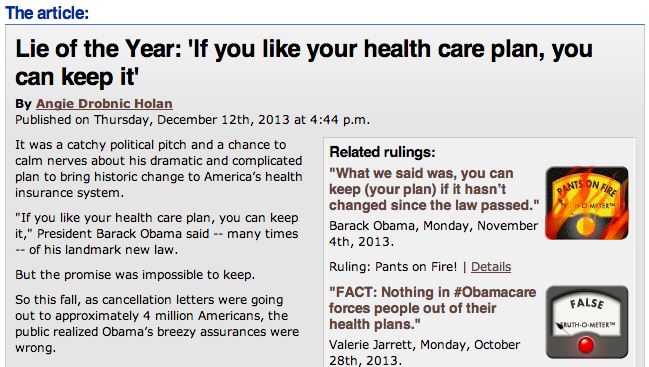
Politifact says: we were just kidding! Kidding!
Politifact said one thing before the election, and the opposite afterwards

So when Politifact rates a statement by a Democrat as true, what they really mean is that it’s pants-on-fire-false, but it’s election time so they don’t say that. It’s not like the critical assessments of Obamacare from health policy experts were not out there between 2007-2012. I know, because I blogged on every study and report on the predicted effects of the law that I could find. But the intellectually lazy journalism-major clowns at Politifact couldn’t be bothered to read those studies and reports.

My conversation about morality with an atheist millennial man

This is one of the memes from the Wintery Knight facebook page
A meme that was posted on the WK Facebook page, by the new meme admin

I spent some time talking to an atheist millennial recently. He considers himself a moral person, and he is very helpful to others. I asked him to define morality, and he said that morality was feeling good, and helping other people to feel good. I was trying to think of a way to punch a hole in his feelings-based utilitarianism. How could I show him that happy feelings are not a good basis for morality?

Now, you’re probably thinking that abortion is the most obvious example of something that is morally wrong – it’s just killing a baby because adults don’t want to take responsibility for their foolish pursuit of pleasure. But atheists typically don’t think of unborn children as people. They usually believe in naturalistic evolution, and they are committed to a view of reality where the universe is an accident, human beings are accidents, there are no objective human rights, and biological evolution progresses because the strong survive while the weak die. So you aren’t going to be able to generate a moral standard that includes compassion for weak unborn children on that scenario. If the rule is “let’s do what makes us happy”, and the unborn child can’t voice her opinion, then the selfish grown-ups win.

Instead, I decided to focus on fatherlessness. I asked him whether he thought that fatherlessness harmed children. Surprisingly, he said that it didn’t, and that he had a relative who was doing a great job raising fatherless kids. I asked him if he had ever looked at the research on what father absence does to children. He hadn’t. Then I asked him if a system of sexual rules based on “me feeling good, and other people around me feeling good”, was likely to protect children. He went silent.

Well, that was the end of that conversation. And I think it was a nice window into how millennials – who are absolutely clueless about what research says about sex, dating, marriage and parenting – think about relationships. They’re making decisions based on their feelings, then acting surprised when their “common sense” decisions based on happiness “in the moment” blow up in their faces, and destroy the lives of their children, including their unborn children.

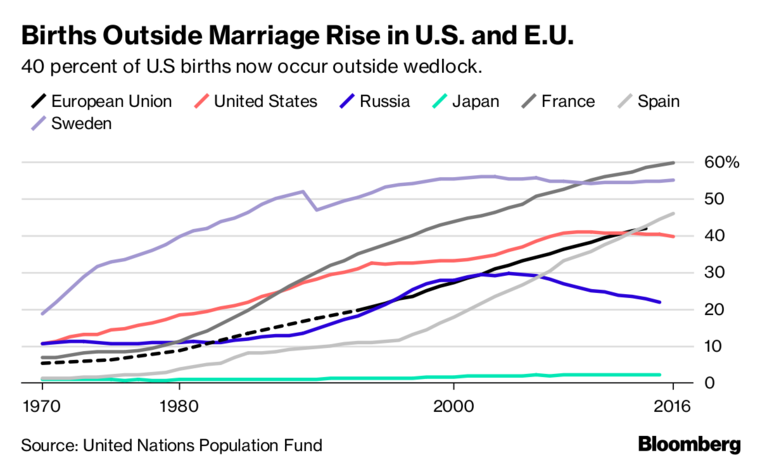
Unfortunately, young people are having children outside of a marriage commitment more and more.

Out-of-wedlocks births rising as cohabitation replaces marriage

Far-left Bloomberg News reports:

Forty percent of all births in the U.S. now occur outside of wedlock, up from 10 percent in 1970, according to an annual report released on Wednesday by the United Nations Population Fund (UNFPA), the largest international provider of sexual and reproductive health services. That number is even higher in the European Union.

The EU has a higher rate of fatherless births because they have high taxes and big government to allow women to have children without having to commit to a husband:

The EU likely sees more births out of wedlock because many member countries have welfare systems that support gender-balanced child care, said Michael Hermann, UNFPA’s senior adviser on economics and demography, in an interview. Public health care systems, paid paternal leave, early education programs and tax incentives give unwed parents support beyond what a partner can provide.

More welfare and more government services make it easier for women to pursue relationships with men who aren’t interested in marriage. Hot bad boys who give them all the tingles. Big government makes those boring, predictable marriage-ready men dispensable. Big government also makes it much harder for a man who does marry to afford a stay-at-home mother for his kids, because he has to pay higher taxes for big government.

More:

The data show such births in the U.S. and EU are predominantly to unmarried couples living together rather than to single mothers, the report says.

[…]Jones also noted that the rise in births outside of marriage is closely correlated to delays in childbearing. “Women are claiming their ground professionally,” she said. “Delaying motherhood is a rational decision when you consider the impact it can have on your career, and that’s contributing to this trend.”

[….]The traditional progression of Western life “has been reversed,” said John Santelli, a professor in population, family health and pediatrics at Columbia’s Mailman School of Public Health. “Cohabiting partners are having children before getting married. That’s a long-term trend across developing nations.”

Regardless of marital status, more couples are choosing not to have kids at all. The U.S. fertility rate hit a historic 30-year low last year, according to the Centers for Disease Control and Prevention. Hermann said the rise in births outside of wedlock has actually mitigated the decline in fertility, which “would be much steeper if women weren’t having children outside marriage.”

What’s interesting about this anti-marriage article is that they have nothing to say about the research showing that cohabitation – and also marriages that occur after a period of cohabitation – are inferior to no-cohabitation marriages. People who are serious about self-control, and who are serious about committing through thick and thin, tend to have longer lasting marriages. But we don’t prioritize chastity, fidelity and self-sacrificial commitment anymore, because that relationships that require self-denial make us unhappy.

The article concludes: “We can’t go back to the ’50s”. Right. Because if feelings-based “morality” is assumed, then any choice between adult happiness and children’s happiness will favor the adults. Today’s young people carefully AVOID any evidence that contradicts their new “happiness-morality”. They act surprised when their unstable relationships dissolve, leaving children separated from their fathers. Marriage requires that both partners have a system of morality that puts the commitment above happy feelings. People have to be accustomed to doing things that feel bad, just because they are good and moral things to do according to an objective standard of morality. The new atheist morality of happy feelings doesn’t develop the character needed for commitment.

If you ask an atheist millennial, they think they are doing a great job of being “moral”. They don’t see the messes they are making for children as something that they are causing themselves, with their own foolish feelings-based decision-making. They think they know everything about relationships through their feelings. They think that they are exempt from the patterns of cause and effect in the peer-reviewed research.

Lawrence Krauss debates “A Universe From Nothing” with an astrophysicist

Two horses fight it out, may the best horse win!

Dina sent me news of an exciting episode of Unbelievable, which features Lawrence Krauss, who debated William Lane Craig. Krauss’ book was also reviewed in the New York Times.

Details:

Lawrence Krauss is a Cosmologist at Arizona State University who describes himself as an “anti-theist”. His latest book “A Universe From Nothing” has received both acclaim and criticism for its attempt to answer the question “Why is there something rather than nothing?” Debating the issue with Krauss is Rodney Holder, Course director at the Faraday Institute, Cambridge. An astrophysicist and priest by background. In a lively exchange they debate whether Krauss’ “nothing” is “nothing”, fine tuning and multiverses, scientific knowledge, miracles and the usefulness of theology and philosophy.

This debate is quite entertaining, and do not be intimidated if your don’t understand science. You can understand pretty easily who is arguing based on facts and who is speculating about unobservable, untestable entities. At one point, Krauss actually denies that there is any fine-tuning in the universe, so please see this link to refute that claim as well as this podcast which explains some examples of fine-tuning. Krauss gets a bit angry at the beginning, but calms down.

Quotation marks are for direct quotes, italics is for made-up snark. See below the summary for more posts that are related to this one.

Summary of the discussion: (picked up at 9:30 when they start talking about the book)

Brierley:

  • explain your theory of how the universe can come into being from nothing

Krauss:

  • the nothing that preceded the universe is “no space, no time, no universe”
  • theists say that God is responsible for creating the universe out of this nothing
  • but the laws of nature can create the universe uncaused out of nothing

Holder:

  • Krauss sometimes writes that the nothing is really a quantum vacuum, but that is not nothing
  • He even acknowledges in his book that a quantum vacuum is not nothing
  • He thinks that the nothing has properties, even though it has no being
  • It has the property of being unstable
  • It has the property of being acted on by quantum fields
  • It has the property of being acted on by gravity

Krauss:

  • But nothing can have the potential to do things inside it
  • For example suppose you have an electron, which is not nothing
  • If it jumps from one level to another, it emits light
  • There was no potential for the light in the electron, but it was there as part of atomic structure

Holder:

  • But in cases like that, there is something physical that has the potential
Krauss:
  • Well, how did God makes the universe then if it had no potential?

Holder:

  • God existed, and the potential for creating the universe in himself

Brierley:

Krauss:
  • It was written by a philosopher, so I dismissed it

Brierley:

Krauss:
  • These book reviewers have not even read my book!

Krauss:

  • Science will be able to figure out how to make something from nothing in the future
  • We are even now speculating about interesting questions, like is there a multiverse?

Brierley:

  • Consider the critical review of your book in the New York Times
  • The author of the review claims that you equivocate on the term “nothing”
  • In order to get things to pop into being, you have to make “nothing” mean “something”
  • Reviewer: none of Krauss’ theories explain how something can come from actual nothingness

Krauss:

  • In physics, something and nothing are not that different
  • The reviewer doesn’t understand the physics
  • He doesn’t understand quantum field theory
  • You could call a quantum vacuum “nothing”, (this is the vacuum fluctuation model, refuted by William Lane Craig in a peer-reviewed publication in an astrophysics journal – get the full text of the article here)
  • Maybe there is an eternally existing multiverse that we can’t observe or test scientifically
  • Maybe it has laws that we don’t know about which allow our universe to pop into being
  • Maybe this popping into being is uncaused
  • (alarmed) Who made God? Who made God?

Holder:

  • God is eternal and necessary

Krauss:

  • (interrupting, angry) What does it mean for something to be necessary?

Holder:

  • Basically, you have to decide whether there is more evidence that the necessary being God or a multiverse

Brierley:

  • So Dr. Krauss are you willing to say that the universe is a brute fact, in some sense, and requires no explanation

Krauss:

  • (angry) Religious people are stupid because they just assume brute facts, not like me and my unobservable, untestable multiverse
  • (angry) Religious people are against the progress of science, they don’t want to figure out how things work

Brierley:

  • But isn’t it possible that naturalists can be opposed to the progress of science?
  • What about the way the Fred Hoyle opposed the Big Bang because he wanted an eternal universe

Krauss:

  • (angry) But naturalists like me let the facts determine our beliefs, like the facts about the eternal unobservable, untestable multiverse
  • (angry, shouting) Philosophers are stupid, they know nothing!

=== Break ===

Brierley:

  • Do you see any evidence of purpose in the universe?

Krauss:

  • Well maybe I would believe if the stars lined up to spell out a message from God

Brierley:

  • Actually no, that wouldn’t be evidence for God on your multiverse view
  • if there an infinite number of universes existing for an infinite amount of time, then anything can happen no matter how unlikely it is
  • therefore, no evidence could convince you that God exists, since the unobservable, untestable, eternal multiverse can make anything it wants

Krauss:

  • That’s a true statement, and very convenient for atheists who don’t want to be accountable to God, don’t you think?
Brierley:
  • Back to the multiverse, how does it solve the fine-tuning?

Krauss:

  • “We have no idea if the universe is fine-tuned for life”, even though the atheist Martin Rees who endorsed Krauss’ book wrote his own book about the fine-tuning of the universe called “Just Six Numbers”
  • Inflationary theory does suggest a way to create multiple universes, (this is the chaotic inflationary model, refuted by William Lane Craig in a peer-reviewed publication in an astrophysics journal – get the full text of the article here)

Brierley:

  • But this theory is still very much a hypothesis, isn’t it? We can’t observe or test this hypothesis can we?

Krauss:

  • “No, and that is really important to state”
  • “I’m an empiricist, so if you can’t falsify it and if you can’t test it then it’s not science”
  • In my book, I speculate about a way that we could test the multiverse theory

Holder:

  • Yes, in principle, the multiverse would be scientific if you could test it through other theories like inflationary theory
  • There are a lot of speculations about multiverse theory, but no evidence from predictions that were validated in the lab

Krauss:

  • “I agree completely with everything you just said”

Brierley:

  • Roger Penrose agrees with Holder that the multiverse theory is too speculative
  • (To Holder) Isn’t the multiverse theory better than positing a completely different kind of being, which is God?

Holder:

  • The multiverse theory is extremely speculative
  • Even if the multiverse were true, you would still need to explain the multiverse

Krauss:

  • People don’t oppose my book because it’s full of self-contradictory speculations
  • People oppose my book because they are stupid and ignorant

Holder:

  • There are things that exist that science cannot measure, like objective morality
  • It’s possible to give explanations for moral behavior by appealing to evolution
  • But that does not ground self-sacrificial morality, such as what occurs in the Christian life

Brierley:

  • Dawkins says there is no purpose or morality in in the universe, do you agree?

Krauss:

  • “There is certainly no evidence of any of that”

Brierley:

  • In the book, you talk about how we live in a special time in the universe’s history to be able to do science, (i.e. – The Privileged Planet hypothesis)
  • You also write about how all the discoveries were are making will not be communicated to anyone in other places in the universe
  • So what is the meaning of doing science on your view? And why are you sad at the knowledge that will not be available to people in the future?
  • Are you longing for some kind of purpose?

Krauss:

  • No, I just get enjoyment from studying the universe with science to gain understanding

Holder:

  • What do you make of Einstein’s statement about the unexpected comprehensibility of the universe
  • Theists would say that this is because God wanted us to study and understand and gain knowledge

Krauss:

  • “It is remarkable that the universe is comprehensible”

Brierley:

  • Why is the universe comprehensible?

Krauss:

  • Well, maybe the universe just has to be that way

Brierley:

  • What do you make of the heat death of the universe, when all life in the universe will die out?

Krauss:

  • That’s the way the universe is
=== BREAK ===

Krauss:

  • I wouldn’t want to live in a universe where there was a God
  • God is a cosmic Saddam Hussein
  • “Religious people turn their minds off” and believe in God for consolation

Holder:

  • First, Jesus is the revelation of God and he is no Saddam Hussein
  • Second, the Christian life is anything but easy, we are facing some persecution already in the UK
  • Third, there is also the problem of being accountable to God when we die
  • It’s very much like science – Christianity is the way it is, not the way we want it to be

Krauss:

  • “If you don’t believe in him, you don’t get any of the benefits, so you have to believe”
  • “And then if you’ve done something wrong, you’re going to be judged for it”
  • “So I don’t want to be judged by God, I want to be… that’s the bottom line”

Holder:

  • Well, Jesus has died to pay the price for those things we’ve done wrong
  • Although we will have to face the charges for what we’ve done, believers will ultimately be forgiven

Finally, Peter Sean Bradley note that Krauss is now walking back his rhetoric in response to criticisms from people like atheist John Horgan.

Related posts