Matthew Vines and Michael Brown debate homosexuality and the Bible on Moody radio

The audio of the Matthew Vines vs Michael Brown debate is streamed here on the Moody site.

Details:

Can you be gay and Christian? Matthew Vines says you can and he’s created a viral video and best-selling book defending his view. This Saturday on Up for Debate, Vines joins host Julie Roys to debate author and leading evangelical apologist, Dr. Michael Brown. Is gay monogamy an option for Christians? Is it unloving to reject gay marriage? Listen and join the discussion this Saturday at 8 a.m. Central Time on Up for Debate!

Summary key: Julie Roys (JR), Matthew Vines (MV), Michael Brown (MB)

Summary:

Opening speeches:

  • JR: Why should Christians be open to reinterpreting the Bible on homosexuality?
  • MV: Consider the lives and testimonies of gay Christians. Here is my personal story.
  • MV: According to the Bible, a person with same-sex attractions would have to embrace lifelong celibacy. I refuse to do that.
  • MV: There are 6 passages in the Bible that are relevant to the goodness of homosexuality. All are negative.
  • MV: None of these passages address gay relationships that are “long-term” and “faithful” that are based on “commitment” and “love”.
  • JR: You say that it is “damaging” for Christians to disagree with you views, is that true?
  • MV: Yes. One of my friends declared his homosexuality and he did not feel safe to come home. He felt pain because Christians disagreed with him.
  • MV: You cannot ask a person with same-sex attractions to be celibate, it causes too much harm to ask gays to abstain from sexual relationships.
  • JR: Respond to Matthew.
  • MB: The Bible only permits heterosexual sexuality and in every case condemns homosexual acts.
  • MB: Matthew is taking his sexual preferences and activities as given, and reinterpreting the Bible to fit it.
  • MB: Genesis talks about women being made to help men, and to fulfill God’s commandment to procreate and fill the Earth.
  • MB: The Bible speaks about the complementarity of the sexes when talking about how two become one in marriage.
  • MB: I am very sensitive to the stories of people who are gay who experience discrimination as “gay Christians”.
  • MB: You can feel sad for people who have two conflicting commitments, but that doesn’t mean we should redefine what the Bible says.
  • JR: Stop talking, we have a break.

JR takes a caller for the next topic:

  • Caller 1: I had same-sex attractions and I was able to change my sexuality.
  • JR: Matthew, respond to that.
  • MV: Alan Chambers of Exodus International says that 99.9% of people he worked with had not changed their gay orientation.
  • MV: Lifelong celibacy is not acceptable to gays, so the Bible must be reinterpreted to suit gays.
  • MB: Matthew thinks that God himself did not understand the concept of sexual orientation and inadvertently hurt gays because of his lack of knowledge.
  • MB: There is a solution in the Bible for people who cannot be celibate, and that solution is heterosexual marriage
  • MB: If a person is only attracted to pre-teen girls, do we then have to re-write the Bible to affirm that so they won’t be “harmed”?
  • MB: Alan Chambers was speaking for his own group, and his statement does not account for the fact that thousands of people DO change.
  • JR: What about the Jones/Yarhouse study that found that 38% of reparative therapy subjects were successful in changing or chastity?
  • MV: (no response to the question)
  • MV: (to Brown) do you accept that the Bible forces gays to live out lifelong celibacy

Another break, then Brown replies:

  • MB: Yes. But change is possible.
  • MV: Do you know of any Christian who acknowledged that this was the consequence of the Bible’s teaching for gays?
  • MB: Paul’s explanation that the options for ALL Christians are 1) celibacy or 2) heterosexual marriage. For 2000 years.
  • MV: Paul (in Romans 1) is talking about people who are not “long-term”, “faithful” gay relationships.
  • MV: Paul was not aware of “long-term”, “faithful” gay relationships at the time he wrote his prohibitions in Romans 1.
  • JR: How do you know that fixed sexual orientation is true? And that the Biblical authors would written different things if they knew?
  • JR: Are there any references in the first century to “long-term”, “faithful” gay relationships?
  • MB: Yes, in my book I quote prominent historian N. T. Wright who documents that those relationships were known.
  • MB: Matthew’s view requires that God did not know about sexual orientation when ordaining the Bible’s content.
  • MB: Leviticus 18 is for all people, for all time. This was not just for the Jews, this was for everyone.
  • MV: I am not saying that Paul was wrong because he was ignorant.
  • MV: Paul was writing in a context where “long-term”, “faithful” gay relationships were unknown.
  • MV: NT Wright does not cite first century texts, he cites a problematic 4th century text.
  • MV: Absence of 1st-century references to “long-term”, “faithful” gay relationships means that God did not intend to prohibit them.
  • MB: Whenever the Bible speaks about homosexuality, it is opposed to it – Old Testament and New Testament.

Another break, then the conclusion:

  • JR: Respond to the Leviticus prohibition, which prohibits homosexuality for everyone, for all time.
  • MV: It is a universal prohibition on male same-sex intercourse, but it does not apply to Christians.
  • MV: For example, Leviticus prohibits sex during a woman’s menstrual period. And Christians are not bound by that.
  • MV: What is the reason for this prohibition of male-male sex in Leviticus? It’s not affirm the complementarity of the sexual act.
  • MV: The Bible prohibits male-male sex because it is written for a patriarchal culture.
  • MV: In a patriarchal culture, women are viewed as inferior. That’s why the Bible prohibits a man from taking the woman’s role in sex.
  • MB: The prohibition in Leviticus is a universal prohibition against male-male sex, applicable in all times and places.
  • MB: Homosexual sex is a violation of the divine order.
  • MB: We can see already the consequences of normalizing this: gay marriage, and supports for polygamy and polyamory.
  • MV: So the earliest reference there is to a “long-term”, “faithful” gay relationship is a 4th century text.
  • MV: But that gay relationship is not like modern gay relationships.

I have a few comments about Vines’ points below.

My comments:

Even heterosexuals who have not married are called upon to embrace lifelong celibacy. I am in my early 40s and am a virgin because I have not married. I wouldn’t seek to reinrepret the Bible to allow premarital sex just because what I am doing is difficult. I would rather just do what the Bible says than reinterpret it to suit me. And it’s just as hard for me to be chaste as it would be for him to be. In short, it’s a character issue. He takes his right to recreational sex as non-negotiable, and reinterprets the Bible to suit. I take the Bible as non-negotiable, and comply with it regardless of whether it seems to make me less happy. With respect to the purposes of God for me in this world, my happiness is expendable. If I don’t find someone to marry, I’m going to be “afflicted” with the lifelong celibacy that Vines seems to think is torture, but let me tell you – God is happy with the contributions I am making for him, and if I have to be chaste through my whole life, I am 100% fine with that. I serve the King. And not the reverse.

Notice that he talks about “long-term” but not permanent relationships, and “faithful” but not exclusive. This is important because the statistics show that gay relationships (depending on whether it is female-female or male-male) are prone to instability and/or infidelity. I just blogged on that recently, with reference to the published research on the subject. Vines is talking about a situation that does not obtain in the real world – according to the data. Gay relationships do not normally value permanence and exclusivity in the way that opposite-sex marriage relationships do, especially where the couple regularly attends church. The divorce rate and infidelity rate for religious couples is far below the rates for gay couples, depending on the sexes involved. Vines is committed to the idea that marriage is about feelings, e.g. – “love”, but that’s not the public purpose of marriage. Marriage is not about love, it’s about complementarity of the sexes and providing for the needs of children. We have published studies like this one showing that there are negative impacts to children who are raised by gay couples, which dovetails with studies showing that children need a mother and that children need a father. We should not normalize any relationship that exposes children to harm. We should prefer to inconvenience adults than to harm children.

Matthew Vines made an argument that Christians have to stop saying that homosexuality is wrong, because it makes gay people feel excluded. I wrote previously about the argument that gay activists use where they say “if you don’t agree with me and celebrate me and affirm me, then I’ll commit suicide”. In that post, I quoted a prominent gay activist who made exactly that argument. I don’t find the threats to self-destruction to be a convincing argument for the truth of the view that gay marriage being the same as heterosexual marriage. In fact, this is confirmed by a recent study which showed that features of gay relationships themselves, and not social disapproval, is to blame for high rates of suicide in the gay community.

Vines seems to want to argue that the context in which the Bible authors were writing did not allow them to address the problem of gays in “long-term”, “faithful” relationships. Well, we have already seen that statistically speaking, those relationships are in the minority. One British study mentioned in the post I linked to above found that only 25% of gay couples were intact after 8 years. The number is 82% for heterosexual marriages, and that doesn’t filter by couples who abstain from premarital sex and who attend church regularly. If you add those two criteria, the number is going to be well above 82% in my opinion. Studies show that premarital chastity and church attendance vastly improve the stability and quality of marriages.

In addition, Vines is trying to argue that 1) the Bible authors were not aware of “long-term”, “faithful” gay relationships and 2) their failure to explicitly disqualify these “long-term”, “stable” gay sexual relationships means that the Bible actually condones them. A friend of mine pointed out that this is a textbook case of the argument from silence, where someone asserts that because something is not explicitly condemned, then it must be OK. Carried through to its logical end, that would mean that things like identity theft are OK, because they are not mentioned explicitly. Brown asserted that there was a blanket prohibition on homosexual acts. He is arguing from what we know. Vines says that “long-term”, “faithful” homosexual relationships are not mentioned, and are therefore OK. He is arguing from what we don’t know. And he is trying to reverse the burden of proof so that he doesn’t have to show evidence for his view. Brown wouldn’t take the bait. The fact of the matter is that no one for the last 2000 years of church history have taken Vines’ view. Every single Christian before Vines, who were closer to Jesus’ teachings than Vines, understood the verses that Brown cited to be providing a blanket prohibition on homosexual sex acts. If Vines wants to claim that the Bible condones what he wants it to condone, he has to produce some positive evidence from the text or from church history or church fathers. He has nothing to support his case that could convince anyone that this is what Christians have believed, and ought to believe.

Finally, if you are looking for another debate, I blogged about a debate between Michael Brown and Eric Smaw. There’s a video and summaries of the opening speeches in that post.

Patient-killing replacing palliative care in Canada’s single payer health care system

Killing patients is an easy way to keep costs down

Canada has a pure single-payer health care system. That means that Canadians are taxed (average family pays $12,057 per year), and then the government decides who will get health care. As you might expect, when health care is free, the demand for it goes up. In order to cut costs, Canada decided to stop treating the elderly.

Here’s an article from Canada’s far-left Maclean’s magazine.

Excerpt:

Canadians were asked in 2016 to accept what is now called Medical Assistance in Dying (MAiD) as standard practice in the health-care system. But as the second anniversary of the federal law sanctioning assisted suicide passes this month, ambiguities embedded in the new regulatory regime are turning end-of-life care into a troubling leap of faith for doctors and patients alike.

Even the Collège des Médicins in Quebec, which sped ahead with its own statute in advance of Ottawa’s Bill C-14, has sounded a strong warning note about patients “choosing” medical assistance in dying purely because their preference for palliative care isn’t available.

That’s Quebec, but there’s more patient-killing going on at the other end of the country in British Columbia:

At the other end of the country in British Columbia, an active proponent of MAiD, acknowledges that she, too, struggled to adapt to the vagueness of the federal law. Dr. Ellen Wiebe says she ultimately concluded she would have to rely on her personal best judgment about whether or not to administer death.

Although there is a shortage of funding for palliative care in Canada, there’s lots of money available for abortions, sex changes, IVF, etc.

I was able to find out about Dr. Wiebe’s worldview from another earlier 2016 article in the far-left Maclean’s magazine:

Much of Wiebe’s 40-year career as a family physician she has spent doing abortions, including at Vancouver’s first abortion clinic, as well as patient advocacy and pioneering abortion drug research.

[…]She was raised in a Mennonite family in Abbotsford, B.C., and Wiebe says,“I know my Bible pretty well. I could quote it, no problem.” Her mother was a homemaker, and her father was a teacher who worked for the Canadian International Development Agency, which meant Wiebe and her three siblings spent parts of their childhood in Asia and Africa with them. They were “wonderful people who loved life,” says Wiebe of her parents, and their Christian beliefs were an “important part of their lives for everything and anything.” But as Wiebe moved through adolescence—precociously so, finishing high school at 15—she abandoned her faith. “I lost all my religiosity by the age of 17,” says Wiebe. “It was just part of being in university, questioning and wondering and learning who you are.”

Looks like her parents were more focused on doing good things for the poor in foreign countries, than on teaching their own child apologetics. Abbotsford is a very conservative and beautiful part of Canada. She must have had an ideal childhood.

The Heritage Foundation notes that in the Netherlands, voluntary euthanasia has already turned into involuntary euthanasia:

For example, euthana­sia is often promoted by its champions as a last resort to alleviate suffering, but the Netherlands already has moved “from assisted suicide to eutha­nasia, from euthanasia for the terminally ill to euthanasia for the chronically ill, from euthanasia for physical illness to euthanasia for psychological distress and from voluntary euthanasia to nonvol­untary and involuntary euthanasia.” Such “ter­mination without request or consent” has been applied to Dutch infants as well. The concern has been that public health system rationing may exert pressure not just to limit spending on certain indi­viduals, but also, either subtly or overtly, to coerce them to be euthanized.

And I’ve already blogged about how the UK’s government-run NHS system pays hospitals bounties for putting patient on an end-of-life track. The new guidelines are even worse, as the UK Telegraph reports:

New NHS guidelines on “end of life” care are worse than the Liverpool Care Pathway and could push more patients to an early grave, a leading doctor has warned.

Prof Patrick Pullicino, one of the first medics to raise concerns over the pathway, said the national proposals would encourage hospital staff to guess who was dying, in the absence of any clear evidence, and to take steps which could hasten patients’ death.

The Liverpool Care Pathway – which meant fluids and treatment could be withdrawn, and sedation given to the dying – was officially phased out last year, on the orders of ministers.
It followed concern that under the protocols, thirsty patients had been denied water and left desperately sucking at sponges.

There’s government run health care for you.

I’m writing about this patient-killing issue today because I think it’s interesting to think about what health care is like in a country that is basically run by atheists, like Canada is. I personally would not like to be forced to pay taxes to pay the salary of a someone like Wiebe, and let her be in charge of my life.

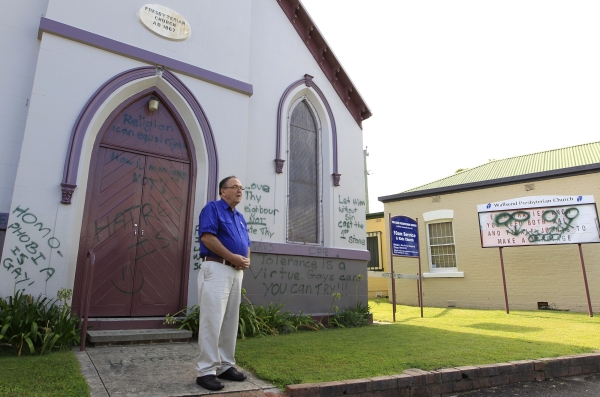
Should people in sinful lifestyles bully churches into celebrating them?

Anti-marriage gay activists vandalize church

This story was the topic of the most recent episode of the Reasonable Faith podcast. Basically, a conservative, apologetics-friendly church had a homosexual person who wanted to be openly gay and still be accepted as a member. After he was told by the church that he could attend the church, but not be a member, he decided to write the mainstream media to shame the church.

Here is the link to Reasonable Faith‘s podcast – and they have a transcript.

I want to first focus on the letter written by the gay man:

Dear Watermark Community Church,

Today I celebrate a very interesting anniversary with you. It was exactly one year ago when you told me that I was no longer worthy to serve, be in a community group, and be a member of your church.

I spent years in your church battling against my homosexuality. I believed with all my heart that God would change me; I prayed for change almost daily. But when I wasn’t able to change, you turned your back on me.

You say our “sin” is not unique, but you treat us in a unique manner; this is unacceptable behavior. We are actual people that have actual feelings.

Here we are a year later and you are still doing to others what you did to me. You are tarnishing the name of God to Christians and non-Christians alike; you should be ashamed of yourselves! Do not forget, Jesus was a angry with people just like you who said certain groups of people were not worthy to be followers of Him.

Thank you for removing yourself from my life! I am who God made me to be. I cannot change my sexual orientation and nor would I want to. I now have internal peace and happiness unlike ever before.

Jason Thomas

As Reasonable Faith notes, this is what he said and this is what the far-left Dallas Morning News reported. It sounds like the church was very mean to him, but is that what really happened?

Here is what the church actually wrote to him:

Dear Jason,

This is a difficult letter to write, as I am sure that it will be a difficult one to hear and receive. We genuinely care for you, love you, and want nothing more for you than to live an abundant life that is found in Jesus Christ alone.

However, in our attempt to shepherd you, we have recognised a destructive pattern that prohibits us in caring for you and playing the role you desire for us to have in your life (1 Peter 5:1-4; Acts 20:28). Specifically, your desire to actively participate in a same-sex relationship with another man, and your unwillingness to heed biblical counsel from your church to turn from that relationship, has made it exceedingly difficult to shepherd you during this time.

As we noted during our time together last Tuesday (9/29/15), and through the years, we have gently & repeatedly brought these patterns to your attention and, at times, you have heeded this counsel and repented. But now, this is no longer the case. So, in obedience to Matthew 18:15-18 and 1 Corinthians 5:11, we are left with no other option but to remove you from our body and treat you as we would anyone who is living out of fellowship with God…and we lovingly, but firmly, call you back to repentance. This means that you are no longer a member of our body at Watermark. We are praying that repentance comes quickly and that you do not continue choosing a path of destruction and one that leads you away from the authority and care of the church.

We recognise that these patterns are only symptoms of a heart that is either unwilling or unable to fully trust God in every area of your life, including your sexuality. We plead with you to run to the Lord and allow the Spirit of God to begin to transform your heart in a mighty way (Titus 3:3-7).

In order to help you through this time, we would like to make some tangible recommendations that we hope will serve as a catalyst for true repentance and heart-change in your life. They are:

1. Faithful attendance of Re:Generation targeting the above issue, while following counsel to not be in a dating relationship during that time.

2. Meet with a Watermark staff member who shares in the same struggle (same sex attraction) who has found freedom, healing, and victory through our Savior Jesus Christ (just let Brandon know when you’re ready to meet with him).

We affirm your many gifts, your heart of kindness, and we value the way God has uniquely formed you (Psalm 139:13-14). We all pray for your repentance and full restoration so that your gifts and passions can be fully unleashed for the Kingdom of God. We love you, Jason, and stand at the gate for you and eagerly await God’s restoration in your life (Luke 15:20).

In Christ,

The Elders of Watermark Community Church

Here is what one of my friends at Watermark who was aware of the situation told me:

I think it’s clear that Watermark was very kind and loving in their discipline and can’t be called hypocritical or homophobic, and they were not trying to change the man’s sexual orientation but rather simply asking him to abstain from sexual relationships. They give lots of chances before administering discipline and the process is the same each time they go through this with members. Some repent and some turn away.

As we have seen, publicizing those who disagree with homosexuality and gay marriage is a favorite tactic of the fascist left. Sometimes, it just involves smearing (e.g. – the Southern Povery Law Center).  Sometimes, it involves lawfare, (e.g. – the attorney general of Washington state). Sometimes, it involves leaking the names of pro-marriage donors (e.g. – the Human Rights Campaign). Sometimes, it involves vandalism, violence and even domestic terrorism (e.g. – Floyd Lee Corkins’ attack on the Family Research Council). When it comes to homosexuality and gay marriage, fascism is the normal response to dissent.

I just find it astonishing that gay activists and other radicals on the left think that they can try to bring in the mainstream media and the law to punish the church for holding to orthodox Christian moral values. But this is why we call sin “sin”. We don’t call chastity a sin, because chaste people don’t behave like fascists when they hear disagreement. We don’t call having lots of children a sin, because people who have lots of children don’t behave like fascists if anyone disagrees with them. There is something really wrong with these behaviors that the Bible forbids. You can see why the Bible condemns certain things as sins when you look at the fascist responses to disagreement with the sin.

Look at 1 Corinthians 6:1-10:

1 If any of you has a dispute with another, do you dare to take it before the ungodly for judgment instead of before the Lord’s people?

Or do you not know that the Lord’s people will judge the world? And if you are to judge the world, are you not competent to judge trivial cases?

Do you not know that we will judge angels? How much more the things of this life!

Therefore, if you have disputes about such matters, do you ask for a ruling from those whose way of life is scorned in the church? 

I say this to shame you. Is it possible that there is nobody among you wise enough to judge a dispute between believers? 

But instead, one brother takes another to court—and this in front of unbelievers!

The very fact that you have lawsuits among you means you have been completely defeated already. Why not rather be wronged? Why not rather be cheated? 

Instead, you yourselves cheat and do wrong, and you do this to your brothers and sisters.

Or do you not know that wrongdoers will not inherit the kingdom of God? Do not be deceived:Neither the sexually immoral nor idolaters nor adulterers nor men who have sex with men

10 nor thieves nor the greedy nor drunkards nor slanderers nor swindlers will inherit the kingdom of God.

Consider 1 Corinthians 5:9-13:

I wrote to you in my letter not to associate with sexually immoral people—

10 not at all meaning the people of this world who are immoral, or the greedy and swindlers, or idolaters. In that case you would have to leave this world.

11 But now I am writing to you that you must not associate with anyone who claims to be a brother or sister but is sexually immoral or greedy, an idolater or slanderer, a drunkard or swindler. Do not even eat with such people.

12 What business is it of mine to judge those outside the church? Are you not to judge those inside?

13 God will judge those outside. “Expel the wicked person from among you.”

Everyone sins. Fine. Keep it to yourself. Don’t use the law to force Bible-believing Christians to celebrate your sins. The church’s job is to help you to be more like Christ. You’re in a community where everyone is supposed to be serious about growing as a Christian and part of that involves improving your character morally. Another part means getting along with other Christians instead of being disruptive.

Regarding complaints about not being able to act on your sexual orientation, I have no sympathy. I am attracted to women, and I am a virgin, because I am not married. I am not going to church to rebel against this requirement. My job is to structure my life in such a way that it is easier to obey it, whether that involves studying the issue in the research or drawing the line long before I have to make a decision in the heat of the moment. God must be #1 in a person’s life, setting goals and policies, and our job is to make and execute effective plans that deliver results for the Boss.

By the way, do not miss this other recent article on homosexuality from Reasonable Faith.