Ryan T. Anderson lectures on marriage and why it matters

Marriage and family
Marriage and family

Here’s the lecture:

About the speaker:

Ryan T. Anderson researches and writes about marriage and religious liberty as the William E. Simon Fellow at The Heritage Foundation. He also focuses on justice and moral principles in economic thought, health care and education, and has expertise in bioethics and natural law theory.

Anderson, who joined the leading Washington think tank’s DeVos Center for Religion and Civil Society in 2012, also is the editor of Public Discourse, the online journal of the Witherspoon Institute of Princeton, N.J.

Anderson’s recent work at Heritage focuses on the constitutional questions surrounding same-sex “marriage.” He is the co-author with Princeton’s Robert P. George and Sherif Girgis of the acclaimed book “What Is Marriage? Man and Woman: A Defense” (Encounter Books, December 2012).

The lecture starts at 7:20 in. The lecture ends at 49:35. There are 32 minutes of Q&A.

Introduction:

  • When talking about marriage in public, we should talk about philosophy, sociology and public policy
  • Gay marriage proponents need to be pressed to define what marriage is, on their view
  • Every definition of marriage is going to include some relationships, and exclude others
  • It’s meaningless to portray one side as nice and the other mean
  • Typically, marriage redefiners view marriage as a more intense emotional relationship
  • Marriage redefiners should be challenged in three ways:
  • 1) Does the redefined version of marriage have a public policy reason to prefer only two people?
  • 2) Does the redefined version of marriage have a reason to prefer permanence?
  • 3) Does the redefined version of marriage have a reason to prefer sexual exclusivity?
  • Also, if marriage is just about romance, then why is the state getting involved in recognizing it?
  • The talk: 1) What marriage is, 2) Why marriage matters, 3) What are the consequences of redefining marriage?

What marriage is:

  • Marriage unites spouses – hearts, minds and bodies
  • Marriage unites spouses to perform a good: creating a human being and raising that human being
  • Marriage is a commitment: permanent and exclusive
  • Male and female natures are distinct and complementary

The public purpose of marriage:

  • to attach men and women to each other
  • to attach mothers and fathers to their children
  • there is no such thing as parenting, there is only mothering and fathering
  • the evidence shows that children benefit from mothering and fathering
  • boys who grow up without fathers are more likely to commit crimes
  • girls who grow up without fathers are more likely to have sex earlier
  • Children benefit from having a mother and a father
  • can’t say that fathers are essential for children if we support gay marriage, which makes fathers optional
  • without marriage: child poverty increases, crime increases, social mobility decreases, welfare spending increases
  • when government encourages marriage, then government has less do to – stays smaller, spends less
  • if we promote marriage as an idea, we are not excluding gay relationships or even partner benefits
  • finally, gay marriage has shown itself to be hostile to religious liberty

Consequences redefining marriage:

  • it undermines the norm in public like that kids deserve a mom and a dad – moms and dads are interchangeable
  • it changes the institution of marriage away from the needs of children, and towards the needs of adults
  • it undermines the norm of permanence
  • we learned what happens when marriage is redefined before: with no-fault divorce
  • no-fault divorce: after this became law, divorce rates doubled – the law changed society
  • gay marriage would teach society that mothers and fathers are optional when raising children
  • if marriage is what people with intense feelings do, then how can you rationally limit marriage to only two people?
  • if marriage is what people with intense feelings do, then if other people cause intense feelings, there’s no fidelity
  • if marriage is what people with intense feelings do, then if the feelings go away, there is no permanence
  • the public policy consequences to undermining the norms of exclusivity and permanence = fatherless children and fragmented families
  • a final consequences is the decline and elimination of religious liberty – e.g. – adoption agencies closing, businesses being sued

We’re doing very well on abortion, but we need to get better at knowing how to discuss marriage. If you’re looking for something short to read, click here. If you want to read a long paper that his book is based on.

Related posts

Is Bernie Sanders correct to say that Canada has better, lower-cost health care?

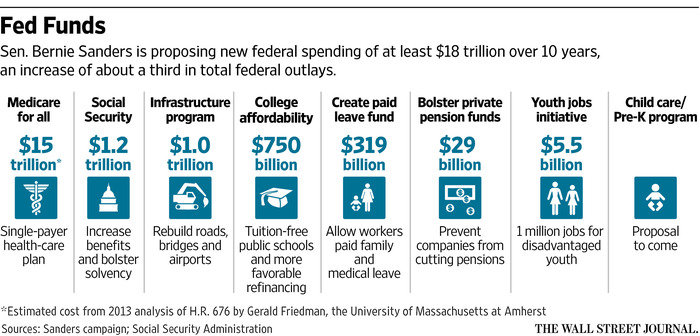
Wall Street Journal calculates cost of Sanders spending plan

He seems to be really passionate about raising taxes on working families, and then giving them “free” health care in return. Let’s see how that’s working out in Canada, where they do have a single-payer health care system.

The Washington Free Beacon reports:

Waiting times for medically necessary health care services under Canada’s single-payer system have hit a record high, according to a report from the Fraser Institute.

[…]The Fraser Institute found that patients under Canada’s single-payer system this year waited an average of 10.9 weeks—roughly two-and-a-half months—from the time they had a consultation with a specialist to the time at which they received treatment. Physicians consider 7.2 weeks to be a clinically reasonable wait time.

The report also found that patients’ wait for treatment after referral to a specialist by their general practitioner was 21.2 weeks, or longer than four months.

“This year’s wait time—the longest ever recorded in this survey’s history—is 128 percent longer than in 1993, when it was just 9.3 weeks,” the report states.

The report, which looks at 10 provinces in Canada, found that there are 1,040,791 patients waiting for procedures. There are also high wait times to receive scans and ultrasounds. Patients waited an average of 10.8 weeks for an MRI scan and 3.9 weeks for an ultrasound.

“Research has repeatedly indicated that wait times for medically necessary treatment are not benign inconveniences,” the report states. “Wait times can, and do, have serious consequences such as increased pain, suffering, and mental anguish.”

According to the report, patients experience long wait times for surgeries, waiting as long as 41.7 weeks for orthopedic surgery, 32.9 weeks for neurosurgery, and 31.4 weeks for ophthalmology.

“In certain instances, [wait times] can also result in poorer medical outcomes—transforming potentially reversible illnesses or injuries into chronic, irreversible conditions, or even permanent disabilities,” the report states. “In many instances, patients may also have to forgo their wages while they wait for treatment, resulting in an economic cost to the individuals themselves and the economy in general.”

Fraser points out that previous studies have found the lost economic output in waiting for joint replacement surgery, coronary artery bypass graft surgery, MRI scans, and cataract surgery totaled $14.8 billion in 2007.

The report also notes that 46.3 percent of patients would prefer to have their procedure performed within a week if they had the opportunity to do so.

The article also quotes Sally C. Pipes, a Canadian health care expert who knows how much Canadian taxpayers pay for “free” health care.

Pipes also refutes Sanders’s claim that Canada’s system offers relatively the same quality of care at a cheaper cost.

“It isn’t cheaper because Canadians pay for health care through their taxes,” Pipes explains. “The average Canadian family pays anywhere between $4,000 and $12,000 a year in taxes for a system where they have to wait over five months from seeing a primary care doctor to getting treatment by a specialist.”

“There’s fewer doctors relative to the population than in all but four other industrialized countries,” she said. “It’s last in terms of acute care hospital beds and there’s doctor shortages, residency spots are down, and waiting times—this is what happens when government controls the health care system, and this is what Bernie Sanders wants for the United States.”

Canadians are also paid less than Americans. Why? Because Canadian employers have to pay a percentage of their employee’s salary to the government for health care. Obviously, the employers are going to take that out of their employee’s salary without telling them.

Finally, it should be obvious that progressive Canadian politicians go South when they’re sick for healthcare. They know that when health care is free, you get the quality you’re paying for.

One thing you need to understand is that if you put health care in the hands of politicians, they they will use it for vote-buying, like they do with any government-run social program. So, if you are young and want an abortion or a sex change, you’re in luck. Because you have a lot of voting ahead of you, and they want to keep you happy with big government. But, if you’re old, and don’t have so much voting left to do, you’re expendable. That’s why countries with big government health care, like the Netherlands and Canada and the UK are always tinkering with euthanasia for the elderly.

Jay Richards: why should Christians learn about economics?

Here’s a good basic introduction to the free enterprise system by Dr. Jay Richards:

In this lecture, Dr. Richards covers the following topics:

  • the piety myth – thinking that good intentions matter more than good results
  • the greed myth – thinking that capitalism is about greed instead of about innovation and serving others
  • the zero sum game myth – thinking that voluntary exchanges between buyers and sellers result in win-lose outcomes
  • the materialist myth – thinking that there is only a set amount of wealth to be divided by competition

It turns out that the best system for lifting the poor out of poverty – by work or charity – is the economic system that creates wealth through human ingenuity and hard work. That system is the free enterprise system.

Something to read?

If you can’t listen to the lecture and don’t want to buy the whole book “Money, Greed and God?” Then I have a series of posts on each chapter for you.

The index post is here.

Here are the posts in the series:

  • Part 1: The Eight Most Common Myths about Wealth, Poverty, and Free Enterprise
  • Part 2: Can’t We Build A Just Society?
  • Part 3: The Piety Myth
  • Part 4: The Myth of the Zero Sum Game
  • Part 5: Is Wealth Created or Transferred?
  • Part 6: Is Free Enterprise Based on Greed?
  • Part 7: Hasn’t Christianity Always Opposed Free Enterprise?
  • Part 8: Does Free Enterprise Lead to An Ugly Consumerist Culture?
  • Part 9: Will We Use Up All Our Resources?
  • Part 10: Are Markets An Example of Providence?

Parts 4 and 5 are my favorites. It’s so hard to choose one to excerpt, but I must. I will choose… Part 4.

Here’s the problem:

Myth #3: The Zero Sum Game Myth – believing that trade requires a winner and a loser. 

One reason people believe this myth is because they misunderstand how economic value is determined. Economic thinkers with views as diverse as Adam Smith and Karl Marx believed economic value was determined by the labor theory of value. This theory stipulates that the cost to produce an object determines its economic value.

According to this theory, if you build a house that costs you $500,000 to build, that house is worth $500,000. But what if no one can or wants to buy the house? Then what is it worth?

Medieval church scholars put forth a very different theory, one derived from human nature: economic value is in the eye of the beholder. The economic value of an object is determined by how much someone is willing to give up to get that object. This is the subjective theory of value.

And here’s an example of how to avoid the problem:

How you determine economic value affects whether you view free enterprise as a zero-sum game, or a win-win game in which both participants benefit.

Let’s return to the example of the $500,000 house. As the developer of the house, you hire workers to build the house. You then sell it for more than $500,000. According to the labor theory of value, you have taken more than the good is actually worth. You’ve exploited the buyer and your workers by taking this surplus value. You win, they lose.

Yet this situation looks different according to the subjective theory of value. Here, everybody wins. You market and sell the house for more than it cost to produce, but not more than customers will freely pay. The buyer is not forced to pay a cost he doesn’t agree to. You are rewarded for your entrepreneurial effort. Your workers benefit, because you paid them the wages they agreed to when you hired them.

This illustration brings up a couple important points about free enterprise that are often overlooked:

1. Free exchange is a win-win game.

In win-win games, some players may end up better off than others, but everyone ends up better off than they were at the beginning. As the developer, you might make more than your workers. Yet the workers determined they would be better off by freely exchanging their labor for wages, than if they didn’t have the job at all.

A free market doesn’t guarantee that everyone wins in every competition. Rather, it allows many more win-win encounters than any other alternative.

2. The game is win-win because of rules set-up beforehand. 

A free market is not a free-for-all in which everybody can do what they want. Any exchange must be free on both sides. Rule of law, contracts, and property rights are needed to ensure exchanges are conducted rightly. As the developer of the house, you’d be held accountable if you broke your contract and failed to pay workers what you promised.

An exchange that is free on both sides, in which no one is forced or tricked into participating, is a win-win game.

If you do get the book, be sure and skip the chapter on usury. It’s just not as engaging as the others, in my opinion.