
Donald Trump promises gay publication “forward motion” on gay rights issues

This is from Bay Windows, which bills itself as “serving New England’s Lesbian, Gay, Bisexual and Transgender communities”.

Here’s what they wrote:

The frontrunner for the Republican presidential nomination today promised “forward motion” on gay and lesbian equality if he is elected.

In an interview with NECN’s Sue O’Connell just days before the crucial New Hampshire primary, Trump cast himself as a uniter on LGBT issues.

O’Connell, who is also Bay Windows’ Publisher, identified herself as a lesbian in a question that noted the progress the LGBT community has made in the last two decades and asked Trump if voters can expect him to continue that momentum if elected

“When President Trump is in office can we look for more forward motion on equality for gays and lesbians?” O’Connell asked him.

“Well, you can,” Trump answered. ” And look, again, we’re going to bring people together, and that’s your thing and other people have their thing. We have to bring all people together and if we don’t we’re not going to have a country anymore.”

Recall that during the Iowa primary, Trump declared how much he loves evangelicals, and even held up a Bible he supposedly got from his mother as evidence of his genuine, authentic Christian faith.

Trump holds up Bible he "received from his mother" to evangelicals
Trump holds up Bible he “received from his mother” to evangelicals

CBS News reports on how Trump pandered to evangelicals in Iowa:

Just two days ahead of the first nominating contest in Iowa, Donald Trump is making a final attempt to court evangelical Christians.

In a new video posted to Facebook Saturday, the billionaire businessman thanked evangelicals and promised to “never let you down.”

“I really appreciate the support given to me by the evangelicals,” Trump said. “They’ve been incredible. Every poll says how well I’m doing with them.”

Trump then held aloft a worn Bible, which he said his mother had given to him “many years ago.”

“In fact, it’s her writing right here,” he added, flipping to the first page of the book. “She wrote the name and my address and it’s just very special to me.”

This is not the first time the GOP front-runner has used the Bible as a prop on the campaign trail.

In September, Trump waved the same copy of the book while giving a speech at the Values Voters Summit hosted by the Family Research Council in Washington, D.C.

Trump has also repeatedly named the Bible as his favorite book — though he has often faced criticisms for his inability to name his favorite Bible verses.

He’s never going to let us down. That’s what he said in Iowa. But in New Hampshire, he is saying something else. That was then, this is now.  His entire case to evangelical Christians was:

  • I’m ahead in the polls
  • I can hold up a Bible and say my mother gave it to me
  • I can wave a Bible around
  • “Two Corinthians” – that’s your favorite verse, right?

Here is the real Donald Trump, for those who have eyes to see, and ears to hear:

As everyone knows, evangelicals are under attack from gay activists, who want to use the power of government to punish those who decline to celebrate gay marriage and participate in gay weddings. When religious liberty and freedom of conscience come up against a gay activists desire to not be offended by dissent, religious freedom and freedom of conscience are losing. Gay people have a right to live how they want, but they shouldn’t be able to redefine marriage for all of us, and then force us to salute the new definition of marriage through coercion.

What about Marco Rubio?

I already blogged on Marco Rubio’s billionaire donor Paul Singer, who donated to the Human Rights Campaign, the largest gay rights group in the United States. Here is an article by Maggie Gallagher that gave Marco Rubio a D rating on the gay marriage Supreme Court decision:

Marco Rubio: Grade D

Issuing only a pro forma statement, Rubio ran away, not towards, the media on this one: “While I disagree with this decision, we live in a republic and must abide by the law. As we look ahead, it must be a priority of the next president to nominate judges and justices committed to applying the Constitution as written and originally understood.” He promised to “strive to protect the First Amendment rights of religious institutions and millions of Americans whose faiths hold a traditional view of marriage.” But he appears to have laid out no concrete plans for doing so…

Cruz gets an A- rating from Gallagher and The Pulse – this is the highest rating of any candidate still running in the Republican primary.

What about Ted Cruz?

Let’s take a look at Ted Cruz’s position on marriage, now:

U.S. Sen. Ted Cruz, R-Texas, today released the following statement regarding a report in the New York Times addressing his support for traditional marriage:

“It speaks volumes that the New York Times considers it newsworthy that a Republican who believes marriage is between a man and a woman would meet with people who hold a different view. The purpose of the meeting and the primary topics of conversation were national security, foreign policy, and America’s commitment to standing with Israel. On the subject of marriage, when asked, I stated directly and unambiguously what everyone in the room already knew, that I oppose gay marriage and I support traditional marriage.

“One person further asked how Heidi and I would react if we found out one of our (4 and 7-year-old) daughters were gay. My reply: ‘We would love her with all our hearts. We love our daughters unconditionally.’

“A conservative Republican who is willing to meet with individuals who do not agree on marriage and who loves his daughters unconditionally may not reflect the caricature of conservatives promoted by the left, but it’s hardly newsworthy.

“I know it’s been a long time since we’ve seen it, but this is what it means to truly be a ‘big tent Republican’ instead of a panderer. I’m happy to go anywhere to anyone to champion conservative values. We’re not always going to agree on everything, and I’m not going to change my fundamental values. But at the same time, I’m hoping to offer enough bold leadership on a broad slate of issues that many voters will decide we agree on far more than we disagree.”

Vote for Ted Cruz, if you are tired of politicians who say one thing, then do something else.
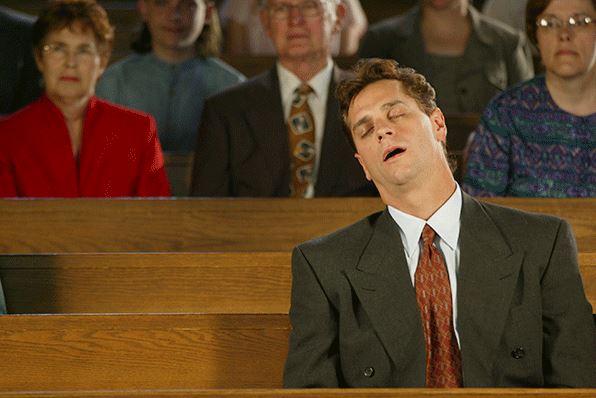
How can we get single men and husbands to be interested in church and ministry?

Church sucks, that's why men are bored there
Church is ineffective and impractical, and that’s why men are bored there

Consider this passage from William Lane Craig’s April 2013 newsletter, which made me very excited and happy. (H/T Triablogue)

Here it is:

One overwhelming impression of these engagements is the way in which the intellectual defense of Christian faith attracts men. Both at Texas A&M and again at Miami every single student who got up to ask a question was a guy! I wondered if the girls are just shy. But then I remembered a lengthy clip Jan and I watched of cast members of Downton Abbey doing a Q&A with an audience in New York. Almost every person who came to the microphone at that event was a woman! It wasn’t until late into the evening that a man finally asked a question, which was remarked by all the cast members. Why the difference between that session and the ones I experienced?—simply because the Downton Abbey program is highly relational, which is more appealing to women, whereas my talks were principally intellectually oriented, which is more appealing to men.

Churches have difficulty attracting men, and the church is becoming increasingly feminized. I believe that apologetics is a key to attracting large numbers of men (as well as women) to church and to Christ. By presenting rational arguments and historical evidences for the truth of the Gospel, by appealing to the mind as well as the heart, we can bring a great influx of men into the Kingdom. I’m so pleased that the church in Canada seems to be awakening to this challenge! I’m convinced that we have the opportunity to revolutionize Western Christianity by reclaiming our intellectual heritage.

Now, I hear a lot of complaints from women in the church and pastors in the church about men not being interested in going to church. I think that the problem is that church is hostile to men’s natures. Men thrive on conflict and competition. Men prefer strict rules and moral judgments. Men prefer to shame people who underperform, rather than coddle them. Men are practical and results focused. So how should the church accommodate the different nature that men have? Apologetics is one way to appeal to the male nature.

Let’s take a look at it.

Pastors: church as it is now is abrasive to men’s male nature

In a recent William Lane Craig podcast, at time 8:47, the WLC tells Kevin Harris about how he and his wife Jan asked about six of the young men who attend his “Defenders” apologetics class which morning service they attended: traditional or contemporary. ALL of the young men said that they attended neither service, because they go to church to learn something and the service has no educational value to them. The only attend the Defenders class. The apologetics class taught them things they could actually use – things they could actually use to think better, and fight better. This is my experience as well, although I am looking for a better church that does have some appeal to men. I might even have to move to find a decent church that has apologetics.

There is absolutely nothing going on in most churches that is valuable to a man. Men, by and large, only pray as a last resort, after we have done everything we can to solve the problem ourselves. We pay the most attention to the parts of the Bible that help us debate with non-Christians, or that give us things to do. We like to find evidence in the real world that connects with what the Bible is saying. We are interested in planning, execution and results. We are not very interested in feelings, singing, devotions, or bending the rules to make people doing bad things feel good. Now that’s not necessarily true for all men, but it is true for the majority of men.

And lest some people worry that fighting makes enemies, it doesn’t. Fighting with non-Christians has two effects: 1) they respect Christianity more, and 2) they want to be your friends and talk to you about spiritual things. Atheists see your standing up for what you believe in and living consistently with it indicative of authenticity. That is not the exception, Christian women and pastors – that is the rule. Atheists don’t think that standing up for what you believe in makes Christianity look fake, they think it makes Christianity look authentic. Well, at least the ones who are worth talking to think that.

Wives: don’t choose men who had no interest in advocating for Christianity before you married them

A related problem I see is the problem of wives marrying the wrong men then complaining that the men they freely chose to marry are not interested in church. This is actually the woman’s fault. Most women don’t think about what is best for God when they think about who to marry and have children with, they think about what makes them feel good. They don’t have any kind of plan where they match the man’s ability to the roles he will play as husband and father – they just pick who makes them feel good. This works about as well as buying and selling stocks based on which make you feel good, or choosing electronics and computers based on the color, or choosing a job or a church based on what the building looks like. The Bible lays out a few minimal requirements for a man: chastity, self-sacrificial love, providing for family, leading on moral and spiritual issues. Most young, unmarried women don’t value those things. If a woman picks a man who doesn’t make any demands on them, and who doesn’t judge them, then she cannot depend on him to show spiritual and moral leadership later on in the marriage. So don’t pick a man like that.

Wives: men respond to attention, recognition and approval from women

The reason that most husbands don’t engage in Christianity is because most wives (not my married friends of course) haven’t approached Christianity as something that is objectively true. Men don’t create illusions for themselves in order to feel better – they are more practical than that. Men only invest in things that they think are true, and where they can see that their practical efforts will make a difference. Men are turned off by the view that Christianity is just something that helps families and communities bond, and makes people feel comfort. We think that’s weakness, and we abhor weakness. Once men get the idea that a woman thinks of Christianity as feelings-fulfillment, we stop trying to achieve anything for the Kingdom of God. Men don’t want to be roped into Christianity if all it means is helping people get along and feel good. But they very much want to be roped into a demanding relationship with God where their efforts to achieve results count with God and gets them recognition and approval from their wives.

So how do wives learn to recognize and approve of what men do as Christians? Well, women need to learn apologetics and they need to practice debating with non-Christians. That will teach them to value conflict and competition, and to see how engagement and authenticity drives relationships with non-Christians forward. If women show an interest in objective truth, moral goodness and theological correctness, then men will become interested in these things, too. They will do it because men are addicted to pleasing women, and they want to help women more than anything in the world, second only to pleasing God. Men will enthusiastically engage in whatever will get them praise and recognition from women, and that means that women have to care about Christianity beyond their personal emotional experience of it and beyond their social cohesion experience of it. Initially, wives must be ready to praise and encourage their husbands, and then once the husbands get it, then they will be self-motivated and move out on their own. It will be self-sustaining.

When talking with a non-Christian, make truth – not behavior – the main issue

Bible study that hits the spot

Pastor Matt posted about something that I think all Christian apologists believe, deep down. (H/T The Poached Egg)

He writes:

Typically, the church has defined loving one’s neighbor as in line with Jesus’ parable of the Good Samaritan (Luke 10:25-37) and Christ’s teaching in passages such as Matthew 25:31-46, in which we are commanded to love the imprisoned, the homeless, the hungry, etc. as if they were Jesus himself. Of course all believers should do so whether by volunteering at a soup kitchen or donating money to ministries like World Help.

But there is more to loving one’s neighbor these days than caring for the poor, as important as that is.  Those of us who live in a first world western country now dwell in a post-Christian society.  Our neighbors are inundated with naturalism masquerading as good science and sound philosophy.  Non-Christians believe the faith is intellectually vacuous.

It shocks many people when those trained in apologetics point out that atheists cannot answer questions like, “How did the universe come into existence?” “Why is our planet so finely tuned for life despite all the odds against it?” “How did life begin?” “Why do humans have consciousness?” “How is there truth or right and wrong without God?” “Why did the disciples die horrible deaths as impoverished traveling peasants rather than deny the resurrection of Jesus?”, etc.

If we are to help bring our neighbors to saving faith, we must first destroy their false ideas of what Christianity is and is not.  That means we must preach the Gospel (2 Cor. 5:21), knock down specious views of the faith and present the truth of what we believe.

Apologetics is not just an intellectual exercise for nerds like me or a debate to be won on college campuses but an increasing tool in loving our neighbors.  For if they do not understand the faith, they will likely not come to faith and that is what the God we love wants and how we must show love to our neighbors.  So, let’s study not just to win arguments but to love others.

That reminds me of 2 Corinthians 10:3-5. Our job is to beat up on false ideas and speculations.

Pastor Matt’s point is critical, I think. Just stop and think for a minute about your non-believing co-workers. Do they know that the universe began to exist? Do they know that the initial conditions and the cosmological constants have to be finely tuned to support things like galaxies, stars, planets and elements heavier than hydrogen? Do they know how much information is in a protein, and how many proteins would be needed to make the first living cell? Do they know what it takes to make a planet that can support life? What facts from the gospels and the Pauline letters pass the tests for historicity? What is the best explanation of those minimal facts?

These are the facts that we share when we discuss spiritual things with people. They are not Christian facts, they are public, testable facts. And yet, almost no one in the culture who is not already a believer is curious to find out these things on their own. But without the evidence, how are they supposed to take the first step towards a relationship with God through Jesus Christ? It’s not possible. This is a propositional faith, and we know it’s true by evidence. To share the evidence with someone so they can decide is as loving as sharing the evidence about retirement planning, or the evidence about nutrition, or the evidence about fitness and exercise, or the evidence about career planning. When you love someone, you tell them the facts, and then they decide. Evangelism is the same thing.

Here’s something from a recent post by J. Warner Wallace, where he talks about doing apologetics with people who have not yet decided whether God exists or not.

The Undecided

In many ways, this group holds the most promise. People who are undecided usually fall into two categories. Some have never really given the issue much thought. They’re neither for nor against; they’ve simply been living unaware. You may be the first person to introduce them to the issues you are trying to share. If so, remember the importance of a first impression. What you say or do will have an impact on the work of those who follow you. The second group of “undecideds” are people who have given the issue some thought, but are just beginning to make their decision. For this group of people, your defense of Christianity may very well be the deciding factor. The responsibility you and I have with the undecided is daunting, but it’s a privilege to play a small part in their decision.

OK, so I want to make a point about this. So often, I see Christian parents and leaders trying to focus on changing people’s behaviors, and not by giving them evidence. Instead of trying to convince them about what’s true, they tell them Bible verses, or maybe tell them they are going to Hell. But given what Matt and J. Warner said, I don’t want us to be focused on changing outward behavior. I want us to be focused on showing people what is true and showing our work – how we arrived at these true beliefs. You are doing Christianity wrong if you focus on getting behaviors from people by shaming them, overpowering them or scaring them.

So in my case, I’m not trying to get non-Christians to act like Christians when they have no reasons to be one. I’m trying to get them to settle on true beliefs – so that each of them and God can shake hands and be reconciled, responding to his drawing them of their own free will. Then, they can decide how they are going to act. And how they act might be even better than what we had in mind for them when all we wanted was for them to quit swearing and eat their vegetables. The Christian life is bigger than just making people do what we want them to do.