
Bible study: Was the resurrection body of Jesus spiritual or physical?

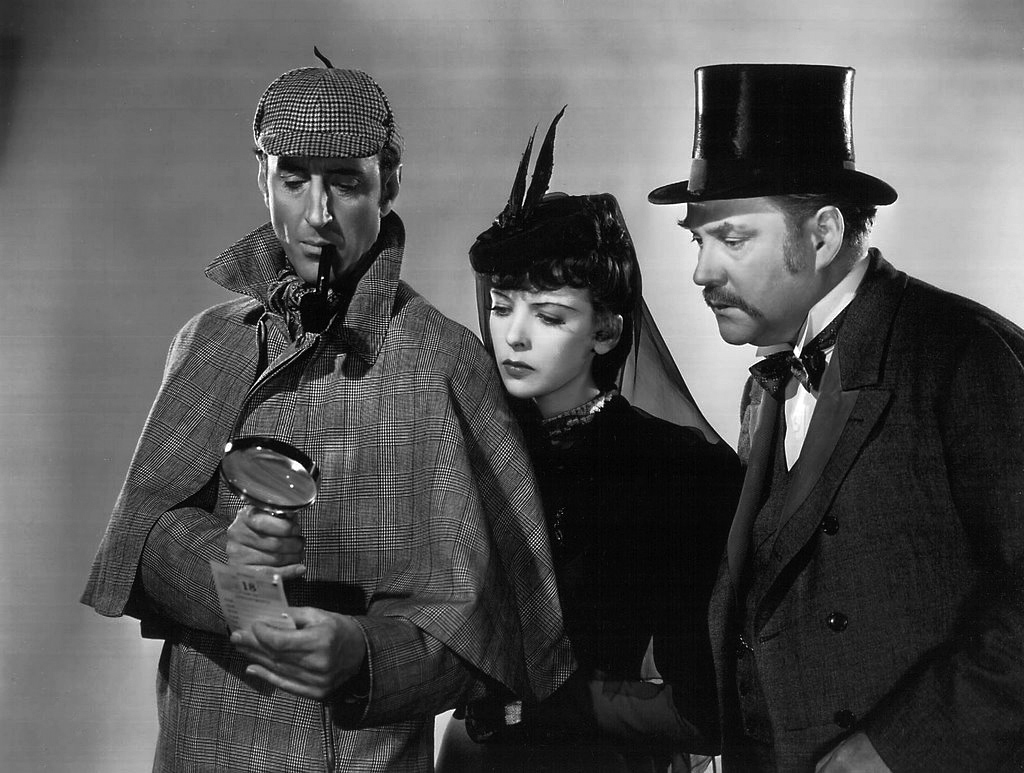
Sherlock Holmes and John Watson are going to take a look at the data

So, everyone from left to right accepts the early creed in 1 Corinthians 15:3-7 being dated to 1-3 years after the death of Jesus, even atheists like Crossley, Ludemann and Crossan. The thing is, some people are not sure that the appearances of Jesus to individuals, groups, and skeptics really were physical appearances. They say “well, Paul’s appearance was non-physical, so the other ones must have been, too”.

Let’s take a look.

Here’s a paragraph from my friend Eric Chabot, from his blog Think Apologetics. He explains why Paul’s use of the word “resurrection” to describe what the other witnesses saw means bodily resurrection.

He writes:

If Paul did have a vision then the term “vision” is vague and must be defined. As Licona points out, visions are either objective (i.e., something that is seen without the use of our natural senses) or subjective (i.e., a  product of our minds). The real  problem is with the vision hypothesis is that it doesn’t explain Paul’s use of resurrection to explain what had happened to Jesus.  The two words are used for resurrection in the New Testament “anastasis” (rising up) and “egersis” (waking up), both imply a physical body. Furthermore, the use of the word “opethe” (the Greek word for appeared) shows the Gospel writers did believe that Jesus appeared physically. “There you will see (opethe) him” (Matt. 28:7); “The Lord has risen and has appeared (opethe) to Simon” (Luke 24:24). When they used “opethe” here, it means that He appeared physically to them.

So when Paul gives his list of appearances in 1 Cor. 15, the issues becomes whether the appearance to him is the same as it was to the disciples. There is no doubt the post resurrection body of Jesus (after the ascension) had to be somewhat different than the body the disciples saw. Also, whenever the New Testament mentions the word body, in the context of referring to an individual human being, the Greek word “soma” always refers to a literal, physical body.Greek specialist Robert Gundry says “the consistent and exclusive use of soma for the physical body in anthropological contexts resists dematerialization of the resurrection, whether by idealism or by existentialism.” [9] Furthermore, in N.T. Wright’s  The Resurrection of the Son of God shows that the Greek word for resurrection which is “anastasis” was used by ancient Jews, pagans, and Christians as bodily in nature.

Now, I think my view on this, and I’m not sure if Eric would correct me, is that Paul got an objective but non-physical vision of Jesus. There was something there that everyone else could see and hear, in my view. But in my view Paul’s “veridical” vision was post-ascension, and so non-physical. Paul uses the word resurrection to describe what the other eyewitnesses saw (and he met them at least twice, according to Gal 1 and Gal 2), and that means physical resurrected body.

Eric Chabot writes this in another place:

Acts 9- Paul’s Damascus Road Experience

Here we see whatever happened,  this was after the ascension. Hence, to say Paul saw the exact same Jesus before he ascended is hard to infer from the text. There simply isn’t enough information here.  The Bible says, “they heard” the same voice Paul did ” (Acts 9: 7). But they “did not see anyone ” (Acts 9: 7). Notice  Paul was physically blinded by the brightness of the light.  One way or the other, the experience involved something that was external to Paul. It wasn’t something that was the same thing as a vision that Paul talks about in 2 Cor. 12:1.  Furthermore, the phrase “he let himself be seen’” (ōphthē , aorist passive, ), is the word Paul uses  in 1 Cor. 15:7 to describe of his own resurrection appearance as the other ones in the creed. As Paul Barnett says:

“It is sometimes claimed that the word appeared (ōphthē) means a mystical seeing, as of a vision, and that since this was what Paul “saw” it was what the other apostles “saw.” In other words, after death, Jesus was taken directly to heaven whence he “appeared” to various people, mystically, as it were. This however, is not all the meaning of Paul’s words. First, the word ōphthē, “appeared” is not limited to visionary seeing it is also used for physical seeing. Moreover, the verb raise used in the phrase ‘raised on the third day” is used elsewhere in combination with the words “from the dead” which literally means “from among the corpses.” Thus raised preceding  appeared gives the latter a physical not a mystical meaning. Christ, as “raised from the dead” ….appeared.”  Furthermore, when Paul asks “ Am I not free? Am I not an apostle? Have I not seen Jesus our Lord?”(1 Cor. 9: 1), he is using the ordinary word horan, “to see” for physical sight. If “seeing” the Lord “raised from the dead” qualified others to be apostles, then Paul is, indeed, an apostle. It was no mere subjective vision that arrested Paul en route to Damascus. (8) .

In the end, word studies can’t entirely resolve this issue. We need to remember the etymological fallacy as well. We  would have to look at all the texts that speak of resurrection (including the entire 1 Cor. 15 chapter in their entire context as well as the anthropology of the New Testament. We also need to study the resurrection in light of the Second Temple Jewish period. See our reading list here for some resources that may help.

But conservative ancient historian Gary Habermas seems to think that Paul got the physical body as well.

He says:

Now, I said before in 1 Corinthians 15, Paul could have chosen to only use the word pneuma. He doesn’t. He does say “spiritual,” but he’s got an adjective there. He also says, soma, “body.” What did Paul mean?

Philippians Chapter 3. It’s a short chapter. There are 21 verses, but Paul says three things in one chapter that indicate he’s talking about a physical resurrection. In the opening verses he says, “I was a Hebrew of the Hebrews” and “as touching the law,” he says, “I was a Pharisee.” Now, it’s very well known that the Pharisee believed in a bodily resurrection. In fact, according to Acts 23, as Paul was being taken captive by the Romans to prevent his being killed, he shouted out to the group of people and said, “Why are you taking me? Because I believe in the resurrec­tion of the dead?” He meant a literal resurrection.
When the Pharisees heard that, they said there’s nothing wrong with this guy. But the Sadducees [who didn’t believe in the Resurrection] didn’t like it. So as a Pharisee, he’s agreeing with the Pharisees.
So, the first evidence is from Philippians 3. As a Pharisee, Paul believes in a physical resur­rection.
Secondly, in verse 11 he says, “That I may attain the resurrection of the dead.” Now, the normal Greek word for resurrection is anastasis, but in this passage, Philippians 3:11, he puts a prefix on there, ek anastasis. Ekanastasis, according to all Greek scholars that I know of, is translated in this passage: “The out resurrection from among the dead.” Paul said, “I want to attain the out resurrection.”
Now, to a Jew, “out resurrection” means “what goes down is what comes up.” You come out from death. And then just a few verses later, Philippians 3:20,21, he said, “From Heaven, we look for Jesus who will change our vile soma (body) to be like unto His glorious soma (or body),” when he should have said pneuma, according to this other view.
So he’s a Pharisee who believes in a physical resurrection. Ek anastasis—“resurrection from out among the dead ones.”
Thirdly, Paul says, “He Jesus will change my body to be like His body.”

So right there in Philippians 3 alone, I think the picture of Jesus being some wispy spirit that appeared to him on the road to Damascus doesn’t fit Paul’s own data.

Yes, that’s why Philippians is my favorite book. You can get so much useful theology out of it. Something about the resurrection in Phil 3, something about Jesus’ divinity in Phil 2, and loads of practical advice on stewardship, charity, fellowship, endurance and practical love for others throughout. Some of it takes a little digging, but that’s what commentaries are for, am I right? But I digress.

If you want to read something a little more challenging, I found a paper from the Evangelical Theological Society (ETS) from their journal, where it talks more about soma and anastasis. If you want a bit of a challenge, download the PDF and read it. It’s by Kirk R. MacGregor and the title is “1 Corinthians 15:3B–6A, 7 And The Bodily Resurrection Of Jesus”.
New study: Tennessee pre-K program provides no educational benefit over control group

This is the most thorough study that I have ever seen evaluating the effectiveness of pre-K programs. The study was done by researchers at Vanderbilt University. (H/T Brad Wilcox tweet)

The study was reported on by the well-respected but leftist Brookings Institute.

They write:

State investments in center-based school readiness programs for preschoolers (pre-K), whether targeted for poor children or universally implemented, have expanded more rapidly than evaluations of their effects. Given the current interest and continuing expansion of state funded pre-K, it is especially important to be clear about the nature of the available evidence for the effectiveness of such programs. Despite widespread claims about proven benefits from pre-K, there is actually strikingly little credible research about the effectiveness of public pre-K programs scaled for statewide implementation.

Like many states that became interested in scaling up a state funded pre-K program in the early 2000’s, voluntary pre-K (TNVPK) was introduced in Tennessee in 1996 as a way to provide academic enhancement to economically disadvantaged children. It expanded in 2005 to an $85 million-plus statewide investment serving 18,000 Tennessee income-eligible children in 935 classrooms across all 95 counties.

Launched in 2009, the TNVPK Effectiveness Study, a coordinated effort between Vanderbilt’s Peabody Research Institute and the Tennessee Department of Education, is a five-year evaluation study funded by the US Department of Education, Institute for Education Sciences. It includes the first randomized control trial of a scaled up state funded pre-K program and the first well-controlled comparison group study of the effects of program participation as children progress through elementary school..

Policymakers and proponents often cite some of the famous early studies of pre-K programs that have shown long term benefits extending into adulthood for the participating children. But those were studies of especially complex programs that are unlike scaled-up public pre-K in many ways. The Vanderbilt study is the first rigorous controlled longitudinal study to be conducted on a large-scale state-funded pre-K program.

And here is a summary of the results:

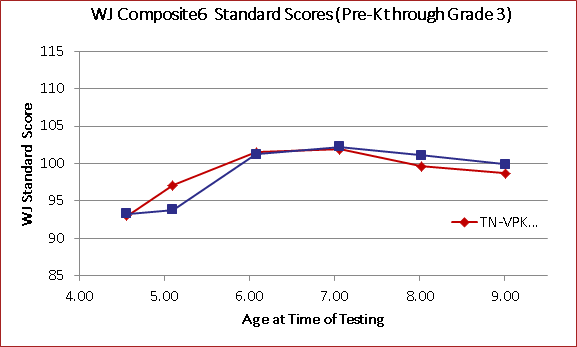
Standard score results from pre-K through 3rd grade on a composite measure that averaged the six achievement subtests are presented from baseline forward in the graph below.

As is evident, pre-K and control children started the pre-K year at virtually identical levels. The TNVPK children were substantially ahead of the control group children at the end of the pre-K year (age 5 in the graph). By the end of kindergarten (age 6 in the graph), the control children had caught up to the TNVPK children, and there were no longer significant differences between them on any achievement measures. The same result was obtained at the end of first grade using two composite achievement measures (the second created with the addition of two more WJIII subtests appropriate for the later grades). In second grade, however, the groups began to diverge with the TNVPK children scoring lower than the control children on most of the measures. The differences were significant on both achievement composite measures and on the math subtests. Differences favoring the control persisted through the end of third grade.

In terms of behavioral effects, in the spring the first grade teachers reversed the fall kindergarten teacher ratings. First grade teachers rated the TNVPK children as less well prepared for school, having poorer work skills in the classrooms, and feeling more negative about school. It is notable that these ratings preceded the downward achievement trend we found for VPK children in second and third grades. The second and third grade teachers rated the behaviors and feelings of children in the two groups as the same; there was a small positive finding for peer relations favoring the TNVPK children by third grade teachers, which did not meet traditional levels of statistical significance.

Results graph:

TNVPK data: pre-K program is in red, baseline is in blue

We are already seeing that cheap daycare in high-tax, big government provinces like Quebec cost a lot, and produce negative results. And of course Hillary Clinton is a longstanding advocate of universal pre-K. As a Senator of New York, she introduced a universal pre-K plan that would cost $10 billion over 5 years. President Barack Obama’s own Preschool for All plan would cost $75 billion over 10 years. This Vanderbilt study should cause us to question whether the policies of the secular left, pushed largely because of emotions and ideology, are worth the tens of billions of dollars they want to take from us. And if you take tens of billions of dollars out of families, then families on the margin will have to give their children to the state to raise. And that includes Christian families, who would no longer be able to afford a stay-at-home mother.

Now, taking children away from parents so that their mothers can work is seen as a worthy goal by those on the secular left. First, communally raising the children is “good” because it removes inequalities between single mothers and traditional working-husband homes. Second, making it easier for women to “go fatherless” is “good” because fathers are not to be trusted to teach their children about morality and religion. That is best left to secular government workers. Third, mothers who choose to marry good providers pay less in taxes if they choose to stay home with their kids and not work. That is “bad” because the government wants more taxes, so they can spend it on vote-buying social programs. Fourth, children who form stable bonds with their parents are less likely to become dependent on the government, meaning their allegiance cannot be bought with government handouts. That is also “bad”. Fifth, it is also “bad” that children who grow up with stay-at-home mothers are more likely to develop empathy and morality, which gives them an independent standard by which to judge the government’s actions.

Related posts

By any measure, Obamacare has been a disastrous failure

Well, the law was supposed to take until now to come into full effect. Now that we are getting the full Obamacare, what are we seeing?

The Wall Street Journal says not enough of the young Democrats who voted for Obamacare are signing up for it:

This month the Health and Human Services Department dramatically discounted its internal estimate of how many people will join the state insurance exchanges in 2016. There are about 9.1 million enrollees today, and the consensus estimate—by the Congressional Budget Office, the Medicare actuary and independent analysts like Rand Corp.—was that participation would surge to some 20 million. But HHS now expects enrollment to grow to between merely 9.4 million and 11.4 million.

Recruitment for 2015 is roughly 70% of the original projection, but ObamaCare will be running at less than half its goal in 2016. HHS believes some 19 million Americans earn too much for Medicaid but qualify for ObamaCare subsidies and haven’t signed up. Some 8.5 million of that 19 million purchase off-exchange private coverage with their own money, while the other 10.5 million are still uninsured. In other words, for every person who’s allowed to join and has, two people haven’t.

Among this population of the uninsured, HHS reports that half are between the ages of 18 and 34 and nearly two-thirds are in excellent or very good health. The exchanges won’t survive actuarially unless they attract this prime demographic: ObamaCare’s individual mandate penalty and social-justice redistribution are supposed to force these low-cost consumers to buy overpriced policies to cross-subsidize everybody else. No wonder HHS Secretary Sylvia Mathews Burwell said meeting even the downgraded target is “probably pretty challenging.”

The program doesn’t work unless young, poor, healthy people are forced to pay for the health care of rich, older, sickly people.

The radically leftist New York Times reports that out of the 22 health insurance co-ops Obamacare created, nine of them have already closed – leaving customers without coverage.

Excerpt:

The grim announcements keep coming, picking up pace in recent weeks.

About a third, or eight, alternative health insurers created under President Obama’shealth care law to spur competition that might have made coverage less expensive for consumers are shutting down. The three largest are among that number. Only 14 of the so-called cooperatives are still standing, some precariously.

The toll of failed co-op insurers, which were intended to challenge dominant companies that wield considerable power to dictate prices, has left about 500,000 customers scrambling to find health insurance for next year. A ninth co-op, which served Iowa and Nebraska, closed in February.

At a time when the industry is experiencing a wave of consolidation, with giants like Anthem and Aetna planning to buy their smaller rivals, the vanishing co-ops will leave some consumers with fewer choices — and potentially higher prices.

The failures include co-ops in New York, Colorado, Kentucky and South Carolina.

The shuttering of these start-ups amounts to what could be a loss of nearly $1 billion in federal loans provided to help them get started. And the cascading series of failures has also led to skepticism about the Obama administration’s commitment to this venture.

UPDATE: A day after this was posted, another IRS co-op has just closed, this time in Utah. Now we are up to 10 out of 22.

Cato Institute health care expert Michael Tanner talks about the increases in health care premiums caused by Obamacare at CNS News:

For example, insurance companies have begun submitting their requests for rate increases for 2016, and those requests suggest that premiums could skyrocket next year. Already we’ve seen requests for increases for individual plans as high as 64.8 percent in Texas, 61 percent in Pennsylvania, 51.6 percent in New Mexico, 36.3 percent in Tennessee, 30.4 percent in Maryland, 25 percent in Oregon, and 19.9 percent in Washington. Those increases would come on top of premium increases last year that were 24.4 percent above what they would have been without Obamacare, according to a study from the National Bureau of Economic Research. At the same time, deductibles for the cheapest Obamacare plans now average about $5,180 for individuals and $10,500 for families.

Recall that on this blog, pretty much all of 2009 and 2010 was spent carefully explaining the moral hazards and other problems created by Obamacare. This was stuff that Republicans knew would happen. But on the other side of the aisle, there was too much naive, youthful exuberance from the secular left. Evidence was ignored, and feelings won the day. Obamacare was passed on the memes and tweets, while the studies reported by people like me went entirely unread.

Investors Business Daily just posted a list of 12 problems with Obamcare for the middle class:

Remember how many times I blogged about this one:

6. Shorter Workweeks

Because ObamaCare’s employer mandate fines don’t apply for workers who average fewer than 30 hours per week, the law gives companies an incentive to put a cap on workhours — particularly for low-wage workers who are less likely to be offered coverage.

The impact isn’t big enough to show up in economywide data, but there’s little doubt that the employer mandate has hurt a lot of people. IBD found 450 employers that capped workhours, and Current Population Survey data show a dive in the share of workers clocking just above 30 hours per week.

And what about the penalty for not buying what the government tells you to:

7. Impact On Wages

In 2016, a company with 50 full-time-equivalent workers could face a penalty of $2,160 per employee (with 30 workers exempted). When the after-tax fine is converted to tax-deductible wages, it equates to $1.71 an hour for a full-time worker.

Who will pay the penalty? For the most part, it won’t be employers — at least not directly. The CBO expects that “the penalty will be borne primarily by workers in the form of reduced wages or other compensation.”

Again, I want to emphasize that it is the evidence-hating secular left that is surprised by these “unexpected” problems with their childish policy. Those of us on the religious right predicted them, because we read the studies that were done before the 2012 election.

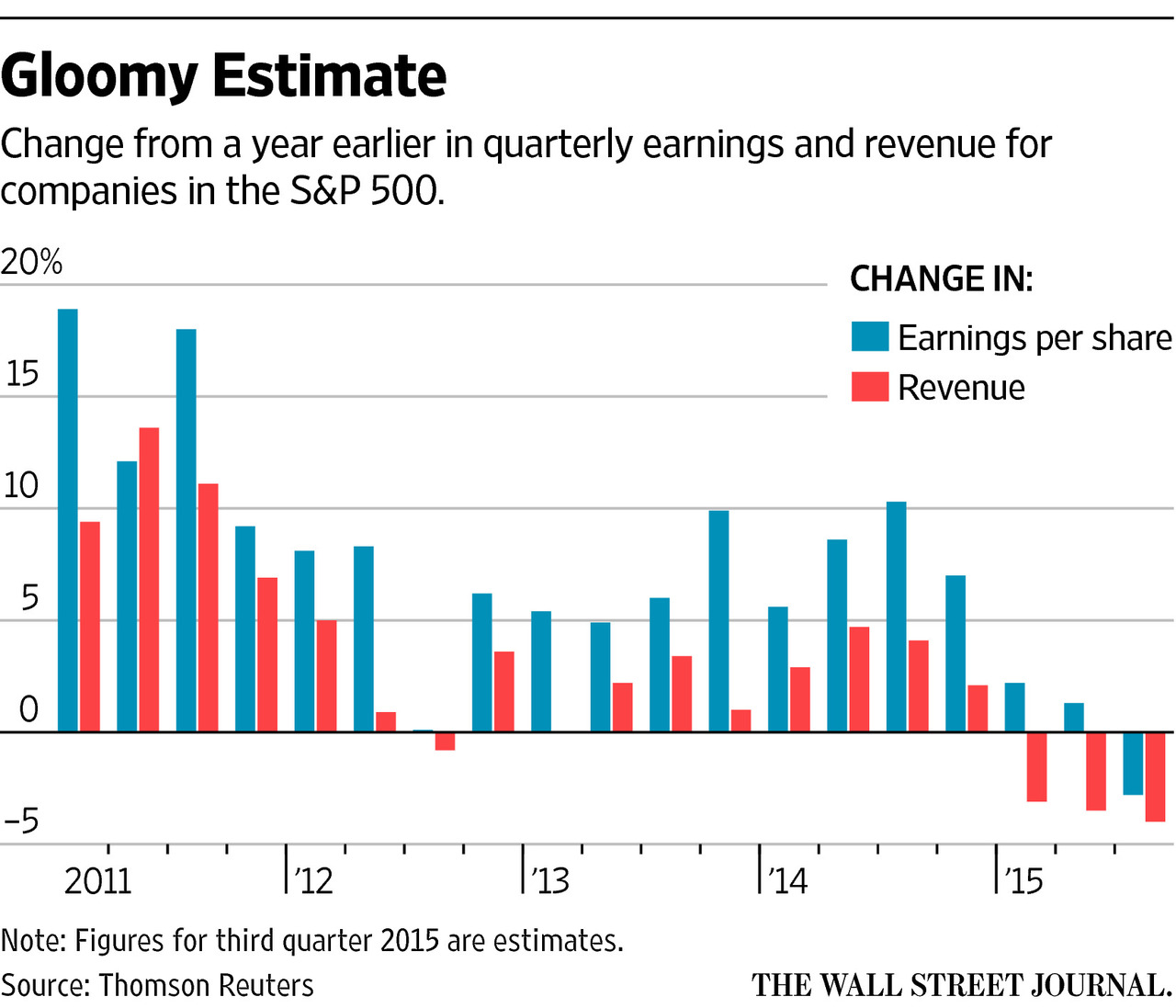
The Wall Street Journal reports that the economy’s not doing so well, either:

Changes in quarterly earnings and revenue for S&P 500 companies

In 2006, we handed both the House and Senate to Democrats. The national debt was $8.5 trillion. In 2008, we handed the Presidency to the Democrats. The national debt was $10 trillion. After 10 years of Democrats, we now have a national debt of $18.5 trillion. It has been a long, low-interest, no-growth Keynesian binge. The kind of economics you expect from a socialist community organizer.