Five reasons why the multiverse is not a good explanation for cosmic fine-tuning

Apologetics and the progress of science

This post by J. Warner Wallace appeared at his Cold Case Christianity blog. It features 5 reasons why the multiverse hypothesis is not a good explanation for the astonishing degree of fine-tuning we find in the cosmic constants and quantities in the universe that allow complex, embodied intelligent life of any conceivable kind.

Here is the list:

  1. This Explanation Lacks Evidential Confirmation
  2. This Explanation Requires Fine-Tuning
  3. This Explanation Relies on Speculative Notions of Time
  4. This Explanation Results in Absurdities Common to “Infinites”
  5. This Explanation Acknowledges an “External” Creative Cause

Let’s take a closer look at numbers two and three:

This Explanation Requires Fine-Tuning
If there is a multiverse vacuum capable of such creative activity, it would be reasonable for us to askhow the physics of such an environment could be so fine-tuned to create a life-permitting universe. As Oxford philosopher Richard Swinburne observes, any proposed multiverse mechanism “needs to have a certain form rather than innumerable possible other forms, and probably constants too that need fine-tuning in the narrow sense . . . if that diversity of universes is to result.” Theoretical physicist, Stephen Hawking, when assessing “eternal inflation” models as a source for the multiverse, admits the same problem of fine-tuning: “The problem is, for our theoretical models of inflation to work, the initial state of the universe had to be set up in a very special and highly improbable way. Thus traditional inflation theory resolves one set of issues but creates another—the need for a very special initial state.”

This Explanation Relies on Speculative Notions of Time
Theorists who propose a pre-existing vacuum must account for the nature of time in this setting. All descriptions of this vacuum describe it as temporal (with bubble universes emerging or quantum events occurring over time). But the Standard Cosmological Model indicates time, as we know it,began with our universe. Physicist Alexander Vilenkin describes the dilemma this way: “There is no matter and no space in this very peculiar state. Also, there is no time . . . In the absence of space and matter, time is impossible to define. And yet, the state of ‘nothing’ cannot be identified with absolute nothingness.” Multiverse explanations must provide an account for the temporal nature of the vacuum lying at the core of their theory.

Regarding  Wallace’s first point, here is MIT physicist Alan Lightman talking about the multiverse’s evidential problems in Harper’s Magazine.

He writes:

The… conjecture that there are many other worlds… [T]here is no way they can prove this conjecture. That same uncertainty disturbs many physicists who are adjusting to the idea of the multiverse. Not only must we accept that basic properties of our universe are accidental and uncalculable. In addition, we must believe in the existence of many other universes. But we have no conceivable way of observing these other universes and cannot prove their existence. Thus, to explain what we see in the world and in our mental deductions, we must believe in what we cannot prove.

Sound familiar? Theologians are accustomed to taking some beliefs on faith. Scientists are not. All we can do is hope that the same theories that predict the multiverse also produce many other predictions that we can test here in our own universe. But the other universes themselves will almost certainly remain a conjecture.

It’s not a good explanation of the data, it’s just desperate speculation. Don’t be one of these people that finds a way to believe what you want to believe. Look through the telescope for yourself. Believe what you can see with your own eyes – that’s the right way to get to the truth.
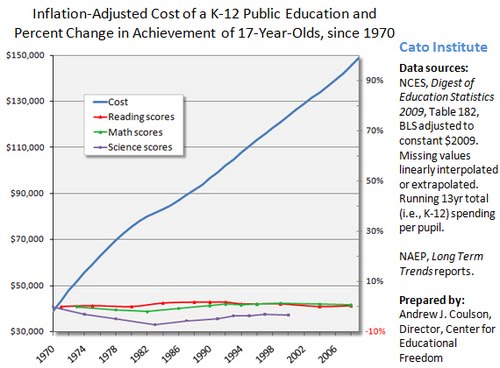
Public schools received more money, but produced lower student test scores

Now, we’ve already seen the dangers of Democrats like Hillary Clinton refusing to do her job at the State Deparment. During her term, she focused on promoting abortion abroad and on promoting LGBT rights, and neglected religious liberty and national security, i.e. – Benghazi and her insecure e-mail server. But what happens when Democrats in the education system focus on pushing a Democrat agenda, and neglect the task of teaching children the basic skills they will need to get jobs?

This article is from Investors Business Daily.

Excerpt:

For the first time in many years, national math and reading test scores have dropped for elementary-school kids. Who’s to blame? The better question is, who isn’t?

The biennial tests conducted by the National Assessment of Educational Progress measure reading and math comprehension among a sample of thousands of fourth- and eighth-graders.

Math scores dropped two points among fourth-graders and three points among those in the eighth grade. Fourth-grade reading scores were up a point, but reading scores in eighth grade dropped three.

Even the growth over the past two decades is unimpressive. The NAEP tests show that two-thirds of eighth-graders are less than proficient in math, and almost as many are below in reading. And proficiency levels in both subjects drop between fourth and eighth grades.

Educrats have offered lots of excuses for this year’s decline, but little explanation. It was the recession. It involved budget cuts. It’s a mystery.

But what the results show pretty clearly is that constant federal meddling and vast amounts of money have, if anything, impeded education progress, not spurred it on.

Per-pupil spending on elementary and secondary education has more than doubled since 1992, while math and reading scores eked out gains of less than 5%, on average.

Moreover, an endless series of Washington-based education changes have done little except cause disruption. In fact, Education Secretary Arne Duncan is now saying President Obama’s Race to the Top and Common Core measures are to blame for the sag in scores because the “improvements” are so sweeping. “Big change,” he said, “never happens overnight.”

Actually, when it comes to our centralized, bloated, bureaucratic, union-dominated public schools, big change never happens, period.

Spending on education has gone up a lot in the past decades, but test scores haven’t budged:

Cato Institute graphs education spending against test scores

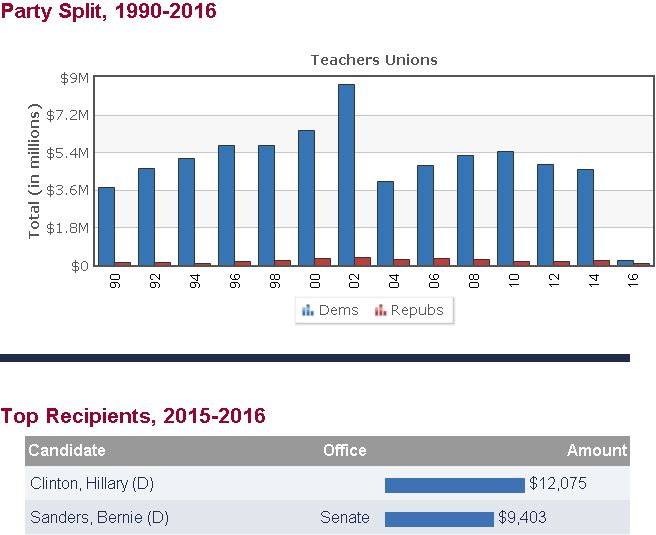
Although test scores are not going up, the teacher unions are donating millions of dollars to the Democrats so that there is no accountability:

Don't expect Democrats to put children's education needs over teacher unions
Don’t expect Democrats to put children’s education needs over teacher unions

(Source: OpenSecrets.org)

But there is some hope… when politicians embrace school choice, parents get to pull their kids out of failing schools and put them into customer-focused schools. Check out Bobby Jindal’s answer to a question about rising tuition costs in last night’s first CNBC debate:

Republicans should care about the education issue… because Democrats surely do not.

Ted Cruz and Marco Rubio won the debate against pro-Democrat CNBC “moderators”

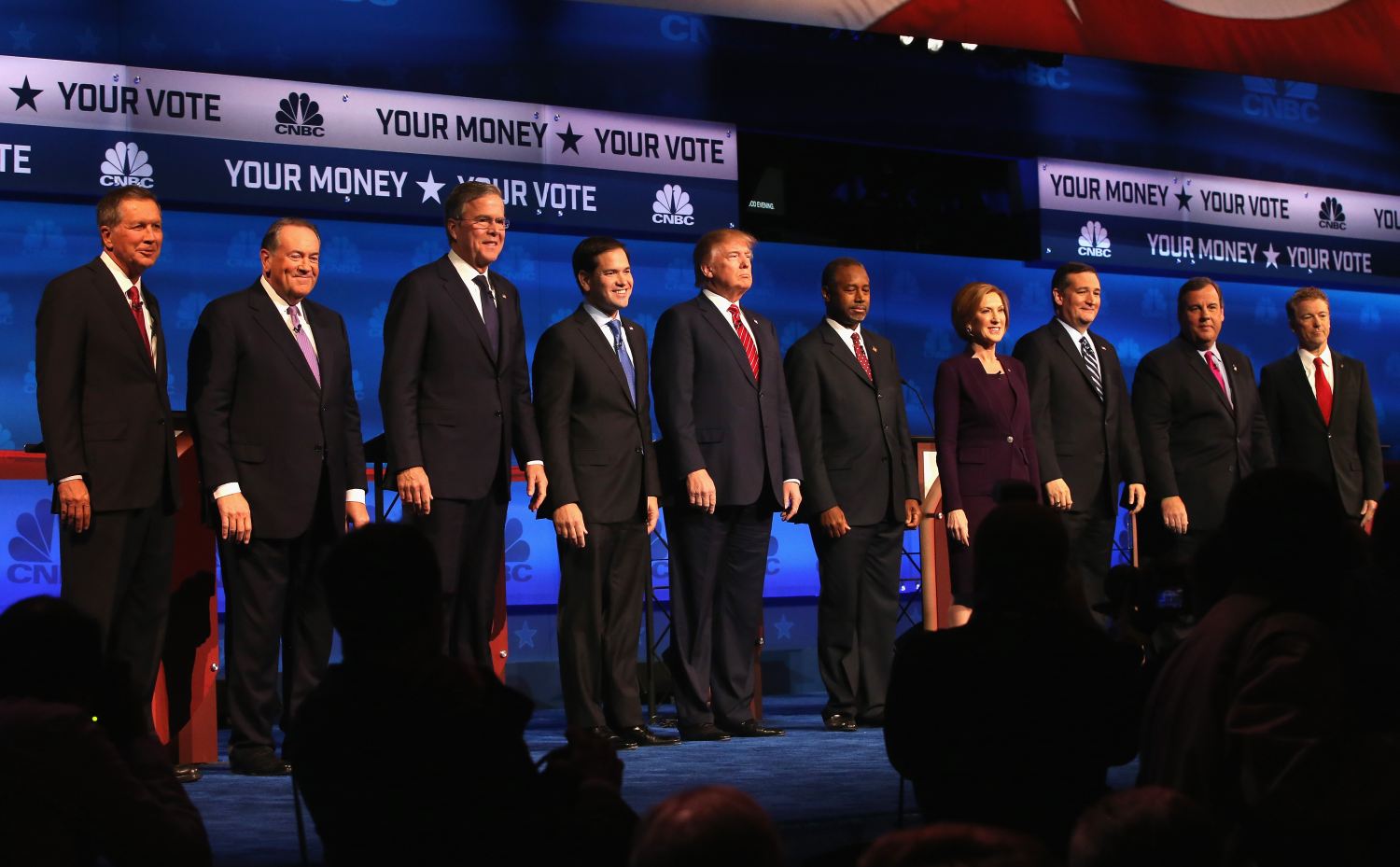
CNBC GOP primary debate candidates

The CNBC debate was a debacle. Leftist Democrat moderators tried desperately to make conservative ideas look as unpalatable as possible. Insults were phrased as questions, and substantive answers were constantly interrupted. But several of the debaters shined, in teeth of blatant media bias. The only questions that were not biased were those from Jim Kramer and Rick Santelli.

The best clip goes to Ted Cruz:

Transcript:

CRUZ: The questions that have been asked so far in this debate, illustrate why the American people don’t trust the media. This is not a cage match. And if you look at the questions, Donald Trump, are you a comic book villain? Ben Carson, can you do the math? John Kasich, can you insult two people over here? Marco Rubio, why don’t you resign? Jeb Bush, why have your numbers fallen? How about talking about the substantive issues people care about —

CNBC: Does this count? Do we get credit for this one?

CRUZ: And Carl, I’m not finished yet. The contrast with the Democratic debate, where every fawning question from the media was, which of you is more handsome and wise?

CNBC: Let me say, you have 30 seconds left to answer should you choose to do so.

CRUZ: Let me be clear. The men and women on this stage have more ideas, more experience, more common sense, than every participant in the Democratic debate. That debate reflected a debate between the Bolsheviks and the Menchavicks. Nobody watching at home believes that any of the moderators have any intention of voting in a Republican primary. The questions being asked shouldn’t be trying to get people to tear into each other, it should be what are your substantive solutions —

CNBC: I asked you about the debt limit and got no answer.

As expected, the ever-agile Marco Rubio outperformed.

Marco Rubio answering a puerile question from one of the CNBC Democrat stooges:

Marco Rubio taking on media for being in the pocketsof the Democrat Party:

Carly Fiorina on big government and socialism:

Ben Carson on his flat tax plan:

Ted Cruz on the need to audit the Federal Reserve:

Marco Rubio on balancing skilled immigration with training up the next generation of American workers, including vocational education in trades:

Ben Carson answers a question on gay rights and political correctness:

So many good Republican candidates, it’s hard to choose. I’m still liking Cruz and Rubio from this first-tier debate.

The Undercard / Second-Tier debate

I also watched the undercard debate, and Bobby Jindal won that one by a mile.

Here is his best clip, answering another biased question:

Jindal talks about his “everyone should pay something” tax plan:

Jindal was asked “Should for-profit schools be held accountable when they take taxpayer money and leave students deep in debt?” and he talked about his school choice policies in Louisiana, consumer-centered policies that promote choice and competition among education providers:

We always get a great post-debate podcast from the experts at The Weekly Standard. They agree with me that Cruz and Rubio won the debate. And they also think that CNBC lost the debate! Indeed. It’s indubitable.

Also, see this late-breaking post at from the Weekly Standard’s Jonathan Last. Last says that we are down to six candidates: “Trump, Carson, Rubio, Cruz, and maybe—just maybe—Fiorina and Christie”.