Tag Archives: Youth

Apologetics helps young men to resist being shamed by their secular peers

A post by Nick Peters about young people and apologetics, at the Christian Apologetics Alliance blog.

Excerpt:

Now picture a teenage youth who is a Christian. Is he on the outs with his peers in any way? Well if he’s a good and observant Christian, he’ll be a virgin (since most teenagers in high school aren’t married). Will that lead to any shame to his peers? Yep. Especially since they consider “getting laid” to be a rite of passage and a sign that you are a real man or woman.

So what happens with a boy who’s seventeen and can drive and who is with the guys who are talking about their sexual exploits and the guy has nothing to contribute? If he is asked why he’s not “getting some” he replies that he is a Christian. Is that going to win him any friends? Nope. His “friends” there will most likely mock him for believing in antiquated ideas that science has disproven and tell him he needs to get with the times. Result? The young man is shamed.

Now imagine instead if he’s told the latter part about how his ideas are antiquated and instead, he’s able to make a rational case for the resurrection of Jesus from the dead. Do you think he’ll be able to be shamed the same way? Sure, his friends can still mock him, but he can take the mockery as a sign that they cannot answer his arguments. The young boy has honor then, rather than shame. He might not be sleeping around, but he can hold his head high knowing he can stand up against his peers.

[…]No one wants to be embarrassed, and that includes youth, but if our young people think they can do something that none of their peers can do, it will help them to have that honor that they seek, and there is nothing wrong with seeking honor. Remember the parable where Christ told us to take a lowly position at a banquet so our host would say, “Move up to a better place” and we would be honored? He was saying that that is the proper way to receive honor. Don’t just go out and try to grab it. Let it be given to you.

There are many things that a young person can be ashamed of, but if they’re intellectually unprepared, being a Christian is something that they may be shamed for. In the face of temptation, they need a reason to be obedient rather than just, “The church says so” or “Mom and Dad say so.” Neither of those will be seen as honorable positions. They need to know for themselves why it is that they hold the stance that they do. If they are waiting until marriage, they need to know why. If they believe a man rose from the dead, they need to know why.

That youth are eating this stuff up should tell us something. Youth don’t want to be shamed in the eyes of their contemporaries. They won’t mind holding a different position as long as they can defend that position. If they cannot, then the tide of social pressure could be enough to get them to abandon that and if their emotions and wills start acting against Christianity, it is only a matter of time until the intellect follows.

That excerpt is basically a summary of my life – that’s how I started out as a teen – with apologetics. I’ve been a Christian the whole time in between then and now. I think many parents and churches are wondering how it is that you get a young man to stand up to the culture and peer pressure. The answer is apologetics, and I think integrating Christianity with every other area of knowledge helps as well. Winning arguments over and over is an excellent way to build a suit of armor against temptation and peer pressure.

And in speaking to young people who were raised as Christians then fell away, the common denominator is that they were uncomfortable claiming to be Christians in a secular environment. We have to have a plan to help our young people deal with pluralism and peer pressure. Apologetics is the best answer I can think of.
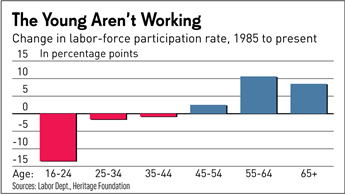
Young people who voted for Obama are holding fewer and fewer jobs

Youth labor force participation

Stephen Moore writes about Investors Business Daily.

Excerpt:

Economists are scratching their heads trying to figure out a puzzle in this recovery: Why are young people not working? People retiring at age 60 or even 55 in a weak economy is easy to understand. But at 25?

The percentage of adult Americans who are working or looking for work now stands at 62.8%, a 36-year low and down more than 3 percentage points since late 2007, according to the Labor Department’s May employment report.

This is fairly well-known. What isn’t so well-known is that a major reason for the decline is that fewer and fewer young people are holding jobs. This exit from the workforce by the young is counter to the conventional wisdom or the Obama administration’s official line.

The White House claims the workforce is contracting because more baby boomers are retiring. There’s some truth to that. About 10,000 boomers retire every day of the workweek, so that’s clearly depressing the labor market. Since 2009, 7 million Americans have reached official retirement age. The problem will get worse in the years to come as nearly 80 million boomers hit age 65.

But that trend tells only part of the story. The chart above shows the real problem: The largest decline in workforce participation has been those under 25.

[…]We do no favors to the young by teaching them that they can consume or have a good time without first earning the money they spend.

I think young people are often brainwashed at a young age to think that bashing the free enterprise system and voting for socialism isn’t going to take away their jobs. But if you vote to tax and regulate the businesses who may employ you later, you’ll find that they are too busy groaning under the strain of big government to employ you.

If young people were serious about getting jobs, they’d be voting to cut subsidies on universities to lower tuition costs, to lower corporate taxes, to cut environmental regulations, to repeal Obamacare, and so on. They would be more concerned that schools teach them actual skills instead of politically correct views, and so they would be voting for school choice and for right-to-work laws, to weaken the teacher unions who are not accountable to them. They should be voting against the minimum wage hikes that will price them out of an all-important first job. They should be voting against the (more than) doubling of the national debt in the 5.5 years under Obama. Job offers are not just there independent of the legal and economic environment. And just reaching a certain age doesn’t mean that you are qualified for a job.

J. Warner Wallace’s experience as a youth pastor

If you are a regular listener to Wallace’s podcast, as I am, you’ll have heard him talk about his experience as a youth pastor before. But if not, give this article a read.

Excerpt:

My first year as a youth pastor was a challenging year of self-evaluation. When I was initially offered the job, I wasn’t sure I could lead or teach high-schoolers; I’d been working with younger students and my own children were not yet teenagers. But I was ambitious and eager, so I accepted the position. I spent several months trying to decide what the teaching focus should be for my group. I surveyed some of the key seniors who had been in the ministry to see what they thought. We ended up doing a series on James and Ecclesiastes, and most of my energy that first year was expended on designing the Sunday service. I was concerned about “relevance” and spent a lot of time trying to understand how to communicate to this age group. I thought experience was as important as content. Actually, I thought experience was more important than content. My students got their money’s worth every Sunday. It was a musical, visual smorgasbord of video, images, interactive eclecticism and burning candles. It was ridiculous.

At the end of the first school year I could tell something was amiss. Most of my key seniors seemed disconnected and disinterested. I got through that first summer and the first semester of the next school year, striving continually to capture the imagination and attention of my student congregation. At Christmas break that year I had an epiphany. One of my key seniors from the prior year returned from Sonoma State where she had been attending her first year as a College freshman and announced to her parents that she was no longer a Christian. I got the call from her mother. I met with this student and she told me about her new life as an atheist. While I was frustrated and didn’t seem to be able to persuade her otherwise, I also wondered if she was the exception or the rule. I did some research on my other graduating seniors from the prior year. All but one had left Christianity, and they were only in their first semester as freshmen!

Don’t worry – the post has a happy ending. I wish more Christian leaders would allow themselves to accept that what they are doing now – avoiding apologetics because it is “divisive” and “prideful” – would learn from J. Warner Wallace. We need this. It works. What we are doing with young people now is not working.