Tag Archives: Work

Arthur Brooks: why is the American public shifting from optimism to envy?

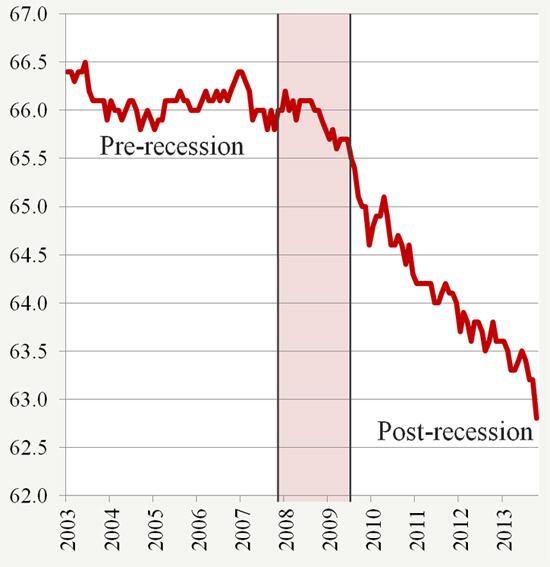
Labor Force Participation down to 62.8%

An editorial by Arthur Brooks appeared today in the leftist New York Times. His topic is the shift from optimism to envy, why it is happening, and whether envy makes us happier than optimism.

Excerpt: (links removed)

The Irish singer Bono once described a difference between America and his native land. “In the United States,” he explained, “you look at the guy that lives in the mansion on the hill, and you think, you know, one day, if I work really hard, I could live in that mansion. In Ireland, people look up at the guy in the mansion on the hill and go, one day, I’m going to get that bastard.”

[…]Unsurprisingly, psychologists have found that envy pushes down life satisfaction and depresses well-being. Envy is positively correlated with depression and neuroticism, and the hostility it breeds may actually make us sick. Recent work suggests that envy can help explain our complicated relationship with social media: it often leads to destructive “social comparison,” which decreases happiness. To understand this, just picture yourself scrolling through your ex’s wedding photos.

My own data analysis confirms a strong link between economic envy and unhappiness. In 2008, Gallup asked a large sample of Americans whether they were “angry that others have more than they deserve.” People who strongly disagreed with that statement — who were not envious, in other words — were almost five times more likely to say they were “very happy” about their lives than people who strongly agreed. Even after I controlled for income, education, age, family status, religion and politics, this pattern persisted.

It’s safe to conclude that a national shift toward envy would be toxic for American culture.

Unfortunately, in the wake of the Great Recession, such a shift may well be underway, given the increasing anxiety about income inequality and rising sympathy for income redistribution. According to data from the General Social Survey, the percentage of Americans who feel strongly that “government ought to reduce the income differences between the rich and the poor” is at its highest since the 1970s. In January, 43 percent of Americans told the Pew Research Center that government should do “a lot” to “reduce the gap between the rich and everyone else.”

Why the shift? The root cause of increasing envy is a belief that opportunity is in decline. According to a 2007 poll on inequality and civic engagement by the Maxwell School of Citizenship and Public Affairs at Syracuse University, just 30 percent of people who believe that everyone has the opportunity to succeed describe income inequality as “a serious problem.” But among people who feel that “only some” Americans have a shot at success, fully 70 percent say inequality is a major concern.

People who believe that hard work brings success do not begrudge others their prosperity. But if the game looks rigged, envy and a desire for redistribution will follow.

This is the direction we’re heading. According to Pew, the percentage of Americans who feel that “most people who want to get ahead” can do so through hard work has dropped by 14 points since about 2000. As recently as 2007, Gallup found that 70 percent were satisfied with their opportunities to get ahead by working hard; only 29 percent were dissatisfied. Today, that gap has shrunk to 54 percent satisfied, and 45 percent dissatisfied. In just a few years, we have gone from seeing our economy as a real meritocracy to viewing it as something closer to a coin flip.

There is a good lesson in this for people who want what is best for the poor. Simply receiving money from others is not going to make poor people happy. What we need to focus on is providing the poorest people with opportunities.

One way to help the poor is by giving poor children a better education. Conservatives support school choice, which takes money away from government and puts it back in the hands of parents, letting them choose the best school for their child. Schools have to produce good outcomes in order to earn the money, just like private businesses have to compete for customers. But Democrats oppose school choice, as when they killed the D.C. voucher program that helped poor black students. Less school choice helps public schools to be insulated from competition, which provides worse outcomes to students, especially poor minority students. If we really cared about poor, minority students, we would put pressure on public schools to compete with private schools. But the Democrats don’t want that, they prefer to give favors to their teacher union allies.

Democrats also want to punish job creators with high taxes and burdensome regulations. Democrats passed Obamacare, which punishes businesses with taxes if they allow part-time workers to work for more than 30 hours a week. Many jobs were lost because of this, and many people are now struggling to pay higher premiums for plans with higher deductibles and co-pays. Obamacare is a nightmare of intrusive regulations, too. Now the Democrats are talking about raising the minimum wage, which is going to put even more pressure on employers to lay off workers, because they can’t afford to pay them more money for the same work. For Democrats, this is all to the good, though. Because if the poor don’t have jobs, or can’t work enough hours, they start to see the economic game as “rigged” and they are more responsive to “envy rhetoric”. They start to look to big government for handouts, rather than trying to prevent the government from taxing and regulating job creators.

What we need to see is that it’s not the Democrats’ objective to help people find jobs. They gain when people become more envious, like in European countries, and start to vote to grow the size and power of government to redistribute wealth. Speeches about income inequality never have the goal of giving people jobs. None of Obama’s policies aim to do that. That’s why he won’t build the Keystone XL pipeline, or boost domestic energy development here at home. Instead, they want to extend unemployment benefits and pass the costs on to the next generation. Their goal is to get you unemployed or on disability or on welfare, so that you will vote for the government to continue to take your neighbor’s money to give it to you. That manufactured envy is what keeps the Democrats in power.

This plan to borrow from young people to buy the votes of old people today works for a while, until the money runs out. But by then, the politicians who put in place the redistribution programs are usually long gone .

Kansas enacts law to attach work requirement to welfare benefits

Kansas governor Sam Brownback

This story is from the Daily Signal, and it’s about a new (April 2015) Kansas law that produced great effects in the last year.

It says:

Over the past several years, the number of Americans on food stamps has soared. In particular, since 2009, the number of “able-bodied-adults” without dependents receiving food stamps more than doubled nationally. Part of this increase is due to a federal rule that allowed states to waive food stamps’ modest work requirement. However, states such as Kansas and Maine chose to reinstate work requirements. Comparing and contrasting the two approaches provides powerful new evidence about the effectiveness of work.

According to a report from the Foundation for Government Accountability, before Kansas instituted a work requirement, 93 percent of food stamp recipients were in poverty, with 84 percent in severe poverty. Few of the food stamp recipients claimed any income. Only 21 percent were working at all, and two-fifths of those working were working fewer than 20 hours per week.

Once work requirements were established, thousands of food stamp recipients moved into the workforce, promoting income gains and a decrease in poverty. Forty percent of the individuals who left the food stamp ranks found employment within three months, and about 60 percent found employment within a year. They saw an average income increase of 127 percent. Half of those who left the rolls and are working have earnings above the poverty level. Even many of those who stayed on food stamps saw their income increase significantly.

Work programs provide opportunities such as job training and employment search services. For example, in Kansas, workfare helped one man, who was unemployed for four years and on food stamps, find employment in the publishing industry where he now earns $45,000 annually. Another Kansan who was also previously unemployed and dependent on food stamps for over three years, now has an annual income of $34,000.

Furthermore, with the implementation of the work requirement in Kansas, the caseload dropped by 75 percent. Previously, Kansas was spending $5.5 million per month on food stamp benefits for able-bodied adults; it now spends $1.2 million.

So, I am doing a hunt to find the best states to live in, and Kansas is in my top 5. They have Governor Sam Brownback, and he has just done a magnificent job pushing conservative policies – not just social policies, but fiscal too. It’s a great state, but still edged out by Oklahoma and Tennessee, in my opinion. We’ll see what else Governor Brownback has in store, though.

You might think that all the news is bad, and that no one is putting into place any conservative policies. Well, of course the good red states are putting in these policies, and of course these policies are achieving the desired objectives. If you elect Democrats, you get Detroit. If you elect Republicans, you get welfare reform that lifts people out of dependency and into earned success. I’m sure that they feel better about not being dependent, too.

Should a man go into full-time apologetics ministry if he intends to marry?

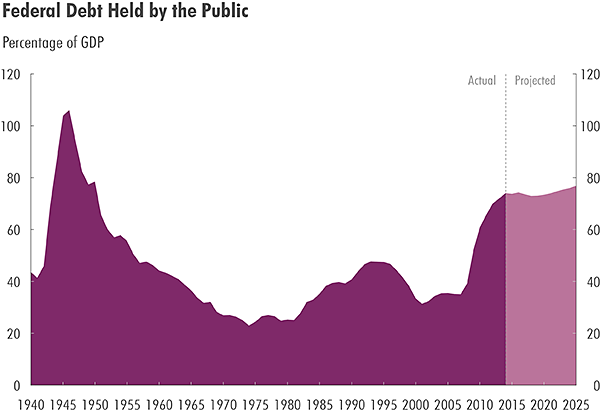
Congressional Budget Office: Debt to GDP ratio

Lydia McGrew has a post up at What’s Wrong With the World blog that is just excellent.

Excerpt:

Apologetics is wonderful and incredibly important. It’s a wonderful thing that a revival of specifically evidentialist apologetics is happening in the United States and even, to some extent, in the Anglophone world at large.

Unfortunately, this revival of interest in apologetics and in being Christian philosophers is coming at a very bad time, economically. Even if you are a genius, your chances in 2013 and following of getting a stable job by the route of going to graduate school in philosophy (or almost any area of the humanities) are pretty darned slim. If you’re not a genius, fuhgetaboutit. Nor were there ever all that many jobs in philosophy. It was always an iffy proposition, but it’s much worse now than it was even twenty years ago.

As for starting ministries, a poor economy makes it extremely hard to do that, too, because people don’t have as much disposable income to donate. Moreover, even in a more robust economy, if all the eager young apologists were to flock to start apologetics and/or campus ministries, they would be competing among themselves for a finite number of available dollars from donors. So that’s not the best idea either.

Let me speak very bluntly here: In my opinion, God doesn’t need a whole raft of impractical idealists out there getting themselves into debt or half starving (or really starving) with no idea of how in the world they are ever going to support even themselves, much less a family, out at the other end of their education. That just burdens the church with a large number of able-bodied but needy Christians who are in a seemingly unending stage of transition, “getting an education for the kingdom” or “hoping to do work for the kingdom” without a viable plan in mind or any fiscal light at the end of the tunnel.

Instead, I believe that we need an army of tentmakers. If you have a job or a marketable skill, for heaven’s sake (literally), don’t quit that job and join the ranks of starving students. Keep your day job, but enrich your mind and prepare yourself to answer people’s questions about Christianity by studying on your own time. If you have entrepreneurial abilities and the capital, start a business. That will support not only yourself but others you employ, and if successful, you will have more money to give to Christian ministries.

But even if you aren’t the entrepreneurial type or don’t have that opportunity, at least make sure (to the extent that one can in today’s world) that you can pay the rent and put food on your own table as well as supporting whatever number of additional people you plan to take on. (In other words, if you are a guy who would like to get married and have children, bear that in mind.) This will inevitably mean spending time at all that distasteful stuff like networking and making a resume. Bookish types don’t enjoy that stuff, because it seems bogus, but it can’t be helped. It will undoubtedly mean, for most people, not being full-time students beyond the undergraduate level, especially not in the humanities, not trying to become full-time academics as a life work, and not going into full-time ministry, even if you would ideally like to do one or more of those three things.

In the end, if we can have this army of tentmakers, there will be (Lord willing) money to allow some people to work in full-time ministry. But it’s going to be quite a small proportion of those who are interested or would ideally like to do so.

[…]Inevitably, the course of action I am suggesting will mean a bifurcation for many between their day job and what they are most passionately interested in. So be it. Indeed, so it has ever been in the world. What proportion of people at any moment in human history have been blessed enough to spend most of their time working on what they are most passionately interested in? The question answers itself. So I think that bifurcation has to be accepted by a great many people and that doing so will lead to what I might call a healthier “Christian economy” among committed Christians than what we could otherwise end up with.

So let’s see her advice in bullet-point form:

  • The job market for philosophers is very bad
  • A bad economy means less support money is available
  • It’s important to have a plan to fund your  ministry
  • Leverage your full-time job to fund your ministry

So I want to make two comments.

Making bad decisions because you think God is telling you to

I often find that when I talk to Christians, there is this sort of hyper-spiritualized way of deciding what to do, and I’ve written about this in one of my favorite posts. Hyper-spiritual Christians read the Bible, which is good, but then they don’t tend to also look at practical things like economics, science and public policy when making their decisions. The Bible doesn’t say much about what to study or what job to get, but there is an example of Paul working at tent-making in order to fund his ministry. So there is precedent for the idea of learning a trade and working to earn enough money to support our families, our ministry and even other people’s ministries.

I think we have an obligation to take the Bible seriously when it tells us what we can do to please God, but coming up with a plan to please God most effectively is our job. We have to make the plans to serve God. Our plans must be within the bounds of Biblical morality, but they should also reflect our knowledge of how the world really works, too. We’ll be more successful with a good plan and some hard work. It’s very easy to be deceived by our feelings about what we would like to do with our lives. And many people who listen to their feelings and find other impractical people to echo and affirm those feelings make many mistakes in life. I would advise people to be very careful about calling their feelings the voice of God speaking to them, then getting into trouble when their lack of wisdom blows up in their faces.

Christian men who want marriage without having to get a job

So that brings me to the concern that I have that I’ve been thinking about for the last week or so. I have been thinking about a couple of Christian apologists I know who are interested in marriage, but unwilling to prepare themselves to prepare for a wife and children. They are both very unaware of the economic and political challenges that they are likely to face, which makes the need to prepare financially even more pressing.

One of the Christian men is getting a BA and is in his early 30s. He says that marriage would have to come second to his ministry. He has never worked a full-time job his entire life, and considers getting a full-time job to be beneath him. The other one is in his late 20s and is in a PhD program. He wants marriage right away, but he has never worked in a real job his entire life, either. Both of these Christian apologists are in debt – they have zero assets and negative net worth. How can it be that they can even be considering marriage? Don’t they realize what a man’s role in marriage is? He is the provider, and that means that he has to have a record of steady work, saving money and being generous at sharing with others. Neither of these men have shown any ability in those areas. Neither of them seems willing to get started on a regular, full-time, private sector job. And neither seems to want to take Lydia’s advice and finance their ministry / marriage from a regular, full-time job. Neither of these students can even afford a wedding or even a wedding ring. Do they even understand what a woman needs from her husband?

So what’s the problem? I talked this over with a wise friend and she said that feminism has become so widespread in this society that a lot of men think that they can contemplate marriage without having a record of earning and saving. They don’t see that men have any distinct “provider” role in a marriage. They sort of expect to get the benefits of marriage with none of the “provider” responsibilities. Many women have also been taken in by feminism, and cannot evaluate men to see which ones are able to work and save and provide, and which ones aren’t. I don’t think young people are being taught how to apply the Bible to the practical challenges of marriage, or how to recognize the challenges of the times we live in.