
Tag Archives: Welfare

How can we win the war on poverty?

Director Blue has a very long and informative post with tons of useful graphs. (H/T ECM)

Here’s what doesn’t work:
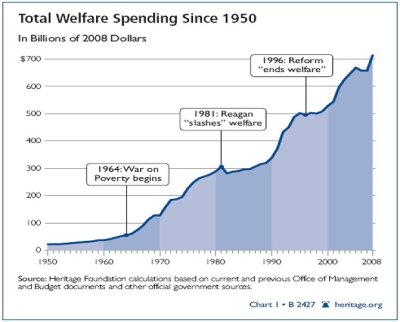
Director Blue explains:

After adjusting for inflation, America’s welfare expenditures are 1300% higher than in 1965. And the results have been absolutely catastrophic. But the documented failures haven’t stopped President Obama and the Democrats from charting a course for massive new spending programs, at a time when the country can least afford it.

What could be the problem? Well, think of welfare as a cash payment given to women who have have babies with men who they chose knowing that those men were not interested in becoming fathers or husbands. Women are having sex with men and having babies with men who have not married them and have no intention of marrying them. And the government is paying them to do this. The government is paying them to oppose chastity. The government is paying them to avoid courting. The government is paying them to avoid chivalry. The government is paying them to avoid marriage.

So what happens next?

Director Blue explains:

The out-of-wedlock birthrate is now 40 percent and the African-American out-of-wedlock birthrate is a shocking 72 percent. But when the “War on Poverty” began, the out-of-wedlock birthrate was just 7 percent.

Of 23 peer-reviewed U.S. studies since 2000, 20 found that family structure directly affects crime and/or delinquency. Research “strongly suggests both that young adults and teens raised in single-parent homes are far more likely to commit crimes, and that communities with high rates of family fragmentation (especially unwed childbearing) suffer higher crime rates as a result.”

Why are the Democrats paying people not to marry?

Director Blue has no hypothesis, but I think the answer is feminism. Feminists do not like the idea that men have a role in marriage as the provider and protector and moral/spiritual leader. The best way to knock men out of their perch as husbands and fathers is to have the state take over the man’s role in the family so that women do not need men. And this is exactly what has happened.

So it’s actually very ironic that the people who whine the most about the poor actually cause poverty. And the people who are strongest in defense of traditional morality, like chastity, chivalry, courting and marriage, are the ones who the most concerned about the poor. Marriage is good for the poor. Democrats aren’t concerned about the poor – they are concerned buying votes by redistributing wealth, so that they can stay in power and line their own pockets. They are willing to put politics – their opposition to marriage because of feminism – ahead of real people’s well-being and prosperity.

Read the whole post at Director Blue’s blog. It turns out that the Democrats want to continue subsidizing the feminist dream of destroying marriage and family with even more government spending on welfare. Eventually the money that the producers in this society for the Democrats to confiscate will run out – and where will we be then?

The conflict between the state and the family

A book review by Raymond J. Keating. I just ordered the book.

Excerpt:

Sympathy and compassion help make humans caring, moral beings. Adam Smith, the father of modern economics, understood that, as illustrated by his emphasis on sympathy in The Theory of Moral Sentiments.

Often, however, sympathy and compassion are transformed from tools of moral judgment and action into weapons of blind ideology, irrational emotionalism, and cynical politics. They particularly serve as the bat with which opponents of the welfare state get pummeled. After all, the argument goes, if you oppose an extensive network of government income, housing, healthcare, employment, and child-care assistance programs, you must be severely lacking in sympathy and compassion. To truly care, you must support big government.

That assumption, unfortunately, has long clouded the debate over welfare policies, especially when it comes to government programs affecting family life. The big-government crowd has pushed blindly for government to play an ever-larger role as financial provider for households, thereby contributing critically to the undermining of traditional families. Meanwhile, it should be noted that some who argue against such programs have tried to make their case without fully acknowledging the important economic and societal roles played by the family.

[…]Part of the problem is the failure to apply economic analysis to the family’s role in the economy and to the impact of government policies on the family. That has been remedied to a degree in The War Between the State and the Family: How Government Divides and Impoverishes by Patricia Morgan. Published initially by the London-based Institute of Economic Affairs, it mainly deals with the programs and realities of Great Britain, but the discussion and analysis obviously apply elsewhere, including the United States.

Morgan pulls together overwhelming evidence and data showing the benefits to adults, children, and society in general of marriage and intact families, and the problems of non-marriage, single parenthood, and divorce. And she illustrates how the welfare state subsidizes and encourages family breakdown.

For example, Morgan shows that marriage boosts personal responsibility and employment among males, while single males are far more likely to be jobless and receiving government assistance. She also makes clear that government benefits have a strong impact on marriage and childbearing decisions and responsibilities among both men and women.

She notes the varying ways in which government policies affect such critical decisions: “By rewarding some behaviours and penalising others, tax and welfare systems affect the preference and behaviour of individuals not just through hard cash calculations but by (unavoidably) embodying and promoting certain values and assumptions. . . . The generous subsidisation of the lone-parent household cannot but reinforce the belief that it is quite acceptable for men to expect the state to provide for their offspring.”

Morgan sums up the implications of all this on the size and intrusiveness of government: “Growing family and household fragmentation” drives government spending and taxes ever higher; increases the “number of clients of the state”; “displaces existing institutional and private arrangements”; places the government in the role of parent and provider to children; allows for increased government intrusions into family life; and generates “an increasing mass of legislation and regulation of provisions for custody, access and financial support.” For good measure, child development is inevitably hampered due to the loss of “private investment in children,” which can never be matched in substance or quality by government programs.

She’s like a British Jennifer Roback Morse, and I mean to read her book.

What I find puzzling is that I keep running into young people who aspire to be married and to have children, but who are going about their plan in ways that seem to be counterproductive – at least to me. I see a lot of young people voting Democrat, for example. I find this confusing, because voting Democrat means that there will be fewer jobs, higher taxes, more debt and more crime. That’s just a start. So why are people voting for Democrats when Democrat policies undermine the feasibility of marriage? Probably because they saw Republicans being mocked on Comedy Central and cannot tell the difference between comedy and news.

How the federal government and stimulus spending discourage work

A post by Hans Bader at the Competitive Enterprise Institute.

Excerpt:

Thanks to food stamps, Medicaid, and housing subsidies, and other welfare benefits, many “poor” people have far more disposable income than self-supporting households earning $40,000 to $60,000 a year.  Veronique de Rugy points to a finding that “a one-parent family of three making $14,500 a year (minimum wage) has more disposable income than a family making $60,000 a year” — even excluding benefits from Supplemental Security Income.  “America is now a country which punishes those middle-class people who not only try to work hard, but avoid scamming the system.”

[…]The analysis de Rugy cites actually understates the disincentives to work, because it ignored the fact that many households that are “poor” in terms of taxable income are not poor at all once you factor in tax-free income from non-governmental sources.  For example, child support is tax-free to the recipient family, no matter how huge the payments they receive (for example, a billionaire may pay several million dollars a year in child support to each of his ex-girlfriends with kids, leaving them in tax-free luxury, and under New York’s child support guidelines, everyone is supposed to pay at least 17 percent of their gross income in child support for just one child, regardless of how high that income is.  In Massachusetts, middle-income households pay 25 percent of gross income for just one kid — which is around a third of their after-tax income — under that state’s child support guidelines).

He also talks about how the federal government encourages child support agencies to yank more children away from their parents – they get more funding that way!