
Tag Archives: Welfare

What UK Prime Minister David Cameron will do, and an extra thing that he should do

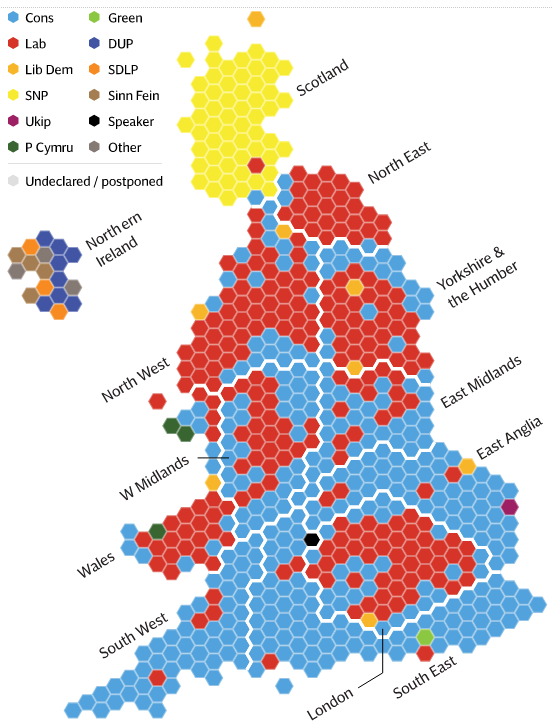
CON = 331 (+24), LAB = 232 (-26), SNP = 56 (+50), LIB = 8 (-47), UKP = 1 (+1), OTH = 22

Here’s an article from the radically leftist UK Independent, which is furious with the Conservative Party victory in Thursday’s national elections.

In it, they explain what Cameron intends to do:

David Cameron will use the Conservative Party’s first majority in the House of Commons for nearly 20 years to “deliver” on a radical agenda to cut welfare, shrink the size of the state and re-define Britain’s relationship with Europe.

Conservative insiders said Mr Cameron would move to the right to consolidate support among his backbench MPs after five years of compromise with the Liberal Democrats.

Among Mr Cameron’s first legislative priorities will be to enshrine an EU referendum into law, bring in the so-called ‘snoopers charter’ to give police greater powers to monitor internet communications and give English MPs a veto over legislation only affecting England.  The Tories also intend to publish plans to scrap the Human Rights Act within their first 100 days. All proposals had been previously blocked by the Lib Dems.

I always think of the UK as the biggest dupes when it comes to global warming, especially after the Climategate e-mails came out showing that that there was a concerted effort to falsify data and persecute global warming skeptics. But, like Canada’s Conservative Party, the UK Conservative Party is taking a stand against the pseudo-science.

Look:

As well as deep welfare cuts The Independent understands that the Department of Business and the Department of Energy and Climate Change, previously run by the Lib Dems, will be among the biggest casualties in terms of spending reductions.

Oliver Letwin, the Tories’ policy chief, has spent the campaign in Whitehall drawing up proposals to merge quangos and slash Government regulation. These are likely to form a key part of the spending review. The review has been made more difficult by Mr Cameron’s late and unexpected election pledge to find an extra £8bn for the NHS. This has yet to be funded and if the Tories stick to their other tax and spending commitments could require further cuts. Most senior Tories had expected to be negotiating another coalition agreement with the Liberal Democrats, giving them the flexibility to raise taxes to fund their additional spending commitments. As it is they are now bound to implement legislation binding the Government not to increase income tax, national insurance or VAT rates for the next five years.

Quangos are “quasi-autonomous non-governmental organisations”. Abolishing or merging these will put a serious dent in government over-spending – and overreach.

The Democratic Unionist Party factor

Cameron would do well to add the Democratic Unionist Party (DUP) members to his coalition. Conservative MEP Daniel Hannan says that “On immigration, on constitutional reform, on defence, on Europe, on rural issues, on education, on law and order, the DUP is, well, conservative.”The Conservatives need 323 seats to govern. They have 331 by themselves, and 8 more would help them in case there are any rebellions from within their own ranks. If he can get the lone UKIP member on board, that would help too, giving him a majority of 340.

More about the DUP:

The DUP bills itself as “right-wing in the sense of being strong on the constitution”, but “to the left on social policy”. The party’s members show a strong leaning towards the Conservatives, Professor Jonathan Tonge notes, backing them by a ratio of seven to one over Labour. The DUP also back the Conservatives on areas like Europe, with Nigel Dodds insisting that any coalition they are involved in would need to offer an EU referendum.

[…]The DUP, which has close links to the Dr Paisley’s Free Presbyterian Church, has frequently sparked controversy for how it discusses homosexuality. This has led to David Cameron facing tough questions earlier this month during a Q&A when one audience member wanted him to vow not to go into coalition with the DUP because of its views on LGBT rights, something he refused to rule out.

[…]The DUP also oppose the right of women to an abortion, with Jim Wells saying it should be ruled out for rape victims. The party has also called for a parliamentary debate on resinstating the death penalty.

It sounds like they are even further right than Cameron, which is good, because Cameron is what Americans would call a RINO.

Give Scotland enough rope to hang itself

But the most important thing for Cameron to do is to give Scotland full fiscal autonomy.

This is even something that the SNP leader wants:

Nicola Sturgeon was forced to admit in the second Scottish leaders’ debate that her MPs would be prepared to vote next year for full fiscal autonomy, which according to experts would make Scotland £7.6 billion worse off.

[…]In March, she suggested it might not happen straightaway as she faced claims it would cost almost 140,000 jobs and leave Scotland with a higher deficit than Spain.

[…]It would mean Scotland opting out of the Barnett Formula which currently sets Scotland’s public spending block grant, and gives Scots around £1,200 extra per head.

[…]In March, Ms Sturgeon dismissed warnings from the impartial Institute for Fiscal Studies (IFS) that her general election demand for full fiscal autonomy would create a multi-billion pound financial black hole in Scotland’s finances.

Daniel Hannan thinks this would be a great idea:

Commentators struggle to explain the rise of the SNP: why, seven months after rejecting separation, should Scots turn to the separatist party? Those commentators miss the point. The SNP knows fine well (as Scots say) that opinion has not moved on the independence issue. Nicola Sturgeon had to keep promising that there’d be no re-run of the vote.

No, the SNP is better understood as Scotland’s version of Greece’s Syriza or Spain’s Podemos – a far-Left, populist insurgency. Like those parties, it has a touching belief in its ability to conjure wealth through alchemy.

[…]There is a very weak link in Scotland between taxation, representation and expenditure. Because of the Barnett Formula, Scottish politicians get to spend money that has been raised through taxation elsewhere. This incentivises their constituents to vote for high-spending parties. Over time, that tendency has become self-reinforcing to the extent that the very act of calling for fiscal restraint is seen as alien, un-Scottish.

Not all Scots are on the Left, obviously. There are some free-marketeers in the land of Adam Smith. But the prevailing assumption among Holyrood politicians and pundits is that higher spending is a defining national characteristic. They don’t use those words, of course. They say, “We’re a compassionate, fair-minded people”. But it’s what they mean.

What can be done about it? Well, the SNP demands full fiscal autonomy, and David Cameron should hurry to meet that demand. Partly because linking taxation to expenditure north of the border might allow a revival, over time, of Right-of-Centre politics in Scotland. Partly because the measure will also be popular with English taxpayers. Partly, too, because, without such a reform, separatism will revive. And partly because greater autonomy for Scotland could bring about a new, devolved settlement for the entire United Kingdom, something that is long overdue. Mainly, though, because most Scots say they want it, and the SNP has won an unarguable mandate. What are we waiting for?

The Scottish electorate – by and large – make Greek socialists like Tsipras / Syriza appear fiscally prudent. They need to find out how economics works the hard way. Let them make their own decisions, and maybe when they are picking leaves off of trees to feed themselves in a few years, they will come to their senses and be ready to deal. It’s very important for people who are led by their feelings and who pursue dreams against reality to crash and burn, so that they understand the value of practical people who have worked hard, saved and played by the rules.

The Scots are voting for slogans like “stop austerity” without any idea of how difficult working and saving really is for taxpayers, of which there are precious few in Scotland. Let them face the consequences of their own folly, and then come back to the negotiating table with a weaker hand, just as Greece is doing now. Maybe if Cameron does this in the UK, it will inspire Harper to do the same with Quebec in Canada. Just give Quebec full fiscal autonomy and then cut off the equalization payments that allow them to live far beyond their means. Make them grow up.

One thing is for sure. The UK electorate (aside from Scotland and Wales) has impressed me. This is the beginning of a period of liberty, prosperity and security for the UK, and I for one am envious that they are getting a head start on it, while we have to wait another year and a half before we join them by electing a Republican president, and holding the House and Senate.

Do tax hikes, welfare spending and minimum wage hikes lower income inequality?

Here’s Heritage Foundation economist Stephen Moore to explain.

He writes:

Massachusetts Sen. Elizabeth Warren recently appeared on one of the late night talk shows, beating the class warfare drum and arguing for billions of dollars in new social programs paid for with higher taxes on millionaires and billionaires. In recent years, though, blue states such as California, Illinois, Delaware, Connecticut, Hawaii, Maryland and Minnesota adopted this very strategy, and they raised taxes on their wealthy residents. How did it work out? Almost all of these states lag behind the national average in growth of jobs and incomes.

So, if income redistribution policies are the solution to shrinking the gap between rich and poor, why do they fail so miserably in the states?

The blue states that try to lift up the poor with high taxes, high welfare benefits, high minimum wages and other Robin Hood policies tend to be the places where the rich end up the richest and the poor the poorest.

California is the prototypical example. It has the highest tax rates of any state. It has very generous welfare benefits. Many of its cities have a high minimum wage. But day after day, the middle class keeps leaving. The wealthy areas such as San Francisco and the Silicon Valley boom. Yet the state has nearly the highest poverty rate in the nation. The Golden State, alas, has become the inequality state.

In a new report called “Rich States, Poor States” that I write each year for the American Legislative Exchange Council with Arthur Laffer and Jonathan Williams, we find that five of the highest-tax blue states in the nation—California, New York, New Jersey, Connecticut and Illinois—lost some 4 million more U.S. residents than entered these states over the last decade. Meanwhile, the big low-tax red states—Texas, Florida, North Carolina, Arizona and Georgia—gained about this many new residents.

What’s wrong? Isn’t raising taxes, growing government and spending more on welfare supposed to make reduce income inequality? Well, the trouble is that you need to think about things from the point of view of the people who create the jobs. People who want to start a business prefer to move to states where they can keep more of the money they earned. So, that’s why there is a mass exodus from states that don’t allow job creators to keep the money they earn. And naturally, they hire workers in their new state once they get there. Eventually people in the high-tax states move to where the jobs are, too.

Stephen Moore has actually measured it:

The least “regressive” tax states [high tax states] had average population growth from 2003 to 2013 that lagged below the national trend. The 10 most highly “regressive” tax states [low tax states], including nine with no state income tax, had population growth on average 4 percent above the U.S. average. Why was that? Because states without income taxes have twice the job growth of states with high tax rates. 

[…]Ohio University economist Richard Vedder and I compared the income gap in states with higher tax rates, higher minimum wages and more welfare benefits with states on the other side of the policy spectrum. There was no evidence that states with these liberal policies had helped the poor much and, in many cases, these states recorded more income inequality than other states as measured by the left’s favorite statistic called the Gini Coefficient.

[…]The 19 states with minimum wages above the $7.25 per hour federal minimum do not have lower income inequality. States with a super minimum wage—such as Connecticut ($9.15), California ($9.00), New York ($8.75), and Vermont ($9.15)—have significantly wider gaps between rich and poor than states without a super minimum wage.

No, I am not an economist, but I think that this is because the real minimum wage is ZERO, and that’s what more people in high minimum wage states make compared to people in low minimum wage states. If Seattle raises the minimum wage to $15 and the workers end up making the real minimum wage (ZERO) because job creators can’t pay them, then naturally the gap between rich and poor increases.

I think it’s always a good idea for people to think about things from the point of view of the small business job creator, and it all makes sense. If you want to get trained in how to do this, I recommend picking up introductory books by economists like Thomas Sowell, Milton Friedman or even F.A. Hayek. The goal here is to achieve good results, not to have good intentions.

Study: children are safest when they live with their two married biological parents

Marriage is the safest environment for children

Story from Family Studies.

It says:

Young people are less likely to be victims of crime if they live in two-parent than in single-parent households. That has been a consistent finding of the National Crime Victimization Survey conducted by the U.S. Department of Justice. But it has been unclear whether the safety advantage stems from married couples living in less dangerous neighborhoods, on average, than unmarried parents, or from other differences in vulnerability between family types. My analysis of recent data from another national survey shows that even when their families live in unsafe neighborhoods, children in married two-parent families are less likely to be exposed to violent crime than children of never-married and divorced parents.

In the 2011-2012 National Survey of Children’s Health, conducted by the U.S. National Center for Health Statistics, parents of 95,677 children aged 17 and under were asked whether their child was “ever the victim of violence or witnessed any violence in his or her neighborhood.” Among children living with their married biological parents, the overall rate of exposure to neighborhood violence was comparatively low: for every 1,000 children in intact families, 36 had witnessed or experienced neighborhood violence. By contrast, among children living with a never-married mother, the rate of violent crime exposure was nearly three times higher: 102 children per 1,000 had one or more such experiences. Among children living with a separated or divorced mother, the rate of exposure was more than twice as high as for children of married parents: 89 children per 1,000. (See Figure 1.) These comparisons are adjusted for differences across family types in the average age, sex, and race/ethnicity of the child; family income and poverty status; the parent’s education level; neighborhood quality; and frequency of residential moves.

Some might assume that the absence of an adult male to protect the household is key to the higher victimization rates of single-parent families. Yet children living with a biological parent and a stepparent also had an elevated rate of exposure to neighborhood violence: 84 children per 1,000. Even children living with both biological parents who were cohabiting rather than married had a significantly higher victimization rate—60 children per 1,000—though not as high as those in never-married or divorced families.

[…]Why are children living with never-married or separated and divorced mothers more susceptible to neighborhood violence? Beyond the greater likelihood of having to live in unsafe neighborhoods and the more frequent moves that often come with family disruption, there are several other factors that increase vulnerability. First is the stress of conflict between parents and the strain of raising children as a lone parent in reduced financial circumstances. These can lead to a lack of vigilance and the overlooking of simple precautions, such as making sure that doors and windows are locked in houses and vehicles. Second, if they have broken up with their child’s other parent, a single parent will usually begin dating and trying to find a new partner. This process often involves being out of the house at night, sometimes leaving children with no or inadequate supervision. Third, as children become adolescents, the peers they become involved with in their less-than-ideal neighborhoods and schools are often troubled ones, who can lead them into hazardous situations and activities.

Marriage matters! We can allow alternatives to natural marriage, but natural marriage is best for kids.

You can read more about the safety advantages of marriage for women and children in this Heritage Foundation paper. Marriage matters, and we should doing everything we can to shrink secular big government programs that discourage marriage (e.g. – single mother welfare),  and promote programs that encourage people to marry and have children, (e.g. – getting rid of the marriage penalty). It’s a policy problem – we aren’t doing enough to help children when the secular big government is more interested in making it easier for people to not marry (single mother welfare), and breaking up existing marriages (no-fault divorce laws).