Tag Archives: Wealth

The Becket Fund assesses Obama’s “compromise” on the contraception mandate

Eric Metaxas shared this on Facebook, so here it is.

Full text:

Facing a political firestorm, President Obama today announced his intent to make changes to a controversial rule that would require religious institutions, in violation of their conscience, to pay for contraception, sterilization, and abortifacient drugs. But this “compromise” is an exercise in obfuscation, not a good faith effort to solve the problem. Thousands of churches, religious organizations, businesses, individuals, and others will still be forced to violate their religious beliefs.

For example, the fake compromise will not help the Becket Fund’s clients Belmont Abbey College in North Carolina, Colorado Christian University, and Eternal Word Television Network (EWTN), a Catholic media organization. They will still be forced to pay for insurance that provides contraceptive coverage. The White House’s claim that “the insurance companies will pay for it” is silly. For-profit insurance companies aren’t going to donate contraceptives and abortion drugs to employees; the employer will pay for it one way or the other. More fundamentally, the Becket Fund’s clients still face the same chilling dilemma they did yesterday: choosing between helping their employees buy immoral abortion drugs or paying huge fines.

“This is a false ‘compromise’ designed to protect the President’s re-election chances, not to protect the right of conscience,” says Hannah Smith, Senior Legal Counsel for The Becket Fund. “No one should be fooled by what amounts to an accounting gimmick. Religious employers will still have to violate their religious convictions or pay heavy annual fines to the IRS.”

According to a White House “fact sheet,” some religious employers will no longer be required to provide insurance coverage for contraception, sterilization, and abortion-causing drugs; coverage for those services will instead be provided for free directly by insurance companies. This does not protect anyone’s conscience. First, the problem is helping employees get abortion drugs, not the cost of providing those drugs. Since providing insurance benefits would still help employees get insurance, religious employers still have to choose between providing health benefits that help employees get abortion drugs, and paying annual fines. Second, thousands of religious organizations self insure, meaning that they will be forced to pay directly for these services in violation of their religious beliefs. Third, it is unclear which religious organizations are permitted to claim the new exemption, and whether it will extend to for-profit organizations, individuals, or non-denominational organizations.

“It is especially telling that the details of this fake ‘compromise’ will likely not be announced until after the election,” said Smith. “Religious freedom is not a political football to be kicked around in an election-year. Rather than providing full protection for the right of conscience, President Obama has made a cynical political play that is the antithesis of ‘hope and change.’”

My previous post in which I chastised the Roman Catholic bishops for supporting Obamacare is here.

Obama revises contraception mandate but Catholic groups still pay for abortion drugs

Life News explains.

Excerpt:

The Obama administration has revised its controversial mandate that had forced religious employers to pay for health insurance coverage that includes birth control and drugs like Plan B, the morning after pill, and ella that can cause abortions.

Responding to a firestorm of opposition from pro-life organizations, Catholics groups and even some Democrats, the Obama administration has revised the mandate in a way that pro-life advocates are saying is even worse.

The revised Obama mandate will make religious groups contract with insurers to offer birth control and the potentially abortion-causing drugs to women at no cost. The revised mandate will have religious employers refer women to their insurance company for coverage that still violates their moral and religious beliefs. Under this plan, every insurance company will be obligated to provide coverage at no cost.

Essentially, religious groups will still be mandated to offer plans that cover both birth control and the ella abortion drug.

According to Obama administration officials on a conference call this morning, a woman’s insurance company “will be required to reach out directly and offer her contraceptive care free of charge. The religious institutions will not have to pay for it.”

The birth control and abortion-causing drugs will simply be “part of the bundle of services that all insurance companies are required to offer,” White House officials said.

“We are actually more comfortable having the insurance industry offer and market this to women than religious institutions,” the White House said on the conference call LifeNews listened to because they “understand how contraception works” and it “makes sense financially.”

[…]Republican Study Committee Chairman Jim Jordan told LifeNews in response to the revised mandate that it violates the right to religious freedom guaranteed by the First Amendment to the Constitution.

“This ObamaCare rule still tramples on Americans’ First Amendment right to freedom of religion. It’s a fig leaf, not a compromise. Whether they are affiliated with a church or not, employers will still be forced to pay an insurance company for coverage that includes abortion-inducing drugs,” he said. “This is not just a problem for church-affiliated hospitals and charities. Under these rules, a small business owner with religious objections to abortion-inducing drugs and contraception must either violate his religious beliefs or violate the law.”

“The liberal Obama administration thinks its political goals trump the religious faith of American citizens. That isn’t right, fair, or constitutional,” he said.

The abortions will still be paid for by the religious groups. They are going to pay for the drugs through medical insurance premiums. So religious organizations are still being forced to provide abortions for their workers.

Who is to blame for this? I blame Catholic bishops. Catholic bishops do believe in socialism. They do want a secular government to take money from religious people. And they do want government to hand out medical care to people, instead of letting individuals, businesses and charities provide health care.

Rick Santorum agrees with me on this.

Consider this interview with Rick Santorum in which he reacts Obama’s health care mandate.

Excerpt:

HH: Now I want to talk to you about two substantive issues, Senator Santorum. The first are these new regulations from the Obama administration. I read the letter from Archbishop Olmstead of Phoenix on the air. Archbishop Jose Gomez of Los Angeles has written a new article in First Things. It’s shocking, actually, what’s going on. Should this be a centerpiece of whoever the nominee’s campaign is?

RS: I talked about it in every speech I’ve given today. And here’s what I said, though, Hugh. I said that I took issue with the Catholic Bishops Conference, because Hugh, you may remember, they embraced Obamacare.

HH: Yes.

RS: They embraced it and said…here’s what I said to them. Be careful when you have government saying that they can give you rights, that you have a right to health care, and government’s going to give you something, because once you are now dependant on government, they, not only can they take that right away, they can tell you how to exercise that right, and you can either like it or not. And that’s the problem. That’s what the Catholic Bishops Conference didn’t get, that there’s no free lunch here, folks. If you’re going to give people secular power, then they’re going to use it in a secular fashion. And that’s why, you know, I hate to say it, but you know, you had it coming. And it’s time to wake up and realize that government isn’t the answer to the social ills. It’s people of faith, and it’s families, and it’s communities, and it’s charities that need to do this as it has in America so successfully for so long.

HH: Rick Santorum, what do you advise Catholic hospitals, Catholic colleges, Catholic…the centers of poverty assistance, the adoption agencies? What do you advise them to do in the face of, as Archbishop Olmstead said, we cannot comply with this unjust law?

RS: Civil disobedience. This will not stand. There’s no way they can make this stand. The Supreme Court, eventually, this thing’s going to get to the Supreme Court just like the ministerial hiring issue that was just decided by the Supreme Court the other day. And it was a 9-0 decision that said the Obama administration can’t roll over people of faith when it comes to hiring. Yet in the face of that decision, this radical, secular government of Barack Obama continues to have faith be the least important of the 1st Amendment. And I just think they fight. They fight in the courts, and they fight by civil disobedience, and go to war with the federal government over this one.

Evangelical protestants feel comfortable with Catholics like Rick Santorum. He gets it. If the bishops are wrong on socialized medicine and wrong on the death penalty and wrong on other things, then so much the worse for the bishops.

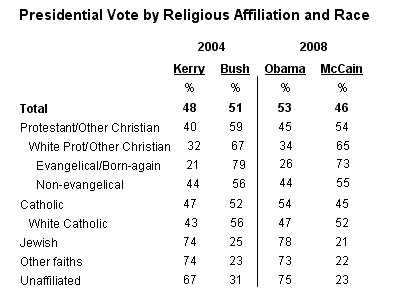
Obama did very well with Catholics in 2008 even though Obama is the most pro-abortion president in the history of the United States. Catholics tend to be more liberal on economic issues than evangelicals, which is why many of them voted for Obama. Evangelicals oppose economic liberalism, because they oppose government taking tax money from workers in order to provide services for other people aren’t trying to be self-sufficient. Evangelicals oppose increasing the dependence of individuals on a secular government. Evangelicals don’t want a secular government to take money from individuals and then use it to push secular leftist ideas like global warming, Darwinism and sex education in government run institutions, e.g. – public schools, public broadcasting, etc. Evangelicals trust individuals to care for the poor, and they don’t want to make it too easy for people to make reckless decisions and then get a check in the mail or a free abortion.

What causes this difference between Catholics and evangelicals? Evangelicals believe in salvation through grace ALONE through faith ALONE in Christ ALONE. Evangelicals put the emphasis on what you believe – it has to be true in order to please God. Catholics, just like Mormons, Jews and other religions, emphasize good works as a requirement for salvation. Many Catholics also support inclusivism, which is the view that you can be saved in other religions like Judaism and Islam. This means that for these Catholics, specific Christian doctrines are not essential for salvation, so long as you have sincerity and good works. On the other hand, evangelicals are exclusivists who emphasize the need for each person to arrive at true beliefs about God in order to be saved, and good works are just natural outworkings of their beliefs.

Evangelicals emphasize the responsibility of the individual to discover truth with their Bibles, reasoning, science and history. This belief in individual responsibility carries over into their approach to charity. Evangelicals believe individuals are responsible for deciding what to do about charity – you earn your own money and then you choose yourself how to share with others. But the responsibility to give away money wisely is an individual responsibility – you share your money in a way that is consistent with your beliefs. Evangelicals don’t generally accept the idea of handing money off to someone else and letting them decide what to do with it. We think that everything is our responsibility, starting with Bible study and theology, and going on through to economics and politics.

And this emphasis on individuals over big government has this effect:
(Source)

Note that this chart puts evangelicals together with born-again Christians. But evangelical Christians differ from born-again Christians, because they are firm on exclusive salvation and evangelism. Evangelicals like to study so that they can discuss their beliefs in public, using reasons and evidence to persuade others. A born-again Christian does not have that same emphasis on study and persuasion, because they don’t focus on evangelism. So, if you separate out the born-agains from that 26%, number for Obama support, then you are likely to get a much lower number for evangelicals who support Obama. We don’t like health care mandates covering abortion. Evangelicals are used to having to puzzle things out for themselves – so they puzzled out what Obama believed and then they voted against him.

A Jewish rabbi explains what the Bible teaches about capitalism

A Jewish rabbi explains what the Bible says about economics, in the Wall Street Journal. (H/T Tom)

Excerpt:

More than any other nation, the United States was founded on broad themes of morality rooted in a specific religious perspective. We call this the Judeo-Christian ethos, and within it resides a ringing endorsement of capitalism as a moral endeavor.

Regarding mankind, no theme is more salient in the Bible than the morality of personal responsibility, for it is through this that man cultivates the inner development leading to his own growth, good citizenship and happiness. The entitlement/welfare state is a paradigm that undermines that noble goal.

The Bible’s proclamation that “Six days shall ye work” is its recognition that on a day-to-day basis work is the engine that brings about man’s inner state of personal responsibility. Work develops the qualities of accountability and urgency, including the need for comity with others as a means for the accomplishment of tasks. With work, he becomes imbued with the knowledge that he is to be productive and that his well-being is not an entitlement. And work keeps him away from the idleness that Proverbs warns leads inevitably to actions and attitudes injurious to himself and those around him.

[…]At the opening bell, Genesis announces: “Man is created in the image of God”—in other words, like Him, with individuality and creative intelligence. Unlike animals, the human being is not only a hunter and gatherer but a creative dreamer with the potential of unlocking all the hidden treasures implanted by God in our universe. The mechanism of capitalism, as manifest through investment and reasoned speculation, helps facilitate our partnership with God by bringing to the surface that which the Almighty embedded in nature for our eventual extraction and activation.

Capitalism makes possible entrepreneurship, which is the realization of an idea birthed in human creativity. Whereas statism demands that citizens think small and bow to a top-down conformity, capitalism, as has been practiced in the U.S., maximizes human potential. It provides a home for aspiration, referred to in the Bible as “the spirit of life.”

The Bible speaks positively of payment and profit: “For why else should a man so labor but to receive reward?” Thus do laborers get paid wages for their hours of work and investors receive profit for their investment and risk.

[…]Many on the religious left criticize capitalism because all do not end up monetarily equal—or, as Churchill quipped, “all equally miserable.” But the Bible’s prescription of equality means equality under the law, as in Deuteronomy’s saying that “Judges and officers . . . shall judge the people with a just judgment: Do not . . . favor one over the other.” Nowhere does the Bible refer to a utopian equality that is contrary to human nature and has never been achieved.

The motive of capitalism’s detractors is a quest for their own power and an envy of those who have more money. But envy is a cardinal sin and something that ought not to be.

God begins the Ten Commandments with “I am the Lord your God” and concludes with “Thou shalt not envy your neighbor, not for his wife, nor his house, nor for any of his holdings.” Envy is corrosive to the individual and to those societies that embrace it. Nations that throw over capitalism for socialism have made an immoral choice.

I think that Christians are sometimes attracted to socialism because they think that the only way to help the poor is by state-controlled redistribution of wealth. Socialists might have the right goal of helping the poor (I actually believe that socialism is just the happy-face on fascism, but let us be charitable), but capitalism is the right way to achieve that goal of helping the poor.

Here is an article by Jay Richards for the American Enterprise Institute.

First, his introduction:

If you’re like me, when you think of wealth and poverty, you picture its material manifestations. To have wealth, we imagine, is to have money, stocks, real estate, or valuable commodities, which, in turn, gives us the means to achieve various material ends, such as food, clothing, cars, housing, and healthcare. Poverty, in contrast, is the lack of such goods, which, in turn, leads to a lack of food, shelter, basic medical care, and other such items. These mental associations can make it hard to discover the preconditions of wealth creation, many of which are immaterial, even spiritual, rather than material.

For most of human history, discovering the sources of wealth creation would have been devilishly hard, since most economies, such as there were, tended to be static. If a Mesopotamian farmer or Greek shepherd in the second century BC ever asked, “Where does wealth come from?” he would have assumed that wealth came from rain, common labor, good luck, or some combination of these. He probably also would have assumed that to get really wealthy, you need to plunder other people.

But we now have concrete examples of cultures that have created vast new wealth, moving the majority of their citizens from poverty to relative prosperity. And when we look at these cultures retroactively, we discover answers that, for most of us, are counterintuitive. I’ve argued elsewhere that we’re able to discern ten crucial features allowing such cultures to alleviate poverty and create wealth. The more of these a culture has or does, the more likely it is to be prosperous.

The Top Ten Ways to Alleviate Poverty

  1. Establish and maintain the rule of law.
  2. Focus the jurisdiction of government primarily on maintaining the rule of law, and limit its jurisdiction over the economy and the institutions of civil society.
  3. Implement a formal property system with consistent and accessible means for securing a clear title to property one owns.
  4. Encourage economic freedom.
  5. Encourage stable families and other important private institutions which mediate between the individual and the state.
  6. Encourage belief in the truth that the universe is purposeful and makes sense.
  7. Encourage the right cultural mores.
  8. Instill a proper understanding of the nature of wealth creation and poverty.
  9. Focus on cultivating your comparative advantage rather than protecting what used to be your comparative advantage.
  10. Work hard.

There is a striking correlation between societies that exhibit these traits, or some subset of them, and the large-scale wealth creation. But notice that only one of them describes a material good. All the others are intangible, immaterial, spiritual. You can’t find economic freedom or cultural mores on a map or put them in a safe. You can’t bottle diligence or weigh the ingredients for stable families and voluntary institutions on a scale. These goods involve beliefs, social conventions, institutions, commitments, virtues, and creativity. Having listed them in brief, now I want to hold each of the ten immaterial ingredients up to the light and consider how each helps a society move from poverty to prosperity.

If someone has a spiritual or moral sickness that is preventing them from working, then the solution is not to hand them someone else’s money. That’s not going to make them happy. They need to earn their own pay and be responsible for their own independence.

Jay Richards on Christianity and Capitalism

Jay Richards actually wrote the book on Christianity and capitalism: “Money, Greed and God“.

To understand what capitalism is, you can watch this lecture entitled “Money, Greed and God: Why Capitalism is the Solution and Not the Problem” by Jay W. Richards, delivered at the Heritage Foundation think tank, and televised by C-SPAN2.

If you can’t see the Richards video, here is an audio lecture by Jay Richards on the “Myths Christians Believe about Wealth and Poverty“. Also, why not check out this series of 4 sermons by Wayne Grudem on the relationship between Christianity and economics? (a PDF outline is here)

And you can listen to Ron Nash’s course on Christianity and economics.