Tag Archives: Washington DC

Wal-Mart cancels plans to build three stores after D.C. leftists raise minimum wage 50%

From Fox Business, a story that shows how completely clueless left-wing politicians are about economics.

Excerpt:

Wal-Mart Stores (WMT) no longer plans to build three stores in the nation’s capitol, after the city’s council voted to force large retailers to pay starting wages that are 50% higher than the minimum wage there.

The world’s largest retailer also said it will consider its options related to three other Washington, D.C., stores that are still under construction.

The bill, called the Large Retailer Accountability Act of 2013, was approved by an 8-to-5 vote, even though Walmart had warned that the company would leave the district.

“Nothing has changed from our perspective: we will not pursue Skyland, Capitol Gateway, and New York Avenue and will start to review the financial and legal implications on the three stores already under construction,” Walmart spokesman Steven Restivo said, referring to the locations of the planned stores.

“This was a difficult decision for us—and unfortunate news for most D.C. residents—but the Council has forced our hand.”

The district’s new law requires retailers with sales of more than $1 billion and with stores of at least 75,000 square feet to pay their workers starting salaries of at least $12.50 an hour, compared to the minimum wage of $8.25.

Unionized businesses are exempt from the measure. Large stores that already have a presence in D.C., including Target (TGT) and Macy’s (M), have four years to comply.

Now for most of my readers who understand economics, what happened here is going to be pretty obvious. But sometimes people get specialized in other areas and neglect the study of economics. The danger then is that they will be moved to support policies that appeal to their hearts. But it’s very important to understand that policies that sound good, like raising wages, often have unexpected negative results.

Here is George Mason University economics professor Walter Williams to explain the problem with increasing the minimum wage, starting with the basics of economics.

Excerpt:

Are people responsive to changes in price? For example, if the price of cars rose by 25 percent, would people purchase as many cars? Supposing housing prices rose by 25 percent, what would happen to sales? Those are big-ticket items, but what about smaller-priced items? If a supermarket raised its prices by 25 percent, would people purchase as much? It’s not rocket science to conclude that when prices rise, people adjust their behavior by purchasing less.

It’s almost childish to do so, but I’m going to ask questions about 25 percent price changes in the other way. What responses would people have if the price of cars or housing fell by 25 percent? What would happen to supermarket sales if prices fell by 25 percent? Again, it doesn’t require deep thinking to guess that people would purchase more.

This behavior in economics is known as the first fundamental law of demand. It holds that the higher the price of something the less people will take and that the lower the price the more people will take. There are no known exceptions to the law of demand. Any economist who could prove a real-world exception would probably be a candidate for the Nobel Memorial Prize in Economic Sciences and other honors.

[…]University of California, Irvine economist David Neumark has examined more than 100 major academic studies on the minimum wage. […]About 85 percent of the studies “find a negative employment effect on low-skilled workers.” A 1976 American Economic Association survey found that 90 percent of its members agreed that increasing the minimum wage raises unemployment among young and unskilled workers. A 1990 survey found that 80 percent of economists agreed with the statement that increases in the minimum wage cause unemployment among the youth and low-skilled. If you’re looking for a consensus in most fields of study, examine the introductory and intermediate college textbooks in the field. Economics textbooks that mention the minimum wage say that it increases unemployment for the least skilled worker.

When considering what economic policies to adopt, it is not enough to do what feels good. Liberals and conservatives agree that it is good to help the poor. Liberals think that higher minimum wage rates help the poor, and conservatives think that lower minimum wage rates help the poor. This is not a topic that is up for debate, though, because economists across the idological spectrum agree on this one – and for the reasons outlined above and illustrated in the Wal-Mart case.

Take a look at this post from moderate Harvard University economist Greg Mankiw.

He writes:

I believe it is better to introduce students to economics with topics about which there is more of a professional consensus. In chapter two of the book, I include a table of propositions to which most economists subscribe, based on various polls of the profession. Here is the list, together with the percentage of economists who agree:

    1. A ceiling on rents reduces the quantity and quality of housing available. (93%)
    2. Tariffs and import quotas usually reduce general economic welfare. (93%)
    3. Flexible and floating exchange rates offer an effective international monetary arrangement. (90%)
    4. Fiscal policy (e.g., tax cut and/or government expenditure increase) has a significant stimulative impact on a less than fully employed economy. (90%)
    5. The United States should not restrict employers from outsourcing work to foreign countries. (90%)
    6. The United States should eliminate agricultural subsidies. (85%)
    7. Local and state governments should eliminate subsidies to professional sports franchises. (85%)
    8. If the federal budget is to be balanced, it should be done over the business cycle rather than yearly. (85%)
    9. The gap between Social Security funds and expenditures will become unsustainably large within the next fifty years if current policies remain unchanged. (85%)
    10. Cash payments increase the welfare of recipients to a greater degree than do transfers-in-kind of equal cash value. (84%)
    11. A large federal budget deficit has an adverse effect on the economy. (83%)
    12. A minimum wage increases unemployment among young and unskilled workers. (79%)
    13. The government should restructure the welfare system along the lines of a “negative income tax.” (79%)
    14. Effluent taxes and marketable pollution permits represent a better approach to pollution control than imposition of pollution ceilings. (78%)

When you raise the price of anything – including labor – fewer people will buy it. Wal-Mart will still spend the money on new stores and new employees, just not in Washington, D.C. – not with those laws. Notice that number one on his list is the case of rent control, where government good-intentioners try to hold the price of rent down. What happens next? Well, it the price goes down then everyone wants to buy more of whatever just went on sale. But the people providing what just went on sale stop making it because they can’t make a profit. The unexpected consequence is that there is a housing shortage. The quantity of housing decreases, and the quality of housing decreases. The quality decreases because demand is so high that property owners no longer have to maintain the properties, since demand has skyrocketed. Economics is something that everyone should study, so that we don’t just have good intentions, but also have good results.
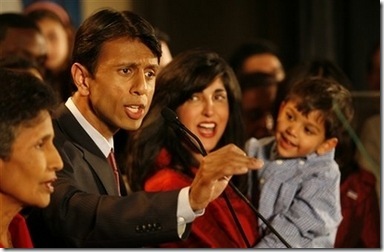
 

Louisiana governor Bobby Jindal delivers effective education reform

Bobby and Supriya Jindal

Looks like Republican governor Bobby Jindal made it into the Wall Street Journal.

Excerpt:

Governors of both parties have promoted education reform, but so far no one has delivered more than Louisiana’s Bobby Jindal. This week he’ll sign two bills that offer a national model for competition and parental choice.

Louisiana’s new laws will essentially give all parents an average of $8,500 to use for their child’s education as they see fit. They can keep their child in their local public school, but they can also try to get Johnny into a more demanding charter school, or a virtual school, or into special language or career-training courses, among other options.

Nearly 400,000 low-income children—a bit more than half of all students—will also be eligible for vouchers to attend private schools. State officials estimate that about 2,000 students will use vouchers this September given private-school capacity limits, but that tens of thousands will do so over time.

Louisiana is also making life easier for charter schools, with new authorizing boards, a fast-track for high-performing networks, and access to facilities equal to that of traditional public schools. The new laws seek to strengthen superintendents and principals over local school boards, which are bastions of bureaucratic and union intransigence.

Nearly as dramatic are reforms in teacher tenure. To earn tenure, teachers will now have to rate in the top 10% (measured in part by student performance) for five of six consecutive years, and any teacher who falls into the bottom 10% loses tenure. No teacher in the bottom 10% can get a raise, while layoffs will no longer hit the junior-most teachers first while ignoring performance.

Mr. Jindal made school reform a second-term priority after winning a landslide re-election last November. By then he had appointed or helped elect reformers to the state superintendent’s office and board of education.

Louisiana voters also had a preview of reform’s potential. Since Hurricane Katrina in 2005, New Orleans schools have become almost exclusively charters—with dramatic academic improvements—and the city has run a small and oversubscribed voucher program since 2008. As for tenure, the reforms attach consequences to a teacher-evaluation system enacted in 2010.

The result: the reforms attracted bipartisan legislative majorities of roughly 60%. Over four votes (two different bills, each having to pass the House and Senate), one-quarter to one-half of Democrats voted for reform, including many black representatives, especially those from New Orleans.

Teachers unions were predictably opposed and even heavier-handed than usual. Michael Walker Jones of the Louisiana Association of Educators dismissed choice on grounds that “If I’m a parent in poverty I have no clue because I’m trying to struggle and live day to day.” Unions pushed principals to cancel school—sometimes giving parents less than 24 hours notice—so teachers could protest at the state Capitol. It was a tired act.

Mr. Jindal joins Indiana’s Mitch Daniels in passing the most far-reaching school reforms, and now they’ll have to follow through to produce better student outcomes. Unions will seize on any troubles as a sign of failure, but success might catalyze similar reforms across the country that could finally improve the life prospects for all American children.

Now is a good time to compare and contrast those reforms with the record of the Obama administration:

The Democrats worked with the teacher unions to kill voucher programs for the poorest students in Washington DC, many of them minority students.

Excerpt:

“House and Senate Appropriators this week ignored the wishes of D.C.’s mayor, D.C.’s public schools chancellor, a majority of D.C.’s city council, and more than 70 percent of D.C. residents and have mandated the slow death of the D.C. Opportunity Scholarship Program. This successful school voucher program–for D.C.’s poorest families–has allowed more than 3,300 children to attend the best schools they have ever known.

The decision to end the program, a decision buried in a thousand-page spending bill and announced right before the holidays, destroys the hopes and dreams of thousands of D.C. families. Parents and children have rallied countless times over the past year in support of reauthorization and in favor of strengthening the OSP.

Yet, despite the clearly positive results and the proven success of this program, Sen. Dick Durbin, Rep. Jose Serrano, Del. Eleanor Holmes Norton, and Secretary Arne Duncan worked together to kill the OSP. Funding the program only for existing children shrinks the program each year, compromises the federal evaluation of the program, denies entry to the siblings of existing participants, and punishes those children waiting in line by sentencing them to failing and often unsafe schools.

What is incredibly disappointing to low-income families in Washington, D.C. has been the silence of President Barack Obama. The President, who benefited from K-12 scholarships himself, worked on behalf of low-income families in Chicago, and exercises school choice as a parent, has stood silently on the sidelines while his Secretary of Education belittled the importance of helping such a small number of children in the nation’s capital.”

Another Wall Street Journal article explains why voucher programs work for children. They don’t work for teacher unions, and that’s why Democrats oppose them.

Excerpt:

In a study published last year, Patrick Wolf of the University of Arkansas found that voucher recipients had graduation rates of 91%. That’s significantly higher than the D.C. public school average (56%) and the graduation rate for students who applied for a D.C. voucher but didn’t win the lottery (70%). In testimony before a Senate subcommittee in February, Mr. Wolf said that “we can be more than 99% confident that access to school choice through the Opportunity Scholarship Program, and not mere statistical noise, was the reason why OSP students graduated at these higher rates.”

The administration downplays these findings. But the students who attend D.C. public schools are overwhelmingly black and poor, and the achievement gap has a particularly devastating impact on their communities. High school dropouts are eight times more likely than someone with a diploma to wind up behind bars. Some 60% of black male high school dropouts in their 30s have prison records. And nearly one in four young black male dropouts is in jail or juvenile detention.

Mr. Obama says he wants to help all students—not just the lucky few who receive vouchers. But that’s an argument for offering more vouchers to those in need, not for reducing school choice. Policies ought to be weighed against available alternatives, not some unattainable ideal. The alternative to a voucher for families in D.C. ghettos and elsewhere is too often a substandard public school.

The positive effects of the D.C. voucher program are not unique. A recent study of Milwaukee’s older and larger voucher program found that 94% of students who stayed in the program throughout high school graduated, versus just 75% of students in Milwaukee’s traditional public schools. And contrary to the claim that vouchers hurt public schools, the report found that students at Milwaukee public schools “are performing at somewhat higher levels as a result of competitive pressure from the school voucher program.” Thus can vouchers benefit even the children that don’t receive them.

Research gathered by Greg Forster of the Foundation for Educational Choice also calls into question the White House assertion that vouchers are ineffective. In a paper released in March, he says that “every empirical study ever conducted in Milwaukee, Florida, Ohio, Texas, Maine and Vermont finds that voucher programs in those places improved public schools.” Mr. Forster surveyed 10 empirical studies that use “random assignment, the gold standard of social science,” to assure that the groups being compared are as similar as possible. “Nine [of the 10] studies find that vouchers improve student outcomes, six that all students benefit and three that some benefit and some are not affected,” he writes. “One study finds no visible impact. None of these studies finds a negative impact.”

Such results might influence the thinking of an objective observer primarily interested in doing right by the nation’s poor children. But they are unlikely to sway a politician focused on getting re-elected with the help of teachers unions.

There is a difference between Demcorats and Republicans, and the difference is that Republicans think that children do better when their parents can choose a school that works for their child. Republicans are the evidence-based party – they do what’s right. But Democrats do whatever it takes to please their special interest groups.