
Tag Archives: University

Boys are falling further and further behind girls in UK public schools

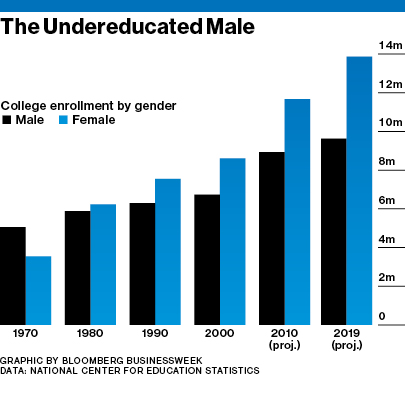
Boys are enrolling in university at a much lower rate than girls

This story is from the UK Telegraph.

Excerpt:

Each time UCAS releases statistics on equality of access to university in the UK, the gap between the entry rates for girls and boys gets a bit worse.

Just before Christmas, our 2015 End of Cycle Report revealed that young women in the UK are now 35pc more likely to go to university than young men, and 52pc more likely when both sexes are from disadvantaged backgrounds.

Today we publish data on the sex balance in specific degree courses, which shows that there are more women than men accepted to most subject areas.

This highly entrenched trend is not just a reflection of the preferences of young men and women when it comes to making decisions about their lives after school or college.  It is a direct consequence of years of lower educational achievement by boys, particularly those from disadvantaged backgrounds, throughout primary and secondary education.

At the end of primary education (age 11), only 22pc of boys achieve Level 5 or better in reading, writing and maths compared to 27pc of girls.

By the age of 16, girls are over 20pc more likely to achieve five GCSEsincluding English and Maths at Grade C or better.

By age 18, only 47pc of students studying for pre-university level qualifications are boys. 30,000 more girls than boys are studying for A levels or other academic qualifications which best support progression to higher tariff universities. Some 5,000 more boys than girls are doing vocational qualifications, but girls are outperforming boys in both academic and vocational qualifications at this level.  The only exception seems to be that slightly more of the boys who are doing A levels get the very highest A* grades, and they still do rather better at maths than girls.

Degrees supporting traditionally male-dominated professions such as medicine, law and dentistry now all recruit more female students than male.  And move over James Herriot – 80pc of students accepted to veterinary medicine last year were female.

The UCAS figures today also show that there are more women than men across a range of subjects including, pathology and anatomy, biology, genetics, nursing, social work, and English. Two years ago women overtook men in Philosophy, and the same happened with history subjects in 2011. Given that there are more men than women in the population, to achieve equality, there would need to be around 5pc more men than women across the board.

Why is this happening? Well the author of the piece nails the cause of the problem:

So what is going wrong?  Does lower achievement for boys have anything to do with the 80pc female dominated state schools’ workforce, which includes 85pc female teachers in primary schools and 62pc in secondary?  Would boys respond and learn better with more male teachers and role models? 

[…]What about the curriculum and qualifications?  In all the heated debates about the primary curriculum, I don’t recall hearing anything about the different impacts on teaching and learning for girls and boys.  

If we were serious about fixing this, we would hire more male teachers and administrators in the schools. Boys do better studying material that is boy-friendly, and when the material is taught by male teachers. Boys tend to underperform in mixed-gender classrooms, too. But there is no effort in the schools to fix that, because men can never be victims – only women. No one in the education system wants to fix problems for boys. No one wants to speak up for boys for fear of being perceived as insufficiently feminist.

Are the UK schools doing anything to address these problems?

Of course not:

[…][A]lthough most schools will track the achievement of their boys and girls, there seems to be little focus on the gender gap in education policy.  A recent FOI request by the men’s human rights group, MRA-UK, asked the Department for Education if it recognized boys’ underachievement, what initiatives are in place, and how much is budgeted for them in 2015/16.  The response in July 2015 was “The Department does not fund any initiatives that just focus on addressing boys’ underachievement”.

My advice to young men is to hit the math and STEM hard, and understand that the odds are stacked against you. You have to take your education seriously, because if you don’t no one else will. You have to take your career seriously, because if you don’t no one else will. The system isn’t there to help boys. You’ll have to make your own way on your own strength, and the system is there to fight you all the way.

Should taxpayer-funded universities allow conservative professors to work?

The Jesus Seminar and their pre-suppositions
In the country of the blind, the one-eyed man is expelled

I guess everyone knows that conservatives are discriminated against at liberal universities. But I thought this Wall Street Journal article had some interesting insights about how far conservative professors have to go to hide their views from their colleagues on the secular left.

It says:

Everyone knows that academia is predominantly liberal: Only 6.6% of professors in the social sciences are Republicans, according to a 2007 study. But what is life like for the pioneering conservatives who slip through the ivory tower’s gates? We decided to find out by interviewing 153 of them.

Many conservative professors said they felt socially isolated. A political scientist told us that he became a local pariah for defending the Iraq war in his New England college town, which he called “Cuba with bad weather.” One sociologist stated the problem well: “To say a strong conservative political opinion with conviction in an academic gathering is analogous to uttering an obscenity.” A prominent social scientist at a major research university spoke of the strain of concealing his political views from his colleagues—of “lying to people all the time.”

Some even said that bias had complicated their career advancement. A historian of Latin America told us that he suffered professionally after writing a dissertation on “middle-class white guys” when it was fashionable to focus on the “agency of subaltern peoples.” Though he doesn’t think the work branded him as a conservative, it certainly didn’t excite the intellectual interest of his peers.

A similarly retrograde literature professor sought advice from a colleague after struggling to land a tenure-track job. He was told that he had “a nice resume for 1940.”

Let’s put some numbers to these stories, with an article from the Washington Times.

Excerpt:

It’s not every day that left-leaning academics admit that they would discriminate against a minority.

But that was what they did in a peer-reviewed study of political diversity in the field of social psychology, which will be published in the September edition of the journal Perspectives on Psychological Science.

Psychologists Yoel Inbar and Joris Lammers, based at Tilburg University in the Netherlands, surveyed a roughly representative sample of academics and scholars in social psychology and found that “In decisions ranging from paper reviews to hiring, many social and personality psychologists admit that they would discriminate against openly conservative colleagues.”

[…][C]onservatives represent a distinct minority on college and university campuses. A 2007 report by sociologists Neil Gross and Solon Simmons found that 80 percent of psychology professors at elite and non-elite universities are Democrats. Other studies reveal that 5 percent to 7 percent of faculty openly identify as Republicans. By contrast, about 20 percent of the general population are liberal and 40 percent are conservative.

Mr. Inbar and Mr. Lammers found that conservatives fear that revealing their political identity will have negative consequences. This is why New York University-based psychologist Jonathan Haidt, a self-described centrist, has compared the experience of being a conservative graduate student to being a closeted gay student in the 1980s.

In 2011, Mr. Haidt addressed this very issue at a meeting of the Society for Personality and Social Psychology — the same group that Mr. Inbar and Mr. Lammer surveyed. Mr. Haidt’s talk, “The Bright Future of Post-Partisan Social Psychology,” caused a stir. The professor, whose new book “The Righteous Mind” examines the moral roots of our political positions, asked the nearly 1,000 academics and students in the room to raise their hands if they were liberals. Nearly 80 percent of the hands went up. When he asked whether there were any conservatives in the house, just three hands — 0.3 percent — went up.

[…]”Because of the way the confirmation bias works,” Mr. Haidt says, referring to the pervasive psychological tendency to seek only supporting evidence for one’s beliefs, “you need people around who don’t start with the same bias. You need some non-liberals, and ideally some conservatives.”

But that’s not all – those findings are confirmed by other studies of campaign donations by professors:

Professors, administrators and others employed at the eight universities of the Ivy League have given $375,932 to Obama and $60,465 to Romney, according to data compiled by the Center for Responsive Politics, a Washington watchdog group that tracks campaign finance issues.

[…]The president’s academic advantage extends behind the Northeast’s ivied walls and into the Midwest.

At Ohio State University in Columbus, for example, Obama has raised $18,230 from faculty and staff, compared with Romney’s $3,500.

How did this massive imbalance happen? Answer: active discrimination against minority viewpoints. Secular leftists discriminate against conservatives in hiring and employment decisions. This is because liberalism is a false ideology, and the only way to maintain it is to punish anyone who disagrees with it. Allow any sort of open, rational discussion of methodology or evidence undermines the delusion that the elites are trying to maintain.

Should a man go into full-time apologetics ministry if he intends to marry?

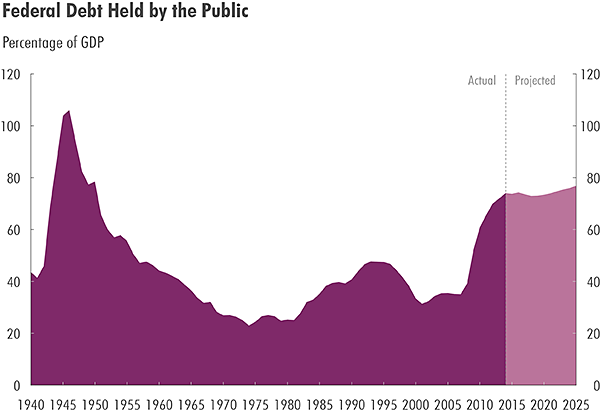
Congressional Budget Office: Debt to GDP ratio

Lydia McGrew has a post up at What’s Wrong With the World blog that is just excellent.

Excerpt:

Apologetics is wonderful and incredibly important. It’s a wonderful thing that a revival of specifically evidentialist apologetics is happening in the United States and even, to some extent, in the Anglophone world at large.

Unfortunately, this revival of interest in apologetics and in being Christian philosophers is coming at a very bad time, economically. Even if you are a genius, your chances in 2013 and following of getting a stable job by the route of going to graduate school in philosophy (or almost any area of the humanities) are pretty darned slim. If you’re not a genius, fuhgetaboutit. Nor were there ever all that many jobs in philosophy. It was always an iffy proposition, but it’s much worse now than it was even twenty years ago.

As for starting ministries, a poor economy makes it extremely hard to do that, too, because people don’t have as much disposable income to donate. Moreover, even in a more robust economy, if all the eager young apologists were to flock to start apologetics and/or campus ministries, they would be competing among themselves for a finite number of available dollars from donors. So that’s not the best idea either.

Let me speak very bluntly here: In my opinion, God doesn’t need a whole raft of impractical idealists out there getting themselves into debt or half starving (or really starving) with no idea of how in the world they are ever going to support even themselves, much less a family, out at the other end of their education. That just burdens the church with a large number of able-bodied but needy Christians who are in a seemingly unending stage of transition, “getting an education for the kingdom” or “hoping to do work for the kingdom” without a viable plan in mind or any fiscal light at the end of the tunnel.

Instead, I believe that we need an army of tentmakers. If you have a job or a marketable skill, for heaven’s sake (literally), don’t quit that job and join the ranks of starving students. Keep your day job, but enrich your mind and prepare yourself to answer people’s questions about Christianity by studying on your own time. If you have entrepreneurial abilities and the capital, start a business. That will support not only yourself but others you employ, and if successful, you will have more money to give to Christian ministries.

But even if you aren’t the entrepreneurial type or don’t have that opportunity, at least make sure (to the extent that one can in today’s world) that you can pay the rent and put food on your own table as well as supporting whatever number of additional people you plan to take on. (In other words, if you are a guy who would like to get married and have children, bear that in mind.) This will inevitably mean spending time at all that distasteful stuff like networking and making a resume. Bookish types don’t enjoy that stuff, because it seems bogus, but it can’t be helped. It will undoubtedly mean, for most people, not being full-time students beyond the undergraduate level, especially not in the humanities, not trying to become full-time academics as a life work, and not going into full-time ministry, even if you would ideally like to do one or more of those three things.

In the end, if we can have this army of tentmakers, there will be (Lord willing) money to allow some people to work in full-time ministry. But it’s going to be quite a small proportion of those who are interested or would ideally like to do so.

[…]Inevitably, the course of action I am suggesting will mean a bifurcation for many between their day job and what they are most passionately interested in. So be it. Indeed, so it has ever been in the world. What proportion of people at any moment in human history have been blessed enough to spend most of their time working on what they are most passionately interested in? The question answers itself. So I think that bifurcation has to be accepted by a great many people and that doing so will lead to what I might call a healthier “Christian economy” among committed Christians than what we could otherwise end up with.

So let’s see her advice in bullet-point form:

  • The job market for philosophers is very bad
  • A bad economy means less support money is available
  • It’s important to have a plan to fund your  ministry
  • Leverage your full-time job to fund your ministry

So I want to make two comments.

Making bad decisions because you think God is telling you to

I often find that when I talk to Christians, there is this sort of hyper-spiritualized way of deciding what to do, and I’ve written about this in one of my favorite posts. Hyper-spiritual Christians read the Bible, which is good, but then they don’t tend to also look at practical things like economics, science and public policy when making their decisions. The Bible doesn’t say much about what to study or what job to get, but there is an example of Paul working at tent-making in order to fund his ministry. So there is precedent for the idea of learning a trade and working to earn enough money to support our families, our ministry and even other people’s ministries.

I think we have an obligation to take the Bible seriously when it tells us what we can do to please God, but coming up with a plan to please God most effectively is our job. We have to make the plans to serve God. Our plans must be within the bounds of Biblical morality, but they should also reflect our knowledge of how the world really works, too. We’ll be more successful with a good plan and some hard work. It’s very easy to be deceived by our feelings about what we would like to do with our lives. And many people who listen to their feelings and find other impractical people to echo and affirm those feelings make many mistakes in life. I would advise people to be very careful about calling their feelings the voice of God speaking to them, then getting into trouble when their lack of wisdom blows up in their faces.

Christian men who want marriage without having to get a job

So that brings me to the concern that I have that I’ve been thinking about for the last week or so. I have been thinking about a couple of Christian apologists I know who are interested in marriage, but unwilling to prepare themselves to prepare for a wife and children. They are both very unaware of the economic and political challenges that they are likely to face, which makes the need to prepare financially even more pressing.

One of the Christian men is getting a BA and is in his early 30s. He says that marriage would have to come second to his ministry. He has never worked a full-time job his entire life, and considers getting a full-time job to be beneath him. The other one is in his late 20s and is in a PhD program. He wants marriage right away, but he has never worked in a real job his entire life, either. Both of these Christian apologists are in debt – they have zero assets and negative net worth. How can it be that they can even be considering marriage? Don’t they realize what a man’s role in marriage is? He is the provider, and that means that he has to have a record of steady work, saving money and being generous at sharing with others. Neither of these men have shown any ability in those areas. Neither of them seems willing to get started on a regular, full-time, private sector job. And neither seems to want to take Lydia’s advice and finance their ministry / marriage from a regular, full-time job. Neither of these students can even afford a wedding or even a wedding ring. Do they even understand what a woman needs from her husband?

So what’s the problem? I talked this over with a wise friend and she said that feminism has become so widespread in this society that a lot of men think that they can contemplate marriage without having a record of earning and saving. They don’t see that men have any distinct “provider” role in a marriage. They sort of expect to get the benefits of marriage with none of the “provider” responsibilities. Many women have also been taken in by feminism, and cannot evaluate men to see which ones are able to work and save and provide, and which ones aren’t. I don’t think young people are being taught how to apply the Bible to the practical challenges of marriage, or how to recognize the challenges of the times we live in.