Tag Archives: Tuition

Another looming debt crisis: law school students racking up $100,000+ in debt

Consider this scary article from the Competitive Enterprise Institute. (H/T Hans)

Excerpt: (links removed)

Federal financial aid policies haveencouraged law students to borrow increasing amounts to attend law school, despite the glut of lawyers (oddly, government policies encourage more people to go to law school, driving up law schooltuition, even as the Obama administration seeks to cut back on vocational education aimed at training the skilled blue-collar workers who are in desperately short supply in much of the country). The result, says law professor Brian Tamanaha, is a “Quickly Exploding Law Graduate Debt Disaster” in which most recent graduates of many law schools will never be able to pay off their staggering student loan debt. At the liberal Balkinization blog, Tamanaha notes that the average student has over $100,000 in debt just from law school at many schools…

[…]As one commenter noted earlier, federal financial aid and student loans have driven up law school tuition and student loan debt: “education loans . . . often have implicit government guarantees,” even those not explicitly backed by the government. As a result, “like the GSE’s, the supply of credit for education loans has continued to expand. So in a way colleges and universities, public and private have been in a bubble akin to the housing bubble. The benefits to the institutions are irresistible and so there is no way they will try to reign in costs and thus tuition. Not as long as students are willing and able to borrow.” When the bubble pops, taxpayers will be on the hook for countless billions of dollars (many graduates already are not repaying their student loans). “Why is college so expensive? A new study points to a disconcerting culprit: financial aid,” notes Paul Kix on page K1 of the March 25 Boston Globe. I and professors and education experts commented earlier on that study at Minding the Campus. Other studies also have concluded that increased federal financial aid, such as student loans, drives up college tuition, and you can find links to some of them here.

[…]When law school graduates are unable to pay off their student loans, lenders will come after their elderly parents who co-signed for the loans.  As the Washington Post notes, “Americans 60 and older still owe about $36 billion in student loans . . . Many have co-signed for loans with their children or grandchildren to help them afford ballooning tuition.”

According to the liberal New York Times, law schools do a woeful job of preparing students to practice law.

Excerpt:

The lesson today — the ins and outs of closing a deal — seems lifted from Corporate Lawyering 101.

“How do you get a merger done?” asks Scott B. Connolly, an attorney.

There is silence from three well-dressed people in their early 20s, sitting at a conference table in a downtown building here last month.

“What steps would you need to take to accomplish a merger?” Mr. Connolly prods.

After a pause, a participant gives it a shot: “You buy all the stock of one company. Is that what you need?”

“That’s a stock acquisition,” Mr. Connolly says. “The question is, when you close a merger, how does that deal get done?”

The answer — draft a certificate of merger and file it with the secretary of state — is part of a crash course in legal training. But the three people taking notes are not students. They are associates at a law firm called Drinker Biddle & Reath, hired to handle corporate transactions. And they have each spent three years and as much as $150,000 for a legal degree.

What they did not get, for all that time and money, was much practical training. Law schools have long emphasized the theoretical over the useful, with classes that are often overstuffed with antiquated distinctions, like the variety of property law in post-feudal England. Professors are rewarded for chin-stroking scholarship, like law review articles with titles like “A Future Foretold: Neo-Aristotelian Praise of Postmodern Legal Theory.”

So, for decades, clients have essentially underwritten the training of new lawyers, paying as much as $300 an hour for the time of associates learning on the job. But the downturn in the economy, and long-running efforts to rethink legal fees, have prompted more and more of those clients to send a simple message to law firms: Teach new hires on your own dime.

“The fundamental issue is that law schools are producing people who are not capable of being counselors,” says Jeffrey W. Carr, the general counsel of FMC Technologies, a Houston company that makes oil drilling equipment. “They are lawyers in the sense that they have law degrees, but they aren’t ready to be a provider of services.”

[…]Consider, for instance, Contracts, a first-year staple. It is one of many that originated in the Langdell era and endures today. In it, students will typically encounter such classics as Hadley v. Baxendale, an 1854 dispute about financial damages caused by the late delivery of a crankshaft to a British miller.

Here is what students will rarely encounter in Contracts: actual contracts, the sort that lawyers need to draft and file. Likewise, Criminal Procedure class is normally filled with case studies about common law crimes — like murder and theft — but hardly mentions plea bargaining, even though a vast majority of criminal cases are resolved by that method.

[…]“We should be teaching what is really going on in the legal system,” says Edward L. Rubin, a professor and former dean at the Vanderbilt Law School, “not what was going on in the 1870s, when much of the legal curriculum was put in place.”

Not only that, but the marketplace is saturated with lawyers already. When supply increases and demand decreases, prices fall. The new batch of lawyers are not going to be able to command the same salaries as the old batch.
In California, students protest the results of their own liberal voting

Victor Davis Hanson writes about it National Review.

Excerpt:

Here in California, students just marched on Sacramento in outrage that state-subsidized tuition at the UC and CSU campuses keeps climbing. It is true that per-unit tuition costs are rising, despite even greater exploitation of poorly paid part-time teachers and graduate-student TAs. But the protests are sort of surreal. The California legislature is overwhelmingly Democratic. The governor is a Democrat. The faculties and administrative classes are largely Democratic. Who then, in the students’ minds, have established these supposedly unfair budget priorities?

Sales, income, and gas taxes are still among the highest in the nation (and are proposed to rise even higher) — prompting one of the largest out-of-state exoduses of upper-income brackets in the nation. The state budget is pretty much entirely committed to K–12 education (whose state-by-state comparative test scores in math and science hover between 45th and 49th in the nation), prisons, social services, and public-employee salaries and pensions. Whom, then, can the students be angry at?

Are students angry at public-union salaries and pensions that are among the highest in the nation? Do they think the many highly compensated retired Highway patrol officers have shorted students at UC Davis? Are they mad at the 50,000 illegal aliens in the California prison system that might have siphoned off scholarship funds from CSU Monterey Bay? Or is the rub the influx of hundreds of thousands of children of illegal aliens who require all sorts of language remediation and extra instruction in the public schools, and so might in theory divert library funds from UC Santa Cruz?

Perhaps the students don’t want billions to be committed to high-speed rail that might rob Berkeley of needed funding, or environmental efforts to introduce salmon into the San Joaquin River, in which the $70 million spent so far in studies and surveys might have come from nearby CSU Fresno? Are they mad at state social services, whose medical expenses have skyrocketed to address the health-care needs of millions of illegal aliens, and thus in theory could curb the choice of classes at CSU Stanislaus? Are they angry that some $10–15 billion a year probably leaves the state as remittances to Mexico?

If one cannot blame the wealthy for “not paying their fair share” (the top 1 percent of Californians now pay about 37 percent of all income-tax revenue — and their numbers have decreased by one-third in recent years, as the state has come to rely on the income tax for half its revenue), or Republican majorities in government, who, then, is left to blame?

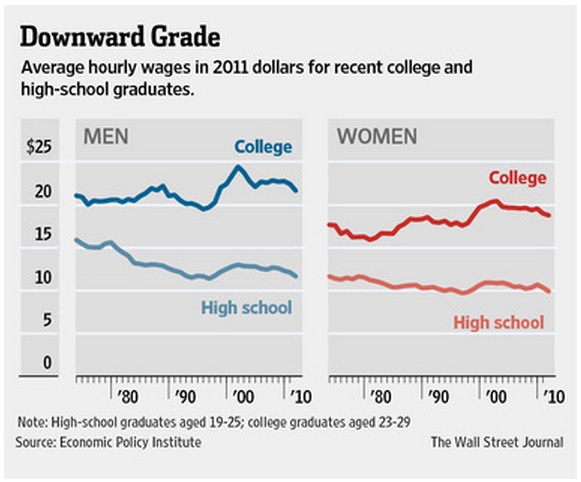
Not only are their tuition costs going UP but their likely salary is going DOWN.

Students majoring in booze and hook-up sex
How's that hopey-changey stuff workin' for ya?

I got that image from a post at the American Enterprise Institute.

Excerpt:

  • Only 35 percent of students starting a four-year degree program will graduate within four years, and less than 60 percent will graduate within six years.
  • The U.S. college dropout rate is about 40 percent, the highest college dropout rate in the industrialized world.
  • Over the past 25 years, the total number of students in college has increased by about 50 percent. But the number of students graduating with degrees in STEM subjects has remained more or less constant.
  • In 2009, the United States graduated 37,994 students with bachelor’s degrees in computer and information science. That’s not bad, but we graduated more students with computer-science degrees 25 years ago!
  • Few disciplines have changed as much in recent years as microbiology, but in 2009 we graduated just 2,480 students with bachelor’s degrees in microbiology—about the same number as 25 years ago. Who will solve the problem of antibiotic resistance?
  • If students aren’t studying science, technology, engineering, and math, what are they studying?
  • In 2009, the United States graduated 89,140 students in the visual and performing arts, more than in computer science, math, and chemical engineering combined and more than double the number of visual-and-performing-arts graduates in 1985.
  • Moreover, more than half of all humanities graduates end up in jobs that don’t require college degrees, and those graduates don’t get a big income boost from having gone to college.

I think this is interesting. What exactly are these students paying for?

If there is one thing I learned from my love of Shakespeare, it’s that it is tragic to be the cause of your own downfall because of your own tragic flaw. Right now, there are a bunch of young people who have been totally brainwashed by the unionized public school teachers and professors to have views on economics that are completely opposite to what works in the real world. They keep voting for bigger and bigger government, which creates more and more debt in order to provide their parents with bigger and bigger benefits. They have lots of self-esteem, but very few marketable skills. Eventually, the bill for all the government spending on “helping the poor”, (e.g. – food stamps for millionaires and bailouts for bankrupt green energy firms), comes due, and it’s the students who will be paying the bill. I wonder if they will look as favorably on socialism and global warming alarmism then?

UPDATE: I noticed that in Quebec, the most liberal province in Canada, students are doing the same thing.

Is a college degree worth what you pay for it?

Michael Barone writing in Human Events.

Excerpt:

We are still suffering from the bursting of the housing bubble created by low interest rates, lowered mortgage standards, and subsidies to Fannie Mae and Freddie Mac. Those policies encouraged the granting of mortgages to people who should never have gotten them — and when they defaulted, the whole financial sector nearly collapsed.

Now some people see signs that another bubble is bursting. They call it the higher-education bubble.

For years, government has assumed it’s a good thing to go to college. College graduates tend to earn more money than non-college graduates.

Politicians of both parties have called for giving everybody a chance to go to college, just as they called for giving everybody a chance to buy a home.

So government has been subsidizing higher education with low-interest college loans, Pell grants, and cheap tuitions at state colleges and universities.

The predictable result is that higher education costs have risen much faster than inflation, much faster than personal incomes, much faster than the economy over the past 40 years.

Moreover, you can’t get out of paying off those college loans, even by going through bankruptcy. At least with a home mortgage, you can walk away and let the bank foreclose and not owe any more money.

Peter Thiel, the co-founder of PayPal, is adept at spotting bubbles. He sold out for $500 million in March 2000, at the peak of the tech bubble, when his partners wanted to hold out for more. He refused to buy a house until the housing bubble burst.

“A true bubble is when something is overvalued and intensely believed,” he has said. “Education may still be the only thing people still believe in in the United States.”

But the combination of rising costs and dubious quality may be undermining that belief.

For what have institutions of higher learning done with their vast increases in revenues? The answer in all too many cases is administrative bloat.

Take the California State University system, the second tier in that state’s public higher education. Between 1975 and 2008, the number of faculty rose by 3 percent, to 12,019 positions. During those same years, the number of administrators rose 221 percent, to 12,183. That’s right: There are more administrators than teachers at Cal State now.

These people get paid to “liaise” and “facilitate” and produce reports on diversity. How that benefits Cal State students or California taxpayers is unclear.

It is often said that American colleges and universities are the best in the world. That’s undoubtedly true in the hard sciences.

But in the humanities and to a lesser extent in the social sciences, there’s a lot of garbage. Is a degree in religious and women’s studies worth $100,000 in student loan debt? Probably not.

As economist Richard Vedder points out, 45 percent of those who enter four-year colleges don’t get a degree within six years. Given the low achievement level of most high school graduates, it’s hard to avoid the conclusion that many of them shouldn’t have bothered in the first place.

I think college is a good idea if you you don’t spend too much on it, and if you can make back the investment by getting a job in a good field. In general, no subject that is easy is worth spending $100,000 on, though. Engineering, science, medicine, law, etc. are worth it.