Tag Archives: Transcript

FL senator Marco Rubio: “We need more taxpayers, not more taxes”

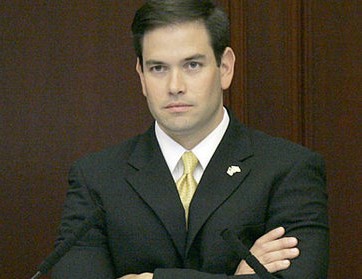
Florida Senator Marco Rubio

If there is anyone I like almost as much as Michele Bachmann, it’s Marco Rubio. And boy, can this guy do an interview.

On the Sean Hannity show: (7 minutes)

And on the Rush Limbaugh radio show: (11 minutes)

He’s William Lane Craig-esque. He just talks about the issues without one hem or haw. Not an uh or an ah to be heard. It’s uncanny. Hmmn. Look at that picture up there. He looks very intense. Do you think he might be some sort of conservative super-android designed by the U.S. Military in a secret base under a mountain in Colorado? I’m not sure.

I actually heard him interviewed on the Hugh Hewitt show on Tuesday night. Hugh played the interview back-to-back in two consecutive hours, and then his producer Duane Patterson posted the full transcript. This one was the best interview of all. Hugh does a great interview, and he was blown away by Marco Rubio.

Excerpt:

HH: Now the President is betting, obviously, that he can turn a conservative message into a toxic one for 2012. Your old colleague from the Florida House, Adam Hasner, is running for Senate down there, a lot like Josh Mandel in Ohio, and Ted Cruz in Texas, they’re running as real conservatives with very much a Rubio-like message from 2010. Will that work in this environment of demagoguery from the White House?

MR: Yeah, it will work, because the common sense of the American people is powerful, and I think that too many people here in Washington walk around thinking well, we can spin it this way, or we can use our allies in the media to confuse people and make them not believe their own eyes. But the truth is that we’re way past that today. The ability of people to get information from multiple sources in real time, the ability of us to communicate directly to our constituents, to go on programs such as yours and talk about the reality of what we’re facing, is something that wasn’t around not that long ago, and it’s incumbent upon us who feel passionate about this to go out there and make clear to the people what our choices are. And this is not a complicated issue. It’s very, very simple. The United States spends more money than it takes in, and it’s not generating enough revenue for its government to pay down the debt. So we have to figure out how do we stop spending more money than we take in? We need a balanced budget amendment. We need a spending cap. And we need real reductions in spending starting right now. And what do we do to get more revenue in the hands of government so it can pay down its debt and not grow its government? Well, you’re not going to do that through tax increases. You’re going to do that through new taxpayers, that is getting people back to work, getting people hired and working, so these people will pay taxes, and then we can use that revenue to pay down the debt. That’s what we need. And you’re not going to create new taxpayers, you’re not going to create economic growth and jobs in America if you’re running around threatening to raise taxes.

HH: Do you think the President understands the underlying economics, Senator Rubio, and is just demagoguing it? Or is he fundamentally misinformed about how capitalism works?

MR: I think there are three things going on here. Number one, I think he’s a prisoner to extremist elements in his own base who not only, they don’t care that the taxes don’t solve any problems. They want their pound of flesh. They want to punish somebody, they want class warfare. That’s what they believe in. And this is their chance to do it, and they’re putting pressure on him to do that. So I think that’s his first problem. His second problem is that I think he’s surrounded by a bunch of people who philosophically do not believe fully in the free enterprise system, and in fact, they’d like to see government play a greater role. And they see this downturn in the economy, and crisis such as this, as an opportunity to exert more government involvement in our economy. And that’s the second problem. And his third problem is a level of incompetence. I think the President, quite frankly, is not up to the job. And if you look at every measure of quality of life in America today, unemployment is higher. The debt is higher. The only thing lower is the value of your home. If you look at every measurable economic thing in America today, they are all worse than they were the day he took over. Two and a half years into his presidency, things continue to get worse, not better, and it’s because the President is incompetent in his job as president. He is not, he doesn’t know what he’s doing.

I think he’s going to be President one day. And I agree with him on Obama’s competence. The man is not qualified in any way, shape or form to run a lemonade stand, much less to be the President of the most powerful country on the planet. I would like to see a Marco Rubio/Allen West ticket in 2020, after the two Michele Bachmann terms are done.


Can people be good if God doesn’t exist?

First, a post by Luke Nix defining the term objective morality.

Excerpt:

Let us examine a more recent debate: William Lane Craig vs. Sam Harris. One of the words that was not clearly defined and accepted by both participants was “objective”. Sam Harris clarified that he was only arguing for a “universal” morality (one that only exists as long as conscious minds exist- he’s referring to humans), while Craig was arguing for morality that exists regardless of whether or not conscious minds exist- he’s also referring to humans. The fact that they were each using different definitions of “objective” caused much confusion for those who did not pick up on the distinction or its significance for the debate (even though Craig pointed out both in his first rebuttal).

Objective morality is binding on us whether we like it or not. An objective moral standard lays out what is right or wrong for us independently of how we feel about that standard. What could ground such a moral standard?

From the Apologetics Guy blog, a simple post explaining the main issue in the debate over morality.

Excerpt:

“Can’t people be good without God?” I mean, couldn’t an atheist do some really good things without God? I guess if we mean “doing the right thing while not believing in God,” then sure. An atheist could do the right thing. For example, they could honestly report their income to the government, be faithful their spouse and so forth. And why not? But maybe the better question is, “Why?” Why even care about being moral?

Think about it like this: If God’s not real, there’s no moral law giver and no such things as objective moral commands. If that’s true, then why not say, “I’ll do the right thing when it makes me feel good or gives me an advantage, and I’ll do the wrong thing when it makes me feel good or gives me an advantage.” Or why not say, “I hereby declare from this day forward that it’s always right to steal.”

If there’s no God and no objective moral standard, there’s no moral difference between abusing someone or taking care of them. Basically, good and evil are reduced to preference. All you could say is, “I don’t like terrorism,” or “I’m not into slavery.” “Human trafficking isn’t my thing.”  But who can really live like this?

If there is no designer of the universe, then there is no design for the universe. If there is no design for the universe, then there is no way that anything ought to be. If there is no way anything ought to be, then there is no way humans ought to be. Any statement about what we “ought” to do in an accidental universe is just someone opinion – you can accept it if you like it, but it’s not real.

Here’s another post by Micah from the Student Apologetics Alliance about the most common objective to the moral argument from objective morality to a moral lawgiver.

Excerpt:

First and foremost though, I want to start off with some background information…namely the Euthyphro Dilemma. This famous dilemma is named after Plato’s dialogue Euthyphro. The dilemma here is thus, “Is something good because God commands it? Or, does God command it because that thing is good?” Either way, one runs into problems. If something is good because God commands it, then God could command anything–like rape or murder–and that would be good, and Christians certainly don’t want to advocate that. On the other hand, does God command something because it’s good? If so, then aren’t we appealing to an independent standard of goodness? Is it that God is looking at some moral standard and says, “Oh, I see, that’s a good thing. I’ll command people to do this then…”? We would then have something that sets itself above God, and in fact, this standard would seem to exist even in God’s absence.

Now, the response I and a lot of other Christian thinkers have offer is that there is a third option: namely that something is good because God is good. God is the standard for morality to which all others measure up to. God being good and being moral is essential to His nature. What this implies is that God’s commands are not arbitrary at all, but rather expressions of His nature. What this also implies is that God does not obey moral laws, but rather He is goodness itself. God being good is as natural and essential as humanness is natural to Plato. What this also implies is that without God, we would not have objective moral values and duties incumbent upon us as humans. Sure, we could subjectively make up our own rules, but they wouldn’t be objective or binding. We would not be able to truthfully say, in the absence of God, that rape is objectively wrong regardless if some believe it’s right.

What I’m NOT saying here is that a person needs to believe in God in order for him or her to recognize moral values and vices. One does not need to believe in God in order to know that rape is wrong, but that’s not the argument here. The argument being offered is that without God Himself, objective morality would not exist–morality would not be grounded. The difference lies between two domains: epistemology (how we come to know things; we can come to know certain moral truths without reference to God) and ontology (the nature of being and existing; that such moral truths would need to be grounded in God’s nature in order for them to be binding on everyone).

It’s very important that we all understand what the moral argument is about. It’s about the means of existing of moral value and moral duties. Are they real? Do they really exist somewhere? Or are they just our personal preferences – like clothing fashions and culinary conventions?

Audio, video and full summary of the William Lane Craig vs Sam Harris debate

The details of the debate:

  • Who: William Lane Craig vs. Sam Harris
  • Where: The University of Notre Dame
  • When: Thursday, April 7 – 7pm to 9pm
  • Topic: Is Good from God?

Here are the links to my preview, the audio and the video.

This comprehensive summary is from Thinking Matters New Zealand. It is entertaining to read, but accurate and comprehensive.

Here’s an overview:

Summary of Craig’s arguments:

  1. Under theism, God accounts for moral values because he is a perfect being and goodness is part of his nature
  2. Under theism, God’s commands account for moral duties
  3. Under atheism, morality is just an evolved convention, in which case it is not actually morality
  4. If morality is evolved convention, it doesn’t refer to anything objective
  5. We can imagine moral conventions evolving differently; therefore they aren’t objective
  6. Harris is trying to redefine goodness as wellbeing, just by his own fiat
  7. Harris’s describing how to be moral doesn’t explain what grounds morality
  8. Harris faces an insuperable problem in the naturalistic fallacy: you cannot derive what ought to be from mere facts about the universe
  9. Harris’s naturalistic view doesn’t allow for free will, which completely undermines his moral theories anyway

Craig’s two basic contentions:

  1. If God exists we have a sound foundation for objective moral values and duties;
  2. If God does not exist we do not have a sound foundation for these.

Summary of Harris’ arguments:

  1. Objective morality is important
  2. You don’t need religion to have objective morality
  3. Science can actually tell us what we ought to value because we never really separate facts and values
  4. Moral values depend on nature because they depend on nature-dependent minds, and so can be understood with science
  5. Morality is intrinsically about wellbeing because we can imagine a possible world in which everyone suffers horribly, and we see that we have an obligation to relieve that suffering
  6. Morality can’t be dictated by divine commands because God is evil
  7. We can say scientifically that the Taliban is bad

Harris’ main argument:

  1. Moral values and obligations depend upon minds
  2. Minds depend upon the laws of nature
  3. Therefore, moral values depend upon nature and can be understood through science

And, for an excerpt, here’s their summary of Craig’s first rebuttal:

Craig started by drawing the audience’s attention to how Harris was confusing moral ontology with moral semantics: confusing the basis or the foundation for moral values with the meaning of moral terms. Craig’s argument, and the topic of the debate, was about what grounds moral values and duties—not what words like “right” and “wrong” and “good” and “evil” mean. Christians readily concede that we can know what good and evil are even if we don’t believe they are grounded ontologically in God.

He then rightly dismissed Harris’s criticism of YHWH’s character as irrelevant. For one thing, there are plenty of divine command theorists who are not Jews or Christians. For another, there’s good reason to think that YHWH (the God of the Bible) is not a moral monster—in that regard he recommended Paul Copan’s new book, Is God a Moral Monster?. “We have not heard any objection to a theistic grounding for ethics,” Craig said. “If God does exist, it’s clear, I think—obvious even—that we have a sound foundation for objective moral values and duties.”

He then started to drag Harris over broken glass by showing that the issue of human flourishing, or conscious wellbeing, is not the question of the debate. We agree that, all things being equal, the flourishing of conscious creatures is good. The question is: if atheism were true, what would make the flourishing of conscious creatures good? Craig observed that Harris is using words like “good” and “better” in non-moral ways: for example, that there is a good way to get yourself killed doesn’t imply that it’s a moral thing to do. Harris’s contrast of the “good” life and the “bad” life is not an ethical contrast: it is a contrast between a pleasurable life and a miserable life. Since Harris had given no reason to identify pleasure and misery with good and evil, there was no reason for thinking that the flourishing of conscious creatures is objectively good.

Here Craig brought down the hammer and completely crushed Harris for the rest of the debate, by not only showing that Harris wasn’t engaging with the topic (he was equivocating between moral epistemology and ontology) but that his entire ethical system was necessarily false, by his own admission. Harris was saying that the property of “being good” is identical with the property of creaturely flourishing…but on the penultimate page of his book, he tellingly admitted that if rapists, liars, and thieves could be just as happy as good people, then his moral landscape would no longer be a moral landscape: it would just be a continuum of wellbeing, whose peaks were occupied by good and bad people alike. But as Craig pointed out, this implies that there’s a possible world where the peaks of wellbeing are occupied by evil people (say psychopaths). If moral goodness is identical to human wellbeing it is logically contradictory for there to be a possible world in which the peaks of wellbeing are occupied by evil people. Thus, moral goodness cannot be identical with human wellbeing or flourishing.

Harris was down for the count, and never even tried to address this argument in his followups.

Craig followed up this crushing argument with a further one, noting that moral obligations only arise when there is an appropriate authority to issue binding commands—and under atheism, no objective authority exists, and so objective moral values cannot exist.

If you missed the debate and can’t listen to the audio or see the video, this summary is well worth reading. It is accurate, and yet snarky, but without any exaggerations. I really think that what is behind atheism’s philosophical flirtations with the language of morality is an effort to put a respectable smokescreen around a worldview adopted by those who simply cannot be bothered with any moral obligation that might act as a speed bump on their pursuit of happy feelings and pleasures here and now. They want to be happy, and being good gets in their way. They aren’t trying to explain morality – they are trying to explain morality away… as the arbitrary conventions of a random process of biological evolution and cultural convention. Then they will be able to dismiss their conscience as an illusion created by the arbitrary culture they were raised in.

UPDATE: An even LONGER summary from New Zealand philosopher Glenn Peoples here.