
Tag Archives: Trade

FARC terrorist leader Alfonso Cano killed by Colombian armed forces

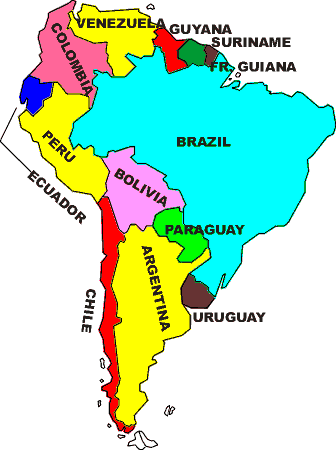
Map of South America

From the Heritage Foundation.

Excerpt:

The armed forces of Colombia have scored a major battlefield victory. They finally hunted down, confronted, and killed the leader of the narco-terrorist Revolutionary Armed Forces of Colombia (FARC), Guillermo Leon Saenz, widely known by his alias Alfonso Cano.

A guerrilla for decades, Cano assumed the top leadership of the FARC following the natural death of founder Manuel Marulanda (2008) and the elimination of senior figures Raul Reyes (2008) and Jorge Briceno (aka Mono Jojoy, 2010).

Seen by some as a modern-day version of the “good revolutionary,” Cano—a life-long advocate of armed violence and terrorism—fell in combat with the Colombian armed forces as they rappelled their way into his secret jungle hideout. Cano was also indicted in a U.S. court for drug trafficking along with dozens of other FARC leaders and had a $5 million price on his head.

FARC is a Marxist terrorist group.

The Economist reports that the Colombian economy is also doing well.

Excerpt:

WHEN the figures are finally tallied, Colombia may prove to have weathered the world recession better than any other of the larger Latin American countries. After a slight contraction at the end of 2008, the economy has been growing modestly this year. This resilience stems from continued foreign investment, an increase in government spending on public works and easier money: since December the central bank has cut interest rates by six percentage points, to 4%, a steeper drop than anywhere in the region outside Chile.

[…]President Álvaro Uribe’s security policies have helped to restore confidence. Investment soared, from 15% of GDP in 2002 to 26% last year, says Mr Zuluaga. Private business has retooled. After many delays, the government has issued licences to expand several ports; this month it hopes to award a contract for the first of four big road schemes, costing a total of $7.5 billion over four years. It hopes for investment of up to $50 billion in mining and oil over the next decade.

And liberal MSNBC has more on the booming Colombian economy.

Excerpt:

…Colombia’s revival is benefiting U.S. economic and political rivals as much as or more than the U.S. itself.

The long delay in signing the treaty allowed Latin America’s fourth-largest economy to strengthen ties with China. It also damaged U.S. credibility in the region, says Eric Farnsworth, vice-president of the Council of the Americas in Washington. “The delay in passing this called into question the United States’ reliability as a partner,” Farnsworth says. “There’s a strategic component to this. It’s not just about economics and trade.”

[…]As talks between the U.S. and Colombia dragged on, Colombia and China forged plans for a rail link between the Pacific and Caribbean that could draw freight away from the Panama Canal. Colombian President Juan Manuel Santos aims for a trade deal with South Korea. To tighten his connections to high-growth Asia, he’s also seeking membership in the Asia-Pacific Economic Cooperation group. “While Washington was debating whether the accord with Colombia was opportune, we advanced in our foreign policy strategy,” says Trade Minister Sergio Diaz-Granados.

Santos has cooperated more with his South American neighbors, organizing a meeting of finance ministers to discuss ways to protect their currencies and economies from the debt crisis in the U.S. and Europe. He supports a stock trading platform with Colombia, Chile, and Peru and wants to bring Mexico and Panama on board. Exports to Brazil have surged tenfold. While the U.S. remains Colombia’s biggest export market, with $16.8 billion in 2010 sales, up 30 percent from a year earlier, sales to China more than doubled last year, to $1.2 billion. Sales to the European Union are also rising, to $5.4 billion this year through August, more than in all of 2010. An EU trade accord could come next year.

The government has reduced cocaine cultivation 37 percent and halved the number of insurgents to about 8,000. Improved security has spurred enough growth to win an investment-grade credit rating from Standard & Poor’s as well as investment from billionaires. Colombia’s victories over the guerrillas opened up swathes of countryside to exploration for oil, gold, and coal. Mexican billionaire Carlos Slim’s push into crude has helped fuel foreign investment that the government says may reach a record $12 billion this year. The economy grew 5.2 percent in the second quarter.

The U.S. faces more competition from Colombia’s neighbors and Canada. In 2010, U.S. agricultural exports to Colombia fell more than 50 percent from 2008, to $827 million, as Argentina’s more than doubled, to $1 billion, according to a report by Senator Richard Lugar’s staff. Diaz-Granados attributes the U.S. setback to the delay in the free-trade agreement.

An August accord reduces or ends Colombian tariffs on Canadian wheat, paper, and machinery. Bank of Nova Scotia, Canada’s third-largest lender, agreed in October to buy 51 percent of Banco Colpatria Red Multibanca Colpatria for about $1 billion—Scotiabank’s largest international takeover. “This is not the Colombia of old,” says Brian J. Porter, group head of international banking for Scotiabank. “The more we looked at Colombia, the more excited we got about the economic potential.”

We really should have signed that trade deal 3 years ago – it would have helped out economy a lot.  But unions got Obama elected, and the unions decided that the trade deal needed to be held up for 3 years. And that’s one of the reasons why we’ve had over 9% unemployment. Our economic policy is being set by unions, not by economists. But in Colombia, economic policy is set by economists, not unions.
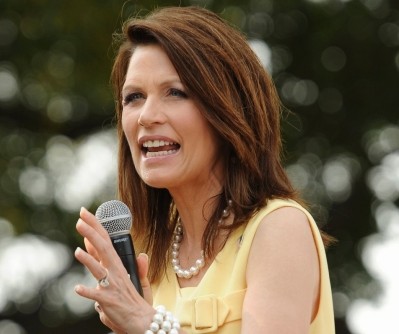

A closer look at Michele Bachmann’s record on fiscal policy

Michele Bachmann: On the Issues

An analysis of Michele Bachmann’s record on economic policy, courtesy of the Club for Growth.

Summary:

Congresswoman Michele Bachmann was first elected to Congress in 2006 after serving in the Minnesota State Senate from 2001 to 2006. If elected President, she would be the first woman President and the second person elected directly from the U.S. House of Representatives since James Garfield. Congresswoman Bachmann received a 100% score in the Club for Growth’s 2010 scorecard and has a lifetime score of 94%. The average house Republican score from 2007-2010 was 78%. Congresswoman Bachmann also has a lifetime score of 94% from the Minnesota Taxpayers League during the time she served in the State Senate. The average score for Republican State Senators during that time was 76%.

These guys do the most thorough job of anyone vetting the candidates – they go over every bill, every speech, every vote, every editorial – even campaign advertisements.

The report covers the following areas:

  • TAXES
  • SPENDING
  • ENTITLEMENT REFORM
  • REGULATION
  • FREE TRADE
  • SCHOOL CHOICE
  • TORT REFORM
  • POLITICAL FREE SPEECH
  • POLITICAL ACTIVITY & ENDORSEMENTS

Excerpt:

SCHOOL CHOICE
The Club for Growth supports broad school choice, including charter schools and voucher programs that create a competitive education market including public, private, religious, and non-religious schools.  More competition in education will lead to higher quality and lower costs.
Congresswoman Bachmann not only has a strong record on school choice, she is the first major presidential candidate to actually found a charter school. In fact, Congresswoman Bachmann co-founded the first K-12 charter school in the nation, New Heights Charter School back in 1993.  Her record on school choice has, predictably, been flawless since then.
In 2011, Bachmann voted to re-establish the DC school voucher program.  As a member of the State Senate, Bachmann voted to prohibit teacher strikes during the school year.  She also voted to allow parents to use education tax credits for tuition at private schools.  She’s introduced legislation to make foster children eligible for education vouchers.
As far back as 2003, Bachmann was fighting the No Child Left Behind Act, filing a bill in the Minnesota legislature that would have prohibited the Dept. of Children, Families and Learning or any other state agency “from entering into a contract or other agreement under the provisions of the No Child Left Behind Act of 2001, unless the financial consequences to the state and each school district have been identified.”  Another bill, S.F. 1921, “requires all state plans, agreements and contracts associated with NCLB compliance to be nullified and revoked on June 1, 2004, unless the Legislature specifically affirms implementation of the federal law by that date.”

Conclusion:

With very few exceptions, Congresswoman Bachmann has supported pro-growth policies throughout her career. She especially deserves praise for her consistent defense of school choice. After reviewing her record, we are confident that Congresswoman Bachmann would be a pro-growth President.

For my social conservative friends: please print out the paper and read it. These guys are not indifferent to your concerns at all.

Pat Toomey and the Club for Growth

The past director of the Club for Growth is current Pennsylvania senator Pat Toomey.

Here’s a blurb from his web site:

Pat is pro-life and believes that children should be welcomed into the world and protected by its laws.

While reasonable people may differ on the question of abortion rights, we should all be able to agree on policies that encourage adoption over abortion, that avoid taxpayer funding of abortions, and that allow parental involvement in decisions that involve minors. As a senator, Pat will support policies that further these important goals.

Pat also believes the tradition of marriage is sacred and is best defined as between a man and a woman. As a congressman, Pat voted to protect the institution of marriage in many ways. For example, Pat voted to reduce the tax penalty on married couples and will support similar policies as a U.S. senator. Throughout his time in Congress, Pat voted for legislation to protect innocent life, strengthen marriage, and protect the traditional values upon which this country was founded.

His voting record on abortion:

  • Voted YES on making it a crime to harm a fetus during another crime. (Feb 2004)
  • Voted YES on banning partial-birth abortion except to save mother’s life. (Oct 2003)
  • Voted YES on forbidding human cloning for reproduction & medical research. (Feb 2003)
  • Voted YES on funding for health providers who don’t provide abortion info. (Sep 2002)
  • Voted YES on banning human cloning, including medical research. (Jul 2001)
  • Voted YES on banning Family Planning funding in US aid abroad. (May 2001)
  • Voted YES on federal crime to harm fetus while committing other crimes. (Apr 2001)
  • Voted YES on banning partial-birth abortions. (Apr 2000)
  • Voted YES on barring transporting minors to get an abortion. (Jun 1999)
  • Rated 0% by NARAL, indicating a pro-life voting record. (Dec 2003)

And on marriage:

  • Voted YES on establishing nationwide AMBER alert system for missing kids. (Apr 2003)
  • Voted YES on reducing Marriage Tax by $399B over 10 years. (Mar 2001)
  • Rated 100% by the Christian Coalition: a pro-family voting record. (Dec 2003)

This is the record of the former leader of the most fiscally conservative PAC. The most pro-business group. The most anti-spending group.

Fiscal conservatives are more socially conservative than you think. If you are a social conservative, but not a fiscal conservative, then you should print out the paper on Michele Bachmann, a radical social conservative, and see how these fiscal conservatives at the Club for Growth judge what counts as fiscally conservative. It might be the case that fiscally conservative positions actually dovetail nicely with socially conservative positions. I think they do.

Campaign speeches, interviews and debates

Speeches:

Reactions from her recent debate performance:

Profiles of Michele Bachmann:

Michele Bachmann on television news

Let Americans spend their own money

Time to prioritize spending

Obama’s plan is to raise your taxes

Michele Bachmann in the legislature

Against socialism:

For economic growth:

Against ACORN funding:

Poll: Disengagement grows the longer workers stay in government jobs

Map of Canada
Map of Canada

From the Ottawa Citizen. (H/T Andrew)

Excerpt:

Recent post-secondary graduates recruited by the federal public service appear to become more disengaged and less ambitious the longer they’re in their jobs.

That’s a key conclusion of a new study that provides an intriguing window into perceptions of government employment by new public service hires and potential recruits. The study, recently posted to a government website, was done for the Public Service Commission by EKOS Research Associates.

It involved online surveys with two groups of people hired through the government’s Post-Secondary Recruitment Program (PSR), as well as recent hires recruited through other methods and “potential recruits” — mostly university graduates under age 35.

As part of the study, EKOS re-interviewed 219 PSR recruits who were surveyed in an earlier phase of the study in 2009. It found some “troubling shifts” in their attitudes.

The importance these recruits attach to “key intrinsic job aspects” has declined over the past year, the study reports. The weight they give to the opportunity to be creative declined by nine percentage points from 2009 to 2010, it says, while the importance they attached to the prestige associated with their jobs fell by 10 points.

There were also smaller declines in the importance ascribed to meaningful work and opportunities for career advancement, while “more extrinsic issues” — such as attractive compensation and a good work-life balance — assumed greater significance.

“These findings suggest that PSR recruits become less ambitious/intrinsically motivated as they spend more time in the federal public service,” the study concludes.

Can people who are disengaged serve the public as well as private sector workers whose compensation and continued employment depends on their being engaged in their work? This is why we need to privatize as much as possible.