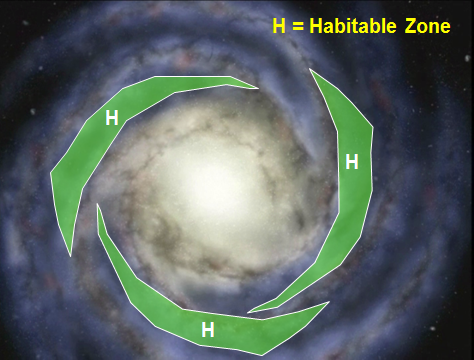
The galactic habitable zone (GHZ) is shown in green superimposed on a spiral galaxy
This is going to be old news to readers of this blog who are familiar with the Michael Strauss, Walter Bradley and Guillermo Gonzalez lectures on habitability and fine-tuning. But, it’s nice to see these ideas show up in one of the most prestigious peer-reviewed science journals in the world (if not the most prestigious).
Scientists have known for several years now that stars, galaxies, and almost everything in the universe is moving away from us (and from everything else) at a faster and faster pace. Now, it turns out that the unknown forces behind the rate of this accelerating expansion—a mathematical value called the cosmological constant—may play a previously unexplored role in creating the right conditions for life.
That’s the conclusion of a group of physicists who studied the effects of massive cosmic explosions, called gamma ray bursts, on planets. They found that when it comes to growing life, it’s better to be far away from your neighbors—and the cosmological constant helps thin out the neighborhood.
“In dense environments, you have many explosions, and you’re too close to them,” says cosmologist and theoretical physicist Raul Jimenez of the University of Barcelona in Spain and an author on the new study. “It’s best to be in the outskirts, or in regions that have not been highly populated by small galaxies—and that’s exactly where the Milky Way is.”
Jimenez and his team had previously shown that gamma ray bursts could cause mass extinctions or make planets inhospitable to life by zapping them with radiation and destroying their ozone layer. The bursts channel the radiation into tight beams so powerful that one of them sweeping through a star system could wipe out planets in another galaxy. For their latest work, published this month in Physical Review Letters, they wanted to apply those findings on a broader scale and determine what type of universe would be most likely to support life.
The research is the latest investigation to touch on the so-called anthropic principle: the idea that in some sense the universe is tuned for the emergence of intelligent life. If the forces of nature were much stronger or weaker than physicists observe, proponents note, crucial building blocks of life—such fundamental particles, atoms, or the long-chain molecules needed for the chemistry of life—might not have formed, resulting in a sterile or even completely chaotic universe.
Basically, the best place for a galaxy that permits complex, embodied life to exist is one where you can pick up enough heavy elements from dying stars nearby, but not be in an area that is so crowded by stars that you will be murdered by intense gamma radiation when they die.
The cosmological constant has to be set just right that we spread out enough to make space between spiral arms for life-permitting solar systems, but no so spread out that we cannot pick up the heavy elements we need for a metal-rich star, a moon, and the bodies of the intelligent agents themselves.
More:
As it turns out, our universe seems to get it just about right. The existing cosmological constant means the rate of expansion is large enough that it minimizes planets’ exposure to gamma ray bursts, but small enough to form lots of hydrogen-burning stars around which life can exist. (A faster expansion rate would make it hard for gas clouds to collapse into stars.)
Jimenez says the expansion of the universe played a bigger role in creating habitable worlds than he expected. “It was surprising to me that you do need the cosmological constant to clear out the region and make it more suburbanlike,” he says.
Remember, this is only one of many characteristics that must obtain in order for a have a location in the universe that can support complex, embodied life of any conceivable kind.
Let’s review the big picture
Time for me to list out some of the things that are required for a galaxy, solar system and planet to support complex embodied life. Not just life as we know it, but life of any conceivable kind given these laws of physics.
a solar system with a single massive Sun than can serve as a long-lived, stable source of energy
a terrestrial planet (non-gaseous)
the planet must be the right distance from the sun in order to preserve liquid water at the surface – if it’s too close, the water is burnt off in a runaway greenhouse effect, if it’s too far, the water is permanently frozen in a runaway glaciation
the solar system must be placed at the right place in the galaxy – not too near dangerous radiation, but close enough to other stars to be able to absorb heavy elements after neighboring stars die
a moon of sufficient mass to stabilize the tilt of the planet’s rotation
plate tectonics
an oxygen-rich atmosphere
a sweeper planet to deflect comets, etc.
planetary neighbors must have non-eccentric orbits
It’s not easy to make a planet that supports life. For those who are interested in reaching out to God, he has left us an abundance of evidence for his existence – and his attention to detail.
And remember, these requirements for a habitable planet are downstream from the cosmic fine-tuning of constants and quantities that occurs at the Big Bang. No point in talking about the need for plate tectonics if you only have hydrogen in your universe. The habitability requirements are a further problem that comes after the fine-tuning problem.
Resources
The best book to read on this topic is “The Privileged Planet“, by Guillermo Gonzalez and Jay W. Richards. The latter is one of my absolute favorite Christian scholars, a real renaissance man. If the book is too much, there is a DVD by the same name that covers everything you need to know at a high level. Just FYI, Gonzalez made the cover of Scientific American in 2001, for his research on habitable zones. This is real evidence you can discuss with anyone, anywhere.
You can also watch the DVD for FREE on YouTube. Not sure how long that will be there. If you like it, buy the DVD, so you can show your friends.
Two bears fight it out, and may the best bear win!
Details:
On October 10th, 2016, David Wood (Christian) debated Michael Shermer (Atheist) on the topic “Does God Exist?” The debate was sponsored by Ratio Christi. In the course of the debate, Wood and Shermer discussed the Scientific Revolution, design arguments, cosmological arguments, moral arguments, the problem of evil, skepticism, and methodology.
The video:
The debate starts at 6:30, following introductory remarks. I was ordered to summarize this debate by my good friend Eric, who said this: “I’m a little less than halfway through the David Wood vs Michael Shermer debate, but it’s amazing. If you summarize it you will sound super snarky but you will actually be doing honest reporting.”
I’m only going to summarize the opening speeches which went until 47:40.I linked to the rebuttals and cross-examination below. I did love the debate, and thought that both sides had great speakers who kept to their times, and were on topic and effective. As always with my snarky paraphrase of the atheist, you should listen to the recording to see what was actually said. I try to present their argument with the spin removed.
Wood’s opening speech:
The scientific revolution was started by Christian theists:
Science requires three assumptions: 1) that the universe can be understood, 2) that human beings can understand it, 3) that it is good for human beings to understand the universe.
Christians produced an explosion of scientific discoveries during the 16th and 17th century
In their writings, these Christian theists explained that their scientific investigation was grounded in their Christian worldview, and was seen as a form of worship and learning from God
It is easy to do science now that the scientific method is widely accepted, but the challenge was to come up with the method and make the first discoveries – Christians did that
Atheism does not ground the assumption that the universe is understandable – it’s an accident
Atheism does not ground the assumption that humans could understand the universe – we are just random accidents that don’t have free will and our consciousness is an illusion
Atheism does not ground the desire to understand the universe, the earliest scientific discoveries had no practical benefit
Theism grounds all 3 of the requirements of the scientific enterprise: the universe is made by a rational mind, human beings are made in the image of God – inheriting free will and rationality, knowledge of God (the highest God) can be obtained from the natural world (the Bible says so in Psalm 19:1 and Romans 1)
The testing of the scientific hypotheses confirmed theism:
scientific progress confirmed the origin of the universe out of nothing
scientific progress confirmed the fine-tuning of the universe for the existence of complex embodied intelligent life
Atheism doesn’t ground the scientific method:
the three elements of the scientific hypothesis, which was birthed by theism, have been confirmed by repeated use of the scientific method
the three elements of the scientific hypothesis, which are not grounded in atheism, have been confirmed by repeated use of the scientific method
Shermer’s opening speech: (snarky paraphrase with spin removed)
An atheist about one more God than you:
There are lots of different religions, just like there there are many answers to math questions, and so that means that none of them can be true.
Just like you, I deny lots of wrong answers to math questions, but I just go one answer further and deny the right answer
Response to David Wood:
Well, in most of these European countries, you had to be a Christian or they would burn you at the stake, because it was against the law to be an atheist
So, since there were only Christians on the face of the planet in every country since the beginning of time (since that was the law everywhere, at all times, and in all places) then OF COURSE Christians invented science since they were the only ones who ever existed
The fact that the earliest scientists credit their Christian worldview for starting them on the path of making scientific discoveries “is irrelevant” (direct quote). “You might as well point to the fact that they are all dog owners. It’s irrelevant.” (direct quote)
Atheism is just a lack of belief in God:
Atheism, which has the definition a belief in the non-existence of God, actually means a lack of belief in God
I like my made-up definition, because then I don’t have to give any reasons or science to show that atheism is true
I just describe my psychological state, not objective reality, and that allows me to not have to defend my worldview
The burden of proof:
David has to produce evidence for his view of reality
I don’t have to produce evidence for my view of reality
The scientists that David quoted never discovered anything:
Those early scientists never discovered anything
They believed that thunder was God bowling
Newton and Copernicus and Galileo and the other famous scientists just said “I can’t figure it out” and “God did it” (direct quote)
The progress of science shows a natural explanation for everything:
The progress of science in the last 50 years has overturned the origin of the universe from nothing, and upheld the eternal universe favored by naturalists
The progress of science in the last 50 years has reduced the number of constants and quantities that have to be fine-tuned
The progress of science in the last 50 years has reduced the complexity of the origin of life from libraries biological information, molecular machines and miniature factories to simple jello that was formed in a warm pond
Who made God?
You can’t explain the origin of space and time and matter by appealing to a cause that is spaceless, eternal and non-material
Why can’t the universe be the thing that doesn’t need to be created (i.e. – it is eternal, and did not begin to exist 14.5 billion years ago, as every scientist says)
Why is there evil?
On atheism, the universe is an accident, and there is no objective standard of morality
Therefore, no atheist can call anything good or evil objectively
God allows human evil and natural evil
I have looked into the repercussions of evil throughout time and space for every act of apparently gratuitous evil and I can confirm God does not have a morally sufficient reason for allowing human evil and natural evil, and I keep the reasons in my garage at home, but you can’t see them because they are invisible, and they are undetectable by any other means
Christians used to believe in witches
Look at me quoting the Bible in the one place it mentions witches!
I believe the parts that make Christianity look bad, but not the early creed in 1 Corinthians 15:3-8 which is accepted as eyewitness testimony by the most skeptical atheist historians
You can repent at the last minute and get eternal life, that’s not fair
Not sure how an atheist misunderstanding Christian doctrines that can be explained by people who have read C.S. Lewis books is an argument against the existence of God
Christianity celebrates human sacrifice
Christians believe in human sacrifice because Jesus had to die for the sins of everyone
I’m pro-abortion and think that killing 56 million children is a great thing though
The doctrine of atonement makes no sense
How could God the Father accept the death of God the Son as a sacrifice for sin?
The rebuttals
I did not summarize the rebuttals, but I did watch them and link to them at the start of each speech.
First, I was very pleased with David Wood’s performance in this debate. I would have liked more focus on the scientific evidence for the origin of the universe and the fine-tuning, and fewer quotations from scientists in the opening speech. The rebuttals were good. And his performance in the Q&A was worth listening to.
Shermer’s first rebuttal gave me the impression that he was not interested in grasping truth through science, but just pushing away the science of today with speculations about the science fiction of tomorrow – might, maybe, let’s say, etc. He’s not a skeptic, he’s a speculator. Theists go wherever the evidence leads, we decide based on the evidence we have today. His attempt to underwrite objective morality by appealing to feelings wasn’t convincing. In the Q&A, he takes the standard atheist view that the nothing that preceded the universe is really something.



 WINTERY KNIGHT