Tag Archives: Theism

William Lane Craig debates Daniel Came: Does God exist?

Dr. Craig's opening speech summary slide
Dr. Craig’s opening speech summary slide

The video of the debate was posted by ReasonableFaith.org – Dr. Craig’s organization. This debate occurred in March 2017 at the University of Dublin, in Ireland.

The video: (91 minutes)

My non-snarky summary is below.

Dr. Craig’s opening speech

Two claims:

1. There are good reasons to think that theism is true.
2. There are not comparably good reasons to think that atheism is true.

Five reasons for God’s existence:

1. The beginning of the universe
– actual infinite past is mathematically impossible
– BGV theorem: any universe that is on balance expanding in its history (like ours) cannot be past eternal

2. Fine-tuning of cosmic quantities and constants
– slight changes to quantities and constants prevent a universe from supporting complex embodied life
– the multiverse response of atheists conflicts with observations, e.g. the Boltzmann Brains problem

3. Objective moral values
– God’s existence is required to ground objective moral values and duties

4. Minimal facts case for the resurrection of Jesus
– there are good reasons to accept the most widely accepted facts about the historical Jesus (empty tomb, appearances, early widespread belief in the resurrection)
– the best explanation of these minimal facts is that God raised Jesus from the dead

5. Experience God directly
– in the absence of any defeaters to belief in God, a person can experience God directly

Dr. Daniel Came’s opening speech

1. The hiddenness of God
– if God wants a personal relationship with us, and a relationship with God would be the greatest good for us
– God ought to reveal himself to us, but he does not  reveal himself to many people, the “non-resistant non-believers”

2. The inductive problem of evil
– many evil events occur that are pointless – there is no morally sufficient reason why God would allow them to occur
– examples: animal suffering, children born with disease, tsunamis
– the theistic response to this is that humans are not in a position to know whether there are morally sufficient reasons, due to our limitations of knowing the consequences
– but this ripple effect defense has 4 possible outcomes, 3 of which don’t do the job of justifying

Dr. Craig’s first rebuttal

1. The hiddenness of God
– God’s goal is not to make his existence known, but to draw them into a love relationship
– it’s speculative that overt displays of God’s existence would draw people to him in a love relationship, they might resent his bullying
– atheist would have to prove that God could draw more people into a love relationship with him by revealing himself more overtly

2. The inductive problem of evil
– as humans, we are not in a position to know for certain that any apparently pointless evil really is pointless
– William Alston article: 6 limitations of human knowing make it impossible to judge that an evil is actually “pointless”
– Dr. Came says that there are 4 possibilities for the ripple effects, and since 3 are bad, it’s likely that there are not morally sufficient reasons for a apparently pointless evil
– it is logically fallacious to assert probability conclusions without knowing the probabilities of those 4 options
– there is actually an argument from evil: since the problem of evil requires an objective standard of good and evil by which to measure, and God is the only possible ground of objective morality, then pressing the problem of evil actually requires the atheist to assume God, in order to ground this objective moral standard

Dr. Came’s first rebuttal

3. Objective moral values
– there are naturalistic theories of moral realism where objective moral duties and objective moral values exist in a naturalistic universe
– I’m not saying that any of them are correct, but there are many theories about object morality in a naturalistic universe

There are naturalistic theories for all of the 5 arguments that Dr. Craig presented. It is Dr. Craig’s responsibility to present those naturalistic theories and prove that they are not as good as his explanations. I’m not going to defend (or even name!) a single naturalistic theory for any of these 5 arguments by Dr. Craig.

Dr. Craig’s explanations for the 5 evidences he gave can’t be admitted, because we have to know how God did something in naturalistic terms before we can know that God did it supernaturally. Explanations are only valid if they are naturalistic.

1. The beginning of the universe
– naturalism explains how the universe expands after it came into being, so that explains how it came into being
– the God explanation, that God created the universe out of nothing, is not admissible, because it is not naturalistic
– how does God, as an unembodied mind interact with the physical world?
– the only agency that we know about is human agents, and we have bodies, so how could God perform actions without having a body?

The theistic hypothesis does not make any predictions, but naturalism makes lots of testable predictions. God could do anything, so he is not constrained and is therefore untestable. We can’t infer God as an explanation in principle because we can’t predict what is more probable if God exists than if he does not.

2. Fine-tuning of cosmic quantities and constants
– the university was not set up to make embodied intelligence plausible, because the vast majority of the universe is hostile to life
– there are models of the multiverse that escape the Boltzmann Brains problem that Dr. Craig raised

Dr. Craig’s second rebuttal

Some of Dr. Craig’s arguments are deductive (e.g. – the beginning of the universe, objective moral values), so that the conclusion follows from the premises if the premises are true. The resurrection passes the standard tests for historical explanations.

1. The beginning of the universe
– the whole point of the argument is that there is no naturalistic explanation for an ultimate beginning of the universe

2. Fine-tuning of cosmic quantities and constants
– the whole point of the argument is that there is no naturalistic explanation for a design of the universe to support life
– he has to prove that intelligences has to be attached to bodies
– human beings are non-physical minds united to physical bodies
– naturalistic attempts to explain mental operations fail
– the arguments prove that unembodied minds exist
– the vast expanse of the universe is required in order to form the galaxies, stars and heavy elements needed for complex life
– why expect that the entire universe should be small, or that life would be everywhere?
– a non-fine-tuned world is more likely in the multiverse, and in a multiverse, we are more likely to have a Boltzmann brain world than a world with complex, embodied life
– Dr. Came has not advanced any naturalistic explanation for the fine-tuning

3. Objective moral values
– non-theistic ethical theories cannot account for the ontological foundations of objective moral values and duties
– atheistic theories of moral realism simply assume objective moral values out of thin air
– it is especially hard to find any basis for objective moral duties in the absence of God

Dr. Came’s second rebuttal

5. Religious experience
– Dr. Craig should not bring up religious experience in a debate where arguments and evidence are central
– people who have dreams, hallucinations and psychotic delusions could appeal to religious experience
– religious experience is by no means universal, and it is possible to doubt it

3. Objective moral values
– there are lots of atheists who hold to objective moral values
– Dr. Craig has to explain how God grounds objective moral values and duties
– Dr. Craig has to explain why atheist moral realist theories don’t work to ground objective moral values and duties

1. The beginning of the universe
– Dr. Craig claims that something can’t come from nothing, that’s not an argument
– there are numerous models that don’t require an absolute beginning of the universe
– Dr. Craig cites the BGV theorem, but Guth (one of the authors) says that only the inflation has a beginning, not the whole universe

Dr. Craig’s conclusion

1. The beginning of the universe
– on theism, there is an efficient cause, but no material cause, for the origin of the universe
– on atheism, there is neither an efficient cause nor a material cause, for the origin of the universe: that’s worse!
– if he thinks that there are models of the universe that don’t require a beginning, then let him name a viable eternal model of the universe
– he never refuted the mathematical argues against an infinite past

2. Fine-tuning of cosmic quantities and constants
– nothing to refute

3. Objective moral values
– God is a better ground for morality than humans, because he is ultimate, and not contingent and arbitrary
– God is a being who is worthy of worship, and therefore command his creatures with moral duties

4. Minimal facts case for the resurrection of Jesus
– nothing to refute

5. Religious experience
– only justified because there are no defeaters to it

1. The hiddenness of God
– atheist has to show that if God’s existence were more obvious, that it would result in more people being drawn to him

2. The inductive problem of evil
– Dr. Came’s argument was logically fallacious, and makes errors in probability theory

Dr. Came’s conclusion

Sometimes, people can’t prove something, but lack of evidence is a justification for doubting it, e.g. – werewolves.

If none of Craig’s arguments work, then it follows that it is not rational to believe that God exists, and it is rational to believe that God does not exist.

Atheists shouldn’t have a burden of proof for what they know, only theists have a burden of proof for what they know.

My thoughts

One quick point. If life were common everywhere then atheists would infer that God wasn’t involved in it. Period. “Life is everywhere, so it’s common, why do we need a designer?” they’d say. I agree with Dr. Came about denouncing religious experience in a formal debate. I don’t like when Dr. Craig brings this up, but I see why he does it – he’s an evangelist, and that’s a good thing, too. I just worry about how it looks to atheists, although it’s good for sincere seekers. I’m not the one on the stage, though, Dr. Craig is.

I think the point about more overt revealing by God would annoy people and make them turn away. Think of how gay people respond to the suggestion that there is anything wrong with them, with rage, vandalism, threats, coercion, attempts to get you to lose your job and business, and using government as a weapon to fine and imprison you. It’s really obvious to me that more God does not mean more love of God. For those who don’t want God, the hiddenness is respect for their choice to put pleasure above the search for truth. (I mean the gay activists – I have great sympathy for people who struggle with same-sex unwanted attractions because they were impacted by a failed bond with their parent of the same sex as they are).

Whenever I meet people like Dr. Came, I always urge them to keep investigating and pursuing truth, because they will find it if they are sincerely seeking after God. Some atheists do sincerely seek God, but I don’t know any who haven’t found him. I’m not sure if that’s because those atheists who claim to be non-resistant and rational are in fact resistant and non-rational, or what the real reason is. If you believe the Bible, all unbelief is non-rational and resistant (see Romans 1). Regarding the werewolves, we don’t have any good arguments for werewolves, we do have good arguments for God. Dr. Came didn’t refute the arguments that Craig raised, nor did his own arguments for atheism work. And there are many, many more arguments (origin of life, Cambrian explosion, habitability-discoverability, molecular machines) that Craig did not raise, too.

Is the presupposition of naturalism in science good for the pursuit of truth?

I have a key that will unlock a puzzling mystery

This topic came up recently in a discussion, and I wanted to be sure that all my readers were aware of how to think about the work that the presupposition of naturalism does in supporting naturalistic views of science. When I was little, way back in the 1990s, Phillip E. Johnson’s work on the definitions of science, evolution and creation were very important stuff. He was everywhere, doing lectures on university campuses and debates on the radio with Eugenie Scott. I was able to get a bunch of this audio from Access Research Network on AUDIO CASSETTES, but now that’s all obsolete.

Thankfully, I was able to find an old column written by Johnson in the Wall Street Journal, and preserved by Access Research Network.

Excerpt:

A Chinese paleontologist lectures around the world saying that recent fossil finds in his country are inconsistent with the Darwinian theory of evolution. His reason: The major animal groups appear abruptly in the rocks over a relatively short time, rather than evolving gradually from a common ancestor as Darwin’s theory predicts. When this conclusion upsets American scientists, he wryly comments: “In China we can criticize Darwin but not the government. In America you can criticize the government but not Darwin.”

That point was illustrated last week by the media firestorm that followed the Kansas Board of Education’s vote to omit macro-evolution from the list of science topics which all students are expected to master. Frantic scientists and educators warned that Kansas students would no longer be able to succeed in college or graduate school, and that the future of science itself was in danger. The New York Times called for a vigorous counteroffensive, and the lawyers prepared their lawsuits. Obviously, the cognitive elites are worried about something a lot more important to themselves than the career prospects of Kansas high school graduates.

The root of the problem is that “science” has two distinct definitions in our culture. On the one hand, science refers to a method of investigation involving things like careful measurements, repeatable experiments, and especially a skeptical, open-minded attitude that insists that all claims be carefully tested. Science also has become identified with a philosophy known as materialism or scientific naturalism. This philosophy insists that nature is all there is, or at least the only thing about which we can have any knowledge. It follows that nature had to do its own creating, and that the means of creation must not have included any role for God. Students are not supposed to approach this philosophy with open-minded skepticism, but to believe it on faith.

[…]All the most prominent Darwinists proclaim naturalistic philosophy when they think it safe to do so. Carl Sagan had nothing but contempt for those who deny that humans and all other species “arose by blind physical and chemical forces over eons from slime.” Richard Dawkins exults that Darwin “made it possible to be an intellectually fulfilled atheist,” and Richard Lewontin has written that scientists must stick to philosophical materialism regardless of the evidence, because “we cannot allow a Divine Foot in the door.”

So, if you’re having a discussion with a person who believes in naturalism – that everything in nature can be explained by material forces alone – then they will give you a stock response to all of your evidence for something outside of nature.

  • Origin of the universe? That’s not science
  • Cosmic fine-tuning? That’s not science
  • Origin of life? That’s not science
  • Cambrian explosion? That’s not science
  • Habitability-discoverability? That’s not science

It’s not that the people who did the science around these discoveries invoked God, and that’s why it’s not science. On the contrary, the mainstream scientists who made these discoveries scrupulously left God out of their microscopes and telescopes. These discoveries – which have only gotten worse for the naturalists as more details emerge – do not have easy naturalistic explanations. If you ask the naturalist for an explanation, they will resort to various sorts of speculations:

  • future science will undermine all our current knowledge
  • we are in an unobservable multiverse that exists eternally
  • aliens seeded the Earth with life, and THEY evolved
  • there are lots of fossils we haven’t discovered yet
  • there are lots of stars and planets we haven’t discovered yet

What’s the answer to this arguing from ignorance?

I think ridicule is best. You need to start by telling the full story about how these discoveries were made. Name the scientists, state the dates. Tell the whole story of how the science was done. Do this for each discovery. Then, at the end, ask them which of these scientific discoveries they deny. Ask them for naturalistic explanations of the ones they accept. Pretend to be confused, then concerned about their sanity. Finally, you should be as condescending as possible, and just explain that we can’t believe in fairies and unicorns. Explain things to them as if they were a child: we have to base our worldview on what science has revealed. We can’t hold out for Santa Claus to come down the chimney with new science that undermines all we have discovered. We have to go with the science we have today, and the science we have today says Creator and Designer. That is the best explanation of the what we know right now. And the trend is that these discoveries are becoming even MORE difficult for naturalism to account for. I guarantee you that the average rank-and-file atheist knows more about Star Wars and Star Trek lore than they do about actual scientific discoveries that threaten their beloved religion of naturalism.

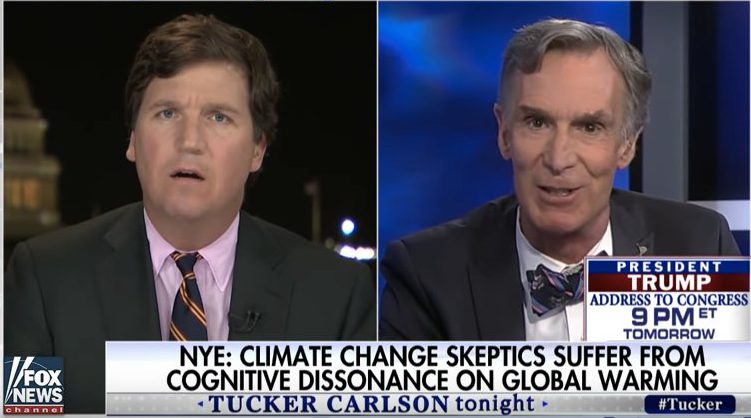
Try to make your face look like Tucker Carlson:

When dealing with a naturalist fundamentalist, make the Tucker Carlson face
The Tucker Carlson face conveys a mix of confusion, disappointment and horror

For God’s sake, even Richard Dawkins admitted in his debate with John Lennox that a good case can be made for a deistic God from the science we have now. If Dawkins can admit this, then you need to be extremely harsh to the village atheists.

If the word “naturalism” is all new to you, you should probably read the whole article and this longer article as well. The longer article really explains the different definitions of the words that are used in these debates. Johnson’s an excellent writer, and you will learn a lot.

New study: belief in free will linked to ability to behave morally and to help others

J. Warner Wallace: God's Crime Scene
J. Warner Wallace: God’s Crime Scene

This is a re-post because I am travelling today.

A while back I finished reading “God’s Crime Scene”, the new book by J. Warner Wallace. I wanted to post something about some studies he mentioned in Chapter 6, on free will. This is one of the places where he found evidence in a surprising area.

Wallace says that free will makes more sense if theism is true, because we have non-material souls that interact with our bodies, but are not causally determined by them. On atheism, only matter exists, and you can’t get free will (or consciousness) from matter. So atheists like Sam Harris and Alex Rosenberg, for example, deny free will, because they are materialists and atheists.

Anyway, here’s what he writes on p. 256:

In 2008, researchers from the University of Minnesota and the University of British Columbia conducted experiments highlighting the relationship between a belief in determinism and immoral behavior. They found students who were exposed to deterministic literature prior to taking a test were more likely to cheat on the test than students who were not exposed to literature advocating determinism. The researchers concluded those who deny free will are more inclined to believe their efforts to act morally are futile and are, therefore, less likely to do so.

In addition, a study conducted by researchers from Florida State University and the University of Kentucky found participants who were exposed to deterministic literature were more likely to act aggressively and less likely to be helpful toward others.” Even determinist Michael Gazzaniga conceded: “It seems that not only do we believe we control our actions, but it is good for everyone to believe it.”” The existence of free will is a common characteristic of our experience, and when we deny we have this sort of free agency, there are detrimental consequences.

I decided to look up these studies.

Here’s the abstract for first study: (2008)

Does moral behavior draw on a belief in free will? Two experiments examined whether inducing participants to believe that human behavior is predetermined would encourage cheating. In Experiment 1, participants read either text that encouraged a belief in determinism (i.e., that portrayed behavior as the consequence of environmental and genetic factors) or neutral text. Exposure to the deterministic message increased cheating on a task in which participants could passively allow a flawed computer program to reveal answers to mathematical problems that they had been instructed to solve themselves. Moreover, increased cheating behavior was mediated by decreased belief in free will. In Experiment 2, participants who read deterministic statements cheated by overpaying themselves for performance on a cognitive task; participants who read statements endorsing free will did not. These findings suggest that the debate over free will has societal, as well as scientific and theoretical, implications.

And the abstract for the second study: (2009)

Laypersons’ belief in free will may foster a sense of thoughtful reflection and willingness to exert energy, thereby promoting helpfulness and reducing aggression, and so disbelief in free will may make behavior more reliant on selfish, automatic impulses and therefore less socially desirable. Three studies tested the hypothesis that disbelief in free will would be linked with decreased helping and increased aggression. In Experiment 1, induced disbelief in free will reduced willingness to help others. Experiment 2 showed that chronic disbelief in free will was associated with reduced helping behavior. In Experiment 3, participants induced disbelief in free will caused participants to act more aggressively than others. Although the findings do not speak to the existence of free will, the current results suggest that disbelief in free will reduces helping and increases aggression.

So what to make of this?

If you’re an atheist, then your worldview is telling you that what you are doing now is the result of genetic programming and sensory inputs. You’re not conscious. You can’t reason. You make no free choices, including moral choices. Naturally, someone who believes this is going to struggle with prescriptive morality, including self-sacrificial care and concern for others. Their worldview undermines the rationality of the moral point of view. You might find atheists acting morally for their own purposes, but their worldview doesn’t rationally ground it. This is a big problem for people who can see objective morality woven into the universe – and themselves – because they have the awareness of objective right and wrong.

I think what atheists like to say is “I can be moral, too”. That’s not interesting. What is interesting is whether it is rational for you to be moral when things start to get a bit uncomfortable. When I look at the adultery of Dawkins, the polyamory of Carrier, the divorces of Shermer and Atkins, etc. I am not seeing anything that really wows me. They all deny free will of course, and think that trying to resist temptation is a waste of time. What difference would it make if they did, anyway – there’s no afterlife on atheism.

Wallace explains how the awareness of free will and moral choices caused him to turn away from atheism, in this blog post.

He writes:

As an atheist, I chose to cling to naturalism, in spite of the fact that I lived each day as though I was capable of using my mind to make moral choices based on more than my own opinion. In addition, I sought meaning and purpose beyond my own hedonistic preferences, as though meaning was to be discovered, rather than created. I called myself a naturalist while embracing three characteristics of reality that simply cannot be explained by naturalism. As a Christian, I’m now able to acknowledge the “grounding” for these features of reality. My philosophical worldview is consistent with my practical experience of the world.

I think atheists who want to be honest about their own experience of first-person consciousness, free will, moral realism, etc. will do well to just accept that theism rationally grounds all of these things, and so you should accept theism. Theism is real. If you like morality, and want to be a virtuous person, then you should accept theism.