Tag Archives: The Rich

Mitt Romney’s tax returns would make him lose the election to Obama

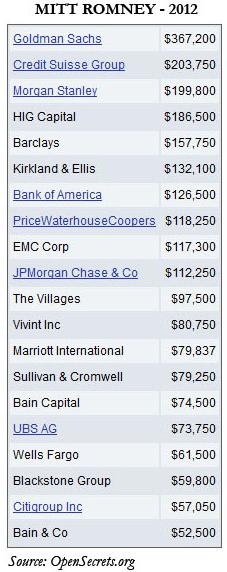
Wall Street Banks contributions to Mitt Romney
Wall Street banks make huge contributions to Mitt Romney

From The Hill. (H/T Riehl Worldview)

Excerpt:

It’s important not to overstate the perils Romney faces. He is still by far the best-funded candidate in the race. He has a state-by-state infrastructure that is the envy of his rivals. Even if he were to lose Saturday’s South Carolina primary, he would  likely remain the overall favorite to clinch the nomination.

But the procession of errors has been striking nonetheless — and it has raised concerns among many in the GOP about his vulnerabilities in a general election contest with President Obama.

Most of Romney’s awkwardness has revolved around questions about his wealth. During a heated exchange during a debate last month, he ill-advisedly offered to bet Perry $10,000 that his own account of what he had written in one of his books was correct. Perry declined, saying he was “not in the betting business,” but the episode heightened perceptions that Romney is out of touch with most Americans.

The same pattern keeps cropping up. Earlier this week, he was asked about the effective tax rate he pays on his income, and managed to injure himself twice in the space of a few sentences. First, he acknowledged that his tax rate was “probably closer to the 15 percent rate than anything.” He then added: “I get speaker’s fees from time to time, but not very much.”

The first claim was almost certainly true. Romney’s income is believed to come chiefly from long-term investments rather than earned income, and that would indeed make him liable for capital gains tax levied at a 15 percent rate. But it still places the multimillionaire in a more lightly taxed band than many voters — something which Newt Gingrich tried to take advantage of with his mocking proposal to introduce a “Mitt Romney 15 percent flat tax.”

Perhaps even worse was Romney’s “not very much” comment. His latest financial disclosure form, which covered the period from February 2010 to February 2011, revealed that he earned $374,327 for speeches. The sum is approximately seven times the median household income in the United States.

Those remarks had been preceded by a televised debate at which he gave a muddled response about whether he would release his tax returns.

Romney flubbed the tax-return question for a second time at a debate last Thursday, eliciting boos from the crowd when he said he would “maybe” follow the example of his late father, former Michigan Gov. George Romney, who released 12 years of tax returns when running for the presidency in 1968.

Romney’s mangled syntax on these occasions seems symptomatic of a wider personal unease in discussing his finances. GOP consultants say he needs to get over that discomfort if he is to prove an effective candidate.

Another concern that I have is that Mitt Romney has $20-100 million dollars in his retirement account.

Excerpt:

Like many Americans, Mitt Romney has an individual retirement account. Unlike most Americans, Mr. Romney has between $20.7 million and $101.6 million in it, a big chunk of his fortune.

Experts on estate planning said it is highly unusual to accumulate such a considerable sum in an IRA, an investment vehicle restricted by annual contribution limits. It appears that Mr. Romney’s grew so large mostly because it holds investments in Bain Capital, the private-equity firm he helped start.

[…]Mr. Romney is one of the richest presidential candidates in decades, and his GOP opponents increasingly are trying to turn wealth into a liability. President Barack Obama is expected to do the same if the former Massachusetts governor wraps up the nomination. Mr. Romney’s tax liability has emerged as a debating point in the GOP nominating contest, a proxy for a bigger argument over who should shoulder the nation’s tax burden.

In recent days, Mr. Romney’s rivals have pressed him to release his tax returns. They have attacked him for his role at Bain Capital, the source of his wealth. When Mr. Romney revealed Tuesday that his effective federal income-tax rate had been about 15% in recent years, both the White House and GOP candidates used the number as a cudgel.

[…]Michael Whitty, a lawyer at Vedder Price in Chicago who advises private-equity executives, said it is impossible to determine from Mr. Romney’s public disclosures how the IRA grew so large. Based on its listed holdings, which include many Bain Capital vehicles, Mr. Whitty theorizes Mr. Romney may have invested in Bain funds through a 401(k)-type plan, or directed some of his Bain holdings into such a plan, which he then rolled into an IRA.

How is he going to explain that? This might be one of the reasons why Romney is not releasing his tax returns. He needs to be pounded on this by Gingrich and Santorum until he drops out – we can’t afford to choose a nominee who has no hope of beating Barack Obama.

Related posts

Richard Epstein explains why economic inequality is required in order to promote innovation

My friend Matt, who blogs at The Conscience of  a Young Conservative, posted this on Facebook.

Epstein explains how the profit motive creates economic value that raises the standard of living of all people, who are able to exchange their money for valuable products and services that they did not create. He explains how wealth redistribution is wasteful and harmful to economic growth.

(Found here)

Now let’s look at some myths that Christians believe about economics.

We need to understand basic economics

Christian philosopher Jay Richards explains basic economics.

Excerpt:

THE ZERO-SUM GAME MYTH.

There are three kinds of games: win-lose, lose-lose, and win-win. Win-lose games, like basketball, are sometimes called “zero-sum games.” When the Celtics and the Bulls compete, if the Celtics are up, then the Bulls are down, and vice versa. The scales balance. It’s a zero-sum.

Besides lose-lose games, which most of us avoid, there are positive-sum, or win-win, games. In these games, some players may end up better off than others, but everyone ends up at least the same if not better off than they were at the beginning.

Millions of people think that the free trade in capitalism is a dog-eat-dog competition, where winners always create losers. This is the zero-sum game myth, which leads many to think that the government should somehow redistribute wealth. While some competition is a part of any economy, of course, an exchange that is free on both sides, in which no one is forced or tricked into participating, is a win-win game. When I pay my barber $18 for a haircut, I value the haircut more than the $18. My barber values the $18 more than the time and effort it took her to cut my hair. We’re both better off. Win-win.

THE MATERIALIST MYTH.

A similar myth leads people to think of the economy as some fixed amount of material stuff—money in safes or gold bars in a vault. Since two firms competing for one customer can’t both get the customer’s money, we might think the whole economy looks that way: wealth itself isn’t created, it’s merely transferred from one party to another.

A common image of this “Materialist Myth” is a pie. If one person gets too big a slice, someone else will get just a sliver. To serve it fairly, you have to slice equal pieces.

This isn’t how a free economy works, however. Over the long run, the total amount of wealth in free economies grows. We can create wealth that wasn’t there before. The “pie” doesn’t stay the same size. Under capitalism, someone can get wealthy not merely by having someone else’s wealth transferred to his account, but by creating new wealth, not only for himself, but for others as well.

THE GREED MYTH.

Friends and foes of capitalism often claim that it is based on greed. Writer Ayn Rand even claimed that selfishness is a virtue (see the accompanying feature article). But greed is one of the seven deadly sins. If capitalism is based on it, then Christians can’t be capitalists.

In truth, Adam Smith and other capitalist thinkers did not believe this “Greed Myth.” Rather, Smith argued that capitalism, unlike static economies, channels even greedy motives into socially beneficial outcomes. “In spite of their natural selfishness and rapacity,” Smith wrote, business people “are led by an invisible hand…and thus without intending it, without knowing it, advance the interest of the society.”3

Rather than inspire miserliness, capitalism encourages enterprise. Entrepreneurs, including greedy ones, succeed by delaying their own gratification, by investing their wealth in creative but risky ventures that may or may not pan out. Before they ever profit, they must first create.

In a fallen world, we should want an economic system that not only channels greed into productive purposes, but unleashes human ingenuity, creativity, and willingness to risk as well.

I think Christians who don’t understand economics really need to make the effort to understand the basics. I recommend Robert Murphy’s “The Politically Incorrect Guide to Capitalism” and Thomas Sowell’s “Basic Economics“. If you want to see how economics works together with Christianity, then you also want Jay Richards “Money, Greed and God” and Wayne Grudem’s “Politics According to the Bible“.

Has Obama succeeded in spreading the wealth around?

Obama Economic Record November 2011

From Investors Business Daily.

Excerpt:

According to an IBD review of various economic data, while corporations and Wall Street investors have made significant gains under Obama’s economic leadership, average Americans have seen their fortunes steadily decline.

Since the start of the Obama administration, corporate profits have climbed 68% (about 59% after inflation), and are now 19% above their pre-recession peak, according to the latest Commerce Department data out Tuesday morning.

Meanwhile, companies are sitting on a pile of cash that’s grown 38% from Q1 2009 to Q2 2011, according to the Federal Reserve’s quarterly “Flow of Funds” report.

And since Obama’s inauguration, the Dow Jones Industrial Average has climbed 45%.

However, these solid gains haven’t translated into prosperity down the economic ladder.

Since Obama took office, median weekly earnings have dropped almost 5% after inflation, according to the Bureau of Labor Statistics. Home prices are below their January 2009 levels; unemployment is higher, as is the inflation rate. Gas prices alone have more than doubled since January 2009.

[…]Household income: Since the recovery started, household income has fallen 6.7%, according to a study by former Census Bureau officials. That’s a bigger decline than during the 18-month recession, when income fell 3.2%.

Jobs: Despite job growth since the recession ended, there are still 1.4 million fewer private sector jobs today than when Obama was sworn in, according to the Bureau of Labor Statistics. And the pace of growth — 1.6 million new jobs over the past two years — is far below what’s needed just to keep up with growth in the labor force.

Income inequality: After remaining essentially flat under President Bush, the gap between rich and poor has climbed in each of Obama’s first two years, according to the Census Bureau.

Consumer confidence: The Consumer Confidence Index dropped to 39.8 in October, down almost 10 points from when the recession ended, and almost right where it stood when Obama took office.

Misery Index: This index, which combines the unemployment rate with the inflation rate and is meant as a proxy of middle class pain, is 60% higher than when Obama took office, and it’s at a level not seen since mid-1983.

Home prices: The median price for existing home sales has dropped 4.6% since January 2009, according to monthly National Association of Realtors data. And the number of underwater mortgages is up, according to Core Logic.

Union membership: The share of private sector workers who belong to a union fell to 6.9% in 2010, compared with 7.6% the year before Obama took office, according to the Bureau of Labor Statistics.

The article explains why Obama’s rhetoric differs from reality – it turns out that the very policies he enacted created the poverty he claims he was going to reduce. Because he’s not an economist. He’s trying to do things that sound good so that people will like him. But those things don’t work.