
Tag Archives: Tax

Keith Hennessey explains one strategy for undoing Obamacare

In the Wall Street Journal.

Excerpt:

Now that the Supreme Court has ruled ObamaCare’s individual mandate constitutional, the direction of American health policy is in the hands of voters. So how do we get from here to “repeal and replace”?

Step one is electing Mitt Romney as president, along with Republican House and Senate majorities. Without a Republican sweep, the law will remain in place.

But a President Romney does not need 60 Republican senators to repeal core elements of ObamaCare. Democrats lost their 60th senate vote in early 2010 after Scott Brown took Edward Kennedy’s seat. To bypass a Senate GOP filibuster and enact portions of ObamaCare, they used a special legislative procedure called reconciliation.

Reconciliation allows a bill to pass the Senate in a limited time period, with limited amendments, and with only 51 votes; filibusters are not permitted. In 2010, Democrats split their health-policy changes into two bills, one of which they enacted through this fast-track process. In 2013, a Republican majority could use the same reconciliation process to repeal those changes.

The reconciliation process, however, applies only to legislative changes to taxes, spending and debt, or the change must be a “necessary term or condition” of another provision that affects taxes or spending.

Crucial parts of ObamaCare meet this test. Thus, if a President Romney has cohesive and coordinated majorities in the House and Senate, a reconciliation bill could repeal the Affordable Care Act’s Medicaid expansion, insurance premium and drug subsidies, tax increases (all 21 or them), Medicare and Medicaid spending cuts, its long-term care insurance program known as the Class Act, and its Independent Payment Advisory Board, a 15-member central committee with vast powers to control health-care and health markets.

Chief Justice John Roberts ruled that the financial penalty enforcing the individual mandate is within Congress’s constitutional power to “lay and collect Taxes,” and that the mandate and penalty are inextricably linked. This should suffice to enable repeal, through reconciliation, of both the individual and employer mandates, and their respective penalty taxes.

The state exchanges and insurance rules—”guaranteed issue,” which forces an insurer to sell a policy to someone who is already sick, and “community rating,” which severely limits the insurer’s right to charge that person a higher premium—are procedurally more difficult. Yet both are linked to the individual mandate, which increases taxes. Whether they can be repealed in a reconciliation bill will ultimately be decided by the Senate Parliamentarian.

Once the individual mandate is repealed, these popular insurance changes cannot stand by themselves. Without the mandate, people have every incentive to save on premiums and not buy insurance until they fall ill. This will send premiums through the roof for healthy people and, if the government clamps down on increased premiums, destroy private insurance companies. Those Republicans who say they favor legislated guaranteed-issue and community-rating requirements but oppose the mandate will be forced to acknowledge that all three must go.

So, for those who are concerned about repealing Obamacare, this is the way forward. We have a tough battle to get it it done, but it is possible.
In 2013, taxpayers will be paying more of their incomes to government

From CNS News.

Excerpt:

The tax increases scheduled to take effect in January 2013 – dubbed Taxmageddon – could have the American people spending more days than ever working to pay for federal and state government, areport from the Tax Foundation shows.

A host of tax rates are scheduled to rise in January 2013 – when George W. Bush-era tax rates and the annual patch for the Alternative Minimum Tax expire – leading to a tax increase of approximately $500 billion in 2013, according to the conservative Heritage Foundation.

The Congressional Budget Office reported in January that taxes would increase by $4.6 trillion over ten years, if Congress allows the rates to rise as scheduled at the end of this year.

Tax Foundation economist William McBride estimated that this historic tax increase would push Tax Freedom Day to its latest point ever.

Tax Freedom Day is the day when – theoretically – Americans begin working for themselves and can stop paying for government. It assumes that 100 percent of a person’s wages go to paying for federal and state tax burdens. The day when government operations are fully paid for is Tax Freedom Day.

In 2012, Tax Freedom Day was April 17. However, Taxmageddon may push it until the end of April or beyond, McBride reported in a blog post on the foundation’s website. At the federal level, the 2012 tax increases would add 11 days to the Tax Freedom Day calculation, pushing it to April 28.

Adding in rising state and local tax revenues could push Tax Freedom Day beyond its May 1 record.

The Taxmageddon provisions adding to the cost of government – measured in the days that Americans will spend paying for it – are as follows:

  • Bush tax rates – 2.6 days
  • Alternative Minimum Tax – 2.2 days
  • Small business tax cuts – 0.4 days
  • Corporate income tax – 3.4 days
  • Payroll tax cut – 2.5 days
  • Estate tax – 0.2 days

One of the problems with all of this voting for bigger government is that there is less money for people to make their marriages and families work. The more we vote for bigger government, the less we haves as individuals for our own plans, including our marriage and family plans.

Julia Gillard’s carbon tax leads to massive defeat in Queensland election

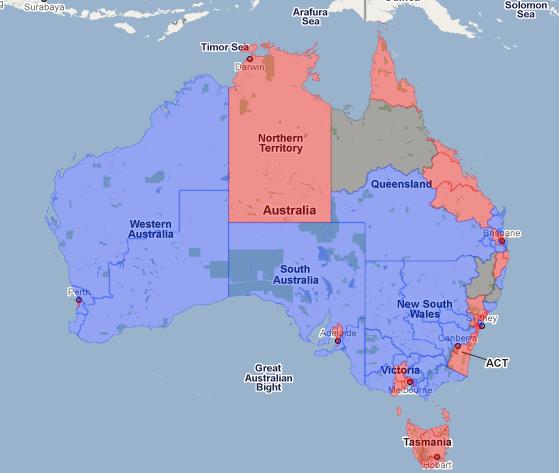
Australia 2010 federal election results
Australia 2010 federal election results (Red = Labor Party)

I was disappointed with Queensland because of the last federal election in 2010. They elected several Labor Party MPs. And now the federal Labor Party is pushing for a carbon tax and gay marriage, too.

Look what happened in 2010:

Turnout 94.41% (CV) — Informal 3.56%
Party Votes % Swing Seats Change
Australian Labor Party 1,020,665 42.91 +8.13 15 +9
Liberal Party of Australia 818,438 34.40 –5.01 10 –7
National Party of Australia 239,504 10.07 +0.32 3 –1
Australian Greens 133,938 5.63 +0.57 0 0

The Liberal Party and the National Party are the two conservative parties – they form a conservative coalition, and they continued to lose seats, just like they did in 2007.

Given that, I was heartened by the results from this past weekend, when Queensland held state-level elections. (H/T Bill M.)

Excerpt:

[Opposition leader] Tony Abbott has sought to capitalise on the Queensland election saying Labor MPs right across the country will be worried about the “fundamental lesson” from yesterday’s landslide defeat.

Speaking on Sky News’s Australian Agenda the Opposition Leader said Labor needed to have a “good, long, hard look at itself” and said the party’s brand was “toxic” around Australia.

“This is a triumph for Campbell (Newman) and the LNP,” Mr Abbott said this morning of the Queensland result.

“I think Labor members of parliament right around Australia would be very worried about the fundamental lesson from this which is that a government which isn’t competent, which isn’t frugal and which isn’t truthful loses and loses big time.

“The basic message is that the Labor brand is toxic right around Australia.”

“Certainly there were two candidates for Queensland one of them Anna Bligh, who was for the carbon tax, and the other Campbell Newman who was against it,” Mr Abbott said.

Mr Newman’s Liberal National Party ended Labor’s 14-year reign in Queensland last night with a crushing win.

The latest forecasts have the LNP winning as many as 78 seats in the 89-seat parliament, with Labor expected to hold just seven seats of its former 51.

Mr Abbott said while the Queensland election had buoyed the Coalition’s hopes of winning the next federal election he conceded things could be different if Julia Gillard improves.

“If the federal Labor government is able to lift its game and be truthful, yes things could be different,” the Opposition Leader said.

“But I think federal Labor has clearly established its character.”

Mr Abbott stood by his comments last week that the Queensland election would be a referendum on the carbon tax and dishonest politicians.

Those results are now final – Labor went from 51 seats to 7 seats! This is as bad as what happened to the leftist Liberal Party in Canada in 2011.

Let’s hope that Julia Gillard, the head of the Australian Labor party, doesn’t learn anything from this and continues to push for left-wing fiscal and social policies. Tony Abbott is quite awesome in general, so they do have a good candidate running against her whenever the next election is held.