

Tag Archives: Tax Cuts

Thomas Sowell explains the historical effects of tax cuts

Thomas Sowell
Thomas Sowell

Here’s part 1 of 3.

Excerpt:

The actual results of the cuts in tax rates in the 1920s were very similar to the results of later tax-rate cuts during the Kennedy, Reagan and George. W. Bush administrations — namely, rising output, rising employment to produce that output, rising incomes as a result and rising tax revenues for the government because of the rising incomes, though the tax rates had been lowered.

Another consequence was that people in higher-income brackets paid not only a larger total amount of taxes, but a higher percentage of all taxes, after what were called “tax cuts for the rich.” It was not simply that their incomes rose, but that this was not taxable income, since the lower tax rates made it profitable to get higher returns outside of tax shelters.

The facts are unmistakably plain, for those who bother to check the facts. In 1921, when the tax rate on people making over $100,000 a year was 73%, the federal government collected a little over $700 million in income taxes, of which 30% was paid by those making over $100,000.

[…]By 1929, after a series of tax-rate reductions had cut the tax rate to 24% on those making over $100,000, the federal government collected more than a billion dollars in income taxes, of which 65% was collected from those making over $100,000.

There is nothing mysterious about this. Under the sharply rising tax rates during the Wilson administration, fewer and fewer people reported high taxable incomes, whether by putting their money into tax-exempt securities or by any of the other ways of rearranging their financial affairs to minimize their tax liability.

Under Wilson’s escalating income-tax rates to pay for the high costs of the First World War, the number of people reporting taxable incomes of more than $300,000 — a huge sum in the money of that era — declined from well over a thousand in 1916 to fewer than three hundred in 1921. The total amount of taxable income earned by people making over $300,000 declined by more than four-fifths in those years.

Secretary Mellon estimated in 1923 that the money invested in tax-exempt securities had tripled in a decade, and was now almost three times the size of the federal government’s annual budget and nearly half as large as the national debt. “The man of large income has tended more and more to invest his capital in such a way that the tax collector cannot touch it,” he pointed out.

Getting that money moved out of tax shelters was the whole point of Mellon’s tax-cutting proposals. He also said: “It is incredible that a system of taxation which permits a man with an income of $1,000,000 a year to pay not one cent to the support of his government should remain unaltered.”

Here’s part 2 of 3.

Excerpt:

Empirical evidence on what happened to the economy in the wake of those tax cuts in four different administrations over a span of more than 80 years has also been largely ignored by those opposed to what they call “tax cuts for the rich.”

Confusion between reducing tax rates on individuals and reducing tax revenues received by the government has run through much of these discussions over these years.

Famed historian Arthur M. Schlesinger Jr., for example, said that although Andrew Mellon, secretary of the treasury from 1921 to 1932, advocated balancing the budget and paying off the national debt, he “inconsistently” sought “reduction in tax rates.”

Nor was Schlesinger the only highly regarded historian to perpetuate economic confusion between tax rates and tax revenues. Today, widely used textbooks by various well-known historians have continued to misstate what was advocated in the 1920s and what the actual consequences were.

According to the textbook “These United States” by Irwin Unger, Mellon, “a rich Pittsburgh industrialist,” persuaded Congress to “reduce income tax rates at the upper-income levels while leaving those at the bottom untouched.”

Thus “Mellon won further victories for his drive to shift more of the tax burden from the high-income earners to the middle and wage-earning classes.”

But hard data show that, in fact, both the amount and the proportion of taxes paid by those whose net income was no higher than $25,000 went down between 1921 and 1929, while both the amount and the proportion of taxes paid by those whose net incomes were between $50,000 and $100,000 went up — and the amount and proportion of taxes paid by those whose net incomes were over $100,000 went up even more sharply.

And here’s part 3 of 3.

Excerpt:

President Kennedy, like Andrew Mellon decades earlier, pointed out that “efforts to avoid tax liabilities” make “certain types of less-productive activity more profitable than other more valuable undertakings” and “this inhibits our growth and efficiency.” Therefore the “purpose of cutting taxes” is “to achieve a more prosperous, expanding economy.”

“Total output and economic growth” were italicized words in the text of Kennedy’s address to Congress in January 1963, urging cuts in tax rates. Much the same theme was repeated yet again in President Reagan’s February 1981 address to a joint session of Congress, pointing out that “this is not merely a shift of wealth between different sets of taxpayers.”

Instead, basing himself on a “solid body of economic experts,” he expected that “real production in goods and services will grow.”

Even when empirical evidence substantiates the arguments made for cuts in tax rates, such facts are not treated as evidence relevant to testing a disputed hypothesis, but as isolated curiosities. Thus, when tax revenues rose in the wake of the tax-rate cuts made during the George W. Bush administration, the New York Times reported:

“An unexpectedly steep rise in tax revenues from corporations and the wealthy is driving down the projected budget deficit this year.”

Expectations, of course, are in the eye of the beholder. However surprising these facts may have been to the New York Times, they are exactly what proponents of reducing high tax rates have been expecting, not only from these particular tax rate cuts, but from similar reductions in high tax rates at various times going back more than three-quarters of a century.

It’s Thomas Sowell – the official economist of the Tea Party.
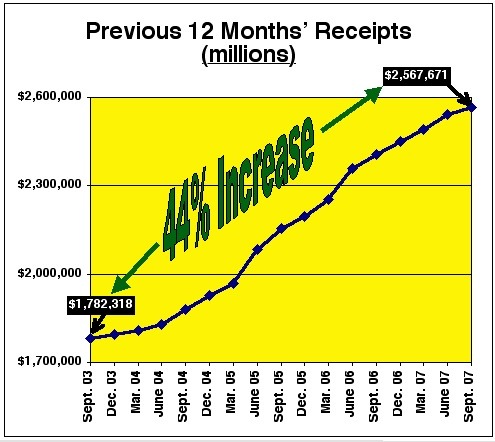
Bush’s tax cuts led to a 44% increase in revenues from 2003 to 2007

Federal Receipts 2003 through 2007

From Newsbusters. It turns out that Bush’s tax cuts in 2001 and 2003 were not responsible for adding to the deficit. They actually increased the amount of tax money being collected, as the economy grew, and more jobs were created. People pay more in taxes when they have jobs.

Excerpt:

The graph doesn’t show collections tanking, does it? Instead, the graph shows that collections increased by 44%, or almost $800 billion, in four years. Adding up the individual increments in each of the four years compared to 2003 (2004 – $98B; 2005 – $371B; 2006 – $624B; 2007 – $785B; 2008, not shown, treating IRS stimulus payments as outlays instead of negative receipts – $835B), what really happened is that in the five full fiscal years after George W. Bush got the across-the-board and investment-related tax cuts he had been pushing for since taking office in 2001, the cumulative increase in tax collections was over $2.7 trillion.

Doubtless, the static analysis crowd will claim that collections would have been even higher (I guess by a cumulative $1.6 trillion, given the AP’s Democratic Party talking point above) if the Bush cuts hadn’t been enacted. Two words, guys: Prove it. Two follow-up words: You can’t.

We can argue all day long about the how much of the increase in collections was due to the incentive effects of the tax cuts and how of the improvement might have occurred anyway, but no one can credibly act as if it’s an established fact that the Bush cuts somehow caused collections to go $1.6 trillion in the opposite direction. There is absolutely no proof for this contention, and plenty of evidence that the Bush cuts jump-started an economy and federal collections, both of which had been flat or declining during the two years leading up to mid-2003. The more reasonable conclusion to reach is that the country would already be dead in the water if the Bush tax cuts hadn’t passed in 2003. Instead, the wire service hopes that its “Bush tax cuts cost us” meme will be gullibly recited during the next several days at its subscribing newspaper, TV, and radio outlets. “Disgraceful” doesn’t even begin to describe this pathetic promotion of self-evident falsehood.

The fact is that the federal budget was one good year away from balancing after the $162 deficit reported in fiscal 2007. Unfortunately, that was the last budget passed by a Republican-controlled Congress, and it was the only year which showed a modest increase in overall spending. Beginning in 2007 with effects beginning in fiscal 2008, the House and Senate controlled by Nancy Pelosi and Harry Reid began increasing spending at rates far beyond what profligate Republicans spent earlier in the decade, and, unfortunately, Bush 43 made no real effort to stop them…

Read the whole thing.

UPDATE: Reggie sent me this article showing that the Reagan tax cuts also increased revenues.

Excerpt:

In 1980, the last year before the tax cuts, tax revenues were $956 billion (in constant 1996 dollars).

Revenues exceeded that 1980 level in eight of the next 10 years. Annual revenues over the next decade averaged $102 billion above their 1980 level (in constant 1996 dollars).

The graph is here.

When you get people to start engaging in the economy, you can collect more taxes from them. They engage when they think that they will be able to keep more of what they make from their labor.

How did the Reagan tax cuts and Bush tax cuts affect unemployment?

Consider this article by the Cato Institute, a libertarian think tank, which discusses how the Reagan tax cuts affected the unemployment rate.

Excerpt:

In 1980, President Carter and his supporters in the Congress and news media asked, “how can we afford” presidential candidate Ronald Reagan’s proposed tax cuts?

Mr. Reagan’s critics claimed the tax cuts would lead to more inflation and higher interest rates, while Mr. Reagan said tax cuts would lead to more economic growth and higher living standards. What happened? Inflation fell from 12.5 percent in 1980 to 3.9 percent in 1984, interest rates fell, and economic growth went from minus 0.2 percent in 1980 to plus 7.3 percent in 1984, and Mr. Reagan was re-elected in a landslide.

[…]Despite the fact that federal revenues have varied little (as a percentage of GDP) over the last 40 years, there has been an enormous variation in top tax rates. When Ronald Reagan took office, the top individual tax rate was 70 percent and by 1986 it was down to only 28 percent. All Americans received at least a 30 percent tax rate cut; yet federal tax revenues as a percent of GDP were almost unchanged during the Reagan presidency (from 18.9 percent in 1980 to 18.1 percent in 1988).

What did change, however, was the rate of economic growth, which was more than 50 percent higher for the seven years after the Reagan tax cuts compared with the previous seven years. This increase in economic growth, plus some reductions in tax credits and deductions, almost entirely offset the effect of the rate reductions. Rapid economic growth, unlike government spending programs, proved to be the most effective way to reduce unemployment and poverty, and create opportunity for the disadvantaged.

The conservative Heritage Foundation describes the effects of the Bush tax cuts. (H/T The Lonely Conservative)

Excerpt:

President Bush signed the first wave of tax cuts in 2001, cutting rates and providing tax relief for families by, for example, doubling of the child tax credit to $1,000.

At Congress’ insistence, the tax relief was initially phased in over many years, so the economy continued to lose jobs. In 2003, realizing its error, Congress made the earlier tax relief effective immediately. Congress also lowered tax rates on capital gains and dividends to encourage business investment, which had been lagging.

It was the then that the economy turned around. Within months of enactment, job growth shot up, eventually creating 8.1 million jobs through 2007. Tax revenues also increased after the Bush tax cuts, due to economic growth.

In 2003, capital gains tax rates were reduced. Rather than expand by 36% as the Congressional Budget Office projected before the tax cut, capital gains revenues more than doubled to $103 billion.

The CBO incorrectly calculated that the post-March 2003 tax cuts would lower 2006 revenues by $75 billion. Revenues for 2006 came in $47 billion above the pre-tax cut baseline.

Here’s what else happened after the 2003 tax cuts lowered the rates on income, capital gains and dividend taxes:

  • GDP grew at an annual rate of just 1.7% in the six quarters before the 2003 tax cuts. In the six quarters following the tax cuts, the growth rate was 4.1%.
  • The S&P 500 dropped 18% in the six quarters before the 2003 tax cuts but increased by 32% over the next six quarters.
  • The economy lost 267,000 jobs in the six quarters before the 2003 tax cuts. In the next six quarters, it added 307,000 jobs, followed by 5 million jobs in the next seven quarters.

The timing of the lower tax rates coincides almost exactly with the stark acceleration in the economy. Nor was this experience unique. The famous Clinton economic boom began when Congress passed legislation cutting spending and cutting the capital gains tax rate.

Those are the facts. That’s not what you hear in the media, but they are the facts.