Tag Archives: Stimulus

Jobless claims rise to eight-month high, consumer confidence falls

Video stolen from NW War College.

Can the government create jobs by spending money and running deficits? (H/T Kelly)

Excerpt:

The number of Americans filing for jobless aid rose to an eight-month high last week and productivity growth slowed in the first quarter, clouding the outlook for an economy that is struggling to gain speed.

While the surprise jump in initial claims for unemployment benefits was blamed on factors ranging from spring break layoffs to the introduction of an emergency benefits program, economists said it corroborated reports this week indicating a loss of momentum in job creation.

New claims for state jobless benefits rose 43,000 to 474,000, the highest since mid-August, the Labor Department said on Thursday. Economists had expected claims to fall.

[…]Other reports this week showed weaker employment growth in the manufacturing and services sectors in April and a step back in private hiring, suggesting Friday’s closely watched data could prove weaker than economists have been expecting.

An industry survey released on Thursday found hiring by U.S. small businesses almost ground to a halt in April.

This isn’t surprising. Government spending takes money OUT of the private sector and puts money IN to the non-productive public sector.

The Heritage Foundation explains how government spending has never worked to create jobs. Not even when Republicans do it.

Excerpt:

Indeed, President Obama’s stimulus bill failed by its own standards. In a January 2009 report, White House economists predicted that the stimulus bill would create (not merely save) 3.3 million net jobs by 2010. Since then, 3.5 million more net jobs have been lost, pushing the unemployment rate above 10 percent.[1] The fact that government failed to spend its way to prosperity is not an isolated incident:

  • During the 1930s, New Deal lawmakers doubled federal spending–yet unemployment remained above 20 percent until World War II.
  • Japan responded to a 1990 recession by passing 10 stimulus spending bills over 8 years (building the largest national debt in the industrialized world)–yet its economy remained stagnant.
  • In 2001, President Bush responded to a recession by “injecting” tax rebates into the economy. The economy did not respond until two years later, when tax rate reductions were implemented.
  • In 2008, President Bush tried to head off the current recession with another round of tax rebates. The recession continued to worsen.
  • Now, the most recent $787 billion stimulus bill was intended to keep the unemployment rate from exceeding 8 percent. In November, it topped 10 percent.[2]

So obviously government spending reduces employment – it could never happen any other way. And everyone who has ever held a job in private industry knows this. Government spending only works in the university classrooms, where the right answer is always the answer that makes academic wordsmiths feel good about themselves. Good intentions are the right answer in the classroom – good results are the right answer in the free market.

Drilling moratorium = higher gas prices = low consumer confidence

What happens to consumer confidence when Obama cuts off oil drilling and gas prices go up?

Excerpt:

Consumer confidence dropped last week to the lowest level in more than a month as rising fuel costs squeezed American household budgets.

The Bloomberg Consumer Comfort Index decreased to minus 46.2 in the week ended May 1, the lowest level since the end of March, from minus 45.1 the prior period. Another report showed claims for unemployment benefits unexpectedly surged last week, raising the risk the improvement in the jobs market has stalled.

Stocks dropped and Treasury securities rose on concern that rising expenses, including the highest gasoline prices in almost three years, may prompt companies and households to cut back on spending. The reports bolster the arguments of Federal Reserve policy makers like Chairman Ben S. Bernanke who’ve said job growth is too slow to remove record monetary stimulus.

Obama has been printing money in order to goose people into spending more instead of saving. The problem with devaluing the currency, which is what he is doing, occurs when you reach the stage where consumers stop spending because prices must increase when you print money. We are now at that stage, and our economy is about to go down the drain. Interest rates will have to rise, which is going to slow economic growth even more. This is all known.

When you don’t understand economics, you take the whack-a-mole approach to fixing the economy. That’s what Obama has done. He keeps trying to control things from the top instead of trusting businesses and consumers with their own money. Everything Obama does makes the economy worst. He doesn’t know what he is doing, and he won’t listen to people who do know. His baseless confidence (arrogance) should have been a red flag to the American people. There is nothing worse than hiring someone who thinks that they know everything, but who hasn’t the qualifications to run a lemonade stand.
What economic policies do left-wing and right-wing economists agree on?

This article is from Harvard economist Greg Mankiw. (H/T Michael)

Excerpt:

Here is the list, together with the percentage of economists who agree:

  1. A ceiling on rents reduces the quantity and quality of housing available. (93%)
  2. Tariffs and import quotas usually reduce general economic welfare. (93%)
  3. Flexible and floating exchange rates offer an effective international monetary arrangement. (90%)
  4. Fiscal policy (e.g., tax cut and/or government expenditure increase) has a significant stimulative impact on a less than fully employed economy. (90%)
  5. The United States should not restrict employers from outsourcing work to foreign countries. (90%)
  6. The United States should eliminate agricultural subsidies. (85%)
  7. Local and state governments should eliminate subsidies to professional sports franchises. (85%)
  8. If the federal budget is to be balanced, it should be done over the business cycle rather than yearly. (85%)
  9. The gap between Social Security funds and expenditures will become unsustainably large within the next fifty years if current policies remain unchanged. (85%)
  10. Cash payments increase the welfare of recipients to a greater degree than do transfers-in-kind of equal cash value. (84%)
  11. A large federal budget deficit has an adverse effect on the economy. (83%)
  12. A minimum wage increases unemployment among young and unskilled workers. (79%)
  13. The government should restructure the welfare system along the lines of a “negative income tax.” (79%)
  14. Effluent taxes and marketable pollution permits represent a better approach to pollution control than imposition of pollution ceilings. (78%)

I wonder which political party believes in most or all of these positions?

Hmmmmn.

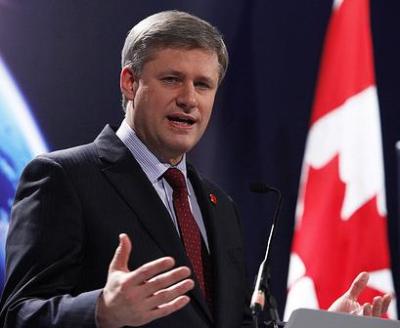
Stephen Harper’s Conservative Party cuts federal spending by 6.2%

Prime Minister Stephen Harper

More news from up north. (H/T Ben)

Excerpt:

Federal government expenditures are set to fall next fiscal year by $16.5-billion, or 6.2%, with big cuts to regional development and environment programs, according to documents tabled Tuesday.

That would leave total expenditures for the 2011-12 year at $250-billion, with the bulk taken up by transfer payments to individuals and governments, and operating costs. Just over $30-billion of that expense is attributed to refinancing Canada’s debt.

The figures, contained in spending estimates provided by the Treasury Board, sees budget increases for departments entrusted with security and law enforcement – such as a 21% boost to jails — but cuts of roughly 20% to Environment Canada, Natural Resources Canada and Agriculture and Agri-Food Canada.

Government is supposed to be concerned with security and law enforcement, not with environmentalist wastefulness.

Here’s Paul Ryan. He would like to cut our budget by 6.2% – and maybe even more.

If Canada is cutting their government waste, then why can’t we?

There are a lot of programs that we could be cutting.

Excerpt:

The federal government could save billions in taxpayer dollars annually by consolidating duplicative government programs, according to a new report.

The newly-released report from the Government Accountability Office “makes us all look like jackasses,” Sen. Tom Coburn (R-Okla.) told reporters Monday night.

The conservative senator said the report — which identifies redundancies in more than 546 individual programs — reveals why the United States is $14 trillion in debt.

“Anybody who says we don’t look like fools up here hasn’t read the report,” he said.

[…]The GAO reviewed 34 areas (among them agriculture, defense and social services) where agencies, offices or initiatives have similar or overlapping objectives. The report also looked at 47 additional cost-saving opportunities related to more general government efficiency. For instance, the report said, “Improved corrosion prevention and control practices could help [the Defense Department] avoid billions in unnecessary costs over time.”

Addressing duplicative efforts on even a single issue could save billions, the report found. For instance, the GAO says the government could save up to $5.7 billion annually by addressing potentially duplicative policies designed to boost domestic ethanol production. Additionally, the Defense Department could save $460 million annually by making broader changes to the governance of its military health care system.

The report finds that there are 15 agencies involved in food safety, 80 programs involved in economic development and more than 100 involved in surface transportation. There are 10 agencies and 82 programs involved in teacher quality, and more than 20 agencies and about 56 programs involved in financial literacy efforts. There are about 2,300 investments across the Defense Department to modernize its business operations.

House Majority Leader Eric Cantor (R-Va.) said today that in order to foster long term economic growth, “we’re going to deal with the pressing issues of regulatory waste in our agencies, as well as long term issues facing our country with entitlement programs.”

This is why we have to stop giving private sector money to government. They don’t earn any money by making things or helping people – they don’t sell anything useful. They just steal money from the productive workers and businesses and then they waste it and run up trillion dollar deficits. This kind of corruption, fraud and waste would not survive in small businesses, and probably not even in big businesses. Business have to be efficient or they go bankrupt. They have to perform or their competitors will have them for lunch. The consumer is king in the private sector.

Related posts