
Tag Archives: Spending

Real greed is when adults force children to give them a bailout from debt

This is a must-read by Mark Steyn.

Excerpt:

While President Obama was making his latest pitch for a brand new, even more unsustainable entitlement at the health care “summit,” thousands of Greeks took to the streets to riot. An enterprising cable network might have shown the two scenes on a continuous split screen – because they’re part of the same story. It’s just that Greece is a little further along in the plot: They’re at the point where the canoe is about to plunge over the falls. America is further upstream and can still pull for shore, but has decided instead that what it needs to do is catch up with the Greek canoe. Chapter One (the introduction of unsustainable entitlements) leads eventually to Chapter 20 (total societal collapse): The Greeks are at Chapter 17 or 18.

What’s happening in the developed world today isn’t so very hard to understand: The 20th century Bismarckian welfare state has run out of people to stick it to. In America, the feckless insatiable boobs in Washington, Sacramento, Albany and elsewhere are screwing over our kids and grandkids. In Europe, they’ve reached the next stage in social democratic evolution: There are no kids or grandkids to screw over. The United States has a fertility rate of around 2.1, or just over two kids per couple. Greece has a fertility rate of about 1.3: 10 grandparents have six kids have four grandkids – i.e., the family tree is upside down. Demographers call 1.3 “lowest-low” fertility – the point from which no society has ever recovered. And compared to Spain and Italy, Greece has the least worst fertility rate in Mediterranean Europe.

So you can’t borrow against the future because, in the most basic sense, you don’t have one. Greeks in the public sector retire at 58, which sounds great. But, when 10 grandparents have four grandchildren, who pays for you to spend the last third of your adult life loafing around?

By the way, you don’t have to go to Greece to experience Greek-style retirement: The Athenian “public service” of California has been metaphorically face-down in the ouzo for a generation. Still, America as a whole is not yet Greece. A couple of years ago, when I wrote my book “America Alone,” I put the Social Security debate in a bit of perspective: On 2005 figures, projected public pensions liabilities were expected to rise by 2040 to about 6.8 percent of GDP. In Greece, the figure was 25 percent. In other words, head for the hills, Armageddon, outta here, The End. Since then, the situation has worsened in both countries. And really the comparison is academic: Whereas America still has a choice, Greece isn’t going to have a 2040 – not without a massive shot of Reality Juice.

Is that likely to happen? At such moments, I like to modify Gerald Ford. When seeking to ingratiate himself with conservative audiences, President Ford liked to say: “A government big enough to give you everything you want is big enough to take away everything you have.” Which is true enough. But there’s an intermediate stage: A government big enough to give you everything you want isn’t big enough to get you to give any of it back. That’s the point Greece is at. Its socialist government has been forced into supporting a package of austerity measures. The Greek people’s response is: Nuts to that. Public sector workers have succeeded in redefining time itself: Every year, they receive 14 monthly payments. You do the math. And for about seven months’ work – for many of them the workday ends at 2:30 p.m. When they retire, they get 14 monthly pension payments. In other words: Economic reality is not my problem. I want my benefits. And, if it bankrupts the entire state a generation from now, who cares as long as they keep the checks coming until I croak?

We hard-hearted, small-government guys are often damned as selfish types who care nothing for the general welfare. But, as the Greek protests make plain, nothing makes an individual more selfish than the socially equitable communitarianism of big government. Once a chap’s enjoying the fruits of government health care, government-paid vacation, government-funded early retirement, and all the rest, he couldn’t give a hoot about the general societal interest. He’s got his, and to hell with everyone else. People’s sense of entitlement endures long after the entitlement has ceased to make sense.

The perfect spokesman for the entitlement mentality is the deputy prime minister of Greece. The European Union has concluded that the Greek government’s austerity measures are insufficient and, as a condition of bailout, has demanded something more robust. Greece is no longer a sovereign state: It’s General Motors, and the EU is Washington, and the Greek electorate is happy to play the part of the United Auto Workers – everything’s on the table except anything that would actually make a difference. In practice, because Spain, Portugal, Italy and Ireland are also on the brink of the abyss, a “European” bailout will be paid for by Germany. So the aforementioned Greek deputy prime minister, Theodoros Pangalos, has denounced the conditions of the EU deal on the grounds that the Germans stole all the bullion from the Bank of Greece during the Second World War. Welfare always breeds contempt, in nations as much as inner-city housing projects. How dare you tell us how to live! Just give us your money and push off.

This is the real character of people who avoid having to care about producing goods and services to please customers – people who join public sector unions and work for the government. They elect candidates who will provide them with a standard of living much higher than what they can produce by their own efforts, and pass the bill down to real workers in the private sector, or worse, workers who are not even born. It’s a shame. It’s a shame that parasites should enslave children who are not yet born so that they can have a standard of living they haven’t paid for. And it’s laughable that they impugn the character of productive private sector workers and business owners by talking about “Greed”. The parasites in the public sector unions are the greedy ones. What could be more greedy than intergenerational theft?
Obama administration blocks oil production in Ohio: 200,000 jobs lost

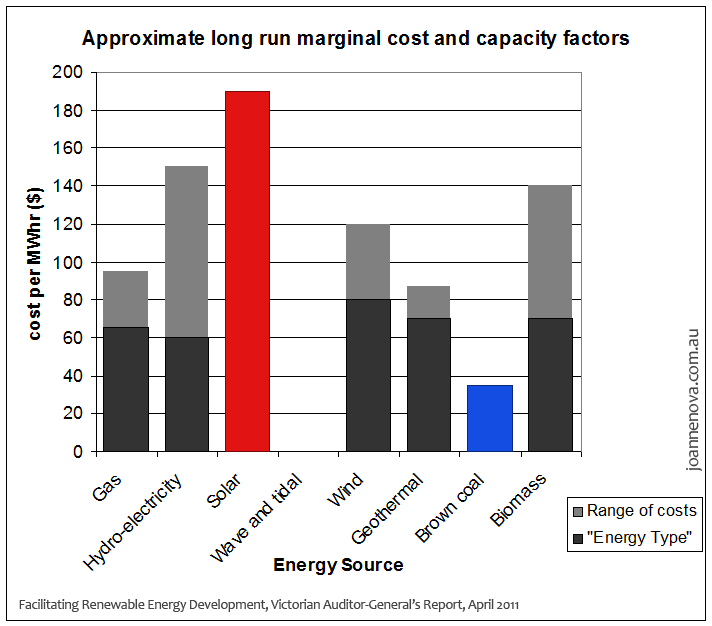
Cost of renewable wind and solar energy

The Heritage Foundation explains Obama’s latest effort to appease the environmentalist cult.

Excerpt:

First, it was 20,000 jobs the Obama Administration delayed by punting a decision to approve the Keystone XL pipeline, which would bring 700,000 barrels of oil per day from Canada into the United States. Multiply that number by 10 and you have the amount of jobs the President is putting on hold by delaying a mineral lease sale in Ohio’s Wayne National Forest for oil and gas drilling. This decision kills jobs and denies Americans access to affordable energy.

The Washington Examiner reports that Wayne National Forest already has 1,300 oil and gas wells in operation, but access to Utica’s shale gas reserves would require hydraulic fracturing. The United States Department of Agriculture announced a six-month delay in the leasing of 3,000 acres in the forest to study the environmental effects of hydraulic fracturing. This decision not only delays access to the jobs and energy that Americans need now, but it blocks an important revenue source for federal and state governments. The Ohio Oil and Gas Energy Education Program estimated that:

Natural gas and crude oil industry could help create and support more than 200,000 Ohio-based jobs from the leasing, royalties, exploration, drilling, production and pipeline construction activities for the Utica shale reserve. The state could experience an overall wage and personal-income boost of $12 billion by 2015 from industry spending.

The study also projects royalty payments to landowners, schools, businesses and communities could increase to as much as $1.6 billion by 2015—a number that exceeds the total amount of royalties distributed by Ohio’s natural gas and crude oil industry in the last decade. Total tax revenue from oil and gas exploration and development in the Utica shale formation from 2011 until 2015, including severance, commercial activity, ad valorem (property), federal, state and local taxes, is projected to be approximately $479 billion. Industry expenditures related to Utica shale development could generate approximately $12.3 billion in gross state product and result in a statewide output or sales of more than $23 billion.

Hydraulic fracturing, known as “fracking,” is a long-proven process by which producers inject a fluid (composed of 99 percent water) and sand into wells to free oil and gas trapped in rock formations. Used in over 1 million wells in the United States over more than six decades, fracking has been successfully used to retrieve over 7 billion barrels of oil and over 600 trillion cubic feet of natural gas.

Spencer Hunt of the Columbus Dispatch reports that “Tom Stewart, vice president of the Ohio Oil and Gas Association, said shale well drilling would be less harmful to the forest than conventional drilling because as many as six shale wells can be drilled on a single pad.”

Fracking is subject to both federal and state regulations, and there have been no instances of contamination to drinking water. Groundwater aquifers sit thousands of feet above where fracking takes place, and studies by the Environmental Protection Agency, the Ground Water Protection Council, and other agencies have found no evidence of groundwater contamination. Where there have been unwanted environmental outcomes—such as gas migration—they were the result of poor well construction or problems with the concrete and steel casings around the well bore. Those instances have been rare, and they were not a result of the fracking process itself.

Hydraulic fracturing will be a critical process in developing energy supplies in the future. The National Petroleum Council estimates that fracking will allow 60–80 percent of all domestically drilled wells in the next 10 years to remain viable.

You can study the effects of hydraulic fracturing for six more months, but the facts are going to remain the same. Fracking is a long-proven process that can help access our nation’s abundant oil and gas reserves. Delaying lease sales is delaying the creation of much-needed jobs.

So let me get this straight. If Obama isn’t handing out $535 million of taxpayer dollars to Solyndra and $1.4 billion of taxpayer dollars to BruightSource, then he’s busy blocking oil drilling in the Gulf and blocking oil drilling in Ohio and blocking the construction of the Keystone XL pipeline. It’s no wonder we have a 9% unemployment rate – this man doesn’t want to create jobs. He wants to reward the people who got him elected by handing out millions and billions of taxpayer dollars to millionaires and billionaires – in effect, transferring wealth from the middle class to rich Democrat fundraisers. I find it very surprising that labor unions back this man in elections. What sense does that make?

Global warming alarmism is nothing but a religion. Why do we have to have so much religion in politics? I understand if environmentalists want to practice their religion in their own homes and in the churches, but why do we have to give them taxpayer money for their environmentalist devotions? And why to we have to put our economy on hold just so that we are compliant with their religious beliefs? Why did we elect a President for believes in forcing a religious ideology onto the rest of us? Why do we have to have our freedom and prosperity – our right to produce goods and our right to purchase goods – limited by a religious ideology?

Related posts

How did the Reagan tax cuts and Bush tax cuts affect unemployment?

Consider this article by the Cato Institute, a libertarian think tank, which discusses how the Reagan tax cuts affected the unemployment rate.

Excerpt:

In 1980, President Carter and his supporters in the Congress and news media asked, “how can we afford” presidential candidate Ronald Reagan’s proposed tax cuts?

Mr. Reagan’s critics claimed the tax cuts would lead to more inflation and higher interest rates, while Mr. Reagan said tax cuts would lead to more economic growth and higher living standards. What happened? Inflation fell from 12.5 percent in 1980 to 3.9 percent in 1984, interest rates fell, and economic growth went from minus 0.2 percent in 1980 to plus 7.3 percent in 1984, and Mr. Reagan was re-elected in a landslide.

[…]Despite the fact that federal revenues have varied little (as a percentage of GDP) over the last 40 years, there has been an enormous variation in top tax rates. When Ronald Reagan took office, the top individual tax rate was 70 percent and by 1986 it was down to only 28 percent. All Americans received at least a 30 percent tax rate cut; yet federal tax revenues as a percent of GDP were almost unchanged during the Reagan presidency (from 18.9 percent in 1980 to 18.1 percent in 1988).

What did change, however, was the rate of economic growth, which was more than 50 percent higher for the seven years after the Reagan tax cuts compared with the previous seven years. This increase in economic growth, plus some reductions in tax credits and deductions, almost entirely offset the effect of the rate reductions. Rapid economic growth, unlike government spending programs, proved to be the most effective way to reduce unemployment and poverty, and create opportunity for the disadvantaged.

The conservative Heritage Foundation describes the effects of the Bush tax cuts. (H/T The Lonely Conservative)

Excerpt:

President Bush signed the first wave of tax cuts in 2001, cutting rates and providing tax relief for families by, for example, doubling of the child tax credit to $1,000.

At Congress’ insistence, the tax relief was initially phased in over many years, so the economy continued to lose jobs. In 2003, realizing its error, Congress made the earlier tax relief effective immediately. Congress also lowered tax rates on capital gains and dividends to encourage business investment, which had been lagging.

It was the then that the economy turned around. Within months of enactment, job growth shot up, eventually creating 8.1 million jobs through 2007. Tax revenues also increased after the Bush tax cuts, due to economic growth.

In 2003, capital gains tax rates were reduced. Rather than expand by 36% as the Congressional Budget Office projected before the tax cut, capital gains revenues more than doubled to $103 billion.

The CBO incorrectly calculated that the post-March 2003 tax cuts would lower 2006 revenues by $75 billion. Revenues for 2006 came in $47 billion above the pre-tax cut baseline.

Here’s what else happened after the 2003 tax cuts lowered the rates on income, capital gains and dividend taxes:

  • GDP grew at an annual rate of just 1.7% in the six quarters before the 2003 tax cuts. In the six quarters following the tax cuts, the growth rate was 4.1%.
  • The S&P 500 dropped 18% in the six quarters before the 2003 tax cuts but increased by 32% over the next six quarters.
  • The economy lost 267,000 jobs in the six quarters before the 2003 tax cuts. In the next six quarters, it added 307,000 jobs, followed by 5 million jobs in the next seven quarters.

The timing of the lower tax rates coincides almost exactly with the stark acceleration in the economy. Nor was this experience unique. The famous Clinton economic boom began when Congress passed legislation cutting spending and cutting the capital gains tax rate.

Those are the facts. That’s not what you hear in the media, but they are the facts.