Tag Archives: Spending

73% of the new jobs created in the last 5 months were government jobs

From CNS News.

Excerpt:

In June, a total of 142,415,000 people were employed in the U.S, according to the BLS, including 19,938,000 who were employed by federal, state and local governments.

By November, according to data BLS released today, the total number of people employed had climbed to143,262,000, an overall increase of 847,000 in the six months since June.

In the same five-month period since June, the number of people employed by government increased by 621,000 to 20,559,000. These 621,000 new government jobs created in the last five months equal 73.3 percent of the 847,000 new jobs created overall.

How is it possible that the unemployment rate is going down? It’s simple. The government is borrowing over $1 trillion dollars a year from unborn and born children, and they are using that money to reduce the unemployment rate.

That explains part of the drop in unemployment, but there’s more.

Excerpt:

As for that big “drop” in the unemployment rate, all of it was due to the fact that 540,000 Americans are no longer looking for work. They either dropped out, took early disability or retired. Since the start of 2009, 9.7 million Americans have fallen into this category.

All told, more than 24 million Americans who want jobs don’t have them, driving the labor force participation rate to 63.6%, just above August’s 31-year low of 63.5%. This is the worst labor market in a recovery ever.

And it may get worse. The quarterly Wells Fargo/Gallup small-business survey found that 21% plan to cut jobs over the next six months — a surge from 10% last June and a record high.

IBD’s own research shows that small businesses account for nearly 80% of all new job creation in America. A small-business slump means no jobs. It’s that simple.

Business are already being regulated to death by Obamacare, and all this deficit spending means borrowing that has to be paid back with inflation or higher taxes. Why on Earth would anyone try to hire people now? This economy is a wreck.
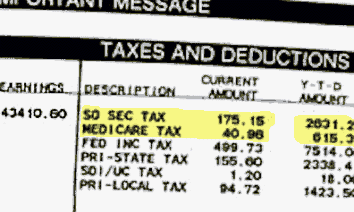
Young workers pay into entitlements that will be bankrupt when they retire

Payroll taxes for Social Security and Medicare

Doug Ross from Director Blue has a public service announcement for young people. Even if they are able to find jobs, they can look forward to paying a large chunk of their income to the government for retirement programs, Social Security and Medicare, that will be bankrupt by the time they are ready to retire.

Excerpt:

Ever seen these numbers on your pay stub? The numbers I’ve highlighted?

That money is being taken from you — or, more properly, it’s being stolen from you — to fund a myth. A mirage.

You’re never going to see a dime of that “Social Security Retirement Insurance” you’re paying for.

You’ll never a see a nickel of that “Medicare Health Care Insurance” either.

That money is being taken from your pay — your livelihood — to fund a system that will be bankrupt in less than a dozen years.

Oh, and it’s not me saying that: Medicare’s own actuary, Richard Foster, is. Social Security is in a similar situation, according to Treasury Secretary Timothy F. Geithner, who serves as the system’s senior trustee.

Suffice it to say that these systems will actually go broke far sooner than anyone’s really admitting because the economy remains poor and appears to be slowing down even further.

My public service message is this: this money is being taken from your pay in exchange for a promise that will be broken in just a few years. You’ll never see that money again. And it is the government — the government, not “the rich”, not the Koch brothers, not the oil companies — that is ripping you off.

It is the government, not corporations, spending untold billions on “green energy” scams like Solyndra. It is the government, not “the rich”, slathering EBT-welfare cards around like confetti. And it is the government, not “the Tea Party”, that is promoting illegal immigration and offering huge financial benefits to those in the country illegally. All with your money.

Medicare is the one that is really in trouble, as Forbes magazine explains:

The Trustees of the Medicare program have released their annual report on the solvency of the program. They calculate that the program is “expected to remain solvent until 2024, the same as last year’s estimate.” But what that headline obfuscates is that Obamacare’s tax increases and spending cuts are counted towards the program’s alleged “deficit-neutrality,” Medicare is to go bankrupt in 2016. And if you listen to Medicare’s own actuary, Richard Foster, the program’s bankruptcy could come even sooner than that.

See, the funny, funny thing about young people is that they are almost complete uninformed about basic economics. They don’t know where jobs come from. They don’t know where the money that the government spends come from. They don’t know how much the government spends. They don’t know about our debt-to-gdp ratio. Their view of economics is all determined by socialist public schools and socialist Hollywood and socialist mainstream media. It’s all emotional for them. They have feelings that the rich are greedy, and must be taxed, and that the government is Santa Claus, helping the poor with money from the rich. It’s the ultimate system of slavery, except the slaves want to be enslaved.

Will raising taxes on the rich help the economy and create more jobs?

The presidents of my two favorite think tanks, Arthur Brooks (AEI) and Edwin Feulner (Heritage) explain in this USA Today editorial.

Excerpt: (links removed)

First, there is no evidence that tax increases will actually solve our troubles. On the contrary, years of data from around the world show that when nations try to solve a fiscal crisis primarily by raising tax revenues, they tend to fail. In contrast, fiscal approaches based on entitlement reform and spending cuts tend to succeed.

American Enterprise Institute economists Kevin Hassett, Andrew Biggs and Matthew Jensen examined the experiences of 21 Organization for Economic Cooperation and Development (OECD) countries between 1970 and 2007. They found that countries with successful fiscal reforms, on average, closed 85% of their budget gaps with spending cuts. The countries with failed reforms, on average, relied at least 50% on tax increases. President Obama’s strategy falls firmly in the latter camp. After discounting the accounting tricks that create fictitious spending cuts, the president’s plan would impose about $3 in tax hikes for every $1 in spending cuts.

That is, his approach would probably land America in the “failed attempt” column. Five years down the line, we would be in the same fiscal mess we are in today, just with higher taxes and a bigger government.

Second, tax hikes aimed at small segments of the population wouldn’t raise much in revenues. Consider the “Buffett Rule” that the president spent many months promoting. According to the Joint Committee on Taxation, it would raise about $47 billion over a decade. The federal government currently spends about $4 billion more per day than it takes in. The Buffett Rule, then, would raise about enough next year to cover 28 hours of government overspending. Heritage Foundation economist Curtis Dubay finds that closing the deficit solely by raising the two highest tax brackets would require hiking them to 159% and 166%, respectively.

Third, as economists and business executives have noted repeatedly, raising taxes on families earning over $250,000 per year is effectively a massive tax hike on small businesses. Most small businesses today organize as S-corporations or other pass-through entities; their income is taxed as personal income. A study by Ernst and Young shows that Obama’s proposed tax hike would force these small businesses to eliminate about 710,000 jobs. Moreover, these households already bear a great deal of tax liability. According to the most recent Internal Revenue Service data, those earning $250,000 and above — roughly 2% of all taxpayers — earn 22% of income, but pay 45% of all federal income taxes.

Simply put, increasing tax rates on the wealthy is not a serious approach to solving America’s fiscal woes. The problem is purely one of excessive spending, not inadequate taxing.

Revenues haven’t changed substantially over the last decade, but government spending is way, way up. That’s what’s causing us to go into debt – massive government spending on turtle tunnels and Solyndra. We can do better than socialism.