
Tag Archives: Spain

Fitch cuts credit ratings on 6 more European nations

From Zero Hedge.

Excerpt:

Fitch Ratings-London-27 January 2012: Fitch Ratings has today concluded its review of the six eurozone sovereigns it placed on Rating Watch Negative (RWN) on 16 December 2011.

The rating actions on the long-term (LT) and short-term (ST) Issuer Default Ratings (IDRs) are as follows:

-Belgium LT IDR downgraded to ‘AA’ from ‘AA+’; Negative Outlook; ST IDR affirmed at ‘F1+’
-Cyprus LT IDR downgraded to ‘BBB-‘ from ‘BBB’; Negative Outlook; ST IDR affirmed at ‘F3’
-Ireland LT IDR affirmed at ‘BBB+’; Negative Outlook; ST IDR affirmed at ‘F2’
-Italy LT IDR downgraded to ‘A-‘ from ‘A+’; Negative Outlook; ST IDR downgraded to ‘F2’ from ‘F1’
-Slovenia LT IDR downgraded to ‘A’ from ‘AA-‘; Negative Outlook; ST IDR downgraded to ‘F1’ from ‘F1+’
– Spain LT IDR downgraded ‘A’ from ‘AA-‘; Negative Outlook; ST IDR downgraded to ‘F1’ from ‘F1+’

All the ratings have been removed from RWN, with the Negative Outlook on all six countries indicating a slightly greater than 50% chance of a downgrade over a two-year time horizon.

[…]The Negative Outlooks on eight eurozone countries (the six sovereigns in this review along with ‘AAA’-rated France and ‘BB+’-rated Portugal) primarily reflect the risk that the crisis could intensify further.

Now consider that Barack Obama is taking us down the same road as these European welfare states. The problem with socialism is that you eventually run out of other people’s money. That’s what is happening in Europe, and it’s going to happen here, unless we get serious about who we elect as President.

My previous post on S&P downgrades of the credit ratings of various European countries.
How Barack Obama used taxpayer dollars to outsource green energy jobs

This is from Hans Bader at GlobalWarming.org.

He links to this ABC News story.

Excerpt:

Despite all the talk of green jobs, the overwhelming majority of stimulus money spent on wind power has gone to foreign companies, according to a new report by the Investigative Reporting Workshop at the American University’s School of Communication in Washington, D.C.

Nearly $2 billion in money from the American Recovery and Reinvestment Act has been spent on wind power, funding the creation of enough new wind farms to power 2.4 million homes over the past year. But the study found that nearly 80 percent of that money has gone to foreign manufacturers of wind turbines.

“Most of the jobs are going overseas,” said Russ Choma at the Investigative Reporting Workshop. He analyzed which foreign firms had accepted the most stimulus money. “According to our estimates, about 6,000 jobs have been created overseas, and maybe a couple hundred have been created in the U.S.” Even with the infusion of so much stimulus money, a recent report by American Wind Energy Association showed a drop in U.S. wind manufacturing jobs last year.

[…]Iberdrola, one of the largest operators of renewable energy worldwide, is based in Spain and has received the most U.S. stimulus dollars — $577 million. It buys some of its turbines from another Spanish manufacturer, Gamesa, which has a U.S. connection. Gamesa has two facilities to manufacture turbine blades in Pennsylvania, but the company said the market forced it to temporarily lay off nearly 100 workers.

[…]A Chinese company called A-power is helping to build a massive $1.5 billion wind farm in West Texas. The consortium behind the project expects to get $450 million in stimulus money.

Walt Hornaday, an American partner on the project, said it would create some American jobs. “Our estimation,” he said, “is that we are going to have on the order of 300 construction jobs just within the fence of the project.”

But that’s in addition to 2,000 manufacturing jobs — many of them in China.

And this News Max story.

Excerpt:

Gulf Oil CEO Joe Petrowski says President Barack Obama’s weekend comments in Brazil that the United States looks forward to purchasing oil drilled for offshore by that nation “is rather puzzling,” and “hypocritical” as his administration has imposed a virtual moratorium on domestic drilling. The signal to purchase more foreign oil comes after the U.S. Export-Import Bank invested more than $2 billion with Brazil’s state-owned oil company, Petrobras, to finance exploration.

“Any drilling, or any new production, especially production outside the Mideast – that is inherently unstable and probably is going to become more unstable as we move forward – is a positive,” Petrowski said Tuesday on Fox News.

“But why Brazil, when we could have the jobs and foreign exchange in this country, is rather puzzling – and I’d say somewhat humorous,” Petrowski told Fox News’ Neal Cavuto. “What is it about Brazil that they have that we don’t have?

Read the rest here – there’s a lot more Obama outsourcing to read about.

Conservatives defeat socialists by a landslide in Spain election

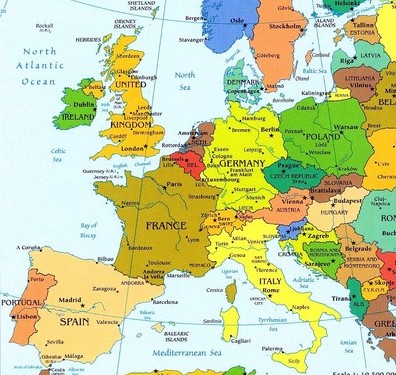
Political Map of Europe

The UK Telegraph explains.

Excerpt:

With almost 98 per cent of the vote counted the Popular Party won 186 seats in the 350 seat congress garnering a strong mandate to push through further austerity measures in an attempt to turn around an economy that risks being engulfed by the sovereign debt crisis.

[…]The socialists suffered their biggest defeat since Spain became a democracy more than 30 years ago, punished by an electorate for their perceived bungling of the economic crisis that has left 5 million unemployed.

[…]Alfredo Perez Rubalcaba, 60, the prime ministerial candidate who took the helm of the PSOE when Jose Luis Rodriguez Zapatero said he would not seek a third term, conceded defeat after the party won just 110 seats down from 169 in 2008.

“The Socialist Party did not have a good result. We clearly lost the elections,” he told party faithful in Madrid.

The conservatives won roughly 44 per cent of the votes and the Socialists took 29 per cent, according to official election results.

The Wall Street Journal analyzes the election result.

Excerpt:

Formerly a solid growth engine for the region’s economy, Spain today is grappling with a burst housing bubble, a 21% unemployment rate and borrowing costs near levels that triggered the international bailouts of several fiscally frail euro-zone peers.

Analysts said the election of Mariano Rajoy, the conservative leader who has committed to austerity and economic overhauls, could help improve investor sentiment toward Spain, but won’t fundamentally change perceptions that Spain and other peripheral nations are risky investments. For that, they said, European Union institutions will have to extend more support, possibly by converting the European Central Bank into a lender of last resort.

[…]The groundswell of support for Mr. Rajoy is chiefly the result of a deep economic crisis that has forced Socialist Prime Minister José Luis Rodríguez Zapatero to make unpopular budget cuts and economic overhauls. Earlier this year, Mr. Zapatero said he wouldn’t seek re-election and his party chose the veteran Mr. Pérez Rubalcaba to succeed him.

Analysts said the fact that change in Spain was coming via the ballot box was another sign of a better track record on governance, which has helped to keep Spanish borrowing costs below those of its fiscally frail peers.

Although Mr. Zapatero lacked a parliamentary majority, he was able to deliver all the measures he promised last year, including a public-sector wage cut, a pension freeze and a labor-market overhaul.

As a result, a clear victory for Mr. Rajoy, who has promised to take overhauls much further than his Socialist rivals, is widely expected to shore up confidence in the Spanish economy inside and outside the country.

Many recall the Popular Party-led governments of José María Aznar of 1996-2004 for their far-reaching moves that helped set the stage for a lengthy economic boom. Mr. Rajoy headed various ministries during that time.

At a polling station in Madrid’s Chamberí district, 18-year-old engineering student Diego Cubero said he had voted for the first time and chosen the Popular Party.

This is the end of a huge mistake made by the Spanish people in 2004 when they elected the socialists. Never, ever, ever elect socialists unless you want your economy to end up like Greece. That’s what socialists do to economies.