
Tag Archives: Socialism

How childhood experiences shape our view of economics

Last time, we looked at how childhood experiences influence our views of religion. This time, I want to go over an article from the Cato Institute from the famous Harvard philosopher Robert Nozick. This article will give you insights into why leftist academics are against capitalism, and what specifically causes them to have that belief.

Here’s a blurb about Nozick:

Robert Nozick is Arthur Kingsley Porter Professor of Philosophy at Harvard University and the author of Anarchy, State, and Utopia and other books. This article is excerpted from his essay “Why Do Intellectuals Oppose Capitalism?” which originally appeared in The Future of Private Enterprise, ed. Craig Aronoff et al. (Georgia State University Business Press, 1986) and is reprinted in Robert Nozick, Socratic Puzzles (Harvard University Press, 1997).

Nozick’s thesis is that the school environment encourages “wordsmith intellectuals” to be hostile to free market capitalism and prefer centralized systems.

First, let’s see what a wordsmith intellectual is:

By intellectuals, I do not mean all people of intelligence or of a certain level of education, but those who, in their vocation, deal with ideas as expressed in words, shaping the word flow others receive. These wordsmiths include poets, novelists, literary critics, newspaper and magazine journalists, and many professors. It does not include those who primarily produce and transmit quantitatively or mathematically formulated information (the numbersmiths) or those working in visual media, painters, sculptors, cameramen. Unlike the wordsmiths, people in these occupations do not disproportionately oppose capitalism. The wordsmiths are concentrated in certain occupational sites: academia, the media, government bureaucracy.

Nozick’s argument is that wordsmiths oppose capitalism because the free market doesn’t provide them with the rewards and adulation from authority figures that they received in their school years.

He writes:

Schools became the major institution outside of the family to shape the attitudes of young people, and almost all those who later became intellectuals went through schools. There they were successful. They were judged against others and deemed superior. They were praised and rewarded, the teacher’s favorites. How could they fail to see themselves as superior? Daily, they experienced differences in facility with ideas, in quick-wittedness. The schools told them, and showed them, they were better.

The schools, too, exhibited and thereby taught the principle of reward in accordance with (intellectual) merit. To the intellectually meritorious went the praise, the teacher’s smiles, and the highest grades. In the currency the schools had to offer, the smartest constituted the upper class. Though not part of the official curricula, in the schools the intellectuals learned the lessons of their own greater value in comparison with the others, and of how this greater value entitled them to greater rewards.

But what happens when these pampered wordsmith intellectuals hit the job market?

The wider market society, however, taught a different lesson. There the greatest rewards did not go to the verbally brightest. There the intellectual skills were not most highly valued. Schooled in the lesson that they were most valuable, the most deserving of reward, the most entitled to reward, how could the intellectuals, by and large, fail to resent the capitalist society which deprived them of the just deserts to which their superiority “entitled” them? Is it surprising that what the schooled intellectuals felt for capitalist society was a deep and sullen animus that, although clothed with various publicly appropriate reasons, continued even when those particular reasons were shown to be inadequate?

So, what economic system do wordsmith intellectuals advocate for instead of capitalism?

The intellectual wants the whole society to be a school writ large, to be like the environment where he did so well and was so well appreciated. By incorporating standards of reward that are different from the wider society, the schools guarantee that some will experience downward mobility later. Those at the top of the school’s hierarchy will feel entitled to a top position, not only in that micro-society but in the wider one, a society whose system they will resent when it fails to treat them according to their self-prescribed wants and entitlements.

Intellectuals can’t make money degreez in Marxist Studies, Peace Studies, or <Insert_Victim_Group_Here> Studies. And yet, they feel entitled because of their classroom experiences. So, the answer is to confiscate the wealth of the productive entrepreneurs and redistribute them to the intellectuals.

But there are further unrelated points I must add to this article.

What makes people less religious the more educated they become?

OK, if you watch the debate between Peter Atkins and Bill Craig, or Lewis Wolpert and Bill Craig, etc. then it’s pretty clear that these “intellectuals” have not rejected God for intellectual reasons. On the contrary, they rejected God based on the reasoning of a 12 year old and never bothered to look for answers since they were 12.

The real reason that more educated people reject God is due to pride. Specifically, they do not want to be identified as believing the same spiritual things as the masses. Their great education makes them feel pressure to please their colleagues by embracing views that are different from the benighted masses.

So, it comes down to peer-pressure. They simply don’t want to be different from their colleagues. They want to be able to look down at the benighted masses.

What makes researchers support socialist dogma and pseudoscience?

Researchers are funded by government grants. Grants proposals have to get the attention of government bureaucrats. Bureaucrats are always looking for a crisis that they can sell to the public in order to increase the size of government and regulate the free market.

Therefore, researchers tend to embrace whatever the latest Chicken Little crisis is, be it global cooling, global warming, or unsafe consumer products, etc. Grant proposals that open up opportunities for government to control the free market will get the most funding.

What makes government-run schools and media support socialism?

Again, government-run schools and media receive funds based on the size of government. NPR, PBS and the whole public school system can never be objective about anything. They must always side with government and against individual liberty. They also oppose competition from private alternatives like Fox News and vouchers.
Conservatives in Ontario defend free speech

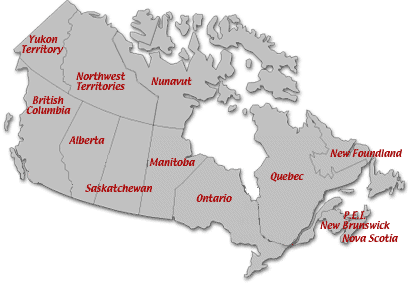
Political Map of Canada

BC isn’t the only province where conservatives are fighting back against progressive threats to fundamental rights. Ontario, (contains Toronto and Ottawa), has one of the other really bad provincial Human Rights Commissions, and provincial representatives Lisa MacLeod and Randy Hillier on the case in that benighted province.

Here’s an assessment of MacLeod and Hillier from free-speech superhero Ezra Levant: (H/T The Western Standard)

Hillier, along with fellow PC MPP Lisa Macleod, have been leading the charge to reform Ontario’s HRCs. They were the ones who pressed for public hearings at which Tribunal appointees would be grilled — which led to some scary revelations about the censorious instincts of that panel. And he also was part of the team (led by Macleod) who brought Mark Steyn to Queen’s Park to testify about the kangaroo court nature of the OHRC.

Levant is referring to her questioning of Mark Steyn regarding the Ontario Human Rights Tribunal. The full transcript is here, courtesy of Pamela Geller at Atlas Shrugs. This is about as strong a defense of free speech as you’ll ever see, folks. And it’s a warning to the consequences of electing progressives who do not trust you to exercise your own free will, lest you hurt someone’s feelings.

Here is a little of Mark Steyn’s opening speech from the hearing:

Mr. Mark Steyn: The present Ontario human rights regime is incompatible with a free society. It is useless on real human rights issues that we face today and, in the course of such pseudo human rights, as the human right to smoke marijuana on someone else’s property or the human right to a transsexual labioplasty, in the course of those pseudo-rights it tramples on real human rights including property rights, free speech, the right to due process and the presumption of innocence. Far from reducing racism or sexism, the Ontario human rights regime explicitly institutionalizes racism and sexism through its inability to view any dispute except through the narrow prism of identity politics. It’s at odds not just with eight centuries of this province’s legal inheritance, but with the United Nations Universal Declaration of Human Rights. Canada likes that one so much, it sticks it on the back of the $50 bill, even though Ontario’s human rights regime is in sustained, systemic breach of article 6, article 7, articles 8 to 10, 11, 12, 18, 19, 21 and 27 of the UN declaration. The good news is that Ontario’s not in violation of as many articles as Sudan or North Korea.

All are equal before the law and are entitled, without any discrimination, to equal protection of the law. That’s article 7. It’s not true in Ontario. Last year, the Ontario Human Rights Commission effectively gave Maclean’s and myself a driveby verdict. They couldn’t be bothered taking us to trial but they decided to pronounce us guilty anyway. That neglects the most basic principle of justice: Audi alteram partem, hear the other side. Chief commissar Barbara Hall didn’t bother hearing the other side; she simply declared us guilty. That is the very defining act of a police state: an apparatchik announcing that a citizen is guilty of dissent from state orthodoxy.

But here’s the point: Maclean’s and I have no fear of Barbara Hall, the commission or the tribunal. You’re welcome to try and do your worst to us. We have deep pockets, we pushed back and we filled the newspapers with stories about all these wacky cases that Barbara Hall and others are so obsessed about. Like all tinpot bullies, the commission couldn’t take the heat and backed down. But if you’re just a fellow who happens to own a restaurant in Burlington, the Ontario human rights regime will destroy your savings, your business, your life for no good reason. The verdict’s irrelevant; the process is the punishment.

He is saying this about a tribunal run by fascist progressive inquisitors hell-bent on ramming their values down the throats of individuals. And here is an excerpt from MacLeod’s questioning of Steyn:

Ms. Lisa MacLeod: Welcome to our committee Mr. Steyn. During the summer, this committee convened to interview and review the 22 vice-chairs and the 22 members of the Ontario Human Rights Tribunal and throughout that process your case, Maclean’s vs. the Ontario Human Rights Commission, as well as what happened in British Columbia to you as well as what happened federally to you was front and centre on our minds. Consistently throughout that process I asked questions of the deputants, those seeking to be appointed to the Ontario Human Rights Tribunal, if they believed free press trumped discrimination or vice versa. One of the deputants actually responded. Today, earlier, I asked the same question to the chair of the Ontario Human Rights Tribunal. He responded and said that neither trumps either. I would like your view on that, because it follows sort of a logical set of questions that I have which are next with respect to freedom of expression and freedom of speech.

Mr. Mark Steyn: With respect to the witness this morning, that has become a standard equivocation at the Ontario Human Rights Tribunal. Whenever tribunal judges take away individual human rights they do so under the guise of what they call balancing competing rights. So for example, going back to the Scott Brockie case, they claim to be balancing his right to freedom of religion with the right of the gay people seeking printed materials to be free from discrimination. In practice they almost never balance those rights. They always defer to collective rights, group rights in favour of individual rights. I’m an absolutist on this. I agree with the view that the ultimate minority is the individual and classically, historically, common law has been entirely antipathetic to group rights, because who can speak for a group? Who can speak for a group? The notion of group rights should be an abomination to a settled democracy as old as this province.

As an aside, Lisa MacLeod is also fighting polygamy in Ontario. (H/T Blue Like You)

I hope that the Canadian conservatives at every level of government turn this into an election issue, in order to draw libertarians away from the other parties. These Human Rights Commissions are the darlings of secular left-wing politically correct fascists, and they can’t stand the idea of their totalitarian censorship seeing the light of day.

This article is a follow-up to yesterday’s article about free speech efforts in British Columbia.

Conservatives in British Columbia defend free speech

Political Map of Canada

Canadian columnist Mark Steyn has some welcome news on the sorry state of free speech north of the border. (H/T Free Canuckistan) Specifically, the good news is from the western province of British Columbia, (contains Vancouver), home to one of the 3 worst Human Rights Commissions operating in Canada.

Steyn writes:

BC is a bit like Quebec in that it has a two-party system in which neither choice is conservative: in la belle province, it’s a choice between the separatists and the Quebec Liberals; on the left coast, it’s a choice between the socialists and the BC Liberals. So the right-of-centre vote in BC goes, faute de mieux, to Gordon Campbell’s party.

So, there really is no way that the provincial conservatives can win at the provincial level, and conservative voters ending up voting for the Liberals, just to keep the socialists out of power.

But suddenly, the provincial conservatives decided that the status quo was not good enough for British Columbians:

Or at any rate that’s the way it was until the upstart BC Tories decided to challenge Premier Campbell from the right in next month’s provincial election. Robert Jago spoke to their leader, Wilf Hanni, about the “Human Rights” Tribunal and got the following response:

A BC Conservative Government will reform the BC Human Rights Tribunal:

* So that any complainant will be responsible for the legal fees associated with his or her human rights complaint.
* To make complainants responsible for paying the defendant’s legal fees should the complainant lose their Human Rights Tribunal case.
* To disallow individuals and organizations from making Human Rights Tribunal complaints when Human Rights Tribunals in other Canadian jurisdictions are already investigating the same issue.
* To disallow cases dealing with freedom of speech under Section 2 of the Charter.
* To allow appeals, to a court of law, for any decision made by the Tribunal.
* So that the Tribunal cannot render penalties outside the boundaries of Canadian Laws.

We realize that it is neither fair nor equitable that complainants currently receive free legal representation no matter how frivolous the complaint, while defendants must pay their own legal fees.

Stay tuned, because tomorrow at 11 AM I will be posting about how conservatives in another province are defending free speech against left-wing fascism.