
Tag Archives: Sex

Does more relationship experience lead to better relationship success?

Published in the Journal of Marriage and Family

Marriage expert Brad Wilcox tweeted this article from the Institute for Family Studies.

It says:

In most areas of life, having more experience is good. Want to be great in your chosen field? Sustained experience is essential. Want to be great at a sport? There’s no substitute for practice. And anyone who runs a business can tell you that their best employees are those who have been in the job long enough to have learned how to handle the normal well and the unexpected with wisdom.

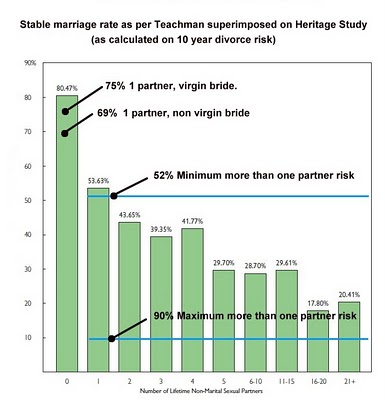
While more experience is often beneficial in life, the story looks different when it comes to some types of experience before marriage. For example, in our Before “I Do” report, we surveyed a national longitudinal sample of young adults about their love lives prior to marriage to examine factors associated with future marital quality. We found that having more sexual and cohabiting partners before marriage is associated with lower relationship quality once married. In particular, having only ever lived with or had sex with one’s spouse was associated with higher marital quality. Our findings are consistent with other studies showing that cohabiting with more partners before marriage is associated with greater likelihood of divorce1 and that a higher number of sexual partners before marriage is associated with lower marital quality and greater likelihood of divorce.2 As we noted, what happens in Vegas may not always stay in Vegas. But why?

There are many reasons why having more romantic partners before marriage may put one at higher risk of difficulties in marriage. One of the most important explanations comes under the heading of what some call selection effects. For many people, an elevated risk of difficulties in marriage was present before they had their first relationship experience. Background characteristics such as parental divorce, low education, and economic disadvantage are associated both with having more sexual and cohabiting partners and also with lower marital quality and/or divorce.3So it may not be that having more sexual or cohabiting partners causes further risk because a lot of risk was already in motion. Selection is a big part of how relationships unfold, but is it the whole story? We believe that, in addition to selection, behavior matters and has plausible connections to marital outcomes. We are going to explain four reasons why having more relationship experience before tying the knot might make it harder to succeed in marriage.

Here are the 4 reasons:

  1. More Awareness of Alternatives
  2. Changed Expectations: The Perfect Sexual Lover (in Your Mind)
  3. More Experience Breaking It Off
  4. Babies

I have to quote the one that I’ve personally encountered in my mentoring – number three: more experience breaking it off. I’ve seen this commitmentphobia in two women who had “wild” periods in their past who had broken up with cohabitating boyfriends.

It says:

Cohabitation has characteristics that seem paradoxical. Living with a partner makes it harder to break up than dating, all other things being equal, and often now comes at a time in relationship development where people have not really chosen each other for the future.8 And yet, cohabiting couples frequently break up, and they are more likely than any other time in history not to end up marrying.9

These days, cohabitation has become more a part of the dating scene than a lead-up to marriage. Let’s call the phenomenon cohabidating. In this context, some people are getting a lot of experience at leaving serious relationships (or surviving being left). Just as with our prior point, that does not sound bad in one way—at least insofar as people are breaking off relationships that had no future. But it’s also true that people tend to get good at things they have a lot of experience doing. People can get good at moving out and moving on.

How does that impact marriage? Some people probably so deeply learn that they can survive leaving a relationship when they are unhappy with it that they leave reasonably good marriages that would have given them and their children the best outcomes in life. They bail too quickly.

Obviously, many others leave very poor or even dangerous marriages only after a lot of agonizing and effort. We’re not suggesting divorce is ever easy or that it is not sometimes the best course. But in a day and age when people get so much experience moving out and moving on, we think many may learn to do so too rapidly, and to their detriment.

If you want to get good at relationships, experience may not be the answer. Reading good studies like this, and making decisions that line up with the research is much wiser. As always, never follow your heart. Always follow rational arguments and evidence, and keep connected to a good panel of advisors who have had long-term relationships success. That’s the best way to avoid disaster.


New study: open relationships in the gay community

Young people seem to like gay marriage more than they like individual liberties

Story from the San Francisco Chronicle.

Excerpt:

A new study released this week by the Center for Research on Gender & Sexuality at San Francisco State University put statistics around what gay men already know: Many Bay Area boyfriends negotiate open relationships that allow for sex with outsiders.

[…]”I think it’s quite natural for men to want to continue to have an active and varied sex life,” said 50-year-old technology consultant Dean Allemang from Oakland, who just ended a 13-year-open relationship and has begun another with a new boyfriend.

“I don’t own my lover, and I don’t own his body,” he said. “I think it’s weird to ask someone you love to give up that part of their life. I would never do it.”

Hoff, who just received a $3.5 million grant from the National Institute of Mental Health to continue the study for five more years, initially started her research based on findings that HIV infection is on the rise among male couples.

“So much of the HIV prevention effort is aimed at a different set – men in dance clubs or bathhouses having anonymous sex,” she said. “HIV prevention might want to expand its message to address relationships; we have to look at risk in a greater context.”

In her study of gay couples, 47 percent reported open relationships. Forty-five percent were monogamous, and the remaining 8 percent disagreed about what they were.

Another researcher quoted in the story explains how same-sex marriage is compatible with an “open relationship”, and that this interpretation of marriage would be a redefinition of traditional marriage.

Related to that, there is this radio interview with a gay activist.

Excerpt:

“It’s a no-brainer that (homosexual activists) should have the right to marry, but I also think equally that it’s a no-brainer that the institution of marriage should not exist. …(F)ighting for gay marriage generally involves lying about what we are going to do with marriage when we get there — because we lie that the institution of marriage is not going to change, and that is a lie.

The institution of marriage is going to change, and it should change. And again, I don’t think it should exist. And I don’t like taking part in creating fictions about my life. That’s sort of not what I had in mind when I came out thirty years ago.

I have three kids who have five parents, more or less, and I don’t see why they shouldn’t have five parents legally… I met my new partner, and she had just had a baby, and that baby’s biological father is my brother, and my daughter’s biological father is a man who lives in Russia, and my adopted son also considers him his father. So the five parents break down into two groups of three… And really, I would like to live in a legal system that is capable of reflecting that reality, and I don’t think that’s compatible with the institution of marriage.”

To me, making a relationship “open” puts an emphasis on each person feeling good, rather than each person committing to love the other self-sacrificially. I wonder if young people understand that. What would be interesting, I think, would be to ask all the young people – especially young women – how they would feel if their partner’s idea of marriage involved having an open relationship. How do they feel about non-exclusivity incorporated into the new definition of the word “marriage”.

It seems to me that it’s one thing to say that marriage is a man and a woman committing to love each other through to old age, regardless of changing feelings and unmet desires. A relationship based on the natural definition of marriage is focused on commitment, and not fulfillment of desires. And that works well for children, who need stability, even if the desires of adults are not met. If marriage is about people abandoning exclusivity and permanence in order to get what they need to be happy “in the moment”, then neither person will be able to depend on the other when they are old, ugly and sickly.

Here’s a video that explains the basics of why people like me support natural marriage:

The word marriage means, one man, one woman, for life. And both parents sacrifice to raise the children they create. And no frivolous divorce, either. And if you ask me, it should also mean no sex before marriage, formal courtship, approval of both sets of parents, and the wife stays home when the children under five.

Are crisis pregnancy centers equipped to discuss the issue of abortion rationally?

I'm Scheming Unborn Baby, and I approve this study
I’m Scheming Unborn Baby, and I approve this message

Consider this article from Stand to Reason, written by Greg Koukl. The title of the article is “The Vanishing Pro-Life Apologist”. Koukl argues that crisis pregnancy centers are less interested in making the case for the right to life of the unborn child, and more interested in giving women who have already chosen life what they need, in terms of material support.

Koukl writes:

The last few years have witnessed a stunning development in the pro-life movement. More and more crisis pregnancy centers (CPCs) refuse to discuss abortion. A new wave of pro-life leaders insist that victory will not be gained in the court of public opinion if the debate centers principally on the morality of abortion.

Paul Swope calls it “a failure to communicate” when right-to-lifers focus primarily on the unborn instead of on the felt needs of women. “The pro-life movement must show that abortion is actually not in a woman’s own self-interest,” he says, “and that the choice of life offers hope and a positive, expanded sense of self.” Reframing the debate in these terms will enable the movement to “regain the moral high ground in the mind of the American public.”

[…]Pro-life feminist Frederica Matthews-Green agrees. “Pro-lifers will not be able to break through this deadlock by stressing the humanity of the unborn….That is a question nobody is asking. But there is a question they are asking. It is, ‘How could we live without it?’ The problem is not moral, but practical.”

Swope and Matthews-Green are not suggesting we frame the debate in terms of the felt needs of women in the narrow context of crisis counseling. It’s certainly appropriate to inform a woman of the physical and psychological consequences of choosing abortion. Rather, they insist the pro-life movement in general must speak less of the unborn and more of the woman in order to break the alleged deadlock.

While it’s true that appealing to self-interest might dissuade some abortion-minded women from killing their babies, it’s hard to image how this could be an effective general strategy. Here’s why: It’s almost always in a woman’s short-term self-interest to abort. This is precisely why the pro-abortion side has been effective. A focus on felt needs favors death, not life.

How can we “regain the moral high ground in the mind of the public,” to use Swope’s words, if we retreat from the moral debate? The whole point of an ethical argument is to give reasons why a woman ought not pursue selfish interests. Felt needs are the problem, not the solution.

This approach completely sabotages the pro-life position. Crisis pregnancy centers do not exist to handle pregnancy. Hospitals and clinics do that. CPCs handle crisis pregnancies, those that are vulnerable to termination by abortion. In a sense, CPCs don’t exist for the woman, but for the child whose life is in danger. The idea is to dissuade women from having abortions precisely because abortion is a moral tragedy. If not, then why oppose it?

What kind of morality does this tactic leave us with? Such a posture implicitly promotes the vice of selfishness instead of the virtue of sacrificial motherhood. Ideas have consequences, and this one may have, as Frank Beckwith observes, “the unfortunate consequence of increasing the number of people who think that unless their needs are pacified they are perfectly justified in performing homicide on the most vulnerable of our population.”

I actually want to go even further than that.

I think that if CPCs refuse to speak up against abortion on on moral grounds, they are doing nothing at all to stem the flow of abortions. Today, men and women are increasingly choosing to have sex when they are not in any kind of committed relationship where a child would be welcome. There are two things we can do to stop this.

First, we can tell them about what abortion really is, and how it is morally wrong to take the life of another person without adequate moral justification. (And selfishness is not moral justification). Second, we can tell them to be more careful about who they choose for relationships, about what the goal of the relationship is (not fun, but marriage), and about making decisions that mature them as a couple so that they are ready to provide for a child. Sex should not be seen as something recreational, and sex partners should not be chosen because of the fun you can have in the moment.

Now if CPCs do not want to tell people that abortion is wrong, and that relationships should be focused on commitment and providing for children, then we will never see fewer abortions. Our job is not to let people in this society think that unless someone else pays the bills, then abortion is OK. Abortion is only OK if the life of the mother is at risk – a very rare scenario. Our job is to educate men and women so that they understand how to have relationships that do not put them in a position where they have to take the life of an unborn child in order to make the lives of the grown-ups more satisfying.

We need to make the the safety of unborn children an issue that people consider when they choose who to have a relationship with, and when to have sex. In particular, women should choose men who value marriage before sex, and who make decisions to ready themselves for the man’s role in marriage. And men should choose women who value chastity and providing above men who offer fun and thrills.

We don’t have enough money to bail everyone out. We have to teach grown-ups moral boundaries, and give them a vision for relationships that is focused on commitment, and therefore safe for unborn children.

Conclusion

So here are my two points about CPCs and pro-life apologetics:

  • crisis pregnancy centers should be committed to defending the right to life of the unborn child in conversations with grown-ups, so that grown-ups police themselves in their relationship and sexual decision-making.
  • crisis pregnancy centers should be working with organizations that use pro-life arguments and evidence to persuade people to value the unborn before the life decision has been made.

And for everyone else, make sure that you’re equipped to explain to others why you think that unborn children deserve full legal protection.

Here’s a good video from Scott Klusendorf to help you do that:

This is an important moral issue, and we can’t be persuasive unless we are equipped with logical arguments and evidence.