

Tag Archives: Separation Anxiety

What caused “a rising tide of personality disorders among millenials”?

Rioters smash windows at a T-Mobile store during a protest against campus speaker

That quote about millenials in the title of this post comes from the American Counseling Association.

PJ Media reports: (H/T Curby)

If you were to come across someone who cried in the streets, who saw the world in terms of black and white and made death threats against strangers, who cowered in a special room and made public displays of naked self-harm and blood letting, you might conclude that they were suffering from a personality disorder.

All these symptoms can be found in the High Conflict Personality Disorder category known as Axis II in DSMV, including Anti-Social PD, Histrionic PD, Paranoid PD, Narcissistic PD, and Borderline PD.

[…]In 2014, a survey of 100,000 college students at 53 U.S. campuses by the American College Health Association found that 84% of U.S. students feel unable to cope, while more than half experience overwhelming anxiety.

The problems begin with how the children are raised. As the size and scope of government grew, taxes had to be raised to pay for the “social safety net”. When taxes go up, women can no longer afford to stay home with their young children during the first five years, which are critical to child development. Instead, the moms go out to work to pay for the new social welfare programs. And their children end up in day cares.

Look:

The National Institute of Child Health and Human Development has found:

Children in full-time day care were close to three times more likely to show behavior problems than those cared for by their mothers at home.

[…]The more time in child care of any kind or quality, the more aggressive the child.

The result is young people who, a decade and a half after daycare, scream at the parent/State for not protecting them sufficiently. It is no coincidence that “safe spaces” resemble daycare centers.

Day cares cause children to have increased anxiety and aggression. It used to be that this would be mitigated as the child grew up and encountered real life. Their narcissism would die because they would have to accept that they were not the center of the universe. They learned that hard work was not fun, and that they had to do things that they didn’t feel like doing in order to survive. But today, things are different – something else is happening to children in public schools and university classrooms.

More:

Faced with histrionic students, university staff end up behaving like “Helicopter Parents”: those largely absent, full-time working parents who overcompensated by flying in to fuss over their child. Attempting to assuage parental guilt, one of the tools they used was “positive parenting” — a philosophy created by social Progressives.

Parents were taught to not scold or punish, and instead to use “positive reinforcement” in an attempt to raise their children with “high self-esteem.” This ideology also became fashionable within an increasingly progressive school system that awarded children prizes for “non-competitive sports” and for merely taking part in school activities.

As they passed from day care to through high school, these children with artificially enforced high self-esteem were also told that they were morally superior to generations that came before. They were inducted into politically correct language and were even taught to lecture their own parents on racism, equality, and ecology. From the ages of six to eighteen, they took part in yearly multiculturalist “save the planet” projects. They were told they had a heroic destiny as “agents of change.”

A false picture of the world and a vastly inflated sense of self-importance did not compensate for the foundational trauma of parental neglect. Instead, as Dr. Jean Twenge has explained, Positive Parenting created young people with a “narcissistic wound” for whom the real world would be perceived as a threat to self-worth.

And this explains why college students today resort to violence when presented with ideas that they disagree with – even if the people are vastly more intelligent and experienced than they are themselves. They don’t care about free speech, because they already know everything. They claim to care about diversity, but they shout down or assault anyone who disagrees with them.

And that’s not the only contradiction:

SJW protests are awash with contradictions. SJWs claim to fight for freedom, but are opposed to freedom of speech, support banning videos and books, and support the violent disruption of public talks, as was seen with the riots at UC Berkeley, Middlebury College, and elsewhere.

SJWs believe in a world with “no boundaries” where “everyone is equal” — free immigration, open access to healthcare and education, etc. — but at the same time are obsessed with creating segregated spaces.

While they protest against the “fascist patriarchal state” they are, at the same time, fundamentally Statist, demanding that the government police language for them and punish their enemies. While SJWs claim to fight for human rights, they parade the symbol of the largest genocides in history — the Communist flag. They are pro-feminist, and at the same time defend Sharia law.

It’s a mess. People like to joke about the zombie apocalypse, but it’s a joke because there is no such thing as a zombie. Except that when I see what the secular left has produced on college campuses, it really does make me think of zombies. Do you think that people with no marketable skills could resist the urge to steal and kill when they find themselves in debt and unable to earn a living with their degree in Marxist-Feminist Studies? Where would a psychotic millennial draw the line? They don’t understand how successful mature people became successful – they only understand that their own failure is not their fault. It’s all the fault of white males, the patriarchy, straights, capitalists, etc. Where does a deluded secular leftist draw the line on violence? Can you expect moral behavior from someone who doesn’t believe in God, and doesn’t believe in personal responsibility?

I think we are going to see a lot more violence from these young leftist psychopaths – especially from the ones being raised without a married mother and father. I think we’re going to see something to rival the most horrifying of zombie apocalypse movies. There isn’t any foundation of empathy or morality inside them – it was never put into them by their own families or the godless schools.
New study: Tennessee pre-K program provides no educational benefit over control group

This is the most thorough study that I have ever seen evaluating the effectiveness of pre-K programs. The study was done by researchers at Vanderbilt University.

The study was reported on by the well-respected but leftist Brookings Institute.

They write:

State investments in center-based school readiness programs for preschoolers (pre-K), whether targeted for poor children or universally implemented, have expanded more rapidly than evaluations of their effects. Given the current interest and continuing expansion of state funded pre-K, it is especially important to be clear about the nature of the available evidence for the effectiveness of such programs. Despite widespread claims about proven benefits from pre-K, there is actually strikingly little credible research about the effectiveness of public pre-K programs scaled for statewide implementation.

Like many states that became interested in scaling up a state funded pre-K program in the early 2000’s, voluntary pre-K (TNVPK) was introduced in Tennessee in 1996 as a way to provide academic enhancement to economically disadvantaged children. It expanded in 2005 to an $85 million-plus statewide investment serving 18,000 Tennessee income-eligible children in 935 classrooms across all 95 counties.

Launched in 2009, the TNVPK Effectiveness Study, a coordinated effort between Vanderbilt’s Peabody Research Institute and the Tennessee Department of Education, is a five-year evaluation study funded by the US Department of Education, Institute for Education Sciences. It includes the first randomized control trial of a scaled up state funded pre-K program and the first well-controlled comparison group study of the effects of program participation as children progress through elementary school..

Policymakers and proponents often cite some of the famous early studies of pre-K programs that have shown long term benefits extending into adulthood for the participating children. But those were studies of especially complex programs that are unlike scaled-up public pre-K in many ways. The Vanderbilt study is the first rigorous controlled longitudinal study to be conducted on a large-scale state-funded pre-K program.

And here is a summary of the results:

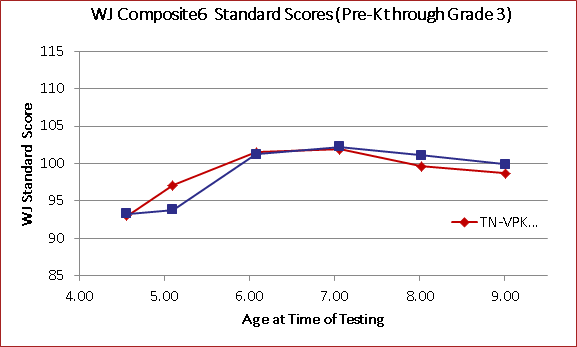
Standard score results from pre-K through 3rd grade on a composite measure that averaged the six achievement subtests are presented from baseline forward in the graph below.

As is evident, pre-K and control children started the pre-K year at virtually identical levels. The TNVPK children were substantially ahead of the control group children at the end of the pre-K year (age 5 in the graph). By the end of kindergarten (age 6 in the graph), the control children had caught up to the TNVPK children, and there were no longer significant differences between them on any achievement measures. The same result was obtained at the end of first grade using two composite achievement measures (the second created with the addition of two more WJIII subtests appropriate for the later grades). In second grade, however, the groups began to diverge with the TNVPK children scoring lower than the control children on most of the measures. The differences were significant on both achievement composite measures and on the math subtests. Differences favoring the control persisted through the end of third grade.

In terms of behavioral effects, in the spring the first grade teachers reversed the fall kindergarten teacher ratings. First grade teachers rated the TNVPK children as less well prepared for school, having poorer work skills in the classrooms, and feeling more negative about school. It is notable that these ratings preceded the downward achievement trend we found for VPK children in second and third grades. The second and third grade teachers rated the behaviors and feelings of children in the two groups as the same; there was a small positive finding for peer relations favoring the TNVPK children by third grade teachers, which did not meet traditional levels of statistical significance.

Results graph:

TNVPK data: pre-K program is in red, baseline is in blue

We are already seeing that cheap daycare in high-tax, big government provinces like Quebec cost a lot, and produce negative results. And of course Hillary Clinton is a longstanding advocate of universal pre-K. As a Senator of New York, she introduced a universal pre-K plan that would cost $10 billion over 5 years. President Barack Obama’s own Preschool for All plan would cost $75 billion over 10 years. This Vanderbilt study should cause us to question whether the policies of the secular left, pushed largely because of emotions and ideology, are worth the tens of billions of dollars they want to take from us. And if you take tens of billions of dollars out of families, then families on the margin will have to give their children to the state to raise. And that includes Christian families, who would no longer be able to afford a stay-at-home mother.

Now, taking children away from parents so that their mothers can work is seen as a worthy goal by those on the secular left. First, communally raising the children is “good” because it removes inequalities between single mothers and traditional working-husband homes. Second, making it easier for women to “go fatherless” is “good” because fathers are not to be trusted to teach their children about morality and religion. That is best left to secular government workers. Third, mothers who choose to marry good providers pay less in taxes if they choose to stay home with their kids and not work. That is “bad” because the government wants more taxes, so they can spend it on vote-buying social programs. Fourth, children who form stable bonds with their parents are less likely to become dependent on the government, meaning their allegiance cannot be bought with government handouts. That is also “bad”. Fifth, it is also “bad” that children who grow up with stay-at-home mothers are more likely to develop empathy and morality, which gives them an independent standard by which to judge the government’s actions.

Related posts

New study: Tennessee pre-K program provides no educational benefit over control group

This is the most thorough study that I have ever seen evaluating the effectiveness of pre-K programs. The study was done by researchers at Vanderbilt University. (H/T Brad Wilcox tweet)

The study was reported on by the well-respected but leftist Brookings Institute.

They write:

State investments in center-based school readiness programs for preschoolers (pre-K), whether targeted for poor children or universally implemented, have expanded more rapidly than evaluations of their effects. Given the current interest and continuing expansion of state funded pre-K, it is especially important to be clear about the nature of the available evidence for the effectiveness of such programs. Despite widespread claims about proven benefits from pre-K, there is actually strikingly little credible research about the effectiveness of public pre-K programs scaled for statewide implementation.

Like many states that became interested in scaling up a state funded pre-K program in the early 2000’s, voluntary pre-K (TNVPK) was introduced in Tennessee in 1996 as a way to provide academic enhancement to economically disadvantaged children. It expanded in 2005 to an $85 million-plus statewide investment serving 18,000 Tennessee income-eligible children in 935 classrooms across all 95 counties.

Launched in 2009, the TNVPK Effectiveness Study, a coordinated effort between Vanderbilt’s Peabody Research Institute and the Tennessee Department of Education, is a five-year evaluation study funded by the US Department of Education, Institute for Education Sciences. It includes the first randomized control trial of a scaled up state funded pre-K program and the first well-controlled comparison group study of the effects of program participation as children progress through elementary school..

Policymakers and proponents often cite some of the famous early studies of pre-K programs that have shown long term benefits extending into adulthood for the participating children. But those were studies of especially complex programs that are unlike scaled-up public pre-K in many ways. The Vanderbilt study is the first rigorous controlled longitudinal study to be conducted on a large-scale state-funded pre-K program.

And here is a summary of the results:

Standard score results from pre-K through 3rd grade on a composite measure that averaged the six achievement subtests are presented from baseline forward in the graph below.

As is evident, pre-K and control children started the pre-K year at virtually identical levels. The TNVPK children were substantially ahead of the control group children at the end of the pre-K year (age 5 in the graph). By the end of kindergarten (age 6 in the graph), the control children had caught up to the TNVPK children, and there were no longer significant differences between them on any achievement measures. The same result was obtained at the end of first grade using two composite achievement measures (the second created with the addition of two more WJIII subtests appropriate for the later grades). In second grade, however, the groups began to diverge with the TNVPK children scoring lower than the control children on most of the measures. The differences were significant on both achievement composite measures and on the math subtests. Differences favoring the control persisted through the end of third grade.

In terms of behavioral effects, in the spring the first grade teachers reversed the fall kindergarten teacher ratings. First grade teachers rated the TNVPK children as less well prepared for school, having poorer work skills in the classrooms, and feeling more negative about school. It is notable that these ratings preceded the downward achievement trend we found for VPK children in second and third grades. The second and third grade teachers rated the behaviors and feelings of children in the two groups as the same; there was a small positive finding for peer relations favoring the TNVPK children by third grade teachers, which did not meet traditional levels of statistical significance.

Results graph:

TNVPK data: pre-K program is in red, baseline is in blue

We are already seeing that cheap daycare in high-tax, big government provinces like Quebec cost a lot, and produce negative results. And of course Hillary Clinton is a longstanding advocate of universal pre-K. As a Senator of New York, she introduced a universal pre-K plan that would cost $10 billion over 5 years. President Barack Obama’s own Preschool for All plan would cost $75 billion over 10 years. This Vanderbilt study should cause us to question whether the policies of the secular left, pushed largely because of emotions and ideology, are worth the tens of billions of dollars they want to take from us. And if you take tens of billions of dollars out of families, then families on the margin will have to give their children to the state to raise. And that includes Christian families, who would no longer be able to afford a stay-at-home mother.

Now, taking children away from parents so that their mothers can work is seen as a worthy goal by those on the secular left. First, communally raising the children is “good” because it removes inequalities between single mothers and traditional working-husband homes. Second, making it easier for women to “go fatherless” is “good” because fathers are not to be trusted to teach their children about morality and religion. That is best left to secular government workers. Third, mothers who choose to marry good providers pay less in taxes if they choose to stay home with their kids and not work. That is “bad” because the government wants more taxes, so they can spend it on vote-buying social programs. Fourth, children who form stable bonds with their parents are less likely to become dependent on the government, meaning their allegiance cannot be bought with government handouts. That is also “bad”. Fifth, it is also “bad” that children who grow up with stay-at-home mothers are more likely to develop empathy and morality, which gives them an independent standard by which to judge the government’s actions.

Related posts