Tag Archives: Self-Centeredness

Should Christians be motivated by the fear of missing out (FOMO)?

Theology that hits the spot

Dina was off from her stressful job last week, so we spent some time talking over some articles that we found on the culture. We specifically talked about what is motivating young people, so I wanted to write something about that.

FOMO: Fear Of Missing Out

Here’s a leftist New York Times article explaining where FOMO comes from:

It’s known as FOMO, or “fear of missing out,” and refers to the blend of anxiety, inadequacy and irritation that can flare up while skimming social media like Facebook, Twitter, Foursquare and Instagram. Billions of Twitter messages, status updates and photographs provide thrilling glimpses of the daily lives and activities of friends, “frenemies,” co-workers and peers.

[…]When we scroll through pictures and status updates, the worry that tugs at the corners of our minds is set off by the fear of regret, according to Dan Ariely, author of “Predictably Irrational” and a professor of psychology and behavioral economics at Duke University. He says we become afraid that we’ve made the wrong decision about how to spend our time.

[…]A friend who works in advertising told me that she felt fine about her life — until she opened Facebook. “Then I’m thinking, ‘I am 28, with three roommates, and oh, it looks like you have a precious baby and a mortgage,’ ” she said. “And then I wanna die.”

It’s like they want to run a race to do fun and exotic things with their peers, and not finish last.

Anyway, I want to begin this post with examples of FOMO behavior I have personally encountered.

FOMO Travel

Dina and I read and discussed this article by Alain de Botton in The European – notice the emphasis on travel and having fun, sophisticated experiences:

We’re continually being bombarded with suggestions about what we might do (go jet skiing, study in Colorado, visit the Maldives or see the Pyramids). We’re always hearing of the amazing things friends have done or are going to do: ‘there was this great bar we all went to …’; ‘she’s getting married in a little country church, then we’re having a picnic…’; ‘the sun was glinting on Sydney Harbour…’ There are endless hints of the allure of life in other places: an article about family-friendly restaurants in Brooklyn, a crime novel set in Trieste, the departure board at the airport with its list of places only a plane trip away: Moscow, Bangkok, Addis Ababa… The modern world makes sure we know at all times just how much we’re missing. It is a culture in which intense and painful doses of FOMO (Fear Of Missing Out) are almost inevitable.

What’s interesting is this – how does FOMO travel affect young, unmarried Christians?

Travel through missions work seems to be the FOMO activity of choice for at least a few young, unmarried Christians. One of my best friends who is married to another of my best friends told me about her missions trip to a European country. I asked her why she did it, since it meant lost savings, lost earnings, lost work experience, etc. (She gave up a year of earnings, and she had a great job in engineering). Her answer was that she did it for the adventure. I have a hard time hearing Jesus say that he was going to do something because he was bored and wanted an adventure. Especially when it’s $30,000 in costs, $60,000 of lost income, and lost work experience – per year. This was before the time of the Internet, though, when missionary work actually made sense. I just don’t think it’s worth spending that kind of money for the impact you make. The people I know who went on missionary trips just wanted to feel spiritual, look spiritual, and have a fun “life experience” vacation. One missionary told me that she was desperate to get away from her boring mid-Western roots.

If you really want to share Christ effectively with people in other countries, then you can start a blog and pay the tiny costs for it out of your earnings from your day job – that’s what I do. I get more people from Europe reading my blog than I could contact in a year of missionary work. I Skype with the people who are interested in Christianity from these countries (Scotland, Northern Ireland, England, Canada, etc.), as well. Meanwhile, I keep working my not-exciting job, so my savings increase, and my resume remains gap-less. This is good stewardship of finances, and self-denial prepares your character for the hard work of marriage and parenting. The Bible says that those who do not work should not eat. And Paul says that he built tents so that no one could accuse him of taking on missionary work for financial gain.

You can tell whether a person is sincere in their missionary intentions by looking at how responsible they’ve been in their decision-making. If a person has gone into debt paying for fun, thrilling activities like skydiving, ziplining, surfing, etc., then it’s FOMO travel. We must look past the spiritual smokescreen, and tell young people to grow up.

After all, if defending God’s honor was the missionary’s main goal, then the real battlefield would be the university.

Bill Craig puts it best:
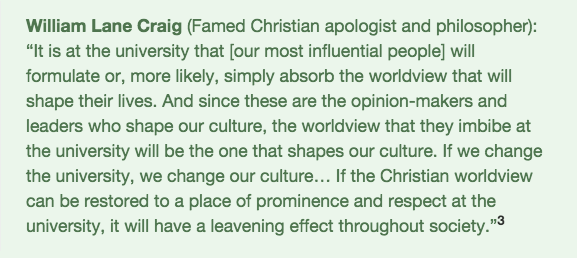
If serving God is your goal, look to the university

There is already a perfectly fine university right next door – no need to fly to Europe to find one! Remember, the university that took your faith away, or maybe the faith of someone you cared about? Yeah, it’s still there in your home town! And it’s still ruining the lives of thousands of young people. It seems to me that it’s better stewardship to stay here and work, then give money to groups like Reasonable Faith. And you can start a blog, teach in church and invite scholars to the local university, too. That costs almost nothing, and it produces better results.

What about Jesus?

Sometimes, it’s a good idea to look beyond the words of the Bible and reflect on the overall message of it at a higher level. When I look in the Bible, I see that Jesus went through a lot of suffering in obedience to God in order to secure the salvation of people who did not even like him. And it’s from this sacrifice on our behalf that his claim on our obedience comes. There are things that I don’t like to do that I do anyway because they work to serve God. Jesus life’s ambition was not to do things that were easy, or that made him happy. Experienced Christians do things that are not fun, because these things are right and because they solve the real problem.

Women tells ex-boyfriend their baby was aborted so she could sell it to a gay man

Is it OK to tell women they are wrong?
Is it OK to tell women when they are wrong?

This is from the UK Daily Mail.

It says:

A pregnant mother allegedly conned her lover into thinking she had undergone an abortion so she could sell his newborn baby to a gay friend, a jury has been told.

The 29-year-old woman, from Perth, Perthshire, who cannot be named for legal reasons, allegedly wanted to pocket up to £300 by selling her unborn daughter to the 35-year-old man.

The court heard how the woman and the gay man allegedly orchestrated an elaborate story in order to dupe the biological father into thinking the child had never been born.

But the court heard how the mother had given birth to the child in February 2011, before claiming the father was her gay friend.

After putting his name on the birth certificate, the pair allegedly duped the NHS, the local registrar and council officials in an alleged scam which rumbled on for nearly three years.

The court heard how, initially, the woman had pretended that she did not give birth to the child at all.

Instead, the pair allegedly set up a fake Facebook profile for a fictional woman known as Clare Green, who was described as the child’s surrogate mother.

The bogus profile claimed that the woman had been a surrogate for the gay man and that she had gone on to give him full custody of the child.

But the mother later admitted to council officials that she had been pregnant with her former lover but terminated the pregnancy. She claimed she then fell pregnant for a second time with her friend after sleeping together on his birthday.

The mother and the man are now on trial accused of carrying out the elaborate hoax over the baby girl’s parentage.

She claimed she had been in a relationship with the biological father from the end of 2009 to early 2010 and had fallen pregnant with him but had lost the baby.

She said that, once they had split up, she ended up sleeping up with her co-accused, an old friend, following a pub crawl to mark his birthday.

[…]The woman insisted that the other man could not have been the father as she had not seen him prior to falling pregnant.

But the court heard how doctors said the baby could not have been conceived in April 2010 and had instead been conceived at least one month later.

It was not until a second police interview that the woman finally conceded that the baby might have been her ex-partner’s because she had ‘slept with both of them’, the court heard.

And the UK Daily Mirror says that in fact her ex-boyfriend was the father:

The court had earlier heard that she and her co-accused duped the biological dad out of knowing he had a child by putting the other man’s name on the birth certificate.

A joint minute was lodged with the court which stated as fact that the duo registered their names as mother and father of the child at the registry office in Perth.

The agreed statement said they had both signed the register but it was a matter of fact, discovered subsequently, that another man was the biological father of the child.

Now remember, children do better when growing up in a stable home with their biological mother and biological father.

But think about the situation this little kid is going to find herself in. What kind of environment can a single gay man offer a child?

A Family Research Council paper cites 4 different studies thus:

In The Sexual Organization of the City, University of Chicago sociologist Edward Laumann argues that “typical gay city inhabitants spend most of their adult lives in ‘transactional’ relationships, or short-term commitments of less than six months.”[5]

A study of homosexual men in the Netherlands published in the journal AIDS found that the “duration of steady partnerships” was 1.5 years.[6]

In his study of male homosexuality in Western Sexuality: Practice and Precept in Past and Present Times, Pollak found that “few homosexual relationships last longer than two years, with many men reporting hundreds of lifetime partners.”[7]

In Male and Female Homosexuality, Saghir and Robins found that the average male homosexual live-in relationship lasts between two and three years.[8]

Is that nice to do to a child? Do we even care any more what children need when deciding who to have sex with? Or is it all adult selfishness, all the time now… and pass the bill for the damages to the next generation of motherless, fatherless, children? Children need us to restrain our passions so that they can get what they need. They are weaker and more vulnerable than we are, and our feelings and desires have to give ground so that they get what they need. We have to get used to self-denial and self-sacrifice for their benefit, because we are the ones who are choosing to make them. They didn’t ask to be born. We are the ones who choose the behaviors that create them, and that puts obligations, expectations and responsibilities on us.

What is it like to be a donor-conceived child?

Marriage and family
Marriage and family

Yesterday, I wrote about children who are raised by same-sex parents. Today I want to link to an article written by two donor-conceived children.

The thing about donor-conceived children is this – the child’s natural father and/or mother’s absence has been bought and paid for by the adopting couple. One or both of the people who conceived the child is being paid by the adopter to go away.

From the article:

[M]y mother informed me of my true parentage when I was 14, and it was, as they say, irrevocable. My mother’s then-husband had waited until they divorced to permit her to tell me, and the revelation of his not being my biological father clarified an overwhelming amount of issues between us. For a multitude of reasons—his background, my personality and beliefs, our lack of biological connection—the cards were stacked against our having a conventional, loving father-daughter relationship. And we didn’t.

One of the greatest tragedies of donor conception is the loss of belonging: to family, to a culture. Essentially, one becomes malleable like an infant. I crave a home. I see myself as I travel in many directions—doing anything in order to find one.

Through the storytelling of other donor-conceived individuals, and scientific research pertaining to third-party reproduction and genetics, I have discovered that my situation is by no means unique, and I now understand the scientific explanations as to why my social father and I—up to a certain point—were unable to bond. It is natural for me to desire my father, for evolution has blessed those that secure such a bond with better survival rates.

The lack of my biological father’s presence is a devastating reality, a burden I will likely bare my entire existence. And now, knowing the truth of my conception, when I remember my past I remember everything that was absent from it.

The study she linked to in that paragraph says this:

It is on these grounds that we hypothesized, many years ago, that any and all sorts of abuse and exploitation would be seen to occur at higher rates in steprelationships than in genetic parent-child relationships, and that the differences would persist when possible confounds such as socio-economic status were controlled for… This hypothesis has since been abundantly supported in our own research and in that of many others. This differential (mis)treatment is what we refer to as the “Cinderella effect”.

[…][I]n several countries, stepparents beat very young children to death at per capita rates that are more than 100 times higher than the corresponding rates for genetic parents.

[…]The evidence for Cinderella effects in nonlethal abuse is much more extensive than that for homicides. Numerous studies from a diversity of countries indicate that stepparents perpetrate both nonlethal physical assaults and sexual abuse at much higher rates than genetic parents.

[…][S]teprelationships are difficult, and those who make it their business to help stepfamilies in distress are unanimous in cautioning that it is a mistake to expect that a stepparent-stepchild relationship is, or will with time become, psychologically equivalent to a birthparent-child relationship… Research tells the same story. Duberman (1975)… interviewed a select sample of well-established, “successful”, middle class, registered-marriage U.S. stepfamilies, and reported that only 53% of the stepfathers and 25% of the stepmothers felt able to say that they had any “parental feeling” (much less “love”) for their stepchildren.

It’s a well-known fact that mothers in particular have trouble treating their adopted children as well as their naturally-born children. This should be a caution to those women who want to put off marriage through their 20s and 30s, thinking that they can always adopt. Until you study the issues, it’s hard to know how to make a plan that takes into account the what children need in order to be happy, healthy and effective. Research should be consulted in order to make plans that will actually work.

More from the original article:

In the study “My Daddy’s Name Is Donor,” it was found that, “Regarding troubling outcomes, even with controls, the offspring of lesbian couples who used a sperm donor to conceive appear more than twice as likely as those raised by their biological parents to report struggling with substance abuse,” an alarming result displaying the reality of being raised without both genetic parents.

Some suggest that spending more money on making children means that they are more loved. Our children are definitively wanted, they say.

“The baby doesn’t care anything about the money,” says marriage and family therapist Nancy Verrier, regarding the issues surrounding surrogacy. “That’s not what hurts the baby. The baby is hurt by the separation, by the loss of that mother that it knows.” This ever-present realization of loss remains with both mother and child throughout their lives. Nature has ensured that mothers and children attach to one another, as it is a trait necessary to our survival; without motivation to love or instinctively care for her child, why would a mother protect her children from potential danger? She wouldn’t, and that would have heralded the end of our species. With this biological connection so immediate and meaningful, why doesn’t society view maintenance of that connection as more imperative?

The answer is that we are becoming more secular as a society as belief in God and therefore in objective morality declines. We are elevating the need to pursue happiness in this life over respect for objective morality. That’s why laws are changing to promote adult selfishness over the needs of children. Abortion, no-fault divorce, same-sex marriage… these are all elements of the secular worldview which wants to avoid the demands that children place on us. We want to have fun – not be saddled with moral obligations to others, that diminish our fun. We as a society have decided – whether we admit it or not – that the universe is an accident, that morality is an illusion, that responsibilities must be avoided, and that this life is all we have.

It’s amazing how widespread this attitude is, not just among atheists, but among Christians as well. Usually, the Christians just put a little spiritual spin on it though – “God told me to pursue my calling, so you can’t assess the feasibility and destructive impact of my choice”. That works to fool many “spiritual” people who put more faith in feelings than competence, but it doesn’t work to prevent the destructiveness of not thinking things through.