Republicans in the Wisconsin Senate passed a resolution Thursday calling for police to take 14 Democrats into custody for contempt after they fled to Illinois to avoid voting on a bill that would strip public-sector unions of nearly all their collective bargaining rights.
On the same day, Republicans in the Indiana House agreed to impose fines of $250 per day on Democrats who are also in Illinois, boycotting the legislature over labor and education bills they oppose.
In Wisconsin, Senate Majority Leader Scott Fitzgerald signed the orders after Republicans voted 19-0 calling for the action unless Democrats returned to the chamber by 4 p.m. Thursday.
None of the Democrats did, prompting Fitzgerald to sign 14 orders of detainment in dramatic fashion in the center of the Senate chamber. State patrol officers watched silently from the gallery.
The move comes two weeks after the Democrats left, effectively delaying the vote on Gov. Scott Walker’s proposal that he says will help him address a $3.6 billion budget shortfall. Walker said Thursday that he will start issuing layoff notices to state workers on Friday if his bill isn’t passed by then.
[…]The resolution gives the sergeant at arms the authority to take any and all steps, with or without force and assistance from police, to bring the senators back.
The Republicans should make the fines $250 per hour, not $250 per day. And they should apply the fine to all the union thugs, not just the Democrat fleebaggers. Then the Republicans could balance the budget. Everybody wins!
Democratic lawmakers fled the state in an effort to torpedo a closely watched vote on what would be the nation’s first major overhaul of union laws in years, as government workers flooded the statehouse for a third day seeking to block passage of the bill.
Surrounded by thousands of tightly packed protesters, including teachers who had been encouraged by union leaders to show up in force, state senators gathered around 11 a.m. to vote on Republican Gov. Scott Walker’s proposal to limit collective-bargaining rights for most state employees.
The governor’s proposal, part of a bill aimed at overcoming a $137 million deficit in the current budget and a projected $3.6 billion hole in the next two years, would allow collective bargaining on wages, but not pensions and health care. Workers would be required to pay more for both.
But a roll call revealed that the 14 Senate Democrats were absent, leaving the chamber short of the 20 votes needed to conduct business.
[…]Late Thursday, Gov. Walker, who could hear chanting every time he opened his office door, blasted the Democrats’ move as a “stunt” and urged them to return to vote on what he called as a “bold political move but a modest, modest proposal” that would preserve benefits for public employees that remained “better than what most people are getting across the state.”
The extraordinary scene was being followed in statehouses across the country, as a test case of both union clout and the political will of newly elected legislators. Wisconsin was at the front edge of voter discontent in 2010, with voters agitated about public spending electing Gov. Walker to succeed Democrat Jim Doyle and handing both houses of the legislature to the GOP.
[…]If the governor’s efforts succeed, other states are expected to try to follow, as governors grapple with deepening deficits. Many new governors in both parties have blamed the states’ fiscal crisis in part on what they say are overly generous benefits and pension obligations granted over many years to organized government workers.
Proposals similar to Gov. Walker’s have been made in New Jersey and Ohio. In Columbus, Ohio, thousands gathered Thursday to protest a Republican proposal that would eliminate collective-bargaining rights for many of that state’s 400,000 public-sector workers.
[…]Gov. Walker first introduced his “budget repair” bill just a week ago, setting off the firestorm that has swept the Capitol. Besides limiting collective-bargaining right for most workers—excepting police, firefighters and others involved in public safety—it would require government workers, who currently contribute little or nothing to their pensions, to contribute 5.8% of their pay to pensions, and pay at least 12.6% of health-care premiums, up from an average of 6%.
In exchange, Gov. Walker has pledged no layoffs or furloughs for the state’s 170,000 public employees. He has said 5,500 state jobs and 5,000 local jobs would be saved under his plan, which would save $30 million in the current budget and $300 million in the two-year budget that begins July 1.
The lawmakers are required by law to report to their posts to vote on all legislation, which is why the police were dispatched to locate them.
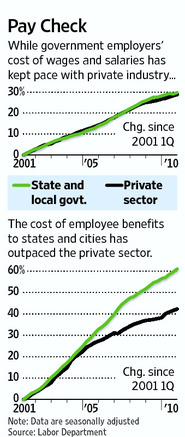
Here’s what the fuss is about:
Public Sector Benefits
And Gov. Walker is not the only one trying to stop the massive transfers of wealth from the productive private sector to non-productive public sector.
Excerpt:
Lawmakers around the country are looking at new ways to prevent budget disasters by changing the rules for overburdened state employee pension funds. But they are meeting stiff resistance from public employee unions.
Two Arizona state lawmakers this week, including the speaker of the House, introduced their plan to salvage the state’s budget by significantly changing the public retirement system.
Following the lead of Gov. Chris Christie, R-N.J., a pair of New Jersey assemblymen on Monday put forth their legislative solution to make solvent a fund that’s $54 billion in the red.
Also on Monday, in his first budget address as governor, Florida’s Rick Scott announced his effort to “stabilize and secure” government employee pensions.
The moves are part of a larger battle over pension reform between conservative budget hawks and government worker unions.
The national debt is currently over 14 trillion, and scheduled to be at 26 trillion by 2021.

 WINTERY KNIGHT