Tag Archives: Science

Robin Collins lectures on fine-tuning for discoverability from particle physics

Christianity and the progress of science

Here’s the lecture:

This lecture is 29 minutes long, the Q&A is 15 minutes. I highly recommend this lecture to all audiences of all levels of ability, for the simple reasons that apart from the content, this lecture is a how-to clinic in the tone, body language, slides and so on for you to use when trying to be persuasive when making your case. Science is king in this lecture. The scientific method is defined and applied in a winsome way. Making science understandable should be the bread and butter approach to Christian apologetics, and this lecture rivals the Mike Strauss lecture at Stanford University and the Mike Strauss lecture at the University of Texas – Dallas as the ideal lectures for showing that. It’s not just the scientific material that makes this lecture by Collins work, it’s the narrative and the style that make the lecture work.

About Robin Collins:

Robin Collins (PhD, University of Notre Dame, 1993), is professor of philosophy at Messiah College, Grantham, PA specializing in the area of science and religion.  He has written over twenty-five articles and book chapters on a wide range of topics, such as the fine-tuning of the cosmos as evidence for the existence of God, evolution and original sin, the Doctrine of Atonement, Asian religions and Christianity, and Bohm’s theory of quantum mechanics.  Some of his most recent articles/book chapters are “Philosophy of Science and Religion” in The Oxford Handbook of Science and Religion, “Divine Action and Evolution” in The Oxford Handbook of Philosophical Theology (2009)  “The Multiverse Hypothesis: A Theistic Perspective,” in Universe or Multiverse? (Cambridge University Press), and “God and the Laws of Nature,” in Theism or Naturalism: New Philosophical Perspectives (Oxford University Press, forthcoming).  He recently received a grant from the John Templeton Foundation to finish a book that presents the case for design based on physics and cosmology,  tentatively entitled The Well-Tempered Universe: God, Cosmic Fine-tuning, and the Laws of Nature.

His thesis in one slide:
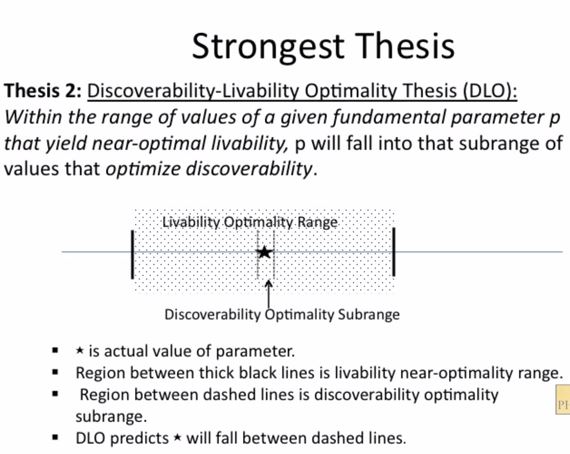
Fine-tuning for discoverability
Fine-tuning for discoverability – the DLO thesis

Summary:

  • Thesis: the universe is more intelligible than we would expect it by chance
  • The regular fine-tuning argument says that complex embodied observers are very rare
  • But the number of highly-discoverable universes that have complex embodied observers is rarer still
  • Why do we exist in a highly-discoverable universe?
  • Can we quantify and test discoverability?
  • Yes: by varying fundamental parameters and seeing how it affects discoverability
  • Conclusion of his calculations: The Discoverability-Liveability Optimality range is an even smaller range within the Liveablity Optimality range of the standard fine-tuning argument
  • Fine-tuning #1: the fine structure constant, governs the strength of the electro-magnetic force
  • If larger, wood-burning fire becomes impossible because fires won’t stay lit, and therefore forging metals becomes unlikely
  • If smaller, wood-burning fires won’t go out, e.g. – from lightning strikes, so that wood would be less accessible
  • Other constraints: smaller value decreases effectiveness of light microscopes, drastically lowers efficiency of transformers and motors
  • Fine-tuning #2: the cosmic microwave background radiation (CMBR), radiation left over from the Big Bang
  • humans need to discover the CMBR in order to confirm the Big Bang creation out of nothing, and it depends on baryon/pothon ratio
  • his calculations show that the actual value of CMBR is exactly at the peak for detectability by humans
  • if baryon/photon ratio larger, CMBR is less discoverable
  • if baryon/photon ratio smaller, CMBR is less discoverable
  • Fine-tuning #3: parameters related to subatomic particles are fine-tuned for their discovery and usefulness, e.g. – the bottom quark, the charm quark, the tau lepton and the Higgs Boson
  • the lifetime of the particles affects their usefulness to scientists who want to investigate the Standard Model of physics
  • decay rates of these subatomic particles are related to several of the finely-tuned parameters
  • for example, the mass of the bottom quark is finely-tuned for its discoverability by scientists
  • the tau lepton and the charm quark are similarly fine-tuned for disoverability
  • the mass of the Higgs boson is finely-tuned for discoverability and for making further discoveries
  • Conclusion: the DLO thesis is strongly confirmed – this is an even greater degree of fine-tuning that the already astonishing probabilities of the fine-tuning for complex, embodied intelligent beings
  • The formalized version of the philosophical argument based on this evidence is impervious with some of the traditional objections to the standard fine-tuning argument
  • #1 multiverse/selection effect: it is not subject to multiverse / observer selection objections
  • #2 normalizeability: it is not subject to the McGrew-Vestrup objection because the range of possible values is finite not infinite
  • #3 falsifiability: it makes falsifiable predictions, and in fact Collins’ earlier calculations of the CMBR discoverability contained an error that falsified the thesis – until he found the error and corrected for it
  • #4 usefulness: it gives clues about the Creator’s purpose for us, namely that the universe was created for us to be able to do science and find evidence of the Creator’s existence – there is no expectation for us to exercise blind faith, trust in God is meant to be a plausible deduction from the progress of experimental science

Sample slide:
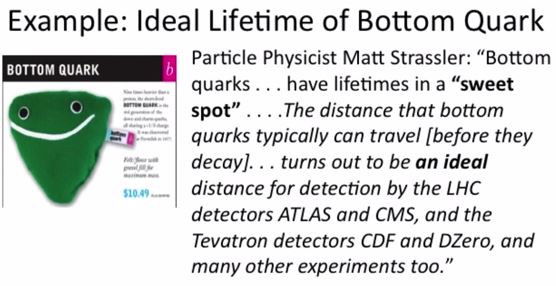
Fine-tuning of the bottom quark for discoverability
Bottom quark lifetime is finely-tuned for discoverability

And another:

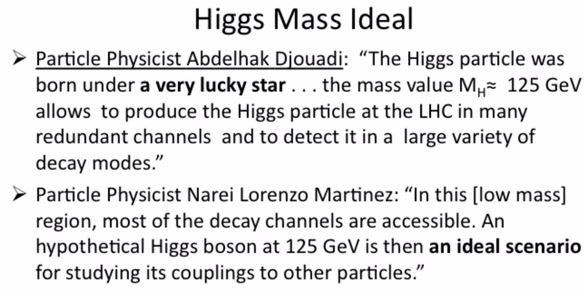
Higgs boson mass is finely-tuned for discoverability

Earlier, I blogged about a Robin Collins lecture on the fine-tuning that allows complex, embodied life to exist. Another must-see lecture. If you are looking for something to study in university, and you have funding, then physics, mathematics and philosophy are the best places to be for a Christian scholar.

New study: first life pushed back earlier, leaving less time for naturalist magic

Christianity and the progress of science

Whenever you discuss origins with naturalists, it’s very important to get them to explain how the first living organism emerged without any help from an intelligent agent. The origin of life is an information problem. A certain minimal amount of biological information for minimum life function has to be thrown together by chance. No evolutionary mechanisms have the potential to work until replication is already in place.

Evolution News reports on a new study that makes the window for naturalistic forces to create the first self-replicating organism even smaller.

Excerpt:

A paper in Nature reports the discovery of fossil microbes possibly older, even much older, than any found previously. The lead author is biogeochemist Matthew Dodd, a PhD student at University College London. If the paper is right, these Canadian fossils could be 3.77 billion years old, or even as old as — hold onto your hat, in case you’re wearing one — 4.28 billion years.

From the Abstract:

Although it is not known when or where life on Earth began, some of the earliest habitable environments may have been submarine-hydrothermal vents. Here we describe putative fossilized microorganisms that are at least 3,770 million and possibly 4,280 million years old in ferruginous sedimentary rocks, interpreted as seafloor-hydrothermal vent-related precipitates, from the Nuvvuagittuq belt in Quebec, Canada. These structures occur as micrometre-scale haematite tubes and filaments with morphologies and mineral assemblages similar to those of filamentous microorganisms from modern hydrothermal vent precipitates and analogous microfossils in younger rocks. The Nuvvuagittuq rocks contain isotopically light carbon in carbonate and carbonaceous material, which occurs as graphitic inclusions in diagenetic carbonate rosettes, apatite blades intergrown among carbonate rosettes and magnetite–haematite granules, and is associated with carbonate in direct contact with the putative microfossils.

This new paper is interesting to compare with a paper from last year, Nutman et al., “Rapid emergence of life shown by discovery of 3,700-million-year-old microbial structures,” also in Nature, which found microbial structures that are a bit younger.

But the “microbial structures” from Nutman et al. 2016 are different from these new “microfossils” presented by Dodd et al. 2017. In Nutman et al., they only found stromatolite-type structures rather than actual microfossils. Some stromatolite experts were a bit skeptical that what they found were really stromatolites.

But the new paper by Dodd and his colleagues, “Evidence for early life in Earth’s oldest hydrothermal vent precipitates,” seems to offer potential bacteria-like microfossils. They are tiny black carbonaceous spheres and “hematite tubes” which the authors think are biogenically created. We’ve seen more convincing ancient microfossils, but these aren’t bad.

According to Dodd et al., these new finds would be the oldest known microfossils, if that is in fact what they are. Very interesting. If so, that just keeps pushing unquestionable evidence of life’s existence on Earth further and further back, which leaves less and less time for the origin of life to have occurred by unguided chemical evolution after Earth became habitable.

If they are in fact 4.28 billion years old, then that would mean there was life very, very early in Earth’s history — as Cyril Ponnamperuma said, it’s like “instant life.”

Instant life is “rational” for naturalistic fideists, but for evidence-driven people who understand the long odds on generating even a simple protein by chance, it’s irrationality.

Let’s recall exactly how hard it is to make even a simple protein without intelligent agency to select the elements of the sequence.

The odds of creating even a single functional protein

I’ve talked about Doug Axe before when I described how to calculate the odds of getting functional proteins by chance.

Let’s calculate the odds of building a protein composed of a functional chain of 100 amino acids, by chance. (Think of a meaningful English sentence built with 100 scrabble letters, held together with glue)

Sub-problems:

  • BONDING: You need 99 peptide bonds between the 100 amino acids. The odds of getting a peptide bond is 50%. The probability of building a chain of one hundred amino acids in which all linkages involve peptide bonds is roughly (1/2)^99 or 1 chance in 10^30.
  • CHIRALITY: You need 100 left-handed amino acids. The odds of getting a left-handed amino acid is 50%. The probability of attaining at random only L–amino acids in a hypothetical peptide chain one hundred amino acids long is (1/2)^100 or again roughly 1 chance in 10^30.
  • SEQUENCE: You need to choose the correct amino acid for each of the 100 links. The odds of getting the right one are 1 in 20. Even if you allow for some variation, the odds of getting a functional sequence is (1/20)^100 or 1 in 10^65.

The final probability of getting a functional protein composed of 100 amino acids is 1 in 10^125. Even if you fill the universe with pre-biotic soup, and react amino acids at Planck time (very fast!) for 14 billion years, you are probably not going to get even 1 such protein. And you need at least 100 of them for minimal life functions, plus DNA and RNA.

Research performed by Doug Axe at Cambridge University, and published in the peer-reviewed Journal of Molecular Biology, has shown that the number of functional amino acid sequences is tiny:

Doug Axe’s research likewise studies genes that it turns out show great evidence of design. Axe studied the sensitivities of protein function to mutations. In these “mutational sensitivity” tests, Dr. Axe mutated certain amino acids in various proteins, or studied the differences between similar proteins, to see how mutations or changes affected their ability to function properly. He found that protein function was highly sensitive to mutation, and that proteins are not very tolerant to changes in their amino acid sequences. In other words, when you mutate, tweak, or change these proteins slightly, they stopped working. In one of his papers, he thus concludes that “functional folds require highly extraordinary sequences,” and that functional protein folds “may be as low as 1 in 10^77.”

The problem of forming DNA by sequencing nucleotides faces similar difficulties. And remember, mutation and selection cannot explain the origin of the first sequence, because mutation and selection require replication, which does not exist until that first living cell is already in place.

Biomimetics: scientists making discoveries using God’s designs in nature

Christianity and the progress of science

Well, scientists are still gaining insights from God’s book of nature.

Evolution News reports on the latest:

Pure science seeks understanding of “the nature of nature” and its operations. Applied science takes the insights from pure research and makes it work for human interests. What if you had a single word that incorporates both? Here’s a contender for such a word: Biomimetics. The application side is clear, because engineers and inventors try to imitate nature’s designs. But the pure-research side becomes active in the process, because you have to understand something before you can imitate it. This is a win-win bonanza for 21st-century science, and intelligent design, if not by that name, is at the center of it.

They list the following areas where scientists borrowed from God’s designs in nature to make scientific progress:

  • drug discovery (Nature Communications)
  • artificial muscles (American Institute of Physics)
  • robotics (Engineering at Illinois News)
  • drones (Live Science and New Scientist)
  • crop pollination (New Scientist)
  • ceramics (Proceedings of the Natural Academy of Science)
  • more ceramics (Nature Communications)
  • clothing (American Chemical Society)
  • more clothing (Phys.org)
  • more robotics (Public Library of Science)

Naturally, I chose the bird example for this blog post, because I love birds more than any creature – especially parrots.

This time it’s peacocks and peahens:

Peacock dye. The American Chemical Society is involved in the gold rush, too, excited to announce that “Peacock colors inspire [a] greener way to dye clothes.” The iridescent colors of birds and butterflies come not from pigments, but from geometric structures at the nanoscopic level that intensify certain wavelengths of light. Everyone from fashion designers to parents to the EPA will be happy to learn about better dyes inspired by peacock feathers. “Testing showed the method could produce the full spectrum of colors, which remained bright even after washing,” an ACS team said. “In addition, the team said that the technique did not produce contaminants that could pollute nearby water.”

Amazing that some people just go about their lives ignorant and oblivious to the design that’s all around them. Then again, if they thought about who made these designs, it might interfere with their pursuit of pleasure. Maybe they just shut out the evidence so they can keeping being the boss of their own lives, and never take responsibility for their moral choices?

Romans 1:18-21:

18 For the wrath of God is revealed from heaven against all ungodliness and unrighteousness of men who suppress the truth in unrighteousness,

19 because that which is known about God is evident within them; for God made it evident to them.

20 For since the creation of the world His invisible attributes, His eternal power and divine nature, have been clearly seen, being understood through what has been made, so that they are without excuse.

21 For even though they knew God, they did not honor Him as God or give thanks, but they became futile in their speculations, and their foolish heart was darkened.

See the related posts below for more posts on biomimetics.

Related posts