Tag Archives: Science

How the discovery of the cosmic microwave background radiation falsified atheism

Prior to certain scientific discoveries, most people thought that the universe had always been here, and no need to ask who or what may have caused it. But today, that’s all changed. Today, the standard model of the origin of the universe is that all the matter and energy in the universe came into being in an event scientists call “The Big Bang”. At the creation event, space and time themselves began to exist, and there is no material reality that preceded them.

So a couple of quotes to show that.

An initial cosmological singularity… forms a past temporal extremity to the universe. We cannot continue physical reasoning, or even the concept of spacetime, through such an extremity… On this view the big bang represents the creation event; the creation not only of all the matter and energy in the universe, but also of spacetime itself.

Source: P. C. W. Davies, “Spacetime Singularities in Cosmology,” in The Study of Time III, ed. J. T. Fraser (Berlin: Springer Verlag ).

And another quote:

[A]lmost everyone now believes that the universe, and time itself, had a beginning at the big bang.

Source: Stephen Hawking and Roger Penrose, The Nature of Space and Time, The Isaac Newton Institute Series of Lectures (Princeton, N. J.: Princeton University Press, 1996), p. 20.

So, there are several scientific discoveries that led scientists to accept the creation event, and one of the most interesting and famous is the discovery of the cosmic microwave background radiation.

Here’s the history of how that discovery happened, from the American Physical Society web site:

Bell Labs radio astronomers Arno Penzias and Robert Wilson were using a large horn antenna in 1964 and 1965 to map signals from the Milky Way, when they serendipitously discovered the CMB. As written in the citation, “This unexpected discovery, offering strong evidence that the universe began with the Big Bang, ushered in experimental cosmology.” Penzias and Wilson shared the Nobel Prize in Physics in 1978 in honor of their findings.

The CMB is “noise” leftover from the creation of the Universe. The microwave radiation is only 3 degrees above Absolute Zero or -270 degrees C,1 and is uniformly perceptible from all directions. Its presence demonstrates that that our universe began in an extremely hot and violent explosion, called the Big Bang, 13.7 billion years ago.

In 1960, Bell Labs built a 20-foot horn-shaped antenna in Holmdel, NJ to be used with an early satellite system called Echo. The intention was to collect and amplify radio signals to send them across long distances, but within a few years, another satellite was launched and Echo became obsolete.2

With the antenna no longer tied to commercial applications, it was now free for research. Penzias and Wilson jumped at the chance to use it to analyze radio signals from the spaces between galaxies.3 But when they began to employ it, they encountered a persistent “noise” of microwaves that came from every direction. If they were to conduct experiments with the antenna, they would have to find a way to remove the static.

Penzias and Wilson tested everything they could think of to rule out the source of the radiation racket. They knew it wasn’t radiation from the Milky Way or extraterrestrial radio sources. They pointed the antenna towards New York City to rule out “urban interference”, and did analysis to dismiss possible military testing from their list.4

Then they found droppings of pigeons nesting in the antenna. They cleaned out the mess and tried removing the birds and discouraging them from roosting, but they kept flying back. “To get rid of them, we finally found the most humane thing was to get a shot gun…and at very close range [we] just killed them instantly. It’s not something I’m happy about, but that seemed like the only way out of our dilemma,” said Penzias.5 “And so the pigeons left with a smaller bang, but the noise remained, coming from every direction.”6

At the same time, the two astronomers learned that Princeton University physicist Robert Dicke had predicted that if the Big Bang had occurred, there would be low level radiation found throughout the universe. Dicke was about to design an experiment to test this hypothesis when he was contacted by Penzias. Upon hearing of Penzias’ and Wilson’s discovery, Dicke turned to his laboratory colleagues and said “well boys, we’ve been scooped.”7

Although both groups published their results in Astrophysical Journal Letters, only Penzias and Wilson received the Nobel Prize for the discovery of the CMB.

The horn antenna was designated a National Historic Landmark in 1990. Its significance in fostering a new appreciation for the field of cosmology and a better understanding of our origins can be summed up by the following: “Scientists have labeled the discovery [of the CMB] the greatest scientific discovery of the 20th century.”8

It’s the greatest scientific discovery of the 20th century.

In the New York Times, Arno Penzias commented on his discovery – the greatest discovery of the 20th century – so:

The best data we have [concerning the Big Bang] are exactly what I would have predicted, had I nothing to go on but the five books of Moses, the Psalms, the bible as a whole.

Just one problem with the greatest scientific discovery of the 20th century: atheists don’t accept it. Why not?

Here’s a statement from the Secular Humanist Manifesto, which explains what atheists believe about the universe:

Religious humanists regard the universe as self-existing and not created.

For a couple of examples of how atheistic scientists respond to the evidence for a cosmic beginning, you can check out this post, where we get responses from cosmologist Lawrence Krauss, and physical chemist Peter Atkins.

You cannot have the creation of the universe be true AND a self-existing, eternal universe ALSO be true. Someone has to be wrong. Either the science is wrong, or the atheist manifesto is wrong. I know where I stand.

Positive arguments for Christian theism

Stephen C. Meyer and Marcus Ross lecture on the Cambrian explosion

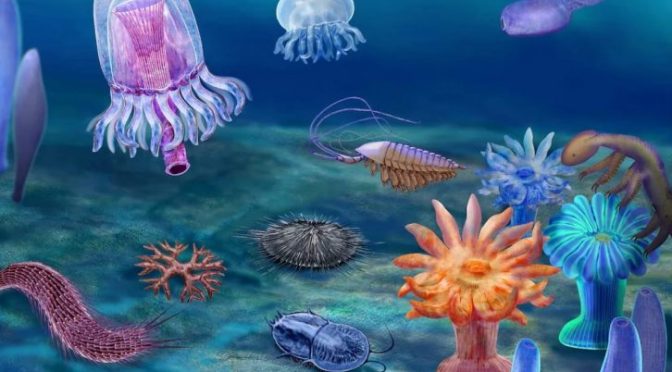
Cambrian Explosion
Cambrian Explosion

Access Research Network is a group that produces recordings  of lectures and debates related to intelligent design. I noticed that on their Youtube channel they are releasing some of their older lectures and debates for FREE. So I decided to write a summary of one that I really like on the Cambrian explosion. This lecture features Dr. Stephen C. Meyer and Dr. Marcus Ross.

The lecture is about two hours. There are really nice slides with lots of illustrations to help you understand what the speakers are saying, even if you are not a scientist.

Here is a summary of the lecture from ARN:

The Cambrian explosion is a term often heard in origins debates, but seldom completely understood by the non-specialist. This lecture by Meyer and Ross is one of the best overviews available on the topic and clearly presents in verbal and pictorial summary the latest fossil data (including the recent finds from Chengjiang China). This lecture is based on a paper recently published by Meyer, Ross, Nelson and Chien “The Cambrian Explosion: Biology’s Big Bang” in Darwinism, Design and Public Education(2003, Michigan State University Press). This 80-page article includes 127 references and the book includes two additional appendices with 63 references documenting the current state of knowledge on the Cambrian explosion data.

The term Cambrian explosion describes the geologically sudden appearance of animals in the fossil record during the Cambrian period of geologic time. During this event, at least nineteen, and perhaps as many as thirty-five (of forty total) phyla made their first appearance on earth. Phyla constitute the highest biological categories in the animal kingdom, with each phylum exhibiting a unique architecture, blueprint, or structural body plan. The word explosion is used to communicate that fact that these life forms appear in an exceedingly narrow window of geologic time (no more than 5 million years). If the standard earth’s history is represented as a 100 yard football field, the Cambrian explosion would represent a four inch section of that field.

For a majority of earth’s life forms to appear so abruptly is completely contrary to the predictions of Neo-Darwinian and Punctuated Equilibrium evolutionary theory, including:

  • the gradual emergence of biological complexity and the existence of numerous transitional forms leading to new phylum-level body plans;
  • small-scale morphological diversity preceding the emergence of large-scale morphological disparity; and
  • a steady increase in the morphological distance between organic forms over time and, consequently, an overall steady increase in the number of phyla over time (taking into account factors such as extinction).

After reviewing how the evidence is completely contrary to evolutionary predictions, Meyer and Ross address three common objections: 1) the artifact hypothesis: Is the Cambrian explosion real?; 2) The Vendian Radiation (a late pre-Cambrian multicellular organism); and 3) the deep divergence hypothesis.

Finally Meyer and Ross argue why design is a better scientific explanation for the Cambrian explosion. They argue that this is not an argument from ignorance, but rather the best explanation of the evidence from our knowledge base of the world. We find in the fossil record distinctive features or hallmarks of designed systems, including:

  • a quantum or discontinuous increase in specified complexity or information
  • a top-down pattern of scale diversity
  • the persistence of structural (or “morphological”) disparities between separate organizational systems; and
  • the discrete or novel organizational body plans

When we encounter objects that manifest any of these several features and we know how they arose, we invariably find that a purposeful agent or intelligent designer played a causal role in their origin.

Recorded April 24, 2004. Approximately 2 hours including audience Q&A.

I learned a lot by watching great lectures from Access Research Network. Their YouTube channel is here. I recommend their origin of life lectures – I have watched the ones with Dean Kenyon and Charles Thaxton probably a dozen times each. Speaking as an engineer, you never get tired of seeing engineering principles applied to questions like the origin of life.

If you’d like to see Dr. Meyer defend his views in a debate with someone who reviewed his book about the Cambrian explosion, you can find that in this previous post.

Further study

The Cambrian explosion lecture above is a great intermediate-level lecture and will prepare you to be able to understand Dr. Meyer’s new book “Darwin’s Doubt: The Explosive Origin of Animal Life and the Case for Intelligent Design“. The Michigan State University book that Dr. Meyer mentions is called “Darwin, Design and Public Education“. That book is one of the two good collections on intelligent design published by academic university presses, the other one being from Cambridge University Press, and titled “Debating Design: From Darwin to DNA“. If you think this lecture is above your level of understanding, then be sure and check out the shorter and more up-to-date DVD “Darwin’s Dilemma“.

Stephen C. Meyer debates Charles Marshall on the Cambrian explosion

Here is a summary of recent podcast of Unbelievable between intelligent design proponent Stephen C. Meyer and UC Berkeley evolutionary biologist Charles Marshall. Dr. Marshall had previously reviewed Dr. Meyer’s new book “Darwin’s Doubt” in the prestigious peer-reviewed journal “Science”.

Details:

Stephen C Meyer is the world’s leading Intelligent Design proponent. His new book Darwin’s Doubt claims that the Cambrian fossil record, which saw an “explosion” of new life forms in a short space of time, is evidence for ID.

Evolutionary biologist Charles Marshall of the University of California, Berkeley has written a critical review of the book. He debates Meyer on whether Darwinian evolution can explain the diversity of life in the Cambrian rocks.

For Meyer & Darwin’s Doubt:
http://www.darwinsdoubt.com/

For Charles Marshall’s review:
http://www.sciencemag.org/content/341/6152/1344.1.full

Here’s the debate on YouTube:

The brief summary this time is not provided by me, it’s from Evolution News.

Excerpt:

This past weekend Britain’s Premier radio network broadcast a debate between Stephen Meyer and UC Berkeley paleontologist Charles Marshall, recorded at the beginning of November. As David Klinghoffer noted yesterday, the subject of the debate was Meyer’s book Darwin’s Doubt. Yes, that’s the same Charles Marshall who reviewed Darwin’s Doubt in Science back in September. See here for our multiple responses.

It was an excellent debate, with both participants offering important insights and good arguments, though in my opinion Meyer unquestionably had the better of it, especially concerning the key scientific question of the origin of the information necessary to build the Cambrian animals. Nevertheless, both parties came to the table ready to engage in serious, thoughtful, and civil discussion about the core issues raised in Darwin’s Doubt, and we commend Marshall not only for participating, but for focusing his critique of the book on the central scientific issues, something other critics have conspicuously failed to do.

The debate was consequently both constructive and civil. Both parties complimented, as well as critiqued, the work of the other. Marshall, for example, described the first third of Darwin’s Doubt — the section that discusses the Cambrian and Precambrian fossil record, Marshall’s own area of principle expertise — as “good scholarship.” He also said it “looks like good science” and that Meyer “writes well,” and that he (Marshall) “really enjoyed reading”Darwin’s Doubt. Meyer, for his, part expressed his admiration for Marshall’s many scientific papers in paleontology and noted that he had been looking forward to the conversation because he and Marshall clearly “shared a passion for the same subject,” despite their different perspectives. Of course, Marshall is not pro-ID and both men expressed spirited disagreements, but they did so in a mostly respectful way that made the debate all the more interesting and engaging to listen to.

I was very impressed with Dr. Marshall’s performance during the debate, although he did try to poison the well a bit against ID at the beginning, and he got nasty at the end. It’s amazing how Dr. Meyer was able to get him to stop it with the politics and get serious, just by sticking to the science. Even when Marshall got insulting at the end, it was still valuable to see how the other side has to abandon rational argument and scientific evidence once they see that they can’t win on the merits. It’s “Inherit the Wind” in reverse.

Evolution News also posted a more complete guide to the debate in this post, and I recommend that you read that post before listening to the debate if you are not familiar with the science.

This is a great debate, and you definitely ought to listen to it. I hope I’ve posted enough here to convince you. If you haven’t yet bought “Signature in the Cell” and “Darwin’s Doubt“, then I urge you to get them, although they are intermediate/advanced level books. The two books are the state of the art in intelligent design research, good enough to be debated with a University of California, Berkeley professor of biology.