The total tax bill for the average Canadian family has increased at a much faster rate since 1961 than any other single household expenditure, according to a new study released today by the Fraser Institute, Canada’s leading public policy think tank. The Canadian Consumer Tax Index 2010, which calculates the total tax bill of the average Canadian family, found that taxes have increased by a whopping 1,624% since 1961. In contrast, expenditures on housing increased by 1,198%, food by 559%, and clothing by 526% from 1961 to 2009. “Taxes have grown much more rapidly than any other single expenditure item for Canadian families to the point where taxes from all levels of government take a greater part of a family’s income than basic necessities such as food, clothing, and housing,” said Niels Veldhuis, the study’s co-author and the Institute’s senior economist.
How much do Canadians pay in taxes?
The Canadian Consumer Tax Index calculates the total tax bill of the typical Canadian family by adding up the various taxes that the family pays to federal, provincial, and local governments. These include direct taxes such as income taxes, sales taxes, Employment Insurance and Canadian Pension Plan contributions, as well as “hidden” taxes such as import duties, excise taxes on tobacco and alcohol, amusement taxes, and gas taxes.
This year’s index shows that even though family incomes have increased significantly since 1961, the total tax bill has increased at a much higher rate.
In 2009, the average Canadian family earned an income of $69,175 and paid total taxes equaling $28,878-41.7 per cent of its income.
In 1961, the average Canadian family earned an income of $5,000 and paid $1,675 in total taxes-33.5 per cent of its income.
Taxes have become the most significant item that Canadian consumers now face in their budgets,” Veldhuis said.
So the typical Canadian family, pays 42% of their family income in taxes. FORTY-TWO PERCENT. Remember, Canada has a VAT tax, which is what Obama is apparently considering to pay for all his spending on bailouts for his rich Democrat buddies.
The Fraser Institute is the equivalent of our Cato Institute. I don’t agree with either of them on many things, (e.g. – Darwinism), but on the topic of taxes being too high, I agree with them both.
Governor David Paterson said Tuesday that the days of profligate spending in Albany are over and that starting immediately lawmakers must participate in an “age of accountability.”
That said, the governor’s new budget has $1 billion in new taxes and nearly $800 million in cuts for New York City.
[…]”Our revenues have crumbled and our budget has crashed and we can no longer afford this spending addiction that we have had for so long,” Paterson said.
[…]”The mistakes of the past have lead us to the breaking point,” Paterson said.
But in addition to the severe belt tightening, the governor said he would need to raise $1 billion in new taxes and fees — some politically controversial.
* A $1 increase in the cigarette tax, raising the state tax to $3.75.
* A new soda tax that will cost consumers 1-cent per ounce — a 16-ounce bottle will cost 16 cents more, a 64-ounce bottle 64 cents more.
* The governor also plans to legalize and sanction cage fighting.
* And allow wine to be sold in grocery stores.
* And introduce 50 speed cameras on highways to catch unsuspecting motorists with fines of up to $100.
And now Albany has no revenues to pay for all of their government spending on social programs, such as paying delinquent teachers to do nothing all day because the teacher unions won’t allow teachers to be fired, no matter how badly they screw up.
Governor Patterson never wanted anything to do with earlier tax increases on the wealthy. At least these new tax increases are on consumption, not on income, and not on corporations. Consumption taxes cost the fewest jobs, in my opinion. Consumption taxes encourage saving, too.
China extended its lead over the U.S. as the world’s biggest auto market in November, with production and sales both surpassing 1 million vehicles, and India saw sales jump 71.9-percent.
[…]China’s auto market is sizzling, thanks largely to tax cuts and subsidies aimed at supporting the industry and encouraging use of more fuel-efficient vehicles. The boom has clinched China’s status as the world’s biggest vehicle market due to languishing sales in the U.S.
[…]The surge is also a sign of how the Indian consumer — encouraged by government tax cuts, a big disbursement of back pay for government employees and falling interest rates — is fueling economic growth in Asia’s third-largest economy.
As everyone knows, the Democrats chose to bail out auto companies with taxpayer money and reward people with taxpayer money for destroying fully functional vehicles. And we all know how well that has worked out.
Chile poised to jump from the third world to the first world
Chile is expected to win entry to OECD’s club of developed countries by Dec. 15 — a great affirmation for a once-poor nation that pulled itself up by trusting markets. One thing that stands out here is free trade.
[…]It’s not like Chile was born lucky. Only 30 years ago, it was an impoverished country with per capita GDP of $1,300. Its distant geography, irresponsible neighbors and tiny population were significant obstacles to investment and growth. And its economy, dominated by labor unions, wasn’t just closed, but sealed tight.
In the Cato Institute’s 1975 Economic Freedom of the World Report it ranked a wretched 71 out of 72 countries evaluated.
Today it’s a different country altogether. Embracing markets has made it one of the most open economies in the world, ranking third on Cato’s index, just behind Hong Kong and Singapore. Per capita GDP has soared to $15,000.
Besides its embrace of free trade, other reforms — including pension privatization, tax cuts, respect for property rights and cutting of red tape helped the country grow not only richer but more democratic, says Cato Institute trade expert Daniel Griswold.
But the main thing, Griswold says, is that the country didn’t shift course. “Chile’s economy is set apart from its neighbors, because they have pursued market policies consistently over a long period,” he said. “Free trade has been a central part of Chile’s success.”
I gave my Dad my copy of “Money, Greed and God” by Jay Richards, and although he thought that it started out slow, he’s warmed up to it. He calls me on the phone at least twice a day, and last night he alerted me to this web site, where you can track each countries average citizen’s life span and per-capita GDP over time. My Dad was pretty liberal on economics before, so naturally I’ve been working on him with lots of introductory books on economics. He’s read about a dozen now, and Thomas Sowell is his favorite.
Anyway, my Dad says that this is what a country needs to succeed:
free trade with other nations
the rule of law
low judicial activism
low tax rates
private property protections
currency not threatened by inflation
low government spending
minimal regulation of commerce
And at that web site, you can track the success of countries like Singapore and Hong Kong, which embrace conservative small government free market fiscal policies, and compare them with countries like Zimbabwe and North Korea, which embrace big government protectionist fiscal policies. Countries fail because they adopt the wrong policies. They succeed when they adopt the right policies. It doesn’t matter how poor they start, if they have the right policies, they grow rich over time.
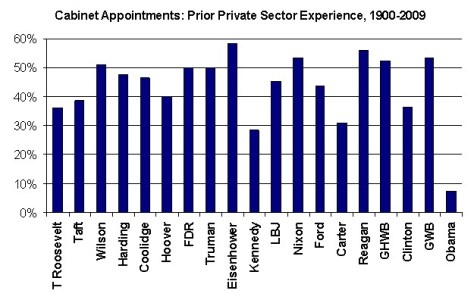
Why are the Democrats so incompetent on economic policy?
Well, it’s because there is almost no one in the Obama socialist regime who has ever run a business or worked in a business. Check out this graphic. (H/T Flopping Aces)
Hunger is spreading while the number of homeless families is increasing as a result of the recession and other factors, according to a report on Tuesday.
The U.S. Conference of Mayors said cities reported a 26 percent jump in demand for hunger assistance over the past year, the largest average increase since 1991.
Middle-class families as well as the uninsured, elderly, working poor and homeless increasingly looked for help with hunger, which was mainly fueled by unemployment, high housing costs and low wages.
Democrats really don’t know what they are doing. It’s like putting pre-schoolers in charge of Amazon.com. It doesn’t work. Their ivory tower, silver-spoon worldview cannot comprehend real-world, grown-up complexities. So long as the Democrats continue to attack the businesses that employ citizens while redistributing wealth from people who produce to people who vote Democrat, our economic troubles will continue.

 WINTERY KNIGHT