Tag Archives: Right to Work

Ohio Republicans pass bill to cut bloated union salaries and benefits

From the Wall Street Journal.

Excerpt:

Ohio state senators narrowly approved a bill that would prohibit public-employee unions representing 400,000 state employees from bargaining over health benefits, pensions and working conditions.

While national attention has focused for weeks on a similar battle in Wisconsin, the vote, by 17-16 in Ohio’s Republican-controlled Senate, virtually ensured that the Buckeye State will become the first to strip collective bargaining rights from public employees as a means of grappling with gaping budget deficits.

The bill now goes to the House, where the Republicans have a 59-40 majority. If approved, as expected, it will move for signature to Republican Ohio Gov. John Kasich, who supports the bill.

[…]Republican lawmakers say worker pay and benefit cuts are needed to offset projected budget shortfalls. “If we’re going to grow in Ohio, we cannot raise taxes,” Republican state Sen. Keith Faber said Wednesday.

[…]Union officials began a coordinated effort to try to block bills in Wisconsin and Ohio that would curtail collective bargaining rights for public workers, and right-to-work legislation introduced in 13 states, including New Hampshire and Missouri. Those bills would allow workers in the private-sector to opt out of paying dues or belonging to a union. Such legislation threatens the unions’ funding and their political clout heading into the 2012 elections.

In Wisconsin, Republican state senators passed a resolution fining the 14 Democrats who left the state Feb. 17 to prevent a vote on Republican Gov. Scott Walker’s bill restricting public employees’ collective-bargaining rights. The vote on the resolution didn’t require a quorum, unlike the budget bill that would curb bargaining.

The Wisconsin Democrats, who are in Illinois, will be fined $100 a day for their absence when the Senate is in session. Several of the Democrats went to Kenosha, Wis., Monday to meet with Republican Wisconsin Senate Majority Leader Scott Fitzgerald, said Fitzgerald spokesman Andrew Welhouse. But the fines seemed to set back efforts to break the impasse.

Remember that Indiana Republicans are proposing a right-to-work bill, which would allow workers to OPT OUT of paying union dues, which are just used to campaign for Democrats and leftists causes anyway. This bill would break the backs of the unions.

Buckeyes and Badgers and Hoosiers, oh my!
Indiana Republicans to introduce right-to-work bill

From Fox News. (H/T Dad)

Excerpt:

Throngs of union members and supporters gathered in Indianapolis Monday for a protest against a proposed bill in the Indiana House that would restrict collective bargaining rights and make it a misdemeanor to require any employee to join or pay dues to a union.

Republican state Rep. Jerry Torr, the bill’s author, described his proposal as a tool to attract business to Indiana. He told Fox59 in Indianapolis that prospective employers are avoiding the state because they’re worried about its work rules.

“What I’m trying to do is bring jobs to Indiana,” Torr said. “We have lost manufacturing jobs in Indiana because we are not a right-to-work state.”

[…]Currently 22 states have right-to-work laws, according to the National Right to Work Legal Defense Foundation. Research by the National Conference of State Legislatures shows that several states in New England and in the northern Midwest are now considering right-to-work proposals.

Minnesota state Rep. Keith Downey wants right-to-work language enshrined in his state’s constitution — that’s part of a proposal he’s putting forward that would also slash the state work force and freeze pay.

Michigan’s Legislature is also weighing the idea of letting local jurisdictions create right-to-work zones. New Mexico, Connecticut and Alaska, among other states, have right-to-work bills currently in committee.

In Wisconsin, Walker is casting every component of his plan as critical.

He told “Fox News Sunday” that he’s not willing to hammer out a compromise that leaves collective bargaining rights in place — even if the state Senate Democrats who skipped town in order to prevent a vote agree on raising benefits contributions.

Walker said he wants to give local governments “the tools they need to balance the budget now and in the future” by changing the collective bargaining laws. His office released a fact sheet Monday giving examples of benefits won through collective bargaining, including health insurance that covers Viagara.

Plus, Walker said workers must have the “flexibility” to stay out of a union — and in turn avoid dues payments — if they choose.

“For us, if you want to have democracy, if you want to have the American way, which is allowing people to have a choice, that’s exactly what we’re allowing there,” Walker said. “People see the value, they see the work, they can continue to vote to certify that union and they can continue to voluntarily have those union dues, and write the check out and give it to the union to make their case, but they shouldn’t be forced to be a part of this if that’s not what they want to do.”

Teachers, for example, are really expensive… I am not sure we can afford to pay them as much as we do during a recession. (H/T Tina)

We really need to stop overpaying people with guaranteed jobs all these inflated salaries and benefits during a recession. There just aren’t enough of us out here working on goods and services to support the unions.

Education reform in India and in Bobby Jindal’s Louisiana

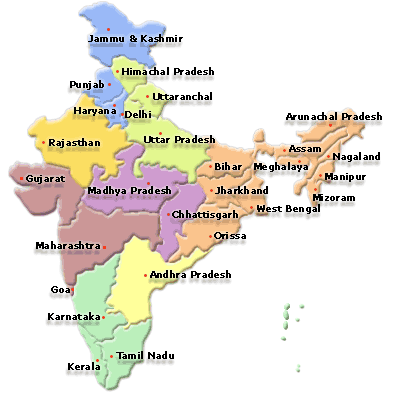
India is focused on education reform

Consider this article from the Philadelphia Bulletin.

Excerpt:

In 2007, the School Choice Campaign, a New Delhi-based education think tank, designed, funded, and implemented a pilot school choice program in the city. The program randomly selected students to be offered a school tuition voucher, which was taken up by 63 percent of students selected. The money could be used at any qualifying private school.

India’s teacher unions have fought the privately funded program tooth-and-nail. “They fight vouchers [because] they will enable students to leave the malfunctioning government schools and make the teachers redundant,” says Jan S. Rao, director of the School Choice Campaign in Delhi. “It is already happening in urban areas. In Delhi there are schools with more teachers than students, since the students have left.”

Oxford economist Francis Teal examined the effect of teacher unions on academic performance in India for a 2008 study. “We thus have in this data clear evidence that unions raise cost and reduce student achievement,” he bluntly states.

[…]For leaders of India’s education choice movement, the success of this trial is only the beginning. They will not be satisfied, says Dr. Parth J. Shah, president of India’s Centre for Civil Society, until “the Delhi government immediately adopts funding all new government schools on a per-pupil basis through vouchers.” That is already the national strategy in Sweden and Chile.

If I ever go totally crazy and just do whatever I want to do, then I’m moving to Chile. Just to see what it would be like. I’d like to move to India, but I’m told that there are a lot of mosquitoes, and the roads aren’t good. But that could change.

What about Louisiana?

Bobby and Supriya Jindal

Well, Louisiana has an Indian-American Republican Governor – his name is Bobby Jindal, and he is very enthusiastic about education reform. What has he done to make education reform work better?

Consider this study done by the Thomas B. Fordham Institute. (H/T Independent Women’s Forum)

Excerpt:

The charter environment thrives in New Orleans. Louisiana state law places no cap on the number of schools that can operate, and it provides for adequate funding of both charters and authorizers. The Louisiana Charter School Start-Up fund also provides zero-interest loans for charter schools to use for facilities-an element of charter funding that many states ignore. New Orleans leads the country in its percentage of students in charters at 57 percent.

That’s right – Louisiana is number one in education reform!

And there’s more:

Every city that receives a D or an F in this analysis is in a collective-bargaining state. Meanwhile, two-thirds of the top nine scorers (cities receiving a B) are located in right-to-work states.  All of the cities located in right-to-work states included in this study received a B or C, and none received a D or F.

Right-to-work means that a teacher can work without having to join a union! And that means that they can be fired if they can’t perform – but if they can perform, then they make more money! So they have an incentive to work harder and to make their students learn more – there is no safe job for them if they underperform.

Is South Carolina next? South Carolina has an Indian-American Republican Nikki Haley running for governor, so they’re probably next for major education reforms. I’m being silly, but you have to wonder… is there something about the Indian culture that makes them take education more seriously?