
Tag Archives: Richard Dawkins

What the reaction to the Indiana religious liberty law tells us about the secular left

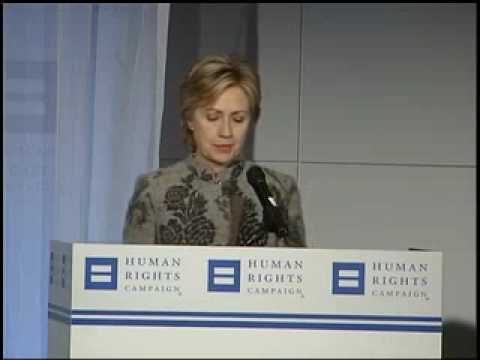
Hillary Clinton and the Human Rights Campaign

I surveyed three articles for this post, and we’ll see a little from each.

Jewish conservative Ben Shapiro has more in Townhall. (H/T Pastor Matt)

Shapiro writes:

Same-sex marriage, it turns out, was never designed to grant legal benefits to same-sex couples. That could have been done under a regime of civil unions. Same-sex marriage was always designed to allow the government to have the power to cram down punishment on anyone who disobeys the government’s vision of the public good. One need not be an advocate of discrimination against gays to believe that government does not have the ability to enforce the prevailing social standards of the time in violation of individual rights. There are many situations in which advocates of freedom dislike particular exercises of that freedom but understand that government attacks on individual rights are far more threatening to the public good.

You do not have a right to my services; I have a right to provide my services to whomever I choose. If you believe that your interpretation of public good enables you to bring a gun to the party, you are a bully and a tyrant. So it is with the modern American left, to whom freedom now means only the freedom to do what it is the left wants you to do at point of gun.

And Ben Shapiro again for Breitbart on what’s next for the secular left:

[…][T]he obvious next step is for the left to target churches for revocation of their non-profit status.

[…]Once non-profit status is revoked for churches on the basis of supposed discrimination against homosexuals, those churches become private institutions engaged in commerce. Which means that they are regulated as common businesses under anti-discrimination law. Which means they can be shut down or fined for failure to perform same-sex weddings. The left says this will never happen. Which means we are a few years away from it happening.

Religious universities will certainly be targeted, both as to their non-profit status and then for fines if they refuse to provide benefits for same-sex spouses, for example. Under the Bob Jones University case, which has already been touted by the left as the model for a federal case against same-sex marriage, universities will be considered discriminatory if they stand against same-sex marriage the same way Bob Jones University was with regard to its interracial dating standard. The difference, of course, is that dating between races is not the same as dating within the same sex. But the left has always equated race with homosexual behavior and will extend that equation to the law as it applies to institutions of higher education.

Just because religious schools are run by religious institutions does not exempt them from the wrath of the left. Leftists have already declared in states in which same-sex marriage has been approved that children must be taught about same-sex marriage in public schools; in California, for example, the law also requires that parents allow children to attend such classes.

This logic will be extended to private schools. Why should private schools be allowed to “discriminate” against same-sex couples by exempting children from learning about them? Why should homeschooled children be given state-credentialed status without being indoctrinated in the decency of homosexual behavior, all in the name of non-discrimination?

Here is an article from The Stream:

History teaches that mass vilification rarely stops short of spilling blood. The French Jacobins who spent the 1780s slandering the clergy in pornographic pamphlets went on in the 1790s to slaughter Christians by the hundreds of thousands. The Turks paved the way for killing a million Armenian Christians with a wave of propaganda. The Bolsheviks followed their “anti-God” crusade of the 1920s with starvation camps and firing squads. The Communist governments of Eastern Europe obeyed the same script, as scholar Anne Applebaum documents in her sobering study The Iron Curtain. The Hutu government of Rwanda prepared for its assault on the once-powerful Tutsis by incessantly describing them as “cockroaches” on radio broadcasts, which triggered a genocide.

The point here is that before the mob resorts to violence, they first have to dehumanize their opponents. That’s what we saw from the secular left in response to laws defending individual religious liberty against the secular state.

I think that it’s important for us to engage the source of secular leftist radicalism – the university. This is where the next generation of radical leftists are indoctrinated. I think that Christians need to be studying apologetics, as well as economics and politics. We need to have Christians study harder things in better schools and take more influential jobs. This is a major failure of the Christian church – we have been too focused on spirituality and piety at the expense of effectiveness and influence. Churches are simply not set up to connect the prosperity, liberty and security that Christians need to act as authentic Christians in the public square, to specific battles over laws and policies. We are not persuasive or effective in those battles.

We really need to be more engaged and well-rounded, but all I see the church doing is the gospel, the gospel, the gospel – every week. I don’t even know whether my pastor is pro-life or pro-marriage, and he certainly has never shared any reasons for his flock to be. And as far as apologetics, politics and economics? Forget it. I wonder how many young evangelicals in his church voted to set in motion the forces that would see him presiding over gay weddings , or having his children taken away from him lest they learn that there is anything wrong with abortion. But I’m sure he is very good at reading devotions, singing praise hymns, and doing Bible study. We need to be training influential young Christians and raising effective children.

Richard Dawkins: prevent parents from teaching their faith onto their kids

Richard Dawkins explains morality on atheism

This is from the radically leftist Huffington Post UK.

Excerpt:

Prominent atheist Richard Dawkins has argued that children with religious parents must be protected from indoctrination.

Dawkins expressed concerns to the Irish Times that parents are given too much leeway when it comes to their children’s education. The biologist, who is backing a campaign by Atheist Ireland to overhaul education, spoke ahead of a talk at Trinity College in Dublin.

He said: “There is a balancing act and you have to balance the rights of parents and the rights of children and I think the balance has swung too far towards parents.

“Children do need to be protected so that they can have a proper education and not be indoctrinated in whatever religion their parents happen to have been brought up in.”

Physicist Lawrence Krauss who was also present for the interview agreed, but stressed he believed state education should be held to different standards than private schools.

He said: “If the state is going to provide education, it has an obligation to try and educate children. That means parents have a limited — it seems to me — limited rights in determining what the curriculum is. The state is providing the education, it’s trying to make sure all children have equal opportunity.”

He added: “Parents, of course, have concerns and ‘say’ but they don’t have the right to shield their children from knowledge.

“That is not right, any more than they have the right to shield their children from healthcare or medicine.

“And those parents who do that are often tried – at least in my country – and imprisoned when they refuse to allow their children to get blood transfusions or whatever is necessary for their health. And this is necessary for their mental health.”

So Richard Dawkins is too cowardly to debate Christianity with William Lane Craig, but he is willing to use the power of big government to force parents not to explain to their children why Christianity is true, and what Christianity teaches.

Why does Dawkins want to prevent parents from teaching their kids about religion? I think the answer is that he doesn’t like that religious people can make moral judgments. If there is no God, then there is no rational basis for saying that anything is objectively right or wrong.

This is in fact Dawkins’ own view. Dawkins has previously written this:

The total amount of suffering per year in the natural world is beyond all decent contemplation. During the minute that it takes me to compose this sentence, thousands of animals are being eaten alive, many others are running for their lives, whimpering with fear, others are slowly being devoured from within by rasping parasites, thousands of all kinds are dying of starvation, thirst, and disease. It must be so. If there ever is a time of plenty, this very fact will automatically lead to an increase in the population until the natural state of starvation and misery is restored. In a universe of electrons and selfish genes, blind physical forces and genetic replication, some people are going to get hurt, other people are going to get lucky, and you won’t find any rhyme or reason in it, nor any justice. The universe that we observe has precisely the properties we should expect if there is, at bottom, no design, no purpose, no evil, no good, nothing but pitiless indifference.

(“God’s Utility Function,” Scientific American, November, 1995, p. 85)

Dawkins’ view is that nothing is really good or bad objectively. Cultures just evolve certain conventions, and those conventions vary arbitrarily by time and place. There’s nothing really right or wrong in the universe. Just do what you like as long as you don’t get caught – or change the laws so that the evil you want to do is legal. You can even force people to pay the costs of it. Heck, you can even use the courts to force them to celebrate what you do. It’s all up in the air for an atheist.

Richard Dawkins himself is in favor of infanticide:

In the past, Dawkins has also spoken positively about adultery.

So this is probably why Dawkins is in favor of using government to prevent parents from teaching their kids that God exists. If you think that morality is an illusion, then you do what feels right to you, hurting the weak if necessary. That is what Darwinism teaches, in fact – survival of the fittest, the strong use and destroy the weak. And if anyone disagrees – well, that’s what big government is for. And that’s why atheism is often wedded to big government – they need the big government to force people with different views to do what they want them to do. Atheists like Dawkins want to do what feels good to them, and they don’t want to be judged for it. Not all atheists are like Dawkins, but he is favored by them for a reason – he represents a large number of them.

Is the Bible’s definition of faith opposed to logic and evidence?

Probably the biggest misconception that I encounter when defending the faith is the mistaken notion of what faith is. Today we are going to get to the bottom of what the Bible says faith is, once and for all. This post will be useful to Christians and atheists, alike.

What is faith according to the Bible?

I am going to reference this article from apologist Greg Koukl of Stand to Reason in my explanation.

Koukl cites three Biblical examples to support the idea that faith is not blind leap-of-faith wishing, but is based on evidence.

  1. Moses went out into the wilderness and he had that first encounter with the burning bush, and God gave him the directive to go back to Egypt and let his people go. Moses said, Yeah, right. What’s going to happen when they say, why should we believe you, Moses?God said, See that staff? Throw it down.Moses threw it down and it turned into a serpent.God said, See that serpent? Pick it up.And he picked it up and it turned back into a staff.God said, Now you take that and do that before the Jewish people and you do that before Pharaoh. And you do this number with the hail, and the frogs, and turning the Nile River into blood. You put the sun out. You do a bunch of other tricks to get their attention.And then comes this phrase: “So that they might know that there is a God in Israel.”
  2. [I]n Mark 2 you see Jesus preaching in a house, and you know the story where they take the roof off and let the paralytic down through the roof. Jesus said, “Your sins are forgiven.” And people get bugged because how can anyone forgive sins but God alone?Jesus understood what they were thinking and He said this: What’s harder to say, your sins are forgiven, or to rise, take up your pallet and go home?Now, I’ll tell you what would be harder for me to say : Arise, take up your pallet and go home. I can walk into any Bible study and say your sins are forgiven and nobody is going to know if I know what I am talking about or not. But if I lay hands on somebody in a wheelchair and I say, Take up your wheelchair and go home, and they sit there, I look pretty dumb because everyone knows nothing happened.But Jesus adds this. He says, “In order that you may know that the Son of Man has the power and authority to forgive sins, I say to you, arise, take up your pallet and go home.” And he got up and he got out. Notice the phrase “In order that you may know”. Same message, right?
  3. Move over to the Book of Acts. First sermon after Pentecost. Peter was up in front of this massive crowd. He was talking about the resurrection to which he was an eyewitness. He talked about fulfilled prophecy. He talked about the miraculous tongues and the miraculous manifestation of being able to speak in a language you don’t know. Do you think this is physical evidence to those people? I think so. Pretty powerful.Peter tells them, These men are not drunk as it seems, but rather this is a fulfillment of prophecy. David spoke of this. Jesus got out of the grave, and we saw him, and we proclaim this to you.Do you know how he ends his sermon? It’s really great. Acts 2:36. I’ve been a Christian 20 years and I didn’t see this until about a year ago. This is for all of those who think that if you can know it for sure, you can’t exercise faith in it. Here is what Peter said. Acts 2:36, “Therefore let all the house of Israel know for certain that God has made him both Lord and Christ, Messiah, this Jesus whom you crucified.” There it is again. “Know for certain.”

What is faith according to Bible-based theologians?

I am going to reference this article from theologian C. Michael Patton of Parchment and Pen in my explanation.

Patton explains that according to Reformation (conservative, Bible-based) theologians, faith has 3 parts:

  1. notitia – This is the basic informational foundation of our faith. It is best expressed by the word content. Faith, according to the Reformers must have content. You cannot have faith in nothing. There must be some referential propositional truth to which the faith points. The proposition “Christ rose from the grave,” for example, is a necessary information base that Christians must have.
  2. assensus – This is the assent or confidence that we have that the notitia is correct… This involves evidence which leads to the conviction of the truthfulness of the proposition… This involves intellectual assent and persuasion based upon critical thought… assensus… says, “I am persuaded to believe that Christ rose from the grave.”
  3. fiducia – This is the “resting” in the information based upon a conviction of its truthfulness. Fiducia is best expressed by the English word “trust.”… Fiducia is the personal subjective act of the will to take the final step. It is important to note that while fiducia goes beyond or transcends the intellect, it is built upon its foundation.

So, Biblical faith is really trust. Trust(3) can only occur after intellectual assent(2), based on evidence and thought. Intellectual assent(2) can only occur after the propositional information(1) is known.

The church today accepts 1 and 3, but denies 2. I call this “fideism” or “blind faith”. Ironically, activist atheists, (the New Atheists), also believe that faith is blind. The postmodern “emergent church” denies 1 and 2. A person could accept 1 and 2 but deny 3 by not re-prioritizing their life based on what they know to be true.

How do beliefs form, according to Christian philosophers?

I am going to reference a portion of chapter 3 of J.P. Moreland’s “Love Your God With All Your Mind” (i.e. – LYGWYM).

J.P. Moreland explains how beliefs form and how you can change them.

  1. Today, people are inclined to think that the sincerity and fervency of one’s beliefs are more important than the content… Nothing could be further from the truth… As far as reality is concerned, what matters is not whether I like a belief or how sincere I am in believing it but whether or not the belief is true. I am responsible for what I believe and, I might add, for what I refuse to believe because the content of what I do or do not believe makes a tremendous difference to what I become and how I act.
  2. A belief’s strength is the degree to which you are convinced the belief is true. As you gain ,evidence and support for a belief, its strength grows for you… The more certain you are of a belief… the more you rely on it as a basis for action.

But the most important point of the article is that your beliefs are not under the control of your will.

…Scripture holds us responsible for our beliefs since it commands us to embrace certain beliefs and warns us of the consequences of accepting other beliefs. On the other hand, experience teaches us that we cannot choose or change our beliefs by direct effort.

For example, if someone offered you $10,000 to believe right now that a pink elephant was sitting next to you, you could not really choose to believe this… If I want to change my beliefs about something, I can embark on a course of study in which I choose to think regularly about certain things, read certain pieces of evidence and argument, and try to find problems with evidence raised against the belief in question.

…by choosing to undertake a course of study… I can put myself in a position to undergo a change in… my beliefs… And… my character and behavior… will be transformed by these belief changes.

I think definition of faith is important, because atheists seemed to want to substitute their own definition of faith as blind belief for this Biblical definition, but there is no evidence for their view that faith is belief without evidence. I think this might be another case of projection by atheists. Blind faith is how they arrive at their views, so they are trying to push it onto us. But the Bible is clearly opposed to it.