Tag Archives: Republican Party

Wall Street Journal: Rick Santorum is a supply-sider for the working man

Just to refresh everyone, a proponent of supply-side economics is someone who believes that economic growth is driven more by innovation and entrepreneurship, and less by consumer spending and government stimulus spending. Supply-siders are all about creating wealth – by letting creative people have the money invent something valuable that consumers will want to buy – like an iPhone or a Kindle. Demand-siders are all about redistributing wealth – by having the government take from one group of people to give it to another group of people – like a Solyndra loan or a Chevy Volt subsidy.

Here’s the Wall Street Journal article about Rick Santorum, and where he fits on the scale.

Excerpt on his economic plan for businesses:

‘I’m someone who believes that making things creates wealth,” says Rick Santorum. It is primary day in New Hampshire, and the former Pennsylvania senator and current presidential candidate is describing his plan to slash corporate tax rates. To encourage companies to make things, he would completely eliminate the federal income tax on manufacturers. For all other businesses, the rate would be cut in half, to 17.5% from 35%.

[…]I ask if his corporate tax plan opens him up to criticism that he and President Obama are both favoring particular sectors of the economy, with Mr. Santorum picking manufacturing while Mr. Obama anoints green energy. “Oh, green energy is not a sector, I mean, come on. It’s like a half-dozen companies,” says Mr. Santorum.

Does this mean the Obama policy would be more legitimate if the president were favoring a larger group of Solyndras?

“He’s talking about handing out tax-free grants and loans,” says Mr. Santorum, who adds that his own plan “is a conservative approach. It’s supply-side. It’s cutting rates. Why are we cutting the corporate rate to 17.5% and making it simple? . . . Because we think it’s what’s necessary to grow the economy. . . . So if what’s necessary to grow the economy in one sector of the economy is different from another, then why should we have the same tax rate?” He argues that manufacturing has been hit particularly hard by the costs of regulation and litigation.

That’s pro-growth – we’re all going to have multiple job offers if he executes this plan – back to 4% unemployment like under Bush.

But what about his economic plan for taxpayers?

Mr. Santorum also believes that making babies creates wealth. It’s very difficult to grow an economy with a shrinking population, he says, pointing to the “demographic winter in Europe” as a cause of that region’s troubles. To help avoid that fate in the U.S., he wants to triple the per-child tax credit and also cut individual tax rates.

[…]On the personal tax side, rewarding child-rearing is consistent with the pro-life views of Mr. Santorum, who has seven children. But the case he makes seems to echo the analysis of some Wall Street economists, who view population growth as a critical advantage the United States will enjoy over China and the euro zone.

Mr. Santorum argues that the cost of Europe’s massive welfare states made it too expensive for young people to have families. He notes that with plummeting birth rates, many European countries have resorted to “baby bonuses” to try to reverse the tide, but the demographic picture remains bleak, while the costs of entitlement programs have exploded.

“Who are benefits promised to, overwhelmingly? Well, they’re promised to older people. And if you have a society like Europe that is upside down where there are a lot more older people than younger people, you have economic calamity,” he says. Asked if giving generous per-child credits will result in an even larger number of households exempt from the income tax and therefore amenable to more spending, he says his plan will drive growth and that, in turn, will bring more people on to the tax rolls. Elimination of deductions might also keep some people paying income taxes. He aims to balance overall taxes and spending at 18% of GDP. Spending has soared to 24% in the Obama era.

In a still-crowded field of non-Romneys trying to compete for the Republican nomination, Mr. Santorum could emerge in the Jan. 21 South Carolina primary as the man who can bring together the old Reagan coalition. A champion of cultural conservatives with a blue-collar background, he is also making the case for deep cuts in federal spending. His credibility on this last issue derives from the political price he paid for being an early promoter of entitlement reform.

And what about his plan for entitlement reform?

To prevent an economic calamity on this side of the Atlantic, he also proposes to cut $5 trillion from federal spending in five years. He calls the plan advanced by House Budget Chairman Paul Ryan “a good starting point,” but he notes that few of the spending cuts happen in the first decade of the plan. Also, Mr. Santorum says that he wants to reform Social Security, not just Medicare and Medicaid. “I like the Ryan plan on the Medicare side. I don’t like waiting 10 years. I don’t like waiting 10 years on anything. I’ve also talked about Social Security.”

Has he ever, going back at least to the 1990s. Says Mr. Santorum, “Some guy just walked up to me at the [New Hampshire campaign] headquarters with a picture of me standing at the presidential podium in Kansas City, Missouri, in April 1998 when I went with Bill Clinton to talk about Social Security reform. I was the Republican lead on the issue,” he recounts, a dangerous proposition for someone representing Pennsylvania, a state with one of the oldest populations in the country. “And I won re-election after that, I might add.”

But after winning that 2000 election—his second Senate victory and his fourth straight win in Democratic territory—Mr. Santorum aggressively backed President George W. Bush’s call for allowing younger workers to own personal accounts.

It’s much easier to contemplate marriage when you 1) have multiple job offers and 2) you are keeping more of what you earn and 3) children are less of a burden on your income and 4) the government is not going to bankrupt those children with out of control entitlements. Marriage-minded men who want to start families will love this plan. It is a signal to men to start working, start marrying and start having children. Men think about these things, you know – losing our jobs, whether our children will be better off than we were, and so on. Santorum gets it – he has a pro-marriage, pro-family economic plan.

Related posts

Is Rick Santorum conservative or liberal? What are Rick Santorum’s political views?

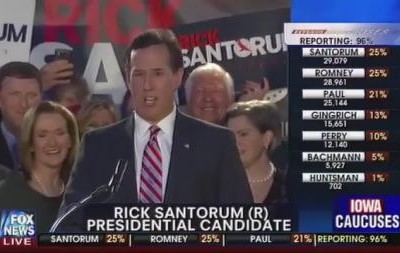
Rick Santorum Iowa Caucuses

Quin Hilyer explains, in the pro-Romney National Review, of all places.

Excerpt:

On taxes, for instance, Santorum has always been superb. The Club for Growth’s white paper on Santorum, calling his tax stances “very strong,” confirms that “Santorum has consistently supported broad-based tax cuts and opposed tax increases either by sponsoring key legislation or by casting votes on relevant bills.”

His record on a host of other conservative issues is as solid as that of any politician in the past two decades. He has been firmly and repeatedly against all sorts of regulatory abuse, against McCain-Feingold and other restrictions on political speech, for school choice, for tort reform, for a strong military, and for a balanced-budget amendment.

Obviously he has been as stalwart a defender of social conservatism, for 20 full years, as any other public figure. And as virtually every conservative involved in the judicial wars during Santorum’s time in the Senate has confirmed, in person or in print, Santorum and his staff were the go-to people in the Senate when you needed to find tireless, committed advocates for conservative jurists. Santorum is, wrote Ed Whelan of the Ethics and Public Policy Center, “the candidate in whom I have by far the greatest confidence” in terms of how likely he would be “to appoint excellent Supreme Court justices and lower-court judges and to work tenaciously to get them confirmed.”

Meanwhile, as Santorum frequently (and entirely accurately) reminds anybody who will listen, his work on the single most important conservative policy reform of the past half century, the 1996 welfare-to-work effort that cut spending and poverty rates simultaneously, was seminal, indefatigable, and remarkably effective. Iowa’s Sen. Chuck Grassley explained to the Des Moines Register a week ago that he was unconvinced about welfare reform until Santorum paid him an office call and “took a lot of time to convince me of his point of view… The sincerity and effort that he has to get his point across in the presidential campaign is almost a total reflection of how he operated as a United States senator.” Grassley yielded and voted for reform.

More broadly, until Rep. Paul Ryan’s recent prominence, nobody in Congress has been as passionate and fearless an advocate for entitlement reform as Santorum. Medicaid block grants. Investment accounts for Social Security. Medicare payments controlled by the beneficiaries rather than third-party payers. Choice rather than government mandates. Indeed, Santorum was the first candidate this year to fully embrace Ryan’s proposed reforms — with this exception, as he reminded me in a phone interview on Thursday: “I’ve criticized Ryan on one thing: waiting ten years [for many of the reforms to kick in]. We can’t afford to wait. We’ve got to start now.”

[…]As for overall spending and his much-discussed history of support for “earmarks” (a position also shared by tightwad Ron Paul), conservative groups’ ratings show that Santorum was better than the average Republican, despite representing a state far bluer than those of most of his Republican colleagues. He demonstrated particular courage in his support for the Freedom to Farm Act and in frequent opposition to floor amendments that would have put additional spending in appropriations bills. Denizens of Capitol Hill in the 1990s fondly remember Santorum’s repeated use of a prop during floor debate called the “Spendometer,” which he used to make a persuasive (and entertaining) case against wasteful federal largesse.

Out of office, he vociferously opposed TARP, the various “stimulus” packages, and the bailouts of car companies and of Fannie Mae and Freddie Mac. All those stances were perfectly in line with the voting record he had established in the House and Senate.

Evangelical Christian stalwart Gary Bauer is endorsing Rick Santorum.

Excerpt:

Social conservative leader and former presidential candidate Gary Bauer will endorse Rick Santorum in South Carolina, he confirmed to The Hill on Saturday.

Bauer said that he didn’t want to get into the details of the endorsement since it was officially still embargoed, but confirmed his support and said he’ll work to get other social conservatives on board for Santorum.

“I want to do whatever I can to convince my colleagues that Sen. Santorum is the right man,” he told The Hill.

[…]Bauer has organized a Friday meeting with top social conservatives in Texas to see if they can coalesce behind one candidate. He said the point of the meeting is not to try to stop Mitt Romney from being the Republican nominee, but that he believes Santorum would be the best candidate to beat President Obama, as well as the best commander in chief.

It’s worth remembering what Rick Santorum did to encourage critical thinking in public school science education, too. This is good news for us who want to have evidence for and against things like naturalistic macro-evolution and anthropogenic catastrophic global warming presented to students. That’s above and beyond the basics of conservatism, right there – and he’s solid on school choice.

The best thing about Santorum, though, is that he has a working class background and he isn’t afraid to debate with people instead of just speaking about his beliefs and generalities. He tries to convince people, and to reason things out with them.

George Will: Rick Santorum connects with the working class

From the liberal Washington Post, a column by moderate conservative George Will.

Excerpt:

On Sept. 26, 1996, the Senate was debating whether to ban partial-birth abortion, the procedure whereby the baby to be killed is almost delivered, feet first, until only a few inches of its skull remain in the birth canal, and then the skull is punctured, emptied and collapsed. Santorum asked two pro-choice senators opposed to the ban, Russ Feingold (D-Wis.) and Frank Lautenberg (D-N.J.), this: Suppose the baby slips out of the birth canal before it can be killed. Should killing it even then be a permissible choice? Neither senator would say no.

On Oct. 20, 1999, during another such debate, Santorum had a colloquy with pro-choice Sen. Barbara Boxer (D-Calif.):

Santorum: “You agree that, once the child is born, separated from the mother, that that child is protected by the Constitution and cannot be killed. Do you agree with that?”

Boxer: “I think that when you bring your baby home . . . .”

Santorum is not, however, a one-dimensional social conservative. He was Senate floor manager of the most important domestic legislation since the 1960s, the 1996 welfare reform. This is intensely pertinent 15 years later, as the welfare state buckles beneath the weight of unsustainable entitlement programs: Welfare reform repealed a lifetime entitlement under Aid to Families with Dependent Children, a provision of the 1935 Social Security Act, and empowered states to experiment with new weaves of the safety net.

White voters without college education — economically anxious and culturally conservative — were called “Reagan Democrats” when they were considered only seasonal Republicans because of Ronald Reagan. Today they are called the Republican base.

Who is more apt to energize them: Santorum, who is from them, or Romney, who is desperately seeking enthusiasm?

Romney recently gave a speech with a theme worthy of a national election, contrasting a “merit-based” or “opportunity” society with Barack Obama’s promotion of an “entitlement society,” which Romney termed “a fundamental corruption of the American spirit”: “Once we thought ‘entitlement’ meant that Americans were entitled to the privilege of trying to succeed. . . . But today the new entitlement battle is over the size of the check you get from Washington. . . . And the only people who truly enjoy any real rewards are those who do the redistributing — the government.”

Romney discerns the philosophic chasm separating those who embrace and those who reject progressivism’s objective, which is to weave a web of dependency, increasingly entangling individuals and industries in government supervision.

Santorum exemplifies a conservative aspiration born about the time he was born in 1958. Frank Meyer, a founding editor of William F. Buckley’s National Review in 1955, postulated the possibility, and necessity, of “fusionism,” a union of social conservatives and those of a more libertarian, free-market bent.

Please make sure you watch Rick Santorum’s speech in Iowa, or read the transcript. The speech was very good, and it’s also very interesting.

In a new national poll from today (Thursday), Santorum now trails Romney nationally 29%-21%.  Gingrich is third with 16%. According to another poll, Santorum is now running third in liberal New Hampshire.

By the way, I am completely fine with a Gingrich/Santorum ticket. But I would prefer a Santorum/Gingrich ticket, if I can get it. Those are the two great conservative communicators in this Republican primary. Both candidates are from the working class, and both are men with bold ideas.