Supporters of traditional marriage are being harassed and intimidated by opponents of the pro-marriage Proposition 8 initiative that passed recently in California. Anti-traditional-marriage activists used public lists of donors to put up web sites with maps showing the names and addresses of people who donated to support traditional marriage.
Here is an excerpt of the Washington Times article: (H/T John Lott)
After giving $10,000 to California’s Proposition 8 campaign last year, Charles LiMandri began receiving some unexpected correspondence.
“I got about two dozen e-mails and hate phone calls,” said Mr. LiMandri, who lives in San Diego….Those e-mails are now among hundreds of exhibits in a landmark case challenging California’s campaign-finance reporting rules, which require the release of the names, addresses and employers of those who contribute $100 or more to ballot-measure committees.
The lawsuit argues that those who contribute to traditional-marriage initiatives should be exempt from having their names disclosed, citing the widespread harassment and intimidation of donors to the Proposition 8 campaign.
…Intimidation tactics range from letters and e-mails to death threats, proponents say. A Sacramento theater director was fired after opponents of the initiative publicized his Proposition 8 campaign contributions.
“Anybody who’s in California knows that it’s very widespread,” said Brian Brown, executive director of the National Organization for Marriage, one of the biggest contributors to Proposition 8 and a joint plaintiff in the lawsuit. “Every donor has a story. I talked to a $100 donor the other day who had a note in his mailbox that said, ‘I know where you live and you’re going to pay.’
I don’t think it’s right for anyone to force their views on others by using threats and intimidation. Maybe we need a Human Rights Commission to protect the rights of supporters of traditional marriage.
Everyone who reads Thomas Sowell knows that the most important question to ask when talking about any economic proposal is “And Then What Happens?” That was the point of his one-two punch of introductory books on economics, “Basic Economics: A Citizen’s Guide to the Economy” and “Applied Economics: Thinking Beyond Stage One”. Don’t examine the intentions of the proposal. Examine the incentives it creates.
But this idea goes back even earlier to Henry Hazlitt, who wrote about it in “Economics in One Lesson”. (The link goes to a statement of the “one lesson”)
…the whole of economics can be reduced to a single lesson, and that lesson can be reduced to a single sentence:
The art of economics consists in looking not merely at the immediate but at the longer effects of any act or policy; it consists in tracing the consequences of that policy not merely for one group but for all groups.
Well, what are the long-term effects of Obama’s federal budget, for all groups?
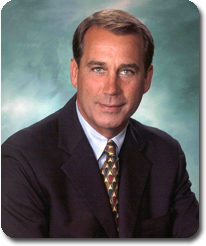
Congressman John Boehner has a breakdown of some of the budget numbers on his blog.
The President’s budget calls for $1.4 trillion in new taxes that will affect every American. There’s a $646 billion “cap and trade” energy tax; a $636 billion tax on income and small businesses; new taxes on investors by raising capital gains and dividend rates; a resurrection of the death tax; and a reduction in charitable deductions which will result in $4 billion less in donations each year to charities across America.
But it’s worse than that. A while back, I wrote about how Obama wanted to discriminate against religious schools by denying them renovation funds. In the budget, he continues his anti-religious trend by de-funding private charities. This is the part that Christians who voted for Obama need to pay attention to, because this matters to us.
Boehner notes:
The proposed reduction in charitable deductions is especially troubling, since it would hurt charities at a time when American families are struggling and in need of assistance.
But remember, when government expands, the state becomes more secular. The capabilities and influence of private religious groups decreases as the state de-funds them and takes over their duties. Instead of people depending on their neighbors’ charity, they now depend on the state. Instead of letting workers decide where to give charity, workers are forced to fund secular government programs.
According to the Center on Philanthropy at Indiana University, total itemized contributions from the highest income households would have dropped 4.8% — or $3.87 billion — in 2006 if the Obama policy had been in place. That year, Americans gave $186.6 billion to charity, more than 40% from those in the highest tax bracket. A back of the envelope calculation by the Tax Policy Center, a left-of-center think tank, estimates the Obama plan will reduce annual giving by 2%, or some $9 billion.
Before Obama’s budget, you might have given charity to a Crisis Pregnancy Center. Now that money could be spent by the government on coerced abortions abroad. Before Obama’s budget, you might have given charity to support William Lane Craig’s web site Reasonable Faith. Now that money could be spent destroying human embryos. Elections matter.
The following is a summary of the Administration’s plans to increase taxes by $1.4 trillion over the next ten years.
Taxing Small Businesses: In 2010, the President’s budget will increase taxes on all taxpayers that earn more than $250,000. The majority of the burden for this $637 billion tax increase will be borne by small businesses that pay taxes as individuals. Small businesses create 60 to 80 percent of all new jobs in America. These new taxes will stifle job creation and economic growth in the midst of a recession.
Taxing Energy Consumers: The budget also proposes to raise taxes by $646 billion on consumers of oil, coal, and natural gas through a complicated “cap and tax” program that will increase the cost of energy for every American. These carbon-based fuels provide about 85% of all energy output in the U.S. This new tax will increase the cost of energy by up to $3,128 per household annually, taking more money out of the pockets of hard working families struggling to pay their bills each month.
Taxing Investors Part I: Under the President’s budget, taxes on capital gains and dividends would increase from 15 to 20 percent, increasing taxes on investors by $338 billion over ten years. These taxes would directly affect investors and shareholders, including many 401k holders and pension funds, most impacted by the declining stock market and would further discourage investments during a time when new investments are essential to jumpstarting our economy.
Taxing Charitable Giving: The budget also caps the value of itemized deductions at 28% for those with an income over $250,000 (married) and $200,000 (single), which will reduce charitable giving by $9 billion a year. The current economic crisis has severely damaged charitable organization’s ability to provide for people who are most affected by the recession, and the budget would leave these charities with at least a $9 billion deficit.
Taxing Death: The budget reinstates the death tax scheduled to be fully repealed in 2010. According to the Joint Committee on Taxation, the death tax has “broad economic effects” and one study has found that the death tax is responsible for lowering overall employment by 1.5 million jobs.
Taxing Investors Part II: The budget would more than double taxes on carried interest, increasing taxes up from the capital gains rate (15%) to the income tax rate (35%). Carried interest is interest gained on profits from investments and is generally used to pay investment fund managers based on the fund’s performance for investors. This tax hike is yet another attack on profit, private equities, and investments in the middle of a recession.
High taxes and big spending is not good for business, and therefore not good for job growth. I predict double-digit unemployment (around 12%) by year’s end as a result of this socialist budget.
Already, Gateway Pundit is reporting that Caterpillar has laid off 2,454 employees, with more layoffs on the way. Hot Air has video on the layoffs here: Obama saying that his bailout will reduce layoffs, and the CEO saying that the bailout will not prevent layoffs.

 WINTERY KNIGHT