Tag Archives: Regulation

Conservative Party MP Pierre Poilievre explains how Canada escaped the recession

Conservative M.P. Pierre Poilevre (Nepean-Carleton), a member of the majority government in Canada, explains how Canada embraced the free entreprise system that America has rejected, and the results they got.

Here is the speech that went viral on Youtube:

And here is his article in the liberal Huffington Post.

Excerpt:

In a few days the “fiscal cliff” deadline will arrive and potentially bring massive automatic spending cuts and tax increases. Even if Congress and the President agree to avoid the cliff, the next crisis awaits. Treasury Secretary, Timothy Geithner, wrote the Senate this week to report that the “statutory debt limit will be reached on December 31, 2012,” which will require extraordinary measures to prevent a mass default. These measures will give the government 60 days before it runs out of money and Uncle Sam’s head smashes into the so-called “debt ceiling.”

It has long been said that when the U.S. sneezes, Canada catches a cold. So why have these debt-related ailments in the U.S. not afflicted the Canadian government?

The answer is that Canada has been practicing what the U.S. always preached: free markets, low taxes and minimal state interference. And it is working.

For example, Canada avoided the interventionist policies that led the U.S. to the sub-prime crisis.

In an attempt to expand home ownership, administrations from Carter to Bush Jr. forced banks to offer mortgages to people who would otherwise not qualify for them. Washington then ordered government-sponsored enterprises such as Freddie Mac and Fannie Mae to insure these “sub-prime” mortgages.

According to a 2010 Report on the U.S. Financial Crisis by the World Bank’s Development Research Group, Freddie and Fannie bought an estimated 47 per cent of these toxic mortgages. Harvard financial historian Niall Ferguson indicates that the amount of mortgage debt backed by these government-sponsored enterprises grew from $200-million in 1980 to $4-trillion in 2007.(1) The government pumped so much air into the housing bubble that it burst in 2008. The resulting financial crisis led to government bailouts of the banking sector.

Big government caused the economic crisis. So we are told the solution is more big government. Funny how the problem becomes the solution.

Because the Canadian government did not impose sub-prime mortgages on the country’s charter banks, we avoided the crisis and did not bailout a single financial institution. To keep it that way, Canada’s Finance Minister has ended all government-backed insurance of low-down payment and long-amortization mortgages. In other words, if you want to take on risky debt, taxpayers will not insure you.

Governments must lead by example when managing their own debt and spending. Low debt is the result of low spending. Federal government spending as a share of the overall economy is 15 per cent in Canada (2) and 24 per cent in the U.S. (3). The numbers are not merely the result of prodigious U.S. military spending, though that is certainly a factor. Non-military federal government spending is 14 per cent of Canada’s economy (4), and 18 per cent of America’s (5).

Take a look at some of these graphs from earlier in the year about the Canadian 2012 budget. (This is straight from their government’s web site – they have new transparency/anti=corruption measures now, so the citizens know everything that government does). When comparing the deficit and debt of Canada to the United States, always multiply the Canadian number by 10 to get a benchmark to compare. For example, Canadian GDP is 1.7 trillion, and the US GDP is 15 trillion.

Canada’s budget deficit is around 30 billion, but ours is 1.2 trillion:
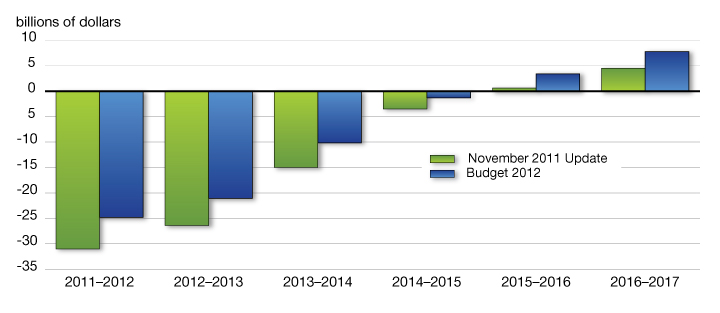
Canada Federal Budget Deficit / Surplus 2012

If we were doing as well as Canada, our deficit would be about $300 billion. But we have run up about 6 trillion in debt over 4 years! Not only that, but Canada’s national debt is only $600 billion. If we multiple that by 10, we would expect ours about $6 trillion. And it was that – during the Bush Presidency. But then the Democrats took over the House and Senate in 2007 and everything went wrong and we packed trillions and trillions onto the debt, including about $6 trillion during Obama’s first term.

Canada’s Debt to GDP ratio is 34%:
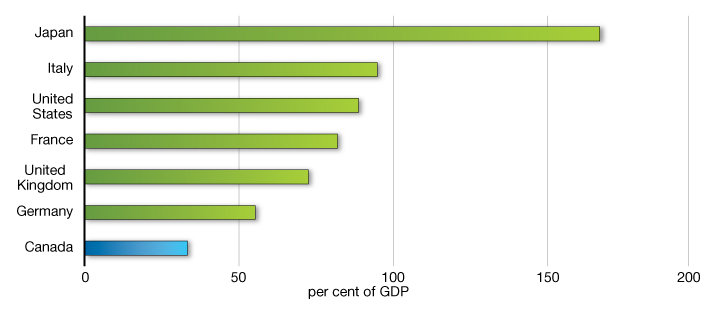
Canada vs US Debt to GDP

But things are even worse for the United States, now. The current United States Debt to GDP is 105%, according to official U.S. government figures. We are due for yet another credit downgrade, and should see Greece-like levels of Debt to GDP during Obama’s second term. We are spending too much, and we aren’t going to be able to make up trillion dollar deficits even if we confiscate every penny that rich people earn. (And they won’t be daft enough to keep working as hard if we did that – they would move, and probably to Canada)

What is happening to us here in the United States is self-inflicted. We are – and have been – voting to impoverish ourselves and generations of children born and unborn, by punishing those who work hard and play by the rules, and rewarding those who don’t work and don’t play by the rules. It didn’t have to be this way. We could have elected a President who actually knew something about business and economics. Knowledge matters. We can’t just choose a President who gives us the “tingles” and then expect him to perform the actual duties of being President. Competence is more important than confidence. Substance is more important than style.
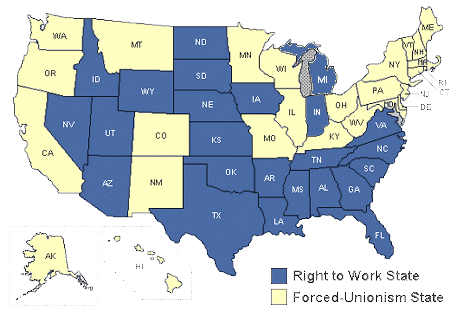
Unemployment rates are lower and wages are higher in right-to-work states

Map of right-to-work states: Michigan is #24

Previously, we saw that unemployment rates in right-to-work states were MUCH lower than in states that force workers to join unions and pay union dues in order to work.

Curtis sent me this article from Investors Business Daily, which looks at whether wages are lower in states that have right-to-work laws.

Excerpt:

The president says right-to-work laws mean “the right to work for less money.” So how does he explain the fact that incomes are up in RTW states while forced unionism is a proven job killer?

Campaigning Monday in Michigan as it stood poised to become the nation’s 24th right-to-work state, President Obama spoke the exact opposite of the truth to union workers at a Daimler Detroit Diesel plant in the birthplace of organized labor.

Is Obama telling the truth?

Let’s see:

According to Michigan’s Mackinac Center, using data taken from the Bureau of Economic Analysis and Bureau of Labor Statistics, private-sector, inflation-adjusted employee compensation in right-to-work states increased by 12% between 2001 and 2011 compared with just 3% over the same period in forced-unionization states.

These good wages came from good jobs. Employment in right-to-work states expanded 2.4% over the same stretch vs. a 3.4% decline in non-right-to-work states. Ironically, Obama is taking credit for jobs created in RTW states.

According to the National Institute for Labor Relations Research, right-to-work states (excluding Indiana, which passed a RTW law in early 2012) “were responsible for 72% of all net household job growth across the U.S. from June 2009 through September 2012.”

This is why people vote with their feet and move to these states. RTW states experienced large population gains of 15.3% from 2000 to 2010, compared to 5.9% in non-RTW states.

Obama did get one thing right, though, when he said the bills that passed both houses of the Michigan legislature “don’t have to do with economics. They have everything to do with politics.”

The president who fought Boeing’s expansion in RTW South Carolina knows it’s all about his keeping union dues flowing into Democratic coffers and maintaining the plush lifestyles of the union leaders who support him.

The right thing for Republicans to do when they get elected is to cut off all sources of funding for the Democrat Party. Right-to-work laws and school choice promote freedom and diminish the amount of power that left-wing, pro-abortion, pro-gay-marriage labor unions can exert. They will have less money, and with less money, they will have less influence on elections. Let the people decide, not the powerful, corrupt labor unions.

Related posts

Michigan governor Rick Snyder signs right-to-work bill into law

Map of right-to-work states: Michigan is #24

It’s official – Michigan has enacted a new right-to-work law that will create more jobs and free workers from having to violate their consciences by forcibly supporting pro-abortion, pro-gay marriage policies via their mandatory union dues.

Here’s an interesting article by Byron York in the Washington Examiner, discussing the political significance of this development.

Excerpt:

Republicans say the move would not only give current workers the freedom to choose whether to join a union and pay dues but would, more importantly, bring many, many new jobs to Michigan. Rep. Gov. Rick Snyder, who supports the bill, points out that Indiana enacted (after a long and bitter fight) the same kind of law earlier this year. “We’ve carefully watched what’s gone on in Indiana since they passed similar legislation back in February,” Snyder told Fox News’ Greta van Susteren last week, “and they’ve seen a significant increase in the number of companies talking about [bringing] thousands of jobs to their state.”

Of course, the move is not just economic. It’s political, too. Democrats depend on millions — actually, billions — of dollars in support from the forced dues of union members. If that money supply were to dry up, or even just decrease, the Democratic Party would be in serious trouble.

De-funding the unions is the first step to education reform. And Michigan students need education reform very badly. Even 40% of the union workers – who are much more sensible and patriotic than the union bosses – agree with the new law:

Regardless of news reports, the people of Michigan are behind this. A recent poll showed that 51 percent of Michigan voters support right-to-work. Only 41 percent are opposed. In fact, 40 percent of union households supported it. In November, Michigan voters rejected a ballot proposal that would have amended the state constitution to prevent the legislature from passing a right-to-work law and elevated union contracts above state law. The New York Times called it “a test case on enshrining the rights of unions,” and unions spent more than $23 million campaigning for the initiative. It lost by 15 points.

[…][M]aking union dues voluntary makes union organizers less aggressive—they get less financial benefit from organizing new firms, because they cannot force workers to pay them. Union organizing attempts drop 40 percent to 50 percent after states pass a right-to-work law. That in turn attracts business investment. Employers want to know unions will leave them alone if they treat their workers well. As a result, right-to-work states have lower unemployment rates—and more manufacturing jobs.

CNS News reports that only 7% of Detroit public school 8th graders can read at proficiency level.

Excerpt:

In the public schools in Detroit, Mich., according to the U.S. Department of Education, only 7 percent of the eighth graders are grade-level proficient or better in reading.

Some public school teachers in the City of Detroit and around the state of Michigan are reportedly taking a vacation or a sick day today to protest right-to-work legislation likely to be approved by the state legislature. Under current law, Michigan public school teachers must pay dues to the teachers’ union. If the right-to-work law is enacted, Michigan public-school teachers will be free to join the union and pay dues to it if they wish, but they will also be free not to join the union and not to pay it dues.

Detroit public-school eighth graders do even worse in math than they do in reading, according to the Department of Education. While only 7 percent scored highly enough on the department’s National Assessment of Educational Progress test in 2011 to be rated “proficient” or better in reading, only 4 percent scored highly enough to be rated “proficient” or better in math.

Statewide in Michigan, only 32 percent of public-school eighth graders scored grade-level proficient or better in reading, and only 31 percent scored grade-level proficient or better in math.

According to this report, over 26,000 students missed school because of the “sick day” protest by the teachers.

Here’s a video of what happens at the protests:

The actual unemployment rate of right-to-work states is 6.7%. Compare that with the 8.7% unemployment rate of forced-unionism states. Jobs are the number one priority right now, and right-to-work means more jobs.

Related posts