Tag Archives: Public Sector

Unemployment rate in socialist Spain now above 20%

Map of Europe
Map of Europe

Here’s the story from Yahoo News.

Excerpt:

Spain announced Friday its jobless rate surged to a 13-year record above 20 percent at the end of 2010, the highest level in the industrialized world, as the economy struggled for air.

It was more bad news for an economy fighting to regain the trust of financial markets and avoid being trapped in a debt quagmire that has engulfed Greece and Ireland and now menaces Portugal.

Another 121,900 people joined Spain’s unemployment queues in the final quarter of the year, pushing the total to 4.697 million people, said the national statistics institute INE.

The resulting unemployment rate was 20.33 percent for the end of the year — easily exceeding Prime Minister Jose Luis Rodriguez Zapatero’s target of 19.4 percent.

Spain appears to be stuck in a rut of staggeringly high levels of unemployment.

After posting a jobless rate of 18.83 percent in 2009 and now 20.33 percent in 2010, the government is forecasting 19.3 percent for 2011 and 17.5 percent in 2012.

The Spanish economy, the European Union’s fifth biggest, slumped into recession during the second half of 2008 as the global financial meltdown compounded the collapse of a labour-intensive construction boom

It emerged with tepid growth of just 0.1 percent in the first quarter of 2010 and 0.2 percent in the second but then stalled with zero growth in the third.

Zapatero has said the fourth quarter will show positive growth which would pick up steam in 2011 but he warned that job creation would be “far from what we need and desire. It will be slow and progressive.”

Remember that Spain elected Jose Luis Rodriguez Zapatero in April 2004, who is a member of the Spanish Socialist Workers’ Party, which is very similar in policy to Barack Obama and the Democrats.  Let’s see what has happened in Spain. (H/T Spain Economy Watch)

Unemployment:
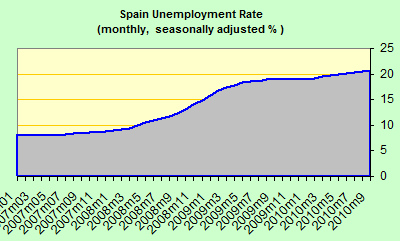
Spain Unemployment Rate

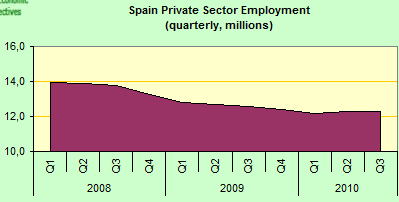
Private sector employment:

Spain Employment Rate - Private Sector
Spain Employment - Private Sector

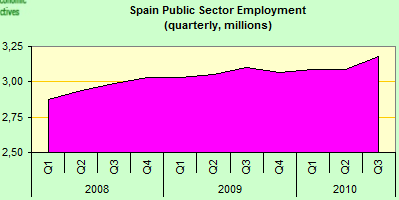
Public sector employment:

Spain Employment - Public Sector

So what do we learn from this?

Well, the public sector doesn’t really sell any products or services, so they don’t really have any customers to please, nor do they have any revenue. They exist by confiscating the wealth of other people (in the private sector) who do have products and services to sell, and do have customers to please. The governments job is to HELP the people in the private sector and not to raise their taxes, or control them, or get in their way except to make sure that they compete fairly and honestly with other people in the private sector. When government oversteps their bounds by raising taxes too high and spending too much, they stop acting like a REFEREE and start acting more like a PARASITE.

You’ll note that Obama is also spending trillions of dollars on government boondoggles – and where is our unemployment rate now?

Are public sector unions to blame for state and local deficits?

ECM sent me this post from the Manhattan Institute.

Full text:

The economists over at the e21 blog take on the argument being made by some pro-labor groups that public sector compensation (pay and the cost of benefits) is not a significant part of current state and municipal budget woes. In an editorial, e21 notes that state and local spending as a percentage of U.S. GDP has doubled in the last 50 years even as investment by local governments in traditional areas like building roads and bridges has been flat. Where has the money gone? Primarily to Medicaid and to public sector compensation.The editorial notes, for instance, that pension costs alone have increased in California from $2.4 billion per year to $4.8 billion from 2003 to 2009, while  New York City’s pension obligations have tripled over the same period.

The Manhattan Institute’s Nicole Gelinas has illustrated how those costs have worked on New York City. Amidst the controversy over the poor snow-cleaning job done by the city’s sanitation department after the Dec. 26 snowstorm, Nicole pointed out that although the department has been shrinking, its personnel costs have been rising rapidly. The average cost of employing a single sanit worker in NYC is now $144,000 annually, up from $79,000 a decade ago. The big driver of costs is sharply rising pension contributions, up from $10 million a decade ago to $200 million today.

The editorial at e21 concludes by comparing public sector pensions with private pensions, using California’s formula for public workers as an example. For a state employee in California earning almost $83,000 at retirement after 25 years of service, e21 estimates that a similar private sector employee with a defined contribution plan would have to put away 23 percent of his pre-tax income every year to amass enough of a pot of money to purchase an annuity that would give him the same kind of retirement benefits.

“Put simply, it is difficult to conceive a way to address the current – and projected – state fiscal crisis without dramatic reductions in state and local employee benefits,’ the editorial concludes.

Somebody has to pay for all this mess.

Senator Tom Coburn lists some bad examples of government waste

Here’s the story.

Excerpt:

Coburn, R-Muskogee, whose office regularly churns out reports mocking federal projects and programs, said Monday that “cutting wasteful and low-priority spending from the budget is not only sensible, but essential.”

“In today’s economy, we can’t afford to spend nearly $2 million to showcase neon signs no longer in use at Las Vegas casinos; nor can Congress and federal agencies afford to spend nearly $1 billion a year on unnecessary printing costs.”

The 100 projects cited on Monday tread some familiar ground for Coburn reports — road signs paid for with stimulus funds, research projects that sound like folly — and are mostly domestic. There is no mention of Iraq or Afghanistan, despite government reports documenting millions lost to fraud and waste.

Topping Coburn’s list is the conclusion of a FOX News story that the Department of Veterans Affairs spends $175 million each year to maintain buildings it can’t use, in some cases because they’re in such disrepair.

Other items on the list:

• $217,000 for a University of California and Stanford University study on when and why political candidates are ambiguous.

• $90,000 to fund promotion of the Vidalia onion, including $60,000 for a campaign timed to coincide with the release of a Shrek movie.

•  $2.5 million on the Census Bureau’s television ad that aired during the Super Bowl to promote the head-count but left many viewers scratching their heads in confusion.

• $465,000 for an international AIDS conference in Austria.

• $35 million paid in fraudulent Medicare and Medicaid claims to an alleged Armenian crime ring.

• $48 million for a streetcar system in Atlanta that runs the same route as the city’s subway system.

• $900,000 to settle sexual harassment claims against a former housing director in Philadelphia.

•  And $28 million to print “rarely used” paper copies of the Congressional Record.

Here’s a recent post from the Washington Examiner that compares Democrats and Republicans on pork barrel spending. (H/T Gateway Pundit via Muddling)

Excerpt:

Press coverage of the budget frenzy on Capitol Hill has suggested that pork-barrel earmark spending is still a bipartisan problem, that after months of self-righteous rhetoric about fiscal discipline, Republicans and Democrats remain equal-opportunity earmarkers.

It’s not true. A new analysis by a group of federal-spending watchdogs shows a striking imbalance between the parties when it comes to earmark requests. Democrats remain raging spenders, while Republicans have made enormous strides in cleaning up their act.

In the Senate, the GOP made only one-third as many earmark requests as Democrats for 2011, and in the House, Republicans have nearly given up earmarking altogether — while Democrats roll on.

The watchdog groups — Taxpayers for Common Sense, WashingtonWatch.com, and Taxpayers Against Earmarks — counted total earmark requests in the 2011 budget. Those requests were made by lawmakers earlier this year, but Democratic leaders, afraid that their party’s spending priorities might cost them at the polls, decided not to pass a budget before the Nov. 2 elections. This week, they distilled those earmark requests — threw some out, combined others — into the omnibus bill that was under consideration in the Senate until Majority Leader Harry Reid pulled it Thursday night. While that bill was loaded with spending, looking back at the original earmark requests tells us a lot about the spending inclinations of both parties.

In the 2011 House budget, the groups found that House Democrats requested 18,189 earmarks, which would cost the taxpayers a total of $51.7 billion, while House Republicans requested just 241 earmarks, for a total of $1 billion.

This is why stimulus spending, which is advocated by Democrats, costs jobs. Democrats waste money. They take money out of the job-creating sector of the economy, and they waste on government spending. If private companies wasted money like government, they would go out of business. Unfortunately, government can waste money like this all the time, and they just borrow more money. When you hear a Democrat say that they want to “invest” money they stole from businesses and workers in order to “stimulate” the economy, what they are talking about is wasting money and/or buying votes from their favored special interest groups.