

Tag Archives: Professor

New York Times profiles philosopher Alvin Plantinga and discusses his new book

Christian philosopher Alvin Plantinga

Alvin Plantinga is widely regarded as the top Christian philosopher in the world, and a former head of the largest professional association of philosophers – the American Philosophical Association (APA).

 Mary sent me this article from the New York Times about Alvin Plantinga and his new book, published by Oxford University Press – the top academic press in the world.

Excerpt:

From Calvin [College], and later from the University of Notre Dame, Mr. Plantinga has led a movement of unapologetically Christian philosophers who, if they haven’t succeeded in persuading their still overwhelmingly unbelieving colleagues, have at least made theism philosophically respectable.

“There are vastly more Christian philosophers and vastly more visible or assertive Christian philosophy now than when I left graduate school,” Mr. Plantinga said in a recent telephone interview from his home in Grand Rapids, adding, with characteristic modesty, “I have no idea how it happened.”

Mr. Plantinga retired from full-time teaching last year, with more than a dozen books and a past presidency of the American Philosophical Association to his name. But he’s hardly resting on those laurels. Having made philosophy safe for theism, he’s now turning to a harder task: making theism safe for science.

For too long, Mr. Plantinga contends in a new book, theists have been on the defensive, merely rebutting the charge that their beliefs are irrational. It’s time for believers in the old-fashioned creator God of the Bible to go on the offensive, he argues, and he has some sports metaphors at the ready. (Not for nothing did he spend two decades at Notre Dame.)

In “Where the Conflict Really Lies: Science, Religion and Naturalism,” published last week by Oxford University Press, he unleashes a blitz of densely reasoned argument against “the touchdown twins of current academic atheism,” the zoologist Richard Dawkins and the philosopher Daniel C. Dennett, spiced up with some trash talk of his own.

[…] Longtime readers of Mr. Plantinga, who was raised as a Presbyterian and who embraced the Calvinism of the Christian Reformed Church as a young man, are used to such invocations of theological concepts. And even philosophers who reject his theism say his arguments for the basic rationality of belief, laid out in books like “Warranted Christian Belief” and “God and Other Minds,” constitute an important contribution that every student of epistemology would be expected to know.

But Mr. Plantinga’s steadfast defense of the biochemist and intelligent-design advocate Michael Behe, the subject of a long chapter in the new book, is apparently another matter.

“I think deep down inside he really isn’t a friend of science,” Michael Ruse, a philosopher of science at Florida State University, said of Mr. Plantinga. “I’m not objecting to him wanting to defend theism. But I think he gets his victory at the level of gelding or significantly altering modern science in unacceptable ways.”

Mr. Dennett was even harsher, calling Mr. Plantinga “Exhibit A of how religious beliefs can damage or hinder or disable a philosopher,” not to mention a poor student of biology. Evolution is a random, unguided process, he said, and Mr. Plantinga’s effort to leave room for divine intervention is simply wishful thinking.

“It’s just become more and more transparent that he’s an apologist more than a serious, straight-ahead philosopher,” Mr. Dennett said.

When Mr. Plantinga and Mr. Dennett (who said he has not read Mr. Plantinga’s new book) faced off over these questions before a standing-room-only crowd at a 2009 meeting of the American Philosophical Association, the event prompted ardent online debate over who had landed better punches, or simply been more condescending. (A transcript of the proceedings was published last year as “Science and Religion: Are They Compatible?”)

Mr. Plantinga, who recalled the event as “polite but not cordial,” allowed that he didn’t think much of Mr. Dennett’s line of reasoning. “He didn’t want to argue,” Mr. Plantinga said. “It was more like he wanted to make assertions and tell stories.”

Would you like to know how well Daniel Dennett can debate the naturalism/theism dispute? First of all, Plantinga has debated Dennett, and you can find the audio for it at Apologetics 315.

William Lane Craig also presented several arguments against naturalism to Daniel Dennett in 2007, and Dennett responded by calling it a “first-rate piece of philosophical reasoning”. I link to the exchange and complain about Dennett’s weak response to Craig’s arguments in a previous post.

You may also find this recent interview with Alvin Plantinga, conducted by Brian Auten, informative.

The resurgence of Christian theism in analytical philosophy

Now let’s move from the specific to the aggregate. What is going on with these Christian philosophers?

Well, you can read an excellent article about the resurgence of Christian theism in philosophy departments in the peer-reviewed philosophy journal Philo, which, in my opinion, is the best journal for atheists and agnostic philosophers. The article is authored by the well-known atheist Quentin Smith.

He writes:

THE DESECULARIZATION OF ACADEMIA THAT EVOLVED IN PHILOSOPHY DEPARTMENTS SINCE THE LATE 1960s

By the second half of the twentieth century, universities and colleges had been become in the main secularized. The standard (if not exceptionless) position in each field, from physics to psychology, assumed or involved arguments for a naturalist world-view; departments of theology or religion aimed to understand the meaning and origins of religious writings, not to develop arguments against naturalism. Analytic philosophers (in the mainstream of analytic philosophy) treated theism as an antirealist or non-cognitivist world-view, requiring the reality, not of a deity, but merely of emotive expressions or certain “forms of life” (of course there were a few exceptions, e.g., Ewing, Ross, Hartshorne, etc., but I am discussing the mainstream view).

[…]The secularization of mainstream academia began to quickly unravel upon the publication of Plantinga’s influential book on realist theism, God and Other Minds, in 1967. It became apparent to the philosophical profession that this book displayed that realist theists were not outmatched by naturalists in terms of the most valued standards of analytic philosophy: conceptual precision, rigor of argumentation, technical erudition, and an in-depth defense of an original world-view. This book, followed seven years later by Plantinga’s even more impressive book, The Nature of Necessity, made it manifest that a realist theist was writing at the highest qualitative level of analytic philosophy, on the same playing field as Carnap, Russell, Moore, Grünbaum, and other naturalists. Realist theists, whom hitherto had segregated their academic lives from their private lives, increasingly came to believe (and came to be increasingly accepted or respected for believing) that arguing for realist theism in scholarly publications could no longer be justifiably regarded as engaging in an “academically unrespectable” scholarly pursuit.

Naturalists passively watched as realist versions of theism, most influenced by Plantinga’s writings, began to sweep through the philosophical community, until today perhaps one-quarter or one-third of philosophy professors are theists, with most being orthodox Christians. Although many theists do not work in the area of the philosophy of religion, so many of them do work in this area that there are now over five philosophy journals devoted to theism or the philosophy of religion, such as Faith and Philosophy, Religious Studies, International Journal of the Philosophy of Religion, Sophia, Philosophia Christi, etc. Philosophia Christi began in the late 1990s and already is overflowing with submissions from leading philosophers. Can you imagine a sizeable portion of the articles in contemporary physics journals suddenly presenting arguments that space and time are God’s sensorium (Newton’s view) or biology journals becoming filled with theories defending élan vital or a guiding intelligence? Of course, some professors in these other, non-philosophical, fields are theists; for example, a recent study indicated that seven percent of the top scientists are theists.1 However, theists in other fields tend to compartmentalize their theistic beliefs from their scholarly work; they rarely assume and never argue for theism in their scholarly work. If they did, they would be committing academic suicide or, more exactly, their articles would quickly be rejected, requiring them to write secular articles if they wanted to be published. If a scientist did argue for theism in professional academic journals, such as Michael Behe in biology, the arguments are not published in scholarly journals in his field (e.g., biology), but in philosophy journals (e.g., Philosophy of Science and Philo, in Behe’s case). But in philosophy, it became, almost overnight, “academically respectable” to argue for theism, making philosophy a favored field of entry for the most intelligent and talented theists entering academia today. A count would show that in Oxford University Press’ 2000–2001 catalogue, there are 96 recently published books on the philosophy of religion (94 advancing theism and 2 presenting “both sides”). By contrast, there are 28 books in this catalogue on the philosophy of language, 23 on epistemology (including religious epistemology, such as Plantinga’s Warranted Christian Belief), 14 on metaphysics, 61 books on the philosophy of mind, and 51 books on the philosophy of science.

And how have naturalist philosophers reacted to what some committed naturalists might consider as “the embarrassment” of belonging to the only academic field that has allowed itself to lose the secularization it once had? Some naturalists wish to leave the field, considering themselves as no longer doing “philosophy of mind,” for example, but instead “cognitive science.” But the great majority of naturalist philosophers react by publicly ignoring the increasing desecularizing of philosophy (while privately disparaging theism, without really knowing anything about contemporary analytic philosophy of religion) and proceeding to work in their own area of specialization as if theism, the view of approximately one-quarter or one-third of their field, did not exist. (The numbers “one-quarter” and “one-third” are not the result of any poll, but rather are the exceptionless, educated guesses of every atheist and theist philosophy professor I have asked [the answers varied between “one-quarter” and “one-third”]). Quickly, naturalists found themselves a mere bare majority, with many of the leading thinkers in the various disciplines of philosophy, ranging from philosophy of science (e.g., Van Fraassen) to epistemology (e.g., Moser), being theists. The predicament of naturalist philosophers is not just due to the influx of talented theists, but is due to the lack of counter-activity of naturalist philosophers themselves. God is not “dead” in academia; he returned to life in the late 1960s and is now alive and well in his last academic stronghold, philosophy departments.

Quentin Smith is a good friend of William Lane Craig, who is a philosopher/theologian and the top Christian defender in the world, and probably of all time. Smith is the co-author, with William Lane Craig, of the book “Theism, Atheism, and Big Bang Cosmology“, also published by Oxford University Press. Craig and Smith debated at Harvard University in 2003, and I transcribed the debate for posterity. If some of you are looking for a way to help promote Christian apologetics, you should pick a debate that hasn’t been transcribed and transcribe it. A lot of people read these debate transcripts. I had them printed out in my binder when I was an undergraduate student, in case my professors got boring! I like a good fight.

On a lighter note, my office plant is named Alvin Plantinga. It was grown in water and then given to me by an atheist with whom I work. We discuss these interesting topics over lunch every few months. And so should you. Why not send the New York Times article and the Philo article to an atheist in your office and get the conversation started? There’s enough in this post alone to help you sound like Alvin Plantinga!
Obama’s plan: raise taxes and borrow $447 billion for more stimulus spending

Obama wants to stay the course: more stimulus spending
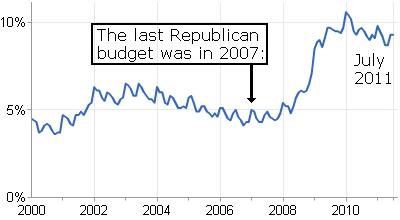
The Democrats took over the House and Senate in January 2007 - and it all went downhill from there

From the liberal Globe and Mail: IT’S JUST ANOTHER STIMULUS BILL.

Excerpt:

Barack Obama is seeking legislative backing for economic stimulus worth $450-billion (U.S.), making the U.S. President a lonely advocate for spending at a moment dominated by calls for austerity.

Mr. Obama told a joint session of Congress Thursday evening that the United States must get a grip on its rising debt, but not at the expense of condemning millions of people to the unemployment rolls and welfare because traumatized companies refuse to hire.

[…]The President’s proposals Thursday were the same as those telegraphed in the U.S. media over the previous 48 hours. He’s responding to an economy that is quickly losing momentum, expanding at an annual rate of only 0.7 per cent in the first half of the year. The unemployment rate is 9.1 per cent, compared with 8.8 per cent in March, and 14 million Americans are unemployed more than two years into the recovery.

[…]Like the roughly $800-billion stimulus program Mr. Obama shepherded through Congress in early 2009, his new proposal would ease the tax burden on the middle class; send money to states, which have cut almost 500,000 jobs since 2010; and seek to create jobs for millions of unemployed construction workers by plowing millions into refurbishing roads and schools.

[…]The U.S.’s publicly held debt is on track to reach 82 per cent of gross domestic product by the end of the decade, higher than in any year since 1948, according to the Congressional Budget Office.

[…]The U.S. economy is faltering in part because previous stimulus programs are dwindling, while private demand has yet to return in robust way.

[…]Mr. Obama also proposes direct transfers worth $140-billion. Some $35-billion will go to states to help them retain teachers, police officers and fire fighters, while $30-billion would be used to refurbish schools, an initiative the White House likes because the work involved tends to be labour intensive and the contracts can be signed quickly.

I found this amusing summary of the jobs speech on National Review.

Spend $450 billion dollars now, it will create jobs, and I’ll tell you how I’m going to pay for it a week from Monday. If you disagree, you want to expose kids to mercury.

That about sums up the Obama years.

Yes, that about sums it up. Obama says: Let me spend your money on turtle tunnels, or you will be blamed and insulted for being “greedy”.

Fact-checking Obama’s speech

The very liberal AP fact-checks Obama’s speech here. (H/T Doug Ross)

Excerpt:

A look at some of Obama’s claims and how they compare with the facts:

OBAMA: “Everything in this bill will be paid for. Everything.”

THE FACTS: Obama did not spell out exactly how he would pay for the measures contained in his nearly $450 billion American Jobs Act but said he would send his proposed specifics in a week to the new congressional supercommittee charged with finding budget savings. White House aides suggested that new deficit spending in the near-term to try to promote job creation would be paid for in the future – the “out years,” in legislative jargon – but they did not specify what would be cut or what revenues they would use.

Essentially, the jobs plan is an IOU from a president and lawmakers who may not even be in office down the road when the bills come due. Today’s Congress cannot bind a later one for future spending. A future Congress could simply reverse it.

Currently, roughly all federal taxes and other revenues are consumed in spending on various federal benefit programs, including Social Security, Medicare, Medicaid, veterans’ benefits, food stamps, farm subsidies and other social-assistance programs and payments on the national debt. Pretty much everything else is done on credit with borrowed money.

So there is no guarantee that programs that clearly will increase annual deficits in the near term will be paid for in the long term.

—OBAMA: “It will not add to the deficit.”

THE FACTS: It’s hard to see how the program would not raise the deficit over the next year or two because most of the envisioned spending cuts and tax increases are designed to come later rather than now, when they could jeopardize the fragile recovery. Deficits are calculated for individual years. The accumulation of years of deficit spending has produced a national debt headed toward $15 trillion. Perhaps Obama meant to say that, in the long run, his hoped-for programs would not further increase the national debt, not annual deficits.

Let’s now look at some of the specific proposals.

But will it work?

Hans Bader explains the plan in this excellent post at the Competitive Enterprise Institute. (He has lots of links, so I removed them, but you can find them in his post on the CEI web site)

Excerpt:

It contains more money for the long-term unemployed, more infrastructure spending, and funds for hiring laid-off teachers. It also would extend a cut in the portion of payroll taxes paid by employees. The measures would be financed mostly by deficit spending, but partly by raising taxes on the so-called “rich” — a category that includes most of the small business owners who actually hire people — and by eliminating what the administration refers to as “tax loopholes” — which are not really tax loopholes at all, but rather provisions that allow industries disfavored by the administration to benefit from the same tax code provisions as other industries.

[…]Even the least-bad of Obama’s proposals will not grow the economy. Aid for the long-term unemployed will reduce the size of the economy by encouraging some people to not accept jobs that pay far less than they were accustomed to, even when those are the only jobs available to them. Obama’s proposed infrastructure spending will not grow the economy either, as Veronique de Rugy and others note, since it will be accompanied by costly Davis-Bacon mandates designed to favor unions (which raise the cost of transportation projects and exclude many small non-union contractors), and some of it will be wasted on rail boondoggles and pork rather than roads and bridges, or on Obama Administration pet projects, like energy efficiency, that require specialized skills that most unemployed construction workers lack. (Ironically, Obama removed most transportation spending from the original $800 billion stimulus package for political reasons, replacing it with more harmful welfare and social spending.)

How about Obama’s previous stimulus plan?

Meanwhile, by sucking money out of the private-sector economy, the stimulus wiped out a million private-sector jobs, even as other stimulus provisions outsourced American energy jobs to foreign countries, and wiped out jobs in America’s export sector, resulting in a net loss to the economy of 550,000 jobs, according to two economists. The Obama administration’s use of taxpayer money to subsidize above-market wages for government employees is at odds with what economists like Lord Keynes (the father of the Keynesian school of economics) counseled in past recessions, and what Franklin Roosevelt did in the Great Depression, when he hired people to do construction and transportation projects in the WPA but paid them only very modest wages, providing opportunities to the unemployed without siphoning off useful talent from private-sector businesses.

But isn’t it a good idea to help the unemployed and public school teachers?

As the Heritage Foundation notes, “The consequences of extended unemployment benefits are some of the most conclusively established results in labor economic research. Extending either the amount or the duration of UI benefits increases the length of time that workers remain unemployed. UI benefits subsidize unemployment. They reduce the incentive unemployed workers have to search for new work and to make difficult choices–such as moving or switching industries–to begin a new job.”

The President’s proposed subsidies for laid-off teachers discriminate in favor of one occupation, without any legitimate reason for doing so: the unemployment rate among teachers is vastly lower than for many occupations, and lower than for most.  It is best understood as the Administration pandering to the teachers’ unions.

This man only has one thing in his mind and it’s spending your children’s money and giving speeches about how great that makes him. He likes to hear the crowds applaud him for spending your children’s money. I do not think well of people who, in tough economic times, come into my house, take my credit card, and spend a bunch of my money on public sector union workers who have job security, benefits and pensions that I can only dream about. Where does he think that the money he is spending comes from in the first place?

Unemployment Rate (Not seasonally adusted)
Unemployment Rate (Not seasonally adjusted)

We need an exit strategy from this Keynesian deficit spending quagmire. This man has spent over a trillion dollars on the job-killing Obamacare program, and over a trillion more on stimulus spending. He is running 1.65 trillion dollar annual deficits and he wants to spend even more. And what have we got to show for it? The worst economic recovery in the history of the country – after a recession caused by his own party – and an unemployment rate that is more than double what Bush’s unemployment rate was when he had a Republican House and Senate in 2006.

Related posts

Obamanomics: $500,000 stimulus grant to grow trees creates 1.72 jobs

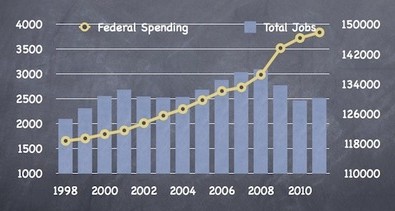
Government Spending Vs Jobs

From Fox News.

Excerpt:

A federal stimulus grant of nearly $500,000 to grow trees and stimulate the economy in Nevada yielded a whopping 1.72 jobs, according to government statistics.

In 2009, the U.S. Forest Service awarded $490,000 of stimulus money to Nevada’s Clark County Urban Forestry Revitalization Project, aimed at revitalizing urban neighborhoods in the county with trees, plants, and green-industry training.

According to Recovery.gov, the U.S. government’s official website related to Recovery Act spending, the project created 1.72 permanent jobs.  In addition, the Nevada state Division of Forestry reported the federal grant generated one full-time temporary job and 11 short-term project-oriented jobs.

[…]Repeated calls by FoxNews.com to the U.S. Forest Service were not returned.

[…]”Looking at the failure of the stimulus to live up to its promises, not just in Nevada, but throughout America, I think the question becomes ‘is there any good use of stimulus money?'” said Douglas Kellogg, communications manager for National Taxpayers Union, in an email to FoxNews.com.

[…]”The president may well propose new stimulus efforts when Congress returns from recess,” said Kellogg, “and those who learn from past stimulus debacles will not be fooled again.”

The Heritage Foundation explains how government spending has never worked to create jobs. Not even when Republicans do it.

Excerpt:

Indeed, President Obama’s stimulus bill failed by its own standards. In a January 2009 report, White House economists predicted that the stimulus bill would create (not merely save) 3.3 million net jobs by 2010. Since then, 3.5 million more net jobs have been lost, pushing the unemployment rate above 10 percent.[1] The fact that government failed to spend its way to prosperity is not an isolated incident:

  • During the 1930s, New Deal lawmakers doubled federal spending–yet unemployment remained above 20 percent until World War II.
  • Japan responded to a 1990 recession by passing 10 stimulus spending bills over 8 years (building the largest national debt in the industrialized world)–yet its economy remained stagnant.
  • In 2001, President Bush responded to a recession by “injecting” tax rebates into the economy. The economy did not respond until two years later, when tax rate reductions were implemented.
  • In 2008, President Bush tried to head off the current recession with another round of tax rebates. The recession continued to worsen.
  • Now, the most recent $787 billion stimulus bill was intended to keep the unemployment rate from exceeding 8 percent. In November, it topped 10 percent.[2]

Why is this? It’s because the government never spends money as efficiently as the private sector. Private sector firms have to stay lean and mean in order to stay afloat – because they have competitors who are always trying to sell better goods and services for less money. In a capitalist economy, the consumer is king – all the businesses fight to earn the customers’ money. But the government has no competitors, and so they neither care about efficiency, nor pleasing their customers.

CBS News reports:

ABC News reports:

And this one features a real economist:

We shouldn’t let the government take money out of the private sector and let the public sector spend it on “stimulus”. Stimulus means taking money away from your boss, or your possible bosses, and spending it on trees. It’s how you lose jobs – and that’s what we have today.

Related posts